

On 7 August Viktar Babariko published a video called “What does Viktar Babariko propose now?” on his own YouTube channel. The next day, at the sixth New Belarus conference, Pavel Latushka answered him in what Belsat headlined as a harsh reply. Within a week Belarusian YouTube had produced more videos mentioning Babariko than in June and July together.
This brief reads that comeback against seven months of counting. Since February, FactCheck.LT has filtered every video published by Belarusian YouTube channels for the names of four politicians: Sviatlana Tsikhanouskaya, Viktar Babariko, Maria Kolesnikova and Pavel Latushka. The monthly reports are on infopolicy.net, and the August numbers say two things at once: media attention to Babariko multiplied by eleven, while search interest from inside Belarus stayed at zero.
What the seven months look like
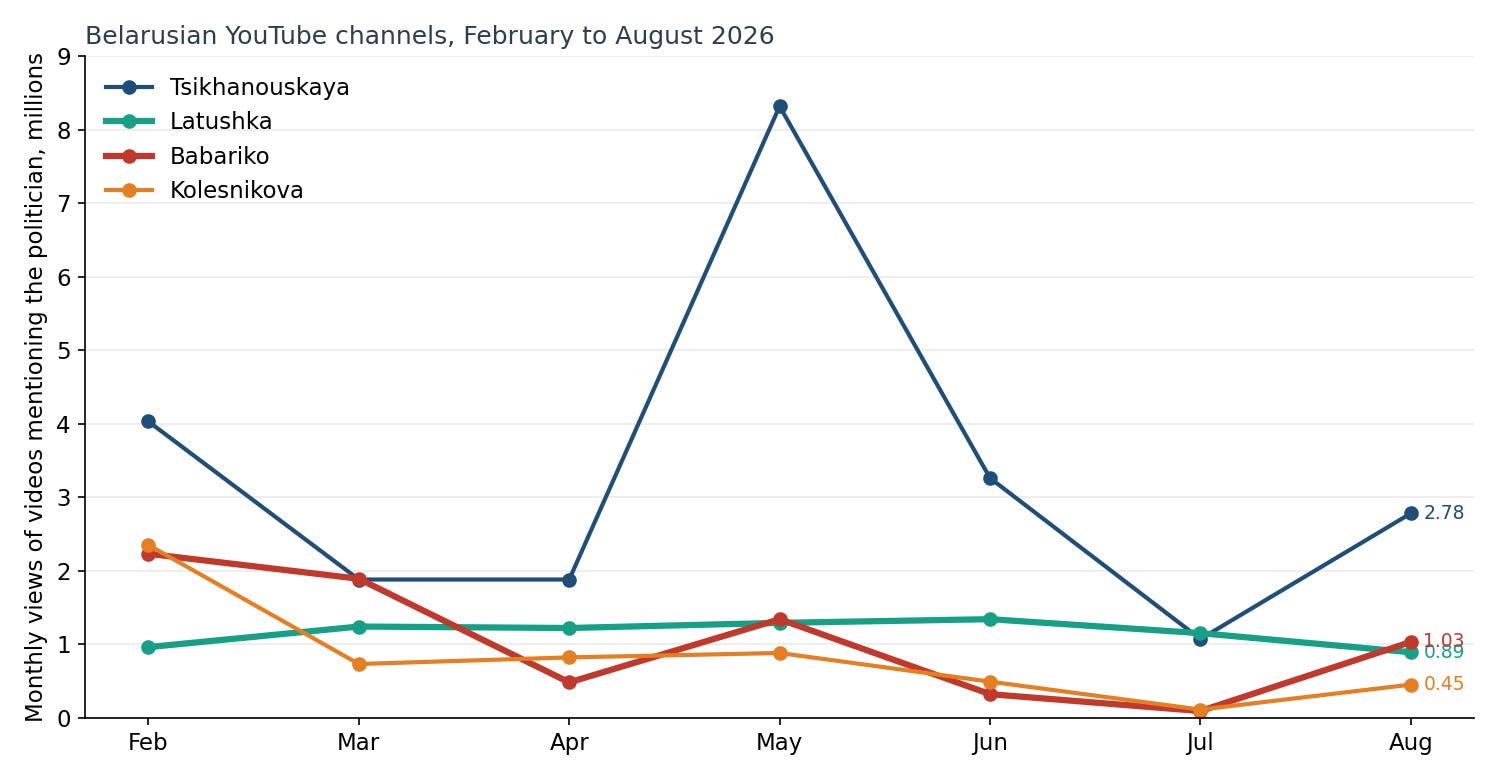
The monitoring covers between 12,000 and 15,400 videos a month, of which between 255 and 503 mention at least one of the four names, and views are then summed per politician.
Tsikhanouskaya has the highest peaks and the deepest falls. Her line runs from 4.0 million in February to 8.3 million in May, then down to 1.1 million in July and back up to 2.8 million in August. Latushka’s line moved inside a narrow band for six months, between 0.96 and 1.34 million, which in July made him the most-viewed of the four for the first time. In August he recorded his first decline, to 0.89 million.
Babariko’s line is a wave that gets weaker each cycle. After 2.2 million in February, each peak was lower and each trough deeper, until July marked the bottom with eight videos and 93,000 views. August is the third peak, at 1.03 million.
Each of Babariko’s previous peaks was lower than the one before. August broke that pattern.
Where the August views came from
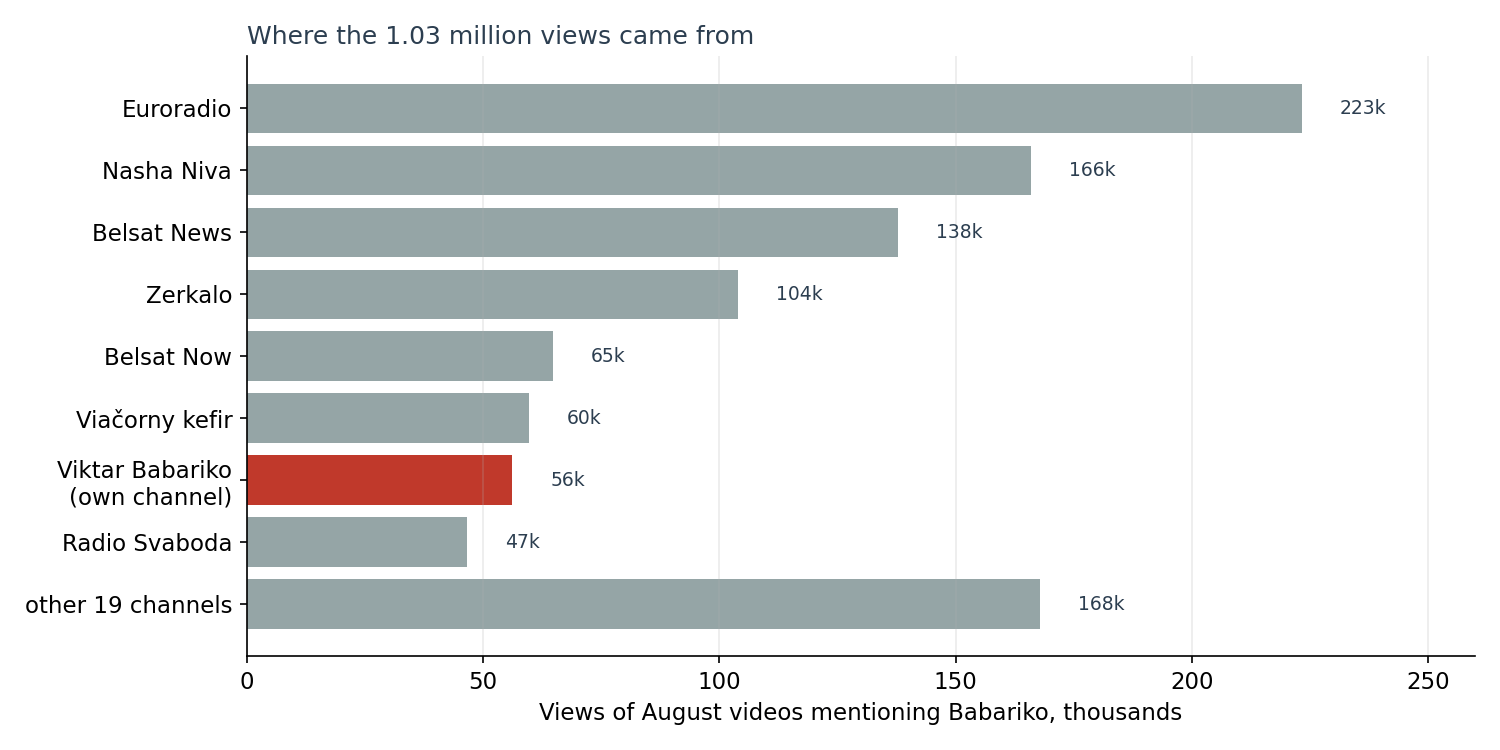
Seventy-seven videos mentioned Babariko in August. They collected 1,026,000 views across 27 channels, and his own channel, “Viktar Babariko”, contributed four of them with 56,000 views, or 5.5 percent of his total.
The largest source was Euroradio with 19 videos and 223,000 views, followed by Nasha Niva with 166,000 views from only two videos. Belsat News, Zerkalo and Belsat Now added 306,000 between them. Nearly all of Babariko’s August audience watched him on channels he does not control.
The pattern inside his own channel is also clear. The programme statement of 7 August took 47,000 views, but three short clips posted between 18 and 20 August took 5,400, 1,600 and 2,500. The channel is older than August: it already appeared in the May sample with three videos, then went silent through June and July.
The channel was reactivated for one statement. Nothing suggests it was built to keep an audience.
The search test
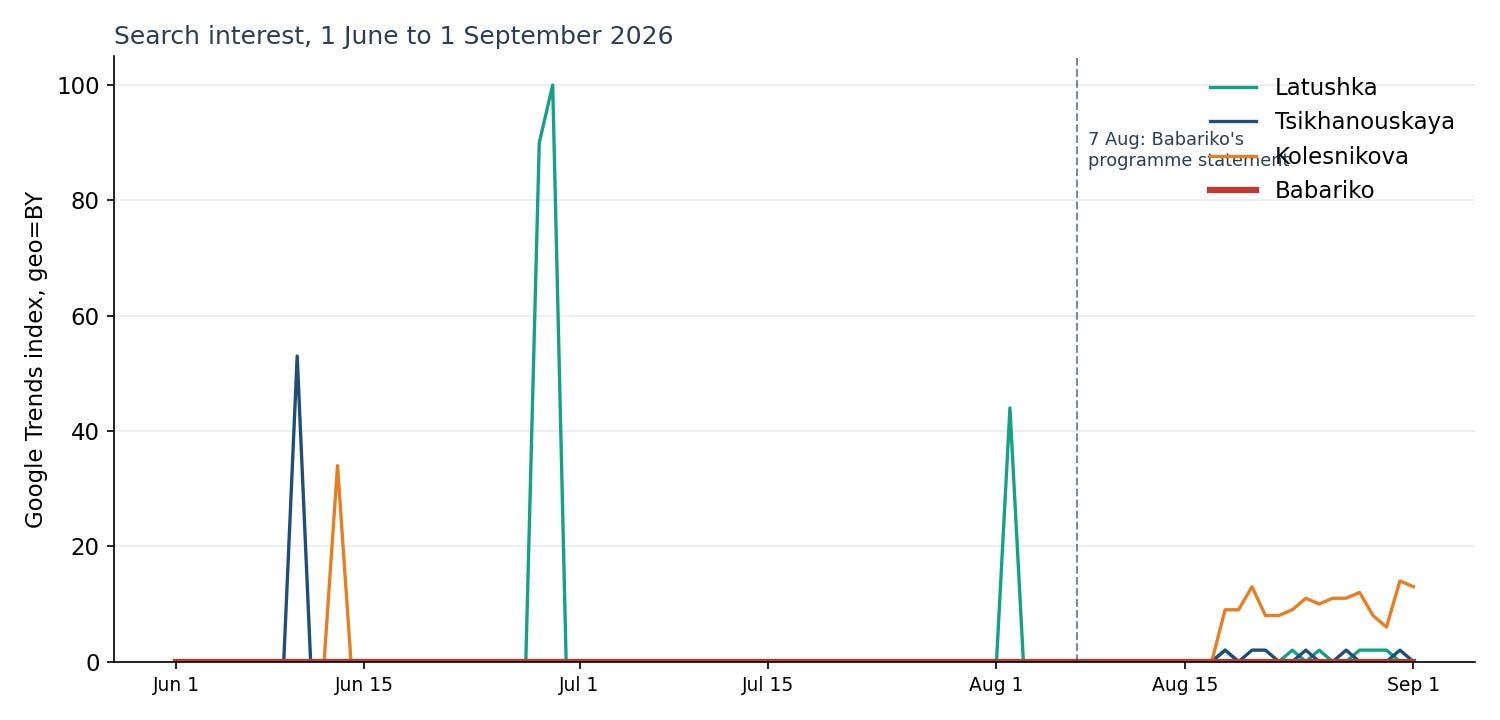
Google Trends, restricted to Belarus, shows the same four names from 1 June to 1 September. The query is comparative, so all four lines share one scale, and the peak of the window is Latushka on 29 June, when a closed Putin–Lukashenko meeting at Valdai made him the most-searched of the four.
Babariko’s line is flat at zero for all 93 days. There is no bump on 7 August when the statement went out, none on 8 August when Latushka replied, and none on 19 August when Zerkalo’s Artyom Shraibman analysed the statement. The comparative scale hides small values, but it does not hide a return of this size. In May, Babariko’s Zerkalo interview registered 59 on the same scale.
Kolesnikova’s line is the only one with a daily signal in August. From the 19th, when Shraibman’s video called her a possible new leader, her index stayed between 6 and 14 every day. This is the fifth month she has shown that kind of baseline. Her YouTube footprint in August was 17 videos and 447,000 views.
One politician generated a million views and no searches. Another generated a fifth of that and was searched for every day.
Who is mentioned with whom
The filter also counts videos that mention two politicians together. In July no video mentioned both Babariko and Latushka, while in August 21 did. Tsikhanouskaya and Babariko appeared together in 34 videos, up from two. The four names had been drifting apart since May until the conference on 8 August pulled them back into a single conversation.
The Babariko–Latushka pair is different from earlier co-mentions. Previous overlaps came from shared events such as the Kyiv visit in May, whereas this one comes from a disagreement. Belsat’s headline of 8 August names the reply. Olga Tokarchuk’s channel framed it as “Babariko takes everyone apart, does not need Tsikhanouskaya”.
Two models that spent six months in separate lanes met in one room.
Confidence
What to watch
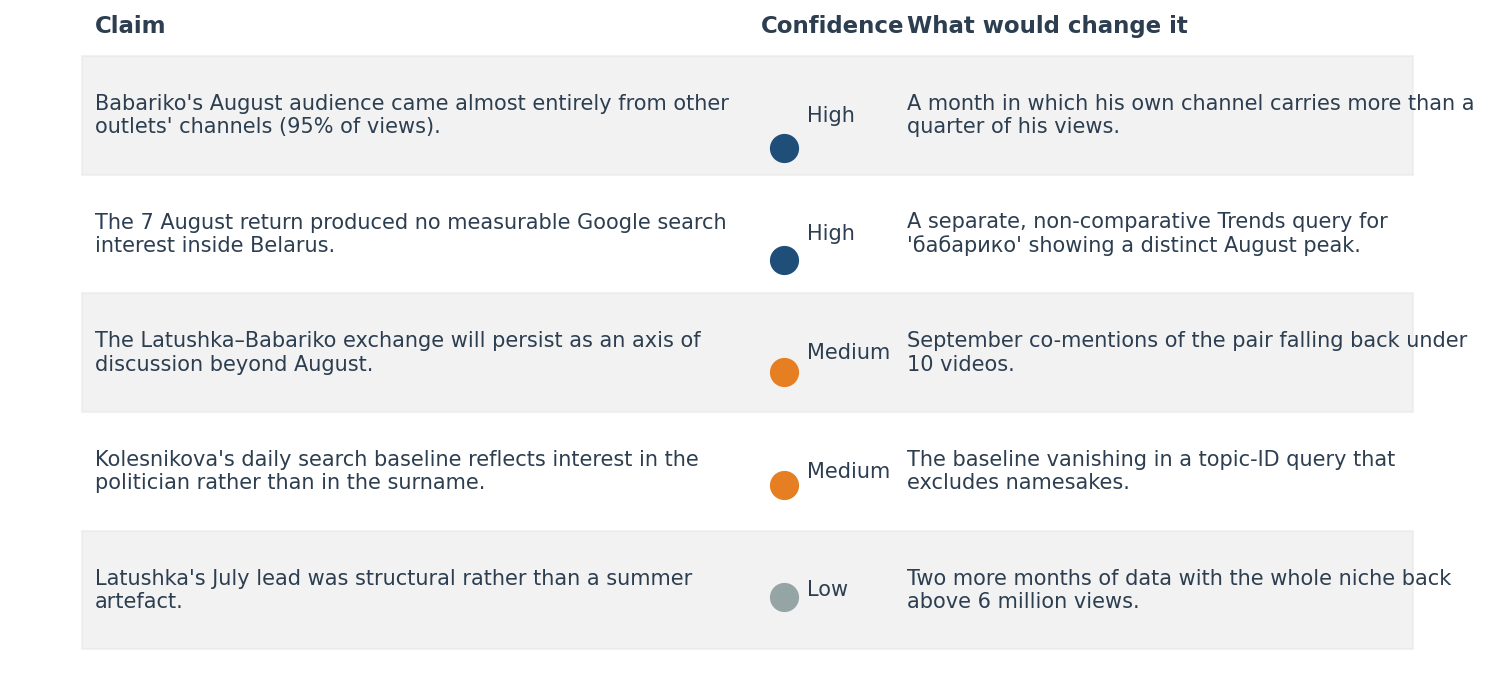
By 30 September. The “Viktar Babariko” channel has published at least eight videos in September. If it has, the August reactivation was the start of something; if it has not, it was a single statement.
By 30 September. A non-comparative Google Trends query for “бабарико”, geo=BY, shows any day in August above 20 on its own scale. If it does, the comparative flat line understated a real but small signal.
By 30 September. Videos mentioning both Babariko and Latushka number at least ten in the September sample. If fewer, the axis of disagreement did not hold.
By 31 October. Latushka’s own channel is back above 400,000 monthly views. In August it fell to 183,000 from 531,000 in July.
Method and limits
The YouTube filter matches all case forms of the four surnames in Russian and Belarusian, in video titles and descriptions. It does not read transcripts, and a video counts for a politician if the name appears anywhere in those two fields, so a news digest listing him in the description counts the same as an interview. The Tsikhanouskaya pattern also catches Siarhei Tsikhanouski, and August had an unusual share of videos about him.
Google Trends values come from a single comparative query. Each value is relative to the highest point among all four names in the window, so zero means the volume was too small to register against that peak rather than that nobody searched. The surname “Kolesnikova” is common in Russian, so part of her baseline may be namesakes. A topic-ID query would settle this and has not been run yet.
The politicians’ own channels are included in the counts, although FORESIGHT’s main corpus does not take them as primary sources. This series is a separate pipeline built on the YouTube API.