

On 10 August the Swedish Migration Agency changed its legal position on Belarusian citizens. Its reasoning is unusual for an administrative document: it cites the UN Special Rapporteur’s finding that Lukashenka’s decree cutting consular services is an abuse of security measures and part of a deliberate policy of punishing Belarusians in exile. Sweden concludes that Belarusians should not be pushed to travel home for a passport, and may instead receive an alien’s passport — one that is not valid for travel to Belarus. It took Sweden three years to get there. Poland and Lithuania, where most Belarusian political emigrants live, needed no decision at all: the document already existed in their law and was available the week the decree appeared. Everywhere else, the Office of Sviatlana Tsikhanouskaya said on 18 August, it takes months, sometimes years of negotiations.
What the origin state did
On 5 September 2023 a decree stopped Belarusian diplomatic missions from issuing or replacing passports abroad, and stripped recognition from powers of attorney executed outside the country. The corpus records the shock in real time: on 5 and 6 September alone, Nasha Niva, Zerkalo, Euroradio, Charter97, Gazetaby, Novy Chas, DW and Wirtualna Polska all carried it, several with the same practical question — what a Belarusian in Poland or Lithuania is supposed to do now.
The instrument is elegant in a way worth stating plainly. It requires no cooperation from any other state, breaks no one else’s sovereignty, and costs nothing to run. A person whose passport expires abroad is left with a choice between returning to a country they fled and losing lawful status where they are.
The two countries that were already there
Poland and Lithuania host most of the Belarusians who left, and both already had the instrument. The Polish foreigner’s travel document and the Lithuanian alien’s passport are ordinary features of national law, and Belarusians could apply from the first week. Zerkalo published the how-to on 5 September 2023, the day the decree surfaced: in Poland the document is issued to Belarusians free, the usual fee of 350 złoty waived, normally in about a month.
Two details in that early guidance matter more than they looked at the time. Both countries require every foreigner on their territory to hold a valid travel document, so obtaining the local replacement is an obligation rather than an option, whether or not the person intends to travel. And eligibility runs through status: in Poland the document goes to holders of permanent residence, EU long-term resident status, subsidiary protection or a humanitarian permit.
That second condition is where this story doubles back on itself, and we come to it below.
What the other receiving states have done
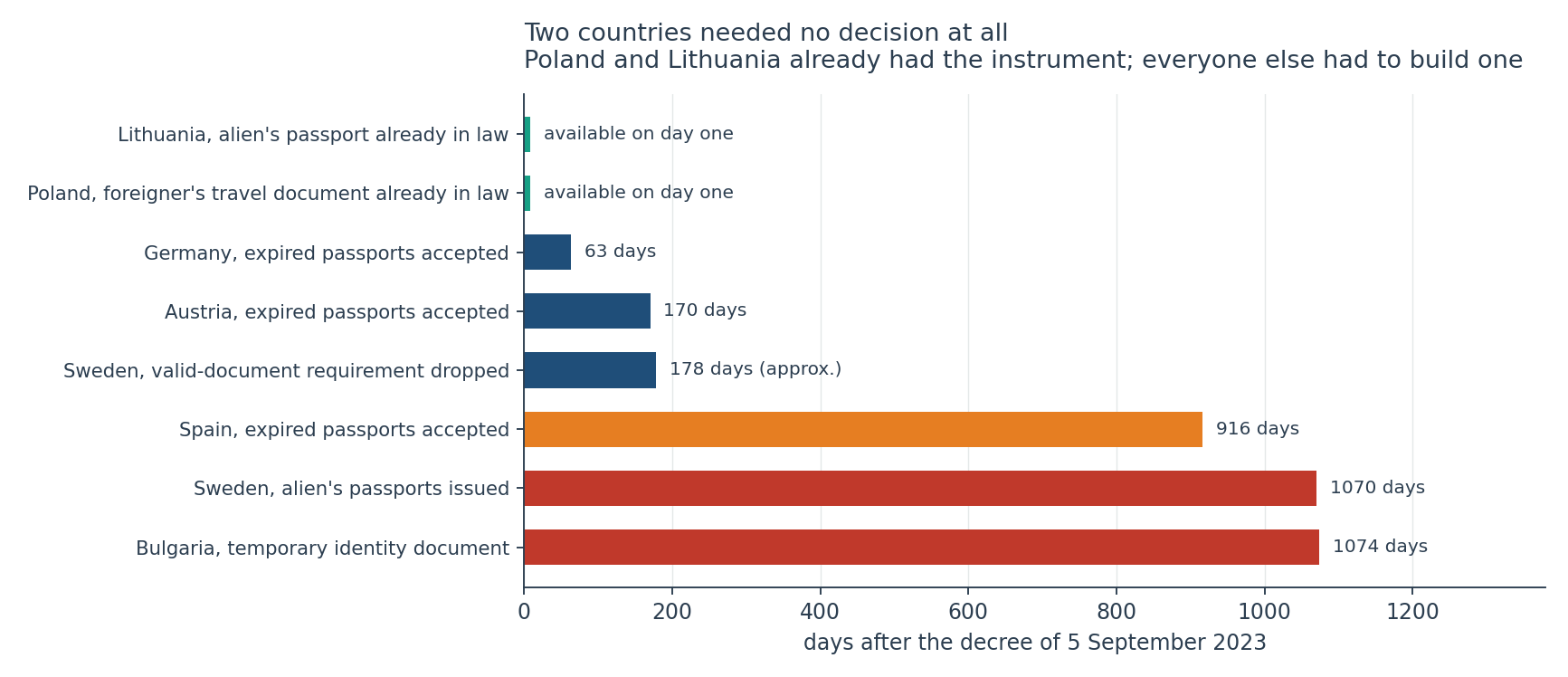
Germany moved fastest among the states that had to build something, accepting expired passports for residence renewals about two months after the decree. Austria followed in February 2024, and Sweden dropped its valid-document requirement for legalisation around March 2024. Then the pace collapses. Spain accepted expired passports in March 2026, two and a half years in. Sweden’s alien’s passport decision landed on 10 August 2026 and Bulgaria’s temporary identity document four days later.
Denis Kuchynski, Tsikhanouskaya’s diplomatic adviser, put the mechanics on the record on 18 August in interviews carried by Zerkalo, Reform and UDF: the work runs on two tracks, a pan-European one and a country-by-country one, and each result takes months or years. The chart is that sentence with dates attached.
Sweden’s document confirms what its holder is: someone who is not going back.
Poland issues the document free. It issues it to people who already hold status, and status is what it has begun refusing.
The reasoning matters more than the decision
Sweden’s document states that available information indicates Belarusian citizens abroad cannot obtain new passports through their country’s diplomatic or consular missions, and that in these circumstances they should not be encouraged to travel home to get one — in practice, they cannot obtain a document valid as a passport at all.
To establish that, the agency leans on the UN Special Rapporteur, who described the decree as an abuse of security measures and part of a deliberate policy of punishing Belarusians in exile, including human rights defenders, journalists and opposition figures, for their presumed political disloyalty.
That is a transnational-repression finding doing work inside another state’s administrative law. It is not advocacy language quoted for colour; it is the premise from which the legal conclusion follows.
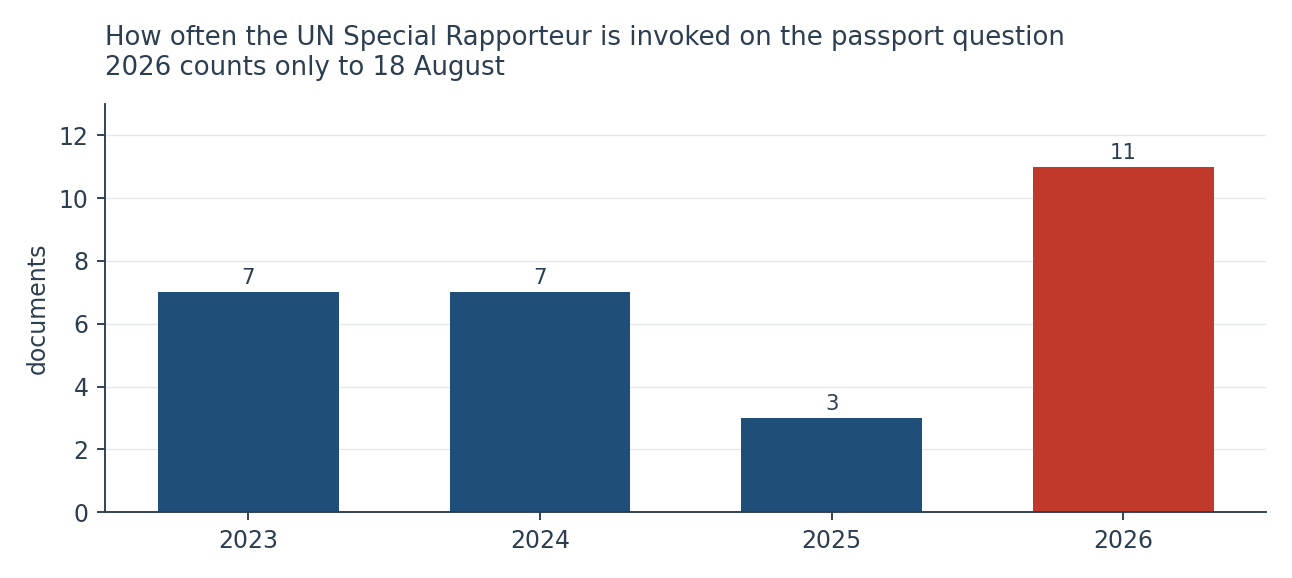
The characterisation is also being invoked more, not less, as it ages. Documents in the corpus that raise the passport question alongside the Special Rapporteur run at seven in 2023, seven in 2024, three in 2025, and eleven so far in 2026 — the highest count in the series, with four and a half months still to go.
The decree needs no other state’s cooperation, breaks no one’s sovereignty, and costs nothing to run.
The other direction
While documents get easier, status gets harder. Poland began refusing international protection to Belarusians whose cases the authorities now consider time-barred or covered by pardons, a shift Zerkalo, Mediazona, MOST and UDF all documented in July. In May, Poland twice refused protection to Andrei Novikau, a former security officer and former political prisoner long associated with Tsikhanouski. Lithuania’s foreign ministry has proposed restricting Belarusians’ property purchases, and Poland is working on harder citizenship rules.
So the same person can now hold a Swedish alien’s passport and a Polish refusal in the same year. One state solves the document; another withdraws the status the document was meant to support.
The Polish case is sharper than that, because both halves sit inside one country. The travel document is available to people who already hold protection or a humanitarian permit — and protection is what Poland has begun refusing. The instrument that was ready on day one reaches only those who clear a gate that is now narrower. Nothing about the document has changed; the population entitled to it has.
A Swedish alien’s passport and a Polish refusal can reach the same person in the same year.
Who is telling this story
Across three and a half years the passport question produced 2,294 documents in independent, exile and diaspora outlets, and 766 in state-aligned ones. Zerkalo leads with 570, then Nasha Niva 248, Reform 223, Pozirk 200, Charter97 199. But BelTA is sixth overall with 184, ahead of Euroradio, and pro-regime Telegram carries 159. This is not a subject the state segment avoids.
The Swedish decision itself was carried on 11 August by Pozirk, Euroradio, Gazetaby, UDF, DW, Reform and Zerkalo — seven outlets in one day — plus one pro-government Telegram channel. Belsat followed on 16 August in Belarusian. The exile press moves on this within hours; what the state segment does with the same facts is a question for a separate piece.
BelTA is the sixth most prolific source on this subject, ahead of Euroradio.
Confidence
Watch items
By 30 September 2026: whether any further state issues alien’s passports to Belarusians, and whether the interval from decree keeps lengthening.
By 31 October 2026: whether Poland’s positive-decision rate for Belarusian protection claims recovers from the July level or stays there.
By 31 December 2026: whether invocations of the Special Rapporteur’s finding hold above the 2023–2024 level, which would mean the characterisation has settled into administrative practice rather than peaking with one decision.
At the next Office briefing: whether the pan-European track produces anything, or whether the record stays a sequence of bilateral wins.
Method and limits
Corpus query over Belarusian state, independent, exile, Telegram and foreign segments, January 2023 to 18 August 2026, one row per URL. The dated decisions in the first chart are each read off a named report and checked by hand; the corpus supplied the candidates, not the dates. That distinction matters here: an automated ledger built on country names appearing near recognition wording put Germany’s first date on an article about an evacuation, because Zerkalo pages carry related-headline text that the scraper stores as part of the article. Nothing in the timeline comes from that method.
Sweden’s March 2024 step is dated to the month, not the day, and is marked approximate. Poland and Lithuania are shown at day zero because their instruments predate the decree; no decision date exists for them, and treating their absence from a decision ledger as absence from the response would have inverted the picture — they carry more coverage on this subject than any other pair of countries in the corpus, 134 documents for Lithuania and 78 for Poland against 45 for Sweden.