

Last month the Center for New Ideas published Monitoring the Belarusian Transition, a report by Ryhor Astapenia, Dzmitry Kruk and Anton Radniankou built on a survey of 29 experts conducted in April 2026, together with an interactive scenario tree at newideas.center/transitmonitoring. Three headline medians: a 15% probability of a power transition by 2030, 60% by 2035, 90% by 2040. A base scenario: authoritarian succession. And a warning that the departure of the incumbent is a moment of maximum uncertainty rather than an opening.
We think this is the most useful Belarus transition document published in years, and we think its numbers should be treated with more suspicion than they will be. Both of those judgements come from the same place: we have spent the past year measuring how well predictions about Belarus have actually performed.
What the report gets right
Start with the framing, because it is the contribution that will outlast the percentages. The report defines transition operationally — a change of the first person and the transfer of power to a new decision-making centre — and refuses to equate that with democratisation. The comparative base rate is not a caveat at the end; it is the premise. Most personalist autocracies produce another authoritarian regime when the autocrat exits, and the report builds its scenarios on that fact rather than around it.
Second, the methodological housekeeping is better than the genre norm. Medians rather than means, with the reason stated. The panel’s professional composition disclosed. Different bases reported for the open-ended items. Non-responses counted. A separate dataset file. Named reviewers.
Third, the recommendations for the EU are institutionally literate in a way that advocacy documents usually are not. A Belarus Democratic Transition Facility modelled on the Ukraine Facility, as a distinct regulation with objectives, access conditions and a payment mechanism, plus NDICI grants, EIB and EBRD access and a pre-agreed sanctions-relief sequence. That is a proposal a desk officer can move. “The EU should pay more attention” is not.
The measurement problem
Now the suspicion. Fifteen, sixty and ninety are suspiciously round numbers. The report acknowledges in a footnote that variance across the panel is high, but the variance is never shown: no interquartile range, no minimum and maximum, no distribution. A median without a spread converts disagreement into false precision, and it is these three figures, not the dispersion behind them, that will be quoted for the next two years.
The panel’s composition also sits awkwardly against the report’s own conclusions. The behaviour of the security services is named as the single most critical uncertainty across every case examined, and as the second most underestimated factor overall. Two of the 29 respondents declared security and armed forces as their field. Economic dependence on Russia is named as the primary constraint on any successor. Two respondents came from economics and finance. Twenty of 29 are political scientists and international relations specialists. How the 29 were selected is not disclosed at all.
Then there is the tree. A survey that asks marginal questions — which trigger, who takes power, what Russia does — cannot by itself yield the conditional probabilities a 14-branch tree requires: the probability that the siloviki fracture given a health trigger and a weakened Russia. The interactive page does not say whether those conditionals came from the experts, the authors, or the model. It does display “Σ P = 1.0” and scales line thickness to path weight, which lends an interpolation the visual authority of a Bayesian object. The claim that the two axes were validated by factor analysis of expert responses deserves the same scepticism: with n=29 and a mix of categorical and percentage items, factor analysis is at the edge of what the method supports.
To the authors’ credit, the page discloses that the interactive model was built by Claude Opus 4.8 under their direction. We run LLM-based analytical pipelines ourselves, so we will say plainly what that disclosure implies and the page does not: a language model asked to construct a transition tree reproduces the central tendency of the transition literature. That is the same literature that formed the panel. The panel and the model are not independent sources, and the tree reads as their convergence rather than as a check on either.
What our audit says about forecasts like this one
This is not a hypothetical concern, because the historical record on Belarus predictions is measurable and we measured it. Working from two archives of English-language commentary on Belarus, we extracted 715 predictive claims and scored 157 of them against what actually happened. Overall accuracy: 65 out of 100.
The interesting part is the spread by analytical framework. Organisations that simply documented what the regime was doing scored highest: Reporters Without Borders averaged 88.3 across 12 predictions, Belapan 91.0 across 3, Reuters 86.5 across 2. International institutions and mainstream outlets hedged their way to the middle, around 57. Think tanks applying democratic transition models did worst: the Jamestown Foundation averaged 18.3 across 3 predictions, RFE/RL 49.7 across 6. The small samples per source deserve stating — three predictions is three predictions — but the pattern holds at cluster level. Predictions grouped around authoritarian consolidation scored 6 correct and 0 wrong. Predictions grouped around European transition scored 3 and 4.
The distance between an analyst and the facts, and the closeness to transition theory, predicted error better than access or expertise did.
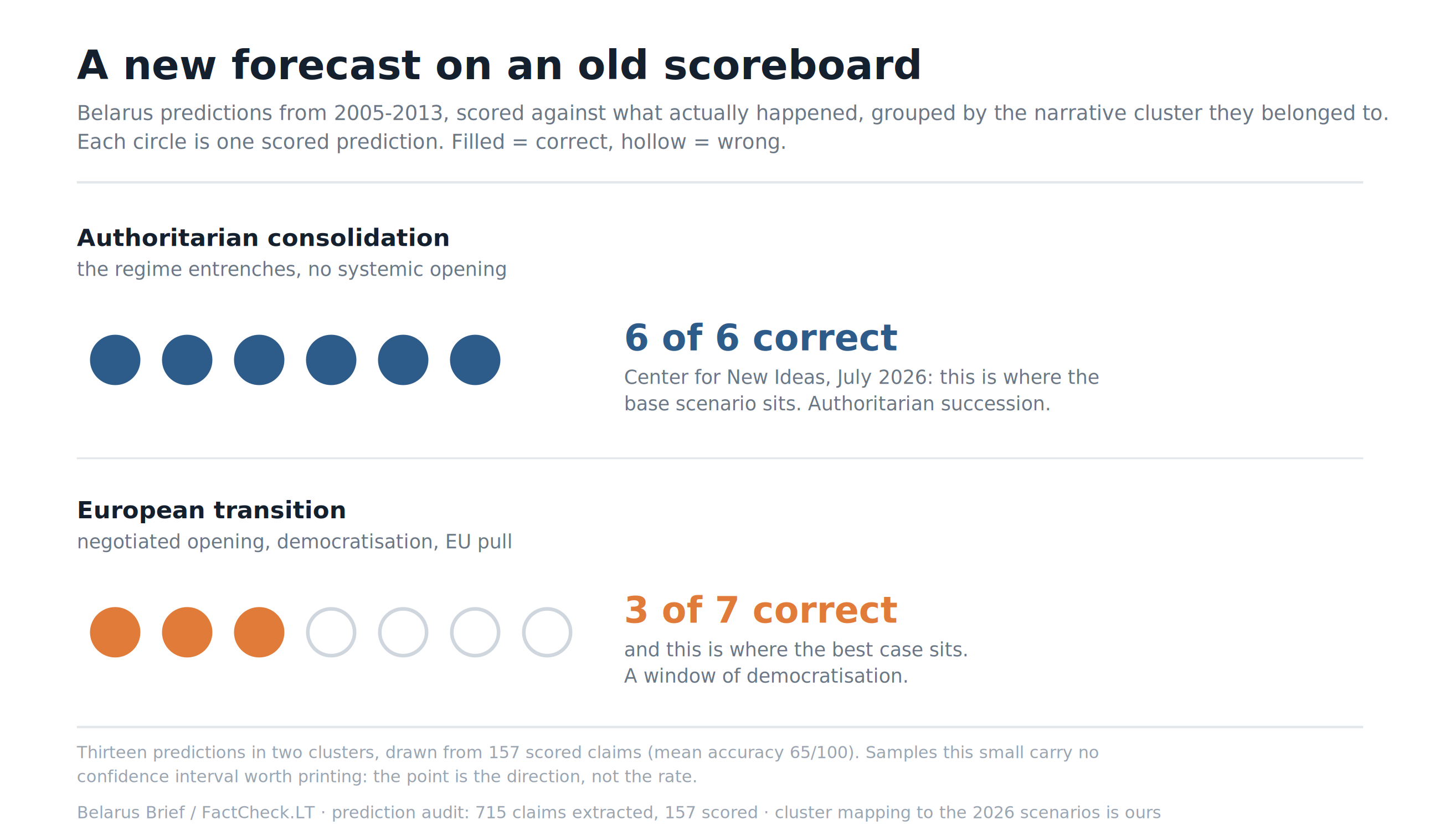
Read the new report against that record and the verdict is split rather than dismissive. Its base scenario — authoritarian succession, power passing to actors already inside the system, cosmetic liberalisation without structural reform — belongs to the cluster that historically scored 100%. Its treatment of the democratisation window as narrow, conditional and improbable is exactly the correction the record demands. Where it becomes speculative is where the record says to be most careful: in assigning calibrated-looking probabilities to trigger events. Our audit also found that 10 of 12 significant post-2013 developments were complete blind spots in the earlier prediction corpus, and that false thaws were identified in 2007, 2009 and 2010. The trigger question is precisely the question the genre has historically got wrong.
The contradiction at the centre
One finding in the report deserves to be pulled out and read twice. Asked which factor analysts most underestimate, the panel’s most frequent answer was the capacity of Belarusian society to act. Asked what society will do at the moment of transition, 55% said it will be passive and accept the status quo — and all four scenarios are built on that passivity.
The single variable the panel identified as underestimated is the one the model holds constant. “Experts underestimate X” is a diagnosis of the panel. It should have been applied to the panel, not printed beside its output.
What monitoring would need
The report promises a series, and the word in its title is monitoring. As published, it contains no operationalised indicator, no threshold, no update rule and no falsification criterion for its base scenario. Nothing states what would move probability mass. Without that, the next wave measures a change in the panel’s mood rather than a change in the country.
This is the gap we can fill, and we would rather propose than complain. A pre-transition period that consists of the quiet redistribution of resources, connections and influence — the report’s own formulation — leaves traces in the information environment, and those traces are countable. Four candidates, all measurable in our corpus of roughly 3 million documents from 73+ sources:
Successor salience. The share of succession-framed items in state media in which any single figure other than the incumbent is the dominant subject. A closed managed handover requires a name to be normalised before it is announced.
ABPA function drift. Whether coverage of the All-Belarusian People’s Assembly emphasises constitutional continuity or personnel. The Turkmen and Kazakh precedents both turned on the dual-power body acquiring an occupant.
Integration vocabulary density. The frequency of Union State and integration-agreement language in state media, which is the leading edge of scenario four rather than a rhetorical constant.
Siloviki visibility. Whether security-bloc figures appear as policy voices or only as enforcement subjects. A bloc with ambitions acquires a public register first.
None of these predicts a transition. All of them are observable now, monthly, without a panel — and each one can be scored against the scenario tree rather than argued about.
Three of our own, dated
Criticising someone else’s probabilities obliges us to post some. Three predictions, each with a resolution criterion and a review date of January 2028. We will publish the scoring whether or not it flatters us.
Through Q4 2027, no single figure other than the incumbent will exceed 15% of succession-framed mentions in the state-media corpus in any quarter. Falsified by a crossing sustained across two consecutive quarters.
Through Q4 2027, ABPA coverage will remain institutional rather than personal: no named individual becomes the dominant subject of ABPA coverage for two consecutive months.
Over the four quarters to Q2 2027, integration-agreement vocabulary density in state media will not decline. A sustained decline would be the first corpus-visible evidence that the elite diversification the report describes is actually happening.
If the base scenario is right, all three hold and we learn little. If any breaks, the tree needs redrawing — and we will have the date it broke.
Read the report: Monitoring the Belarusian Transition (Center for New Ideas, July 2026). Interactive scenario tree: newideas.center/transitmonitoring.