

A new Belarusian Helsinki Committee report argues that political discrimination in Belarus is built to stay out of sight. One trace in our data fits that claim. The list that makes a subscription punishable has nearly tripled since 2023, while reports of people punished for subscriptions have fallen by about three quarters.
The Belarusian Helsinki Committee (BHC) has published “You Know How It Is”, a report on systemic political discrimination in Belarus from May 2020 to September 2026 (BHC, PDF). Its main claim is that repression now works through statuses and “signals of unreliability”, and that it reaches people who never took part in politics. Much of it stays hidden, the authors write, because dismissals and expulsions are made on neutral grounds. We tested one part of that claim. On 15 November our crawl of the Information Ministry’s list of “extremist materials” counted 6,209 rows; rulings up to the end of 2023 account for 2,130 of them. Since 2023, independent outlets have written less and less about people punished for subscriptions, likes and comments: 367 items in 2023, 95 in 2025. What we cannot see is whether fewer people are punished or fewer cases reach the press.
What the report argues
The report takes its title from a phrase that every Belarusian knows. Officials use “you know how it is” in place of a legal ground, the authors say, when a decision rests on a political motive that nobody writes down. Katsiaryna Dziaikala, a BHC expert, called the phrase an “informal code” when she presented the report online on 5 November (Svaboda, 5 November 2026).
The mechanism the report describes runs through status. A conviction for a “crime of an extremist nature”, or a place on the list of persons “involved in extremist activity”, triggers bans in many unrelated laws. Teachers lose the right to permanent work with children for life. Tour guides lose their certification. A former political prisoner on the list is barred from at least eight professions, the report says. As of autumn 2026, it counts 6,930 “extremists”, 1,674 “terrorists”, more than 9,000 “extremist materials” and more than 365 “extremist formations” in the state registers.
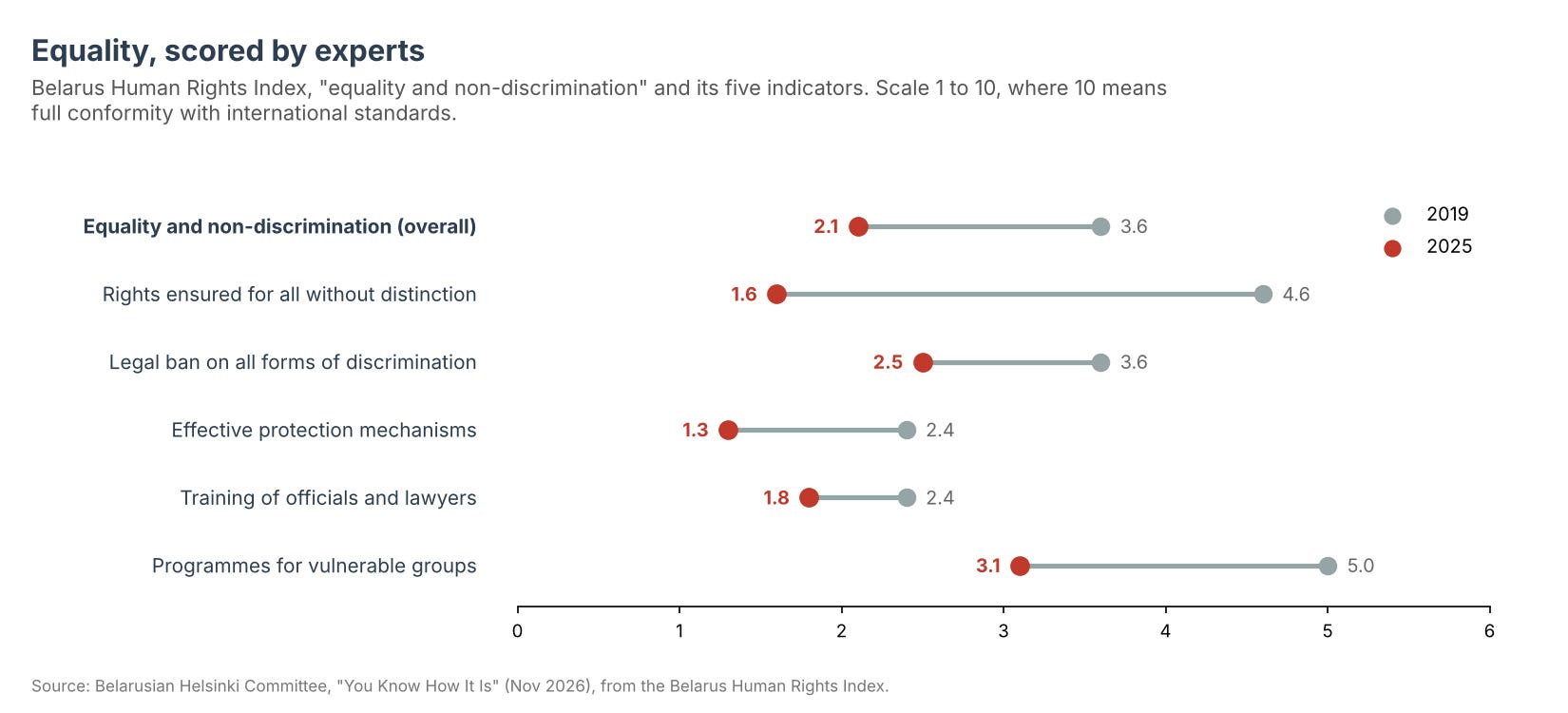
The report’s figures on equality come from the Belarus Human Rights Index, which the BHC also produces. Its experts scored “equality and non-discrimination” at 2.1 out of 10 in 2025, against 3.6 in 2019. The largest fall is in whether rights are ensured for everyone without distinction, from 4.6 to 1.6.
The BHC itself has been an “extremist formation” since a KGB decision of 31 March 2026. The report’s cover warns that subscribing to, storing or sharing its materials may create risks for people in Belarus. The report itself sits under the mechanism it describes. In our corpus, three independent outlets reported it between 5 and 12 November: Svaboda, Euroradio (Euroradio, 7 November 2026) and Viasna’s Telegram channel (Viasna, 12 November 2026). No state item in our corpus mentioned it.
The list keeps growing
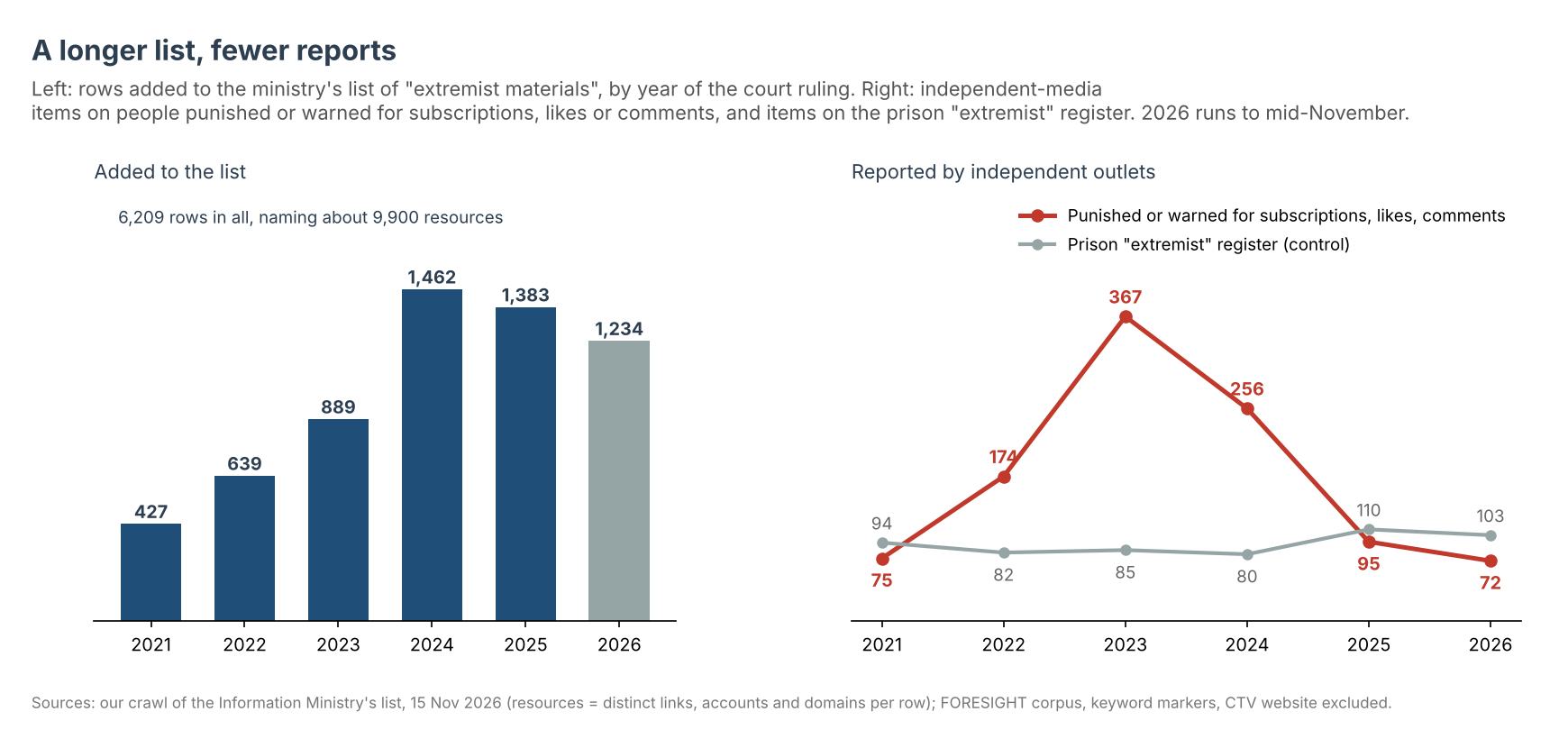
The report gives a figure of more than 9,000 “extremist materials”. Our crawl of the ministry’s website found 6,209 rows on 15 November, the latest from a ruling of 12 November. One row often names several accounts or sites. Counted by distinct links, accounts and domains, the rows name about 9,900 resources, so the two figures agree.
The report itself sits under the mechanism it describes.
The list grows through court rulings. By the year of the ruling, it added 889 rows in 2023, 1,462 in 2024, 1,383 in 2025 and 1,234 so far in 2026. Rulings up to the end of 2023 account for 2,130 rows, so the list has nearly tripled since. Each new row adds one more channel, page or book that it is an offence to share or keep. Courts have also fined people for subscribing to such pages (Charter97, 5 October 2023). The list keeps growing, and the reports keep falling.
Not every register moves at the same pace. On 10 November Zerkalo reported that a Telegram channel close to the security services, which had published the names of “extremists”, had been deleted (Zerkalo, 10 November 2026). The Interior Ministry’s own list of “extremists” had not been updated for six weeks. The 6,930 names in the report may be the last figure that list showed. The list of materials kept growing through October and into November.
Fewer reports of what the list punishes
Independent outlets wrote most about these cases in 2023. That year 367 items dealt with people detained, fined or warned over subscriptions, likes or comments, with a peak of 55 in October. The count fell to 256 in 2024, 95 in 2025 and 72 so far in 2026. State outlets wrote little about it at any point: between 14 and 20 items a year until 2024, and three a year since. In August 2023 the Justice Ministry’s Telegram channel told its readers that subscribing to “extremist” channels was a criminal offence (Justice Ministry, 22 August 2023).
The list keeps growing, and the reports keep falling.
The fall does not look like a general loss of interest in repression. The same independent outlets wrote about the prison “extremist” register at a steady 80 to 110 items a year from 2021 to 2026. This is the preventive record that marks political prisoners with yellow tags.
The practice itself did not stop. In its review of July 2025, Viasna described the usual sequence. Officers find a “like”, a repost, a subscription or a forwarded “extremist” item on a phone, “or subscribe the person themselves”, and a court then orders administrative arrest (Viasna, 4 August 2025). On 12 November 2026 Mediazona reported that workers at the Mozyr oil refinery had been warned about liability for subscriptions and comments on TikTok (Mediazona, 12 November 2026).
The report would read the fall as latency. People clean their phones and laptops before trips and checks, as independent guides have advised since 2024 (Mediazona, 26 January 2024). Those who are punished may avoid publicity, and so may their families. Fewer cases may also reach the courts. Our data cannot tell a quieter practice from a quieter press.
The rules are public
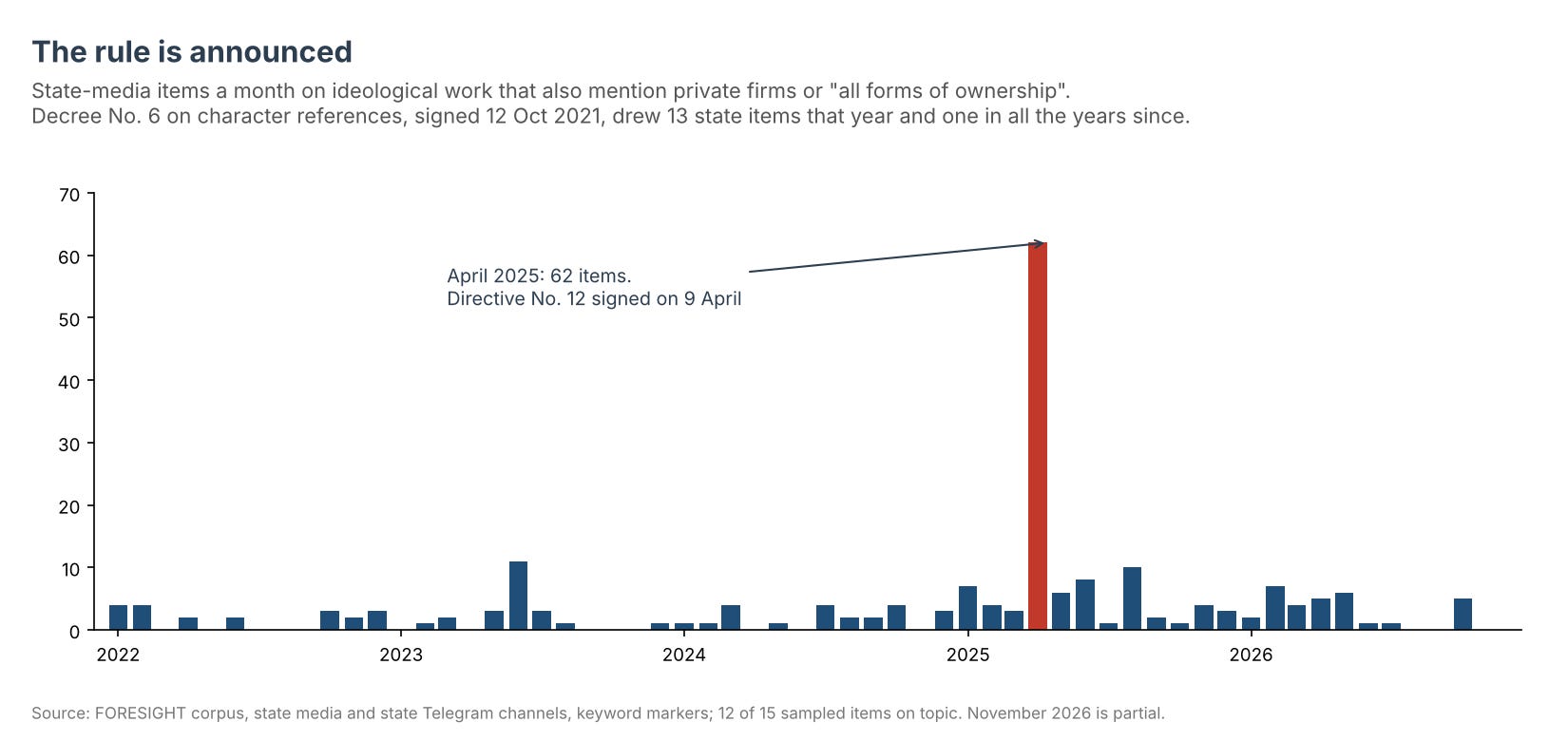
What the state does publish is the rules. On 12 October 2021 Lukashenko signed Decree No. 6, which tightened the rules for hiring managers and staff in state bodies and state-owned companies. A reference from the previous employer must now state a person’s “attitude towards state and public institutions, the constitutional order” (Zerkalo, 12 October 2021; BelTA, 12 October 2021). State outlets announced the reference rule in one burst. They carried it in 13 items in 2021 and have mentioned the requirement once since.
Our data cannot tell a quieter practice from a quieter press.
Independent outlets showed the rule at work. In May 2022 Zerkalo quoted a reference given to a woman whose contract was not renewed after she had signed for an alternative candidate in 2020. It noted “cases of an ambiguous attitude towards state and public institutions, the constitutional order” (Zerkalo, 26 May 2022).
Directive No. 12 was signed on 9 April 2025 (House of Representatives, 9 April 2025). According to the report, it requires organisations of all forms of ownership, private firms included, to carry out ideological work and to name staff for it. That April, 62 state items covered ideological work and also mentioned private firms or “all forms of ownership”. The total for 2025 was 111, against 22 in 2024. In August 2025 SB reported that key performance indicators had been drawn up for the “ideological vertical” (SB, 20 August 2025). Later items show the rule in use. In September 2025 the head of ideology for Mogilev region met the staff of a private mining-machinery plant (Mogilevnews, 17 September 2025). In May 2026 the MP Vadim Gigin visited the head office of the IT company ISsoft. He wrote that “Directive No. 12 prescribes that ideological work covers organisations of all forms of ownership” (Vadim Gigin, 25 May 2026).
State outlets announced the reference rule in one burst.
Lukashenko has addressed such dismissals directly. At a press conference in January 2025 a journalist asked whether Belarus had a human rights problem with workers dismissed for taking part in the 2020 “riots”. Lukashenko said that taking part in riots was itself a violation (BelTA, 26 January 2025).
How sure we are
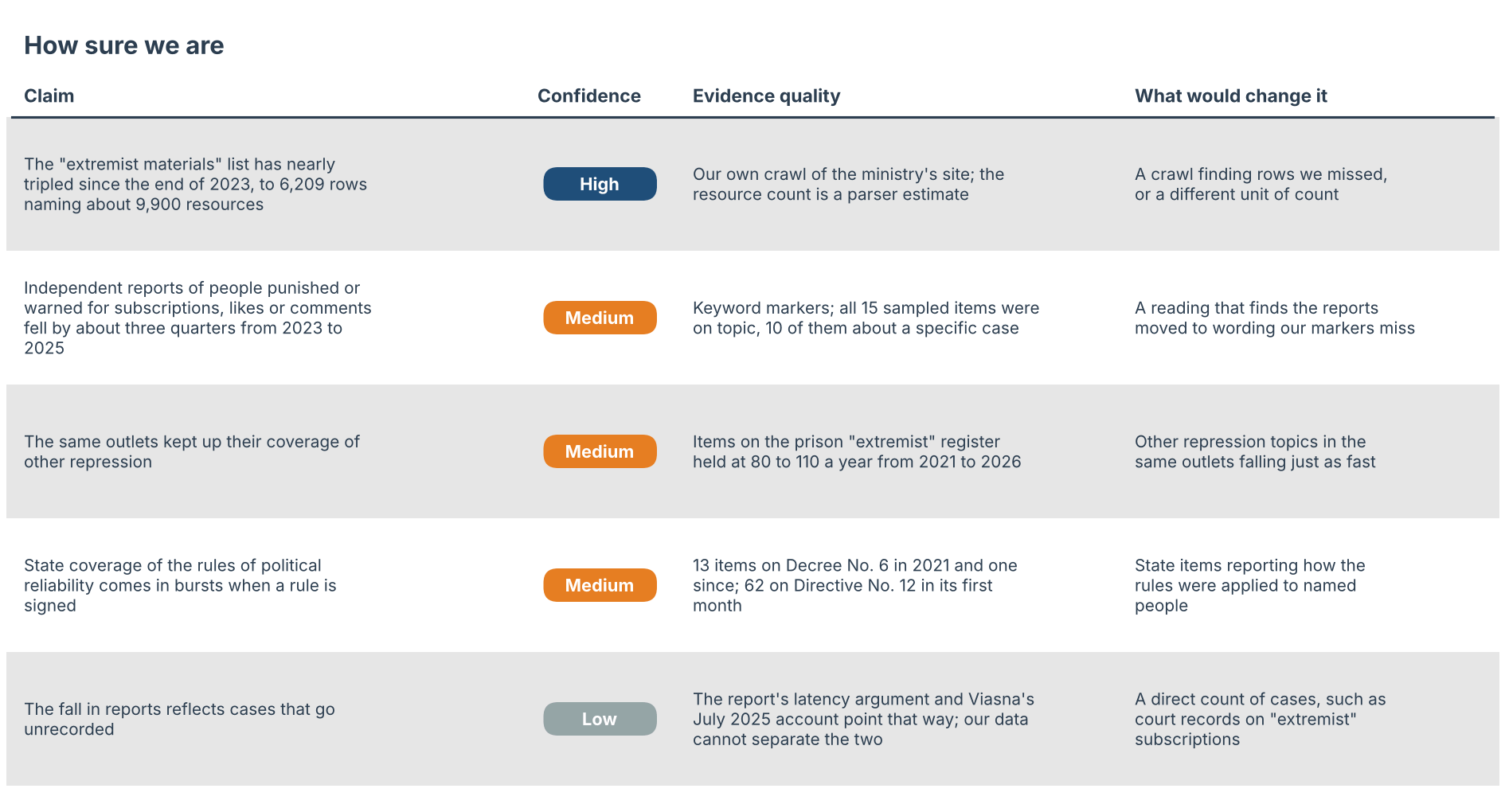
The “extremist materials” list has nearly tripled since the end of 2023, to 6,209 rows naming about 9,900 resources. High. It rests on our own crawl of the ministry’s site; the resource count is a parser estimate. A crawl finding rows we missed, or a different unit of count, would change it.
Independent reports of people punished or warned for subscriptions, likes or comments fell by about three quarters from 2023 to 2025. Medium. The count uses keyword markers; all 15 sampled items were on topic, 10 of them about a specific case. A reading that finds the reports moved to wording our markers miss would change it.
The same outlets kept up their coverage of other repression. Medium. Items on the prison “extremist” register held at 80 to 110 a year from 2021 to 2026. Other repression topics in the same outlets falling just as fast would change it.
State coverage of the rules of political reliability comes in bursts when a rule is signed. Medium. There were 13 state items on Decree No. 6 in 2021 and one since, and 62 on Directive No. 12 in its first month. State items reporting how the rules were applied to named people would change it.
The fall in reports reflects cases that go unrecorded. Low. The report’s latency argument and Viasna’s July 2025 account point that way, but our data cannot separate the two readings. A direct count of cases, such as court records on “extremist” subscriptions, would change it.
How it fits
We have read the list of “extremist materials” before, as administrative throughput in “The Ledger That Cannot Shrink” and court by court in “The Busiest Bench”. The BHC report adds what each row does to a person: it turns a subscription into a possible case. Our count supports the report’s figure of more than 9,000 materials and adds a time line to it. The report’s wider claim, that discrimination now touches every sphere of life, is beyond what our corpus can test. The thesis model does not cover this; we record it as an observation.
What to watch
By 31 January 2027. The Interior Ministry’s list of persons “involved in extremist activity” shows more than 6,930 names. Expectation: yes. Confidence: medium.
By 31 March 2027. Independent items on people punished or warned for subscriptions, likes or comments in January to March 2027. Expectation: fewer than 30. Confidence: medium.
By 30 June 2027. The Information Ministry’s list of “extremist materials” passes 7,000 rows. Expectation: yes. Confidence: medium.
Method and limits
The report was read in its English version. List figures come from our crawl of the Information Ministry’s website on 15 November 2026. Rows are dated by the court ruling, and resources are the distinct links, accounts and domains in each row, a parser estimate. Media counts come from the FORESIGHT corpus from 2021, with the CTV website left out, and use keyword markers in Russian and Belarusian. Subscription items put subscriptions, likes or comments within 120 characters of “extremist” or “banned”. A second filter on words such as “staff” and “employer” was meant to isolate workplace cases, but it passes most items, since police officers are “staff” too. Prison-register items put the preventive register within 120 characters of “extremist” or “political”. Ideology items mention ideological work or Directive No. 12 together with private firms or “all forms of ownership”; 12 of 15 sampled state items were on topic. We dropped a planned count of political dismissals, because one Belarusian stem also matched the Russian word for “arbitrary”.
Thesis tag: none (observation).