
On 22 and 23 August cyclone Priska crossed Poland, Belarus, Lithuania and Latvia. At the peaks more than half a million Lithuanian and Latvian customers had no power, and two people died. We read how Belarusian state media and pro-government Telegram channels covered the neighbours’ storm over the next three weeks. One thing we cannot check is how long Belarusians themselves sat in the dark, because the energy ministry counted villages and towns, not customers.
The short version
The news wires of BelTA, SB and CTV reported the neighbours’ storm mostly accurately and called it severe.
The line “a few hours here, days there” first appeared on a state talk show on 24 August.
Mockery started in anonymous channels. Personal channels of propagandists copied it within one to fifteen minutes.
SB’s Telegram channel called the storm next door “destructive” in its news lines and a “simple storm” in a closing jibe.
The wires kept count
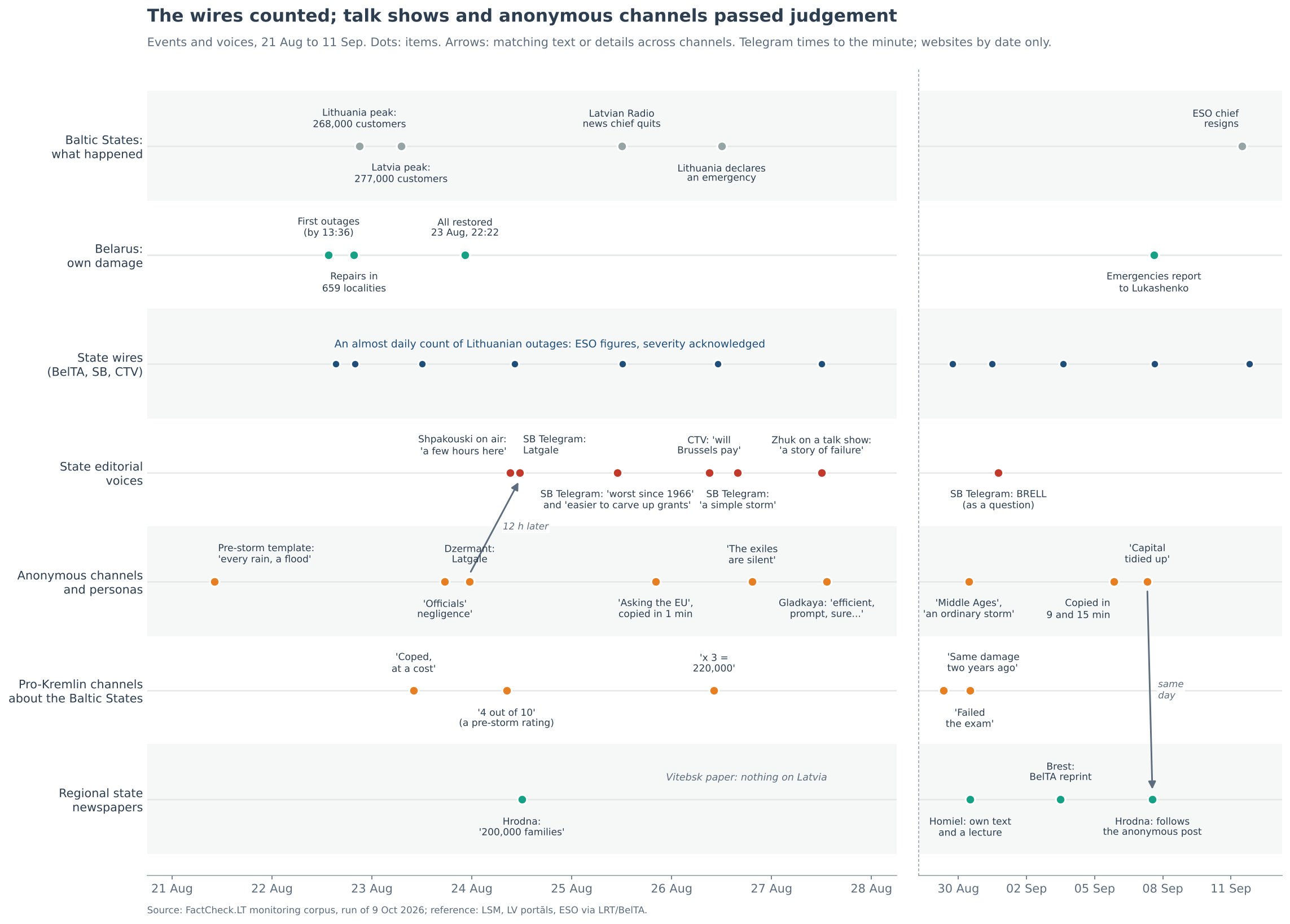
From 22 August to 11 September BelTA, SB and CTV ran an almost daily count of Lithuanian outages, based on figures from the grid operator ESO. On 24 August BelTA wrote that 268,000 Lithuanian customers had lost power on the evening of 22 August and that Latvia had its worst outages in 20 years. On 7 September it was still counting: 1,200 customers.
The wires did not play the storm down. CTV quoted the operator calling the situation catastrophic. BelTA reported ESO’s view that the storm was more than a third stronger than one a couple of years earlier. SB called it one of the largest in decades. The wires did make mistakes. The most common was “people” instead of “customers”, in BelTA and SB alike. One CTV item put Latvia’s outage at “more than 270 families” instead of 277,000 customers.
Belarus had its own damage. At 19:00 on 22 August the energy ministry listed repairs in 659 localities and 1,876 transformer substations switched off. At 22:22 the next day it said every locality had power again, with 41 customer requests still open. In total more than 889 localities were hit. The ministry posts we found give no count of customers without power.
SB’s Telegram channel called the storm next door “destructive” in its news lines and a “simple storm” in a closing jibe.
The judgement came from elsewhere
On the morning of 24 August a clip from the talk show Budni went up on YouTube. Aliaksandr Shpakouski, a member of the lower house of parliament, said some Belarusians had been annoyed to spend “a few hours” without electricity. “Our neighbours in Lithuania, 155,000 people, cannot overcome this problem for days. That is the difference in approach,” he said. The 155,000 figure dated from the evening of 22 August. On the day of the clip BelTA reported 129,000. Belarus did restore power faster by its own measure, but “a few hours” is not what its own figures show. About 33 hours passed between the first timed report of outages and the ministry’s all-clear, and even then 41 requests were open.
On 27 August the information minister, Dzmitry Zhuk, appeared on the same show. He called the outages “a story of failure” for the Lithuanian and Latvian authorities and said Belarusians could rely on their government, a “luxury” the neighbours did not have. SB’s write-up of the show then added lines of its own: Latvia and Lithuania “failed the exam”, and their people “are used to the inaction of the authorities”. The write-up gives no Belarusian figure. Two days earlier BelTA had reported that Lithuania had called in the army.
SB’s Telegram channel worked in the same way. A post would carry the facts and then a closing line. On 25 August a post said Latvia’s storm was the worst since 1966 and ended: “Easier to carve up grants.”
There is a simpler reading of this division of labour. Agency copy rarely carries opinion on any subject, and talk shows always do. It would then be a habit of genre, not a decision about this storm. One way to test it is to look at a foreign crisis with no Belarusian angle. If the wires stay neutral there too and the shows still compare, genre explains most of it.
Belarus did restore power faster by its own measure, but “a few hours” is not what its own figures show.
Two vocabularies
The words changed where the judgement began. On 22 August SB’s Telegram channel wrote of a “destructive cyclone” and “enormous forces” at work in Belarus. In its news lines it used the same word for the neighbours: a “destructive storm” on 27 August and on 31 August. But on 26 August a closing line about Lithuania read: “If things are so bad after a simple storm, it is not clear how they plan to fight a war.”
Anonymous channels did the same, only harder. One opened a post with “the strongest storm of recent years” and closed it with “not some incredible natural disaster, just a strong storm”. Another wrote of “the Middle Ages” after “an ordinary storm” (30 August). An expert quoted by BelTA on 4 September called it a “little hurricane”. He said that inside the old BRELL power ring the outage could not have lasted so long.
[CHART: storm_two_vocabularies_en.png]
Copied within minutes
Telegram posts carry a time to the minute, so copies are easy to see. A post by the anonymous Zheltye Slivy network about Latvia asking the EU for money went up at 20:09 on 25 August. Ryhor Azaronak reposted it word for word at 20:10. Two later Zheltye Slivy posts were copied by personal channels within 9 to 15 minutes.
Among the personal channels, Liudmila Gladkaya of SB wrote most often about the neighbours’ storm, usually a news item with a sarcastic line added. A promo for a live show with her, Yauhen Gorin and Azaronak, with the line “Lithuania without power”, was reposted by Azaronak a minute later and by Aleh Gaidukevich 47 minutes later. For a joint show that is ordinary cross-promotion.
Belarusian anonymous channels and pro-Kremlin channels about the Baltic States share material. A post by Teni Pribaltiki about Lithuania’s shortage of electricians reappeared in an anonymous Belarusian channel the next morning. A weekly round-up by Aleksei Stefanov was copied by Ksenia Lebedeva seven minutes after it appeared and then by five more channels.
Copies within minutes show a shared feed. They do not show who decided what to post.
The chain also reached print. On 7 September the regional paper Grodnenskaya Pravda published “Riga shines while the provinces lie in ruins”. It closely follows a Zheltye Slivy post from 07:40 that morning, down to a paraphrase of the same quote from Latvian officials. The paper’s own text admits that power had already returned. Its other piece on the neighbours, on 24 August, used the previous day’s figure of more than 200,000, turned customers into “families” and said rescue crews “simply do not come”, with nothing to back it.
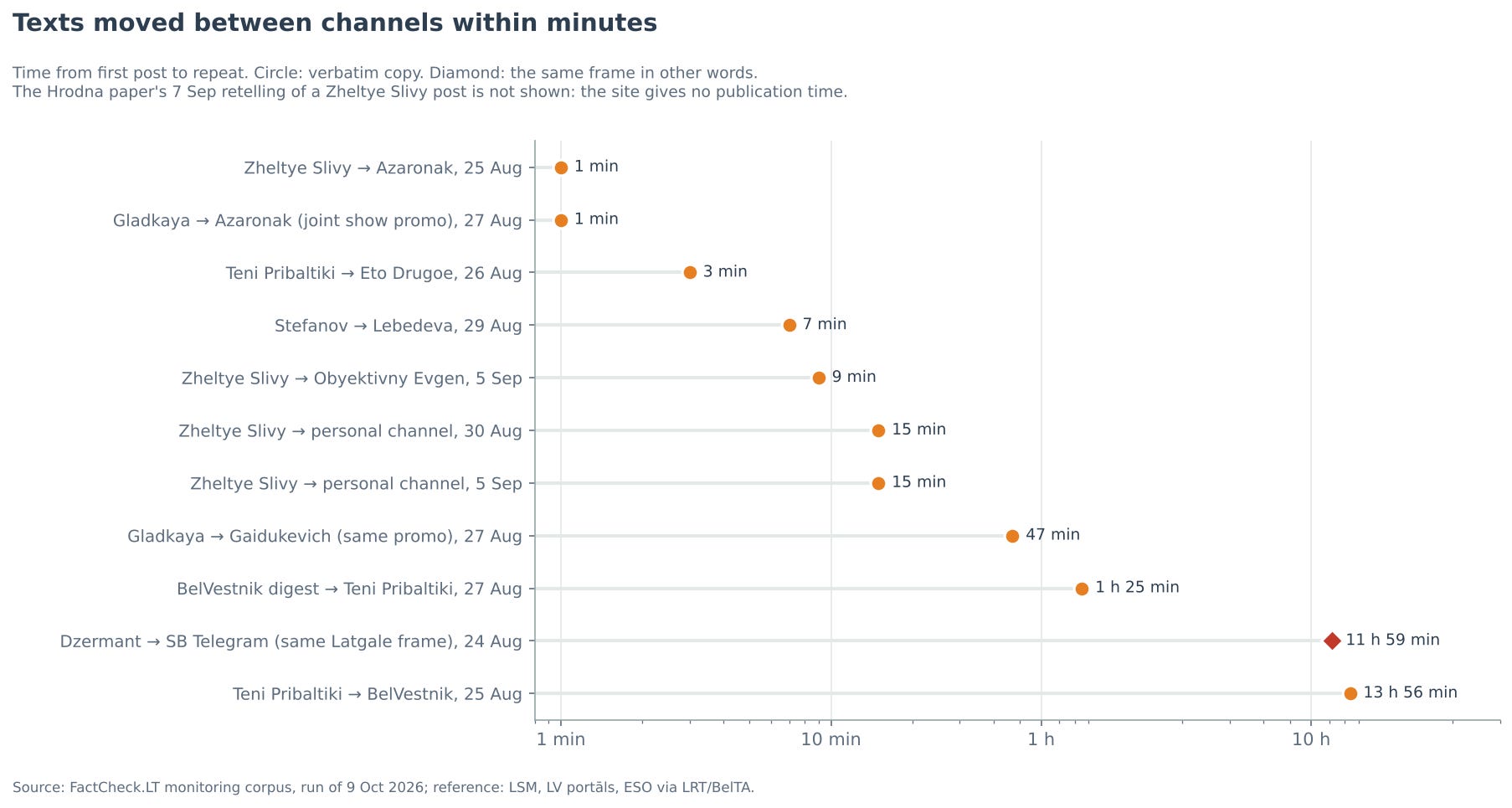
Copies within minutes show a shared feed. They do not show who decided what to post. Our earlier work found that the three Zheltye Slivy channels publish from one autoposting operator, and personal channels may simply forward what is popular. The newspaper’s site gives a date but no time, and a shared outside source is possible, though we did not find one.
The other regional papers barely covered the neighbours. The Vitebsk paper wrote nothing about Latvia, although the storm hit its own border districts. The Brest paper reprinted BelTA. The Homiel paper wrote its own piece, factual until a closing lecture about what the country “spent on fences, defence or strengthening the borders”.
The raw material was real
Most of the “failures” came from real Baltic self-criticism. Lithuania’s energy minister said the mistakes were obvious, and the head of ESO resigned. The head of a Latvian telecom operator said he would have liked the crisis centre to take over coordination. The channels then processed it. A Latvian minister said his country might have to ask the European Commission for help. A minister’s “may have to ask” became “Latvia has asked” within a day (26 August). A Latvian official’s rating of crisis readiness as four out of ten was presented as a lesson of the storm, although he gave it on 13 August, nine days earlier (LSM). Teni Pribaltiki multiplied 74,000 households by three, while the average Lithuanian household has two people. CTV wrote of “the promised 200 euros for every Lithuanian” still sitting by candlelight (26 August). The actual scheme is for customers cut off for more than 72 hours: compensation calculated by ESO, plus a claim for direct losses of up to 220 euros per object (Lithuanian finance ministry).
Some of the material was simply true. On 24 August Teni Pribaltiki wrote that Latvia’s prime minister, Andris Kulbergs, had “rushed to Kyiv” and left the storm response behind. He was indeed in Ukraine on 23 and 24 August and held meetings in Kyiv (UNN, LV portāls). That he abandoned the response is the channel’s judgement, not a fact.
Some frames we expected barely appeared. BRELL came up twice, late. Latgale came up twice, first in a post by Aliaksei Dzermant and twelve hours later on SB’s channel. Nobody offered Belarusian help. The resignation of the Latvian Radio news chief over storm coverage never reached the state segment. Pul Pervogo, the channel close to Lukashenko’s press service, said nothing about the neighbours’ storm.
A minister’s “may have to ask” became “Latvia has asked” within a day.
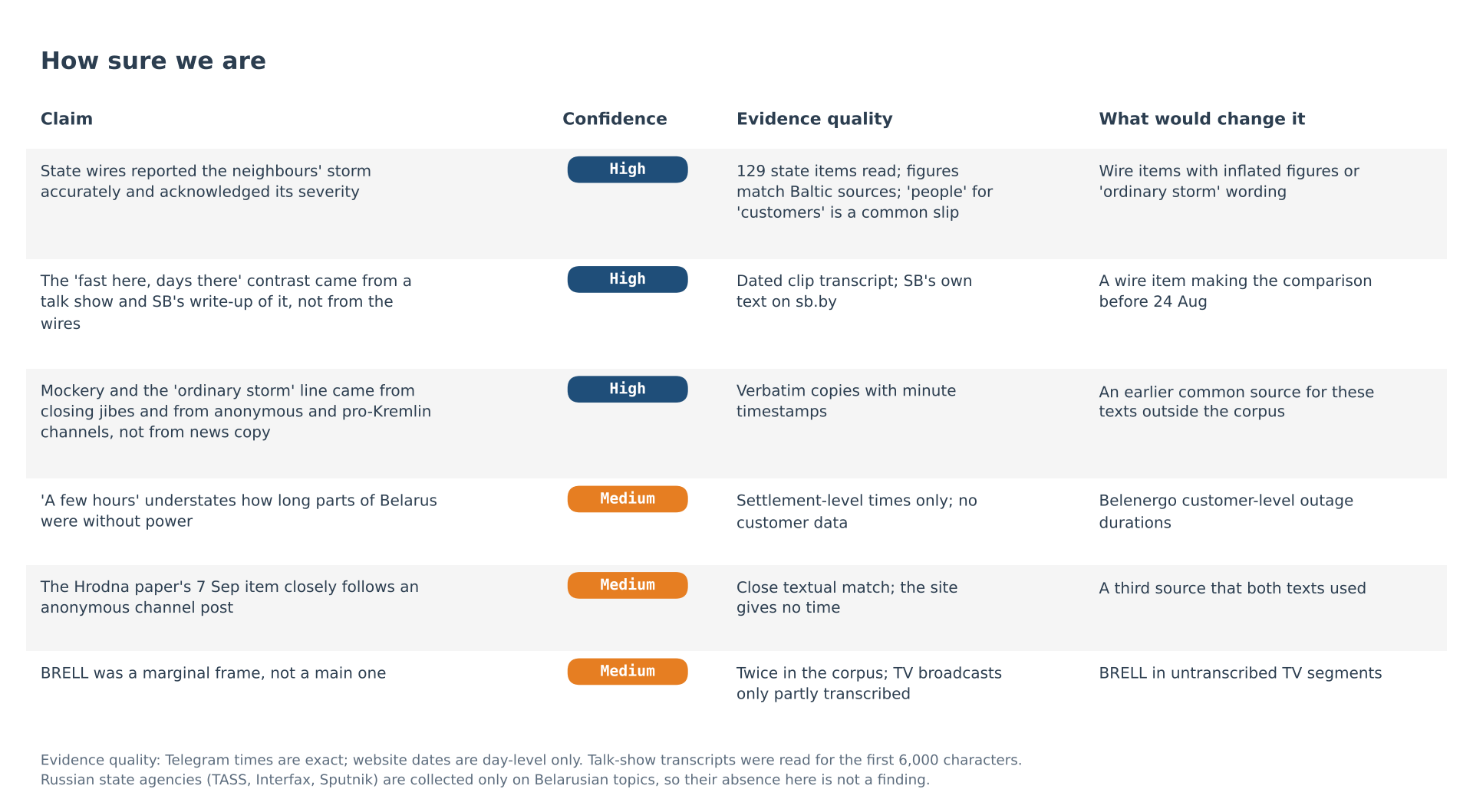
Rows two and three rest on texts with exact times, row one on dated website items. The weakest point is Belarus’s own outage time, which only the state grid could settle.
What to watch
By 31 March 2027: if a storm or ice causes major outages in Belarus this winter, the energy ministry will again report localities and substations, not customers. High.
By 31 March 2027: at the next serious weather emergency in Lithuania, Latvia or Poland, an “ordinary storm” or “could not cope” line will appear in anonymous pro-government channels within 48 hours, while BelTA’s copy stays factual. Medium.
By 31 December 2026: Grodnenskaya Pravda will again publish a piece on a Baltic or Polish topic that closely follows an anonymous Telegram post from the same day. Medium.
By 31 December 2026: when Lithuania publishes final compensation figures or the review of ESO’s response, BelTA will report the numbers accurately and SB’s Telegram channel will add an evaluative closing line. Medium.
How it fits
Observation: the same state outlets carried accurate copy and evaluative lines side by side, sometimes in a single post. The judgement sat in talk shows, write-ups of talk shows, closing lines of Telegram posts and anonymous channels. It fits [T?] in the working model. The alternative is that this is genre, the normal gap between agency copy and opinion formats, with no link to this story. What would separate them is a control case: a foreign disaster with no Belarusian angle, read with the same method. If the closing lines and the “here and there” comparison appear only when a neighbour can be shown to fail, genre is not enough.
Method and limits
We searched the FactCheck.LT monitoring corpus from 15 August to 15 September 2026 with a storm vocabulary and read the results by hand. The search returned 567 documents. Among them were 129 items from state websites, state Telegram channels and regional papers, and 83 posts by personal, anonymous and pro-Kremlin channels, all about the neighbours’ storm. Most websites carry a date only, so copy chains are proven only for Telegram. Talk-show transcripts were read for the first 6,000 characters. The split between personal and anonymous channels follows the FactCheck.LT list. We did not establish where the pro-Kremlin Baltic channels are run from. Russian state agencies are collected only on Belarusian topics, so their absence here means nothing. We found no source for the claim that the Latvian prime minister proposed sending rescue services to Ukraine for training. The government’s own release on his visit speaks of using Ukraine’s experience in cyber and civil security. The full investigation, with all twelve fact-checks, is on FactCheck.LT