
CSO Fusion scores Belarusian civil society at 6.2 for 2025, against 6.1 for 2024. Five parameters worsened by a tenth of a point, one by two tenths, and one did not move because it no longer can: legal environment reached 7.0, the bottom of the scale, in 2021 and has stayed there since. The year being scored is the year the Trump administration shut USAID and ended American assistance to the sector. A BYNGO survey of fifty-three organisations in February 2025 found the stoppage had reached 64.2 per cent of them, and that American money had been more than half the annual budget for a third. Groups that had been running projects of 100,000 euros started applying for grants of five to ten thousand. Financial sustainability moved from 6.7 to 6.8.
The direction is right and the year is documented in unusual detail. The number attached to it would look almost the same if none of it had happened.
Seven tracks and a floor
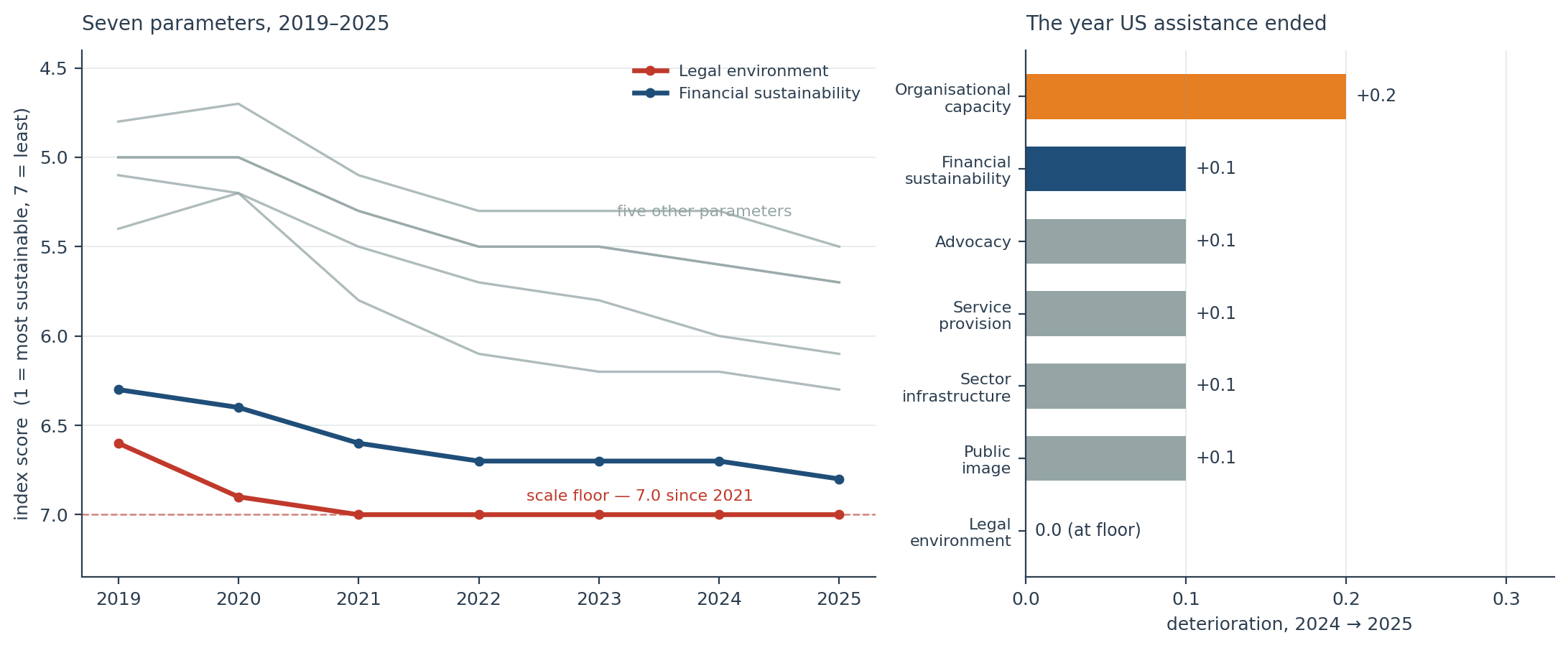
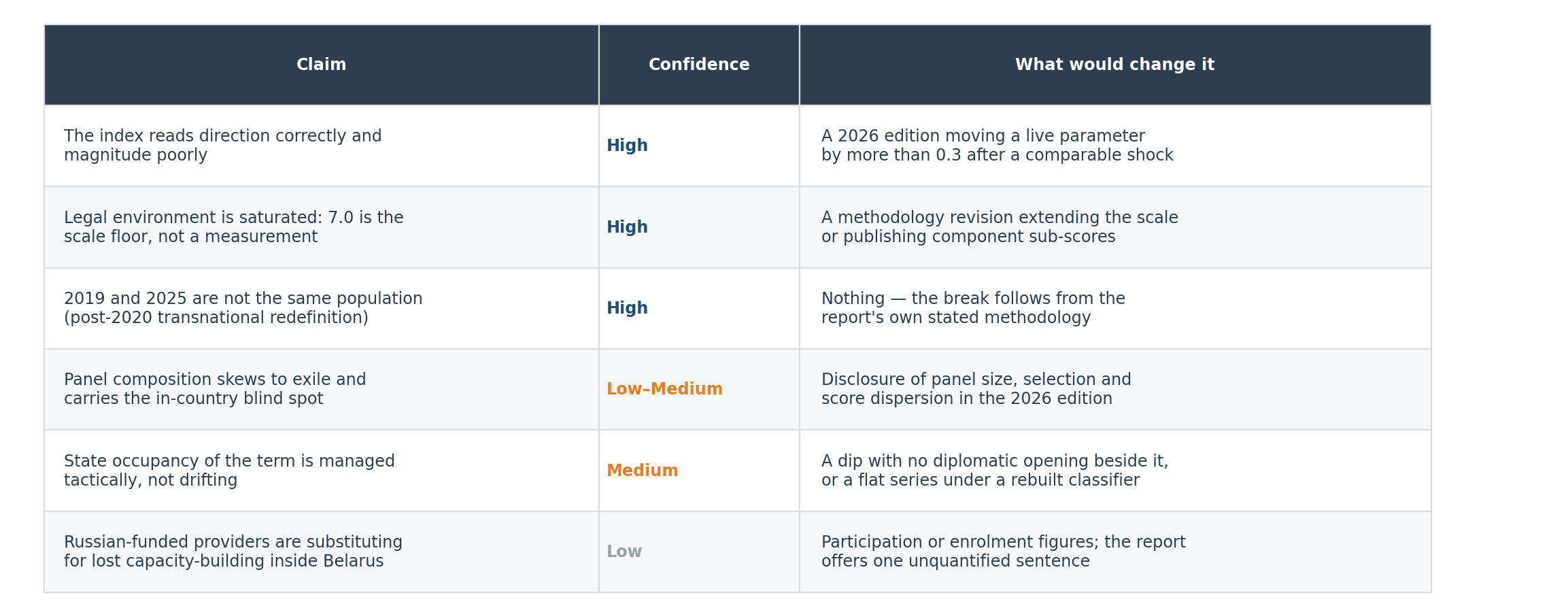
Every parameter has deteriorated since 2019 or 2020. Legal environment reached the boundary first, financial sustainability now sits two tenths away from it, advocacy is at 6.3. Across the six parameters that can still move, something like seven points of range remain in total, and the panel is spending that range a tenth at a time. An index whose worst-affected areas are pinned at the edge of its own scale has stopped distinguishing a bad year from a catastrophic one.
The report notes the saturation once, for the legal environment, and then averages that constant into the headline score anyway.
What the methodology does not say
The methodology section gives a seven-point scale, an expert group of practitioners and researchers, and averaging across parameters. It does not give the size of that group, how members were selected, whether scores were reached by consensus or by aggregation, or how far apart the experts were on any parameter. A movement of 0.1 is presented with the same authority as a movement of 1.0. For a document that will be quoted in funding applications and donor strategy papers through 2026, the missing dispersion is the most consequential omission in it.
There is a second problem the report raises and then walks past. It states that more than a third of organisations reported losing access to their target groups by late 2025, and that organisations working from abroad find it increasingly hard to know what is happening to those groups inside the country. If the panel draws on that same relocated pool, the in-country scores inherit exactly the blind spot the report has just described. Anonymisation compounds it. In-country organisations and their projects go unnamed even where publicly known, which is the right call for people’s safety and which also leaves that half of the evidence unauditable, with no coded identifiers carried across editions and no indication of how many claims rest on how many informants.
The word, measured separately
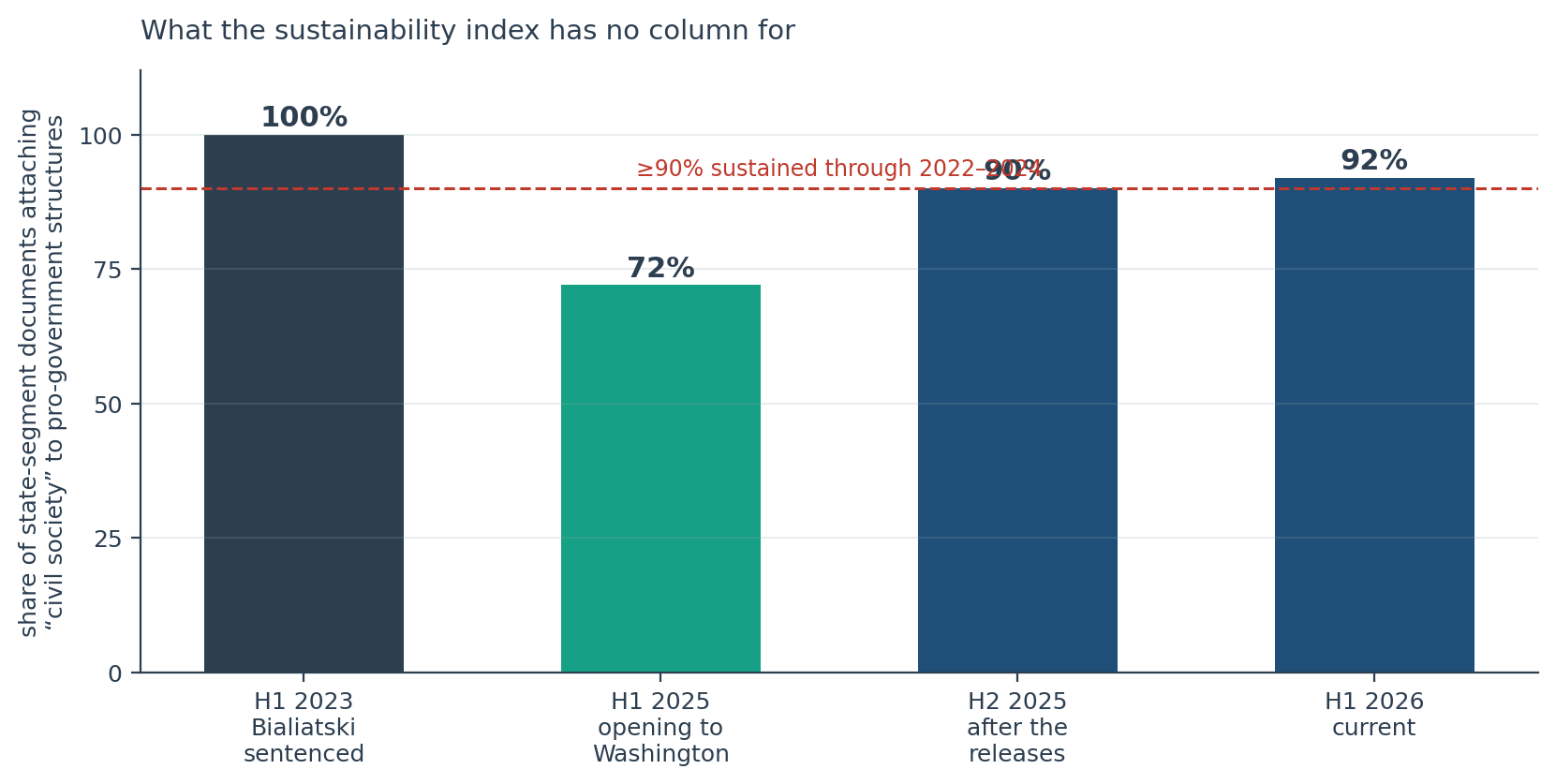
A corpus run on the term itself resolves the same period differently. Of more than 927,000 documents, 4,429 contain “civil society” or its Belarusian variants. In the state and pro-government segment, the share of those documents attaching the term to loyal structures — BRSM, Belaya Rus, the All-Belarusian People’s Assembly, the state unions — has held above 90 per cent since 2022. It reached 100 in the half-year Bialiatski was sentenced. It fell to 72 in the first half of 2025, through the opening to Washington. After the September and December releases it came back to 90, then 92.
Three hundred and forty-two people came out of prison in 2025, one hundred and eighty-nine of them expelled from the country in the process, and the state’s occupancy of the word went back up. CSOSI cannot register that, because it scores organisations, and this is a property of the term those organisations have to operate under.
Substitution has no parameter
The most strategically loaded sentence in the report sits in the infrastructure chapter and carries no number: some civil society representatives inside Belarus are now taking their professional training from Russian organisations, because joining Belarusian programmes online reads as risky and offline training abroad is reachable by few. Around it, a UNDP project on localising the Sustainable Development Goals in Belarus, funded by the Russian government, financed 21 social initiatives in 2025; Russkiy Mir and the Russian Houses network pay for social, educational and cultural work.
The report files this as context. It is a transfer of function, and it is countable. Belaya Rus took rent concessions on 118 state properties. State social procurement in HIV and tuberculosis prevention closed 26 service and project contracts worth roughly 199,000 euros, with nine organisations executing them. Those figures were obtainable. What appears nowhere in the index is a GONGO share — of state funding, of the service space, of people trained — so the report can describe replacement and cannot score it.
Confidence
Watch
Adoption during 2026 of the law on foreign gratuitous aid, already in the legislative drafting plan, with the current pre-registration and permitted-purpose regime intact. That fixes the legal environment at 7.0 for a sixth consecutive year and makes the floor permanent rather than incidental.
Lawtrend’s 2026 liquidation count. Thirty-nine forced liquidations in 2025 against hundreds a year from 2021 to 2024, alongside 66 recorded self-dissolutions. A second year under forty establishes targeted use as the steady state.
New registrations. Around 38 in 2025 and around 255 since 2021. A 2026 figure below twenty would indicate the administrative filter tightening beyond what registration statistics currently show.
Whether the next edition publishes panel size, selection or any dispersion measure. Its absence twice running is a methodological choice rather than an oversight.
Whether state-segment occupancy of “civil society” stays above 90 per cent through the second half of 2026. A dip with no diplomatic opening beside it would break the reading that the term is being managed tactically.
Method and limits
Scores, survey figures and case detail come from the 2025 Civil Society Organisation Sustainability Index for Belarus, published by CSO Fusion with support from the Konrad Adenauer Foundation’s Belarus representation, continuing an assessment run annually since 2000 and executed nationally since USAID’s role ended in 2023. Figures the report attributes to third parties — Lawtrend, the February 2025 BYNGO survey, RADA and the Centre for New Ideas — are reproduced as given and were not independently verified.
The half-year occupancy figures come from the FORESIGHT corpus under classifier v3.4, which treats a set of terms (Viasna, Bialiatski, BAJ, “extremist”, “liquidated”, “political prisoner”) as regime-frame in state outlets and independent-frame in independent ones, because the same word carries opposite meaning by segment. An earlier version produced lower absolute values across the series with the same shape, so levels here should not be read against previously published numbers. Four half-year points are plotted because those are the points the current version has been run for.
This brief assesses a report and a corpus. It does not establish the state of Belarusian civil society, and where the report’s in-country claims are anonymised, neither the report nor this brief offers a way to check them.