
Latvia voted on 3 October, and on the night of 5–6 October armed, masked men escorted about 20 migrants from Belarus to its border. For a week Belarusian state news sites ran eight items on the election in our collection and one on the incident. On 7 October ten Telegram channels, state and pro-regime, posted the same text calling the incident a fake staged by Riga to get EU money. On 13 October Lukashenko made the same case in person, and BelTA put it in a headline. A group called “Black Rus” had by then claimed the night as a “test”, and none of these voices mentioned the claim. What we cannot see is who the men in masks were.
The vote, told as decline
State outlets covered the election as a sign of decay. BelTA and SB led with the Latvian president’s worry about a record low turnout. On STV the political scientist Andrei Lazutkin spoke of “manipulation of turnout and infringement of rights”. On election day state channels added a second theme: the Saeima’s ban on Russian-language broadcasts by public media from 2027, as NEWS.BY put it.
Pro-regime channels were blunter. Yellow Leaks called it a “non-election”, and Nikitin’s channel ran a headline that the winner had “turned to Russia”. Around the vote STV ran a steady line of Latvian troubles, from a record diesel price to hospital shortages and fewer cows.
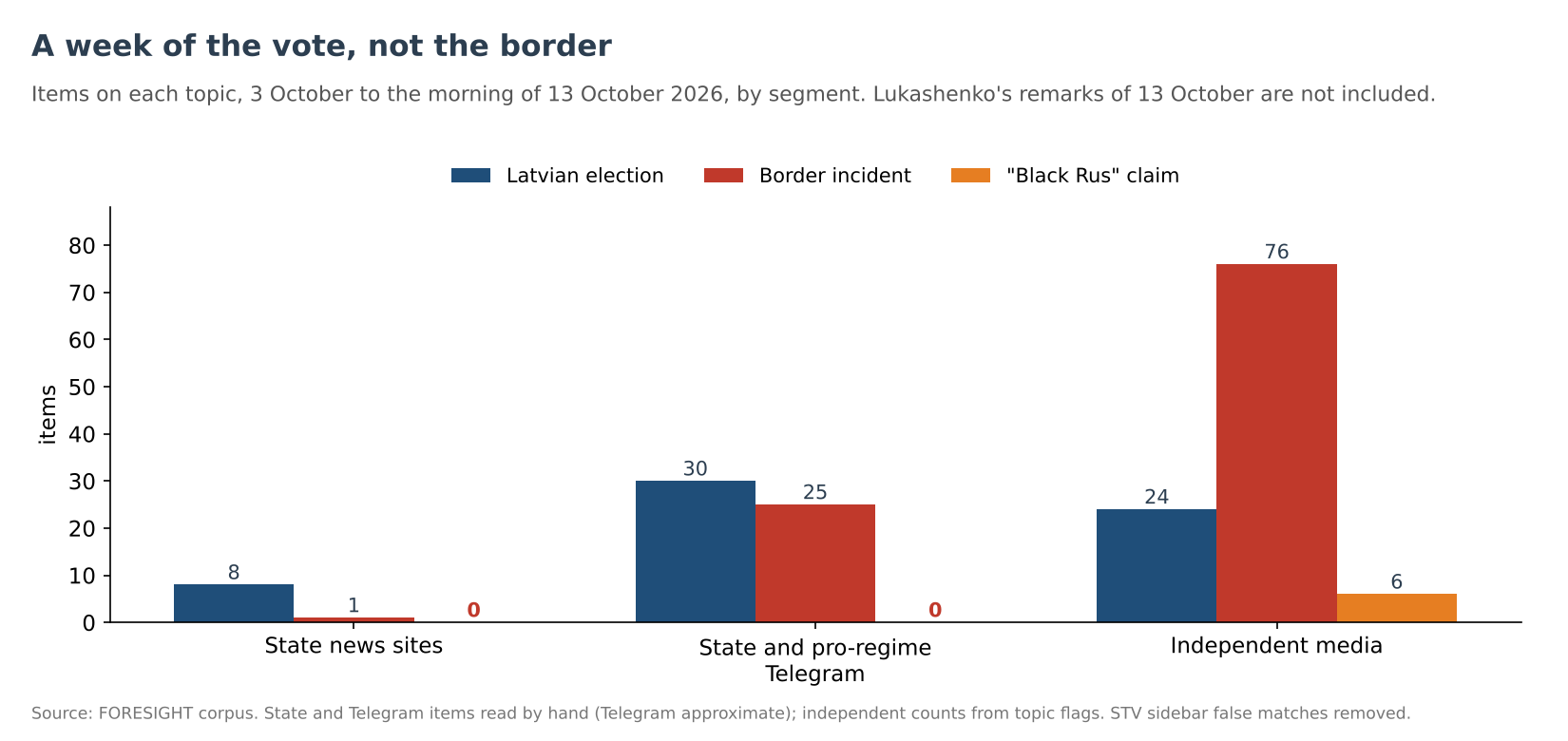
For a week Belarusian state news sites ran eight items on the election in our collection and one on the incident.
The night at the border
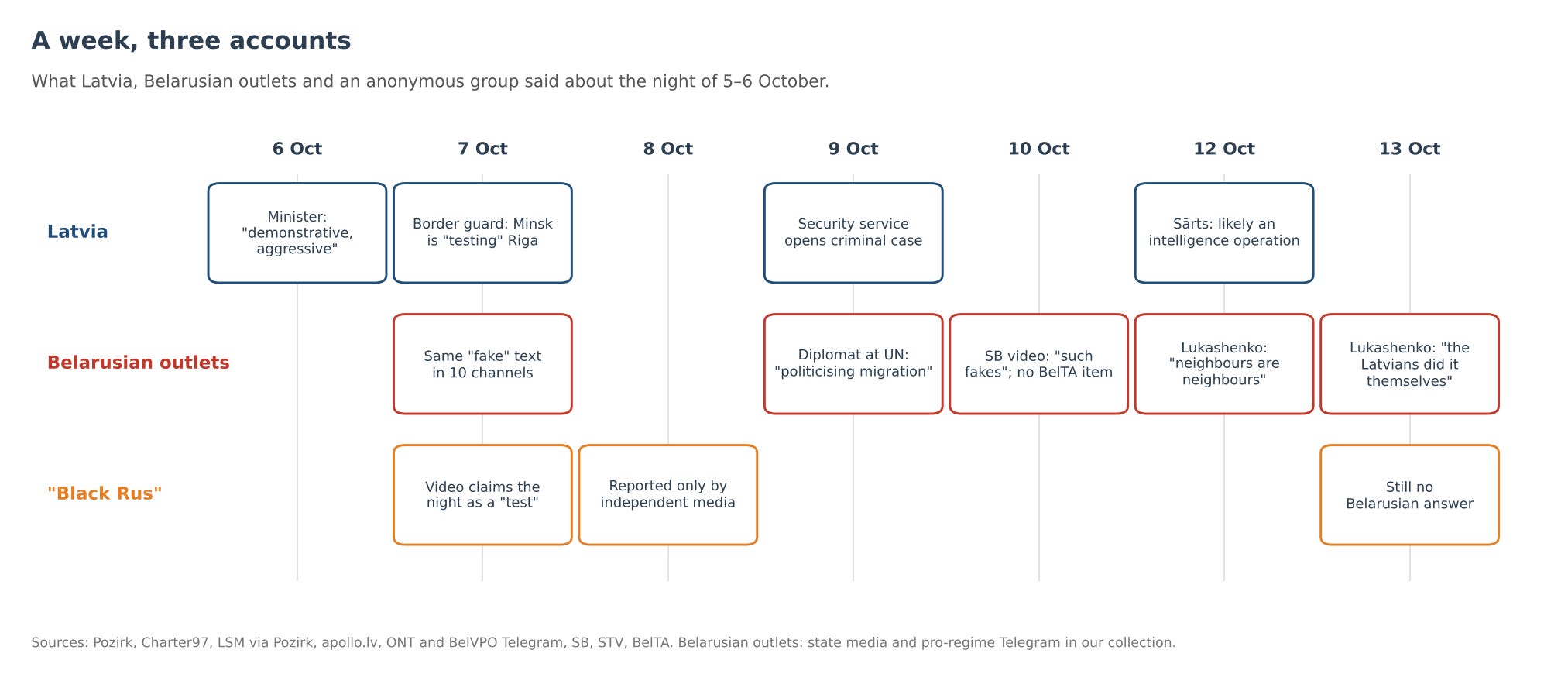
Latvia’s interior minister, Jānis Dombrava, called the incident “particularly demonstrative and aggressive”. Masked men drove the migrants toward the border and threatened soldiers. Hours later they crossed into Latvia, damaged a switch box and stole surveillance cameras. The deputy head of the border guard said his officers may not fire toward Belarus, and that Minsk was testing Riga’s reaction. Latvia has recorded attempts to cross from Belarus for more than 200 days in a row.
For a week Belarusian state sites reported the events around the incident and not the incident itself. BelTA wrote three items around it. Estonia had tightened controls on its border with Latvia. Latvian farmers were losing investment to the militarised border with Russia. A Latvian surveillance drone flew along the frontier. The only state-site item on the incident was a video discussion on SB, four days later, about “such fakes”. Its first speaker was SB’s columnist Lyudmila Gladkaya, whose own channel had posted the “fake” text on 7 October.
One text in ten channels
Telegram answered on 7 October with a single text. “Latvian state services’ plant about an ‘attack on the Belarusian-Latvian border’ is a provocation by Riga”, it began. It cited “a source close to the situation”. Latvia, it said, was playing the victim to get more EU money, and the head of its border guard had run a “secret operation”. ONT’s channel, the channel of SB columnist Lyudmila Gladkaya, Nikitin, the LDPB leader Haidukevich and six pro-regime channels, among them BelVPO, posted it word for word on 7 and 8 October.
On 7 October ten Telegram channels, state and pro-regime, posted the same text calling the incident a fake staged by Riga.
NEWS.BY used its own words, “yet another fake from our western neighbours”. Other channels chose mockery, with a text about a “Tarantino scene” of armed men and stolen cameras. At the UN on 9 October a Belarusian diplomat accused EU neighbours of politicising migration.
A claim nobody answered
On 7 October, the day after the incident, a little-known group called “Black Rus” claimed it in a short video, Charter97 reported. A masked man called it a “test of the Latvians, which they failed” and promised more sabotage against Belarus’s neighbours, according to Pozirk’s account of a report by Latvian public media. Jānis Sārts, who heads NATO’s strategic communications centre in Riga, said the group probably does not exist and that the video is an information operation by intelligence services. Latvia’s security service opened a criminal case on 9 October.
In our collection the claim appears only in independent media, in six items. Belarusian state outlets, the 60 pro-regime channels we follow and Russian state agencies did not mention it. TASS had reported the Latvian account of the incident itself.
On 13 October Lukashenko made the same case in person, and BelTA put it in a headline.
From a source to the leader
On 12 October Lukashenko struck a different note: “neighbours are neighbours, we must cooperate with them”, STV reported.
A day later Gladkaya’s channel went back to Latvia with another story of danger. In March a Latvian woman was shot in the back while walking to the sea near a military base in Riga. The military police had closed the case. The post warned Latvians that “the defenders can shoot you anywhere”. The facts came from Latvian public television, which had reported the closure on 11 October. The post left out how that report ended: her lawyer has appealed, and a prosecutor has a month to decide whether to reopen the case.
The same day, shortly after noon, Lukashenko spoke about the border himself. He was at a meeting on an inspection of an Interior Ministry special brigade. The Latvians had staged the incident themselves, he said, as a reason “to get money from the European Union”. He added: “We have nothing to do with it.” Such things, he said, “were not agreed with me”. BelTA headlined it “The Latvians did it themselves”. It was the first BelTA item on the incident that we have seen, a week after the night at the border.
His argument was the one the Telegram text had made on 7 October, when it cited only “a source close to the situation”. He did not mention the “Black Rus” claim either.
How sure we are
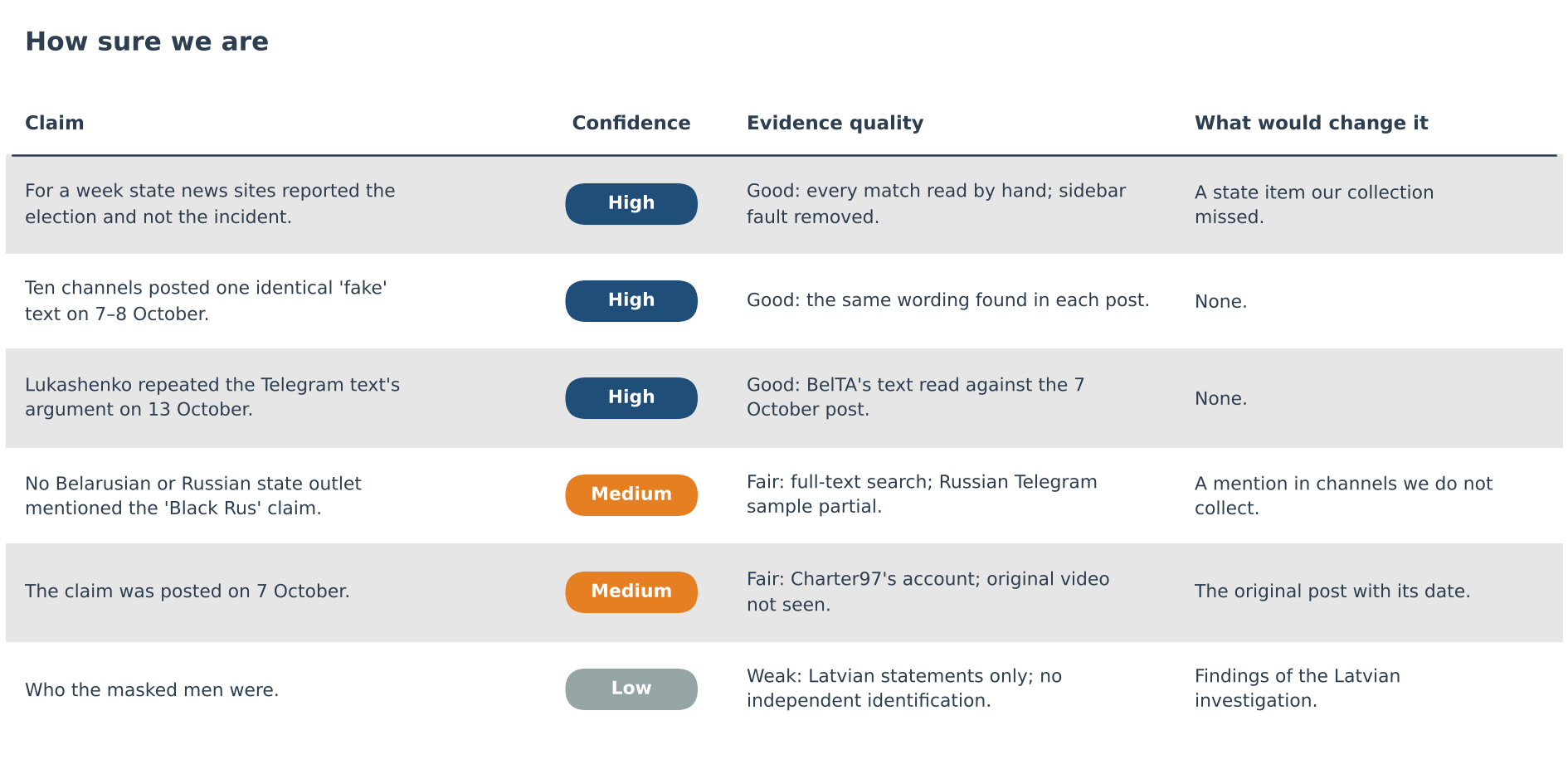
The counts of what each segment published are High after we removed a sidebar fault on one state site. The weakest row is the one about the men themselves, since no independent source has identified them.
For a week Belarusian state sites reported the events around the incident and not the incident itself.
How it fits
How it fits. For a week the incident was denied on Telegram and left out of state news sites. Then Lukashenko made the denial himself, with the argument the anonymous text had used, and the claim that contradicted both was never answered. This fits T3: Minsk treats a neighbour’s crisis as material for a story of decline, and silence fills the space where a denial would need evidence. A simpler reading is that state editors wait for the leader before they touch a sensitive foreign story. That explains the week of silence on news sites, but not why nobody answered the “Black Rus” video. If a state outlet takes up the claim or the Latvian investigation’s findings, the simpler reading gains weight.
What to watch
By 31 December 2026, Lukashenko or a Belarusian state outlet mentions the “Black Rus” claim. We expect no mention, with Medium confidence.
By 30 November 2026, Latvia reports another crossing attempt with armed escorts from Belarus. We expect one, with Low confidence.
By 31 December 2026, Latvia’s security service publicly links the group to a state service. We expect no public attribution by then, with Medium confidence.
Method and limits
We searched our corpus from 19 September to 13 October 2026 for Latvia and classified each match by topic in a window around the word. We then read the items about the election and the border by hand. On 5 and 6 October a sidebar on STV’s site repeated one list of headlines on more than a hundred pages. We removed those false matches. “Black Rus” was searched in Russian, Belarusian and Latvian spellings from 1 October. We do not collect the group’s own channel, and our Russian Telegram sample is partial. Television broadcasts are covered only where they are written up. Lukashenko’s remarks of 13 October came after our search and were read on BelTA’s site. Thesis tag: T3.