

On 30 September 2026 Lukashenko signed the targets for 2027: GDP growth of 1.9%, inflation of no more than 6% and reserves of at least $12.8 billion. The growth target equals the pace the economy actually reached in January to August 2026, and the reserve floor sits about $1.8 billion below what the central bank held on 1 October. Since the 2025 target was missed by almost three points, the growth target has been cut twice. What we cannot tell yet is whether this is a new habit of realistic targets or a lower bar that will be easier to clear.
From 4.1 to 1.9
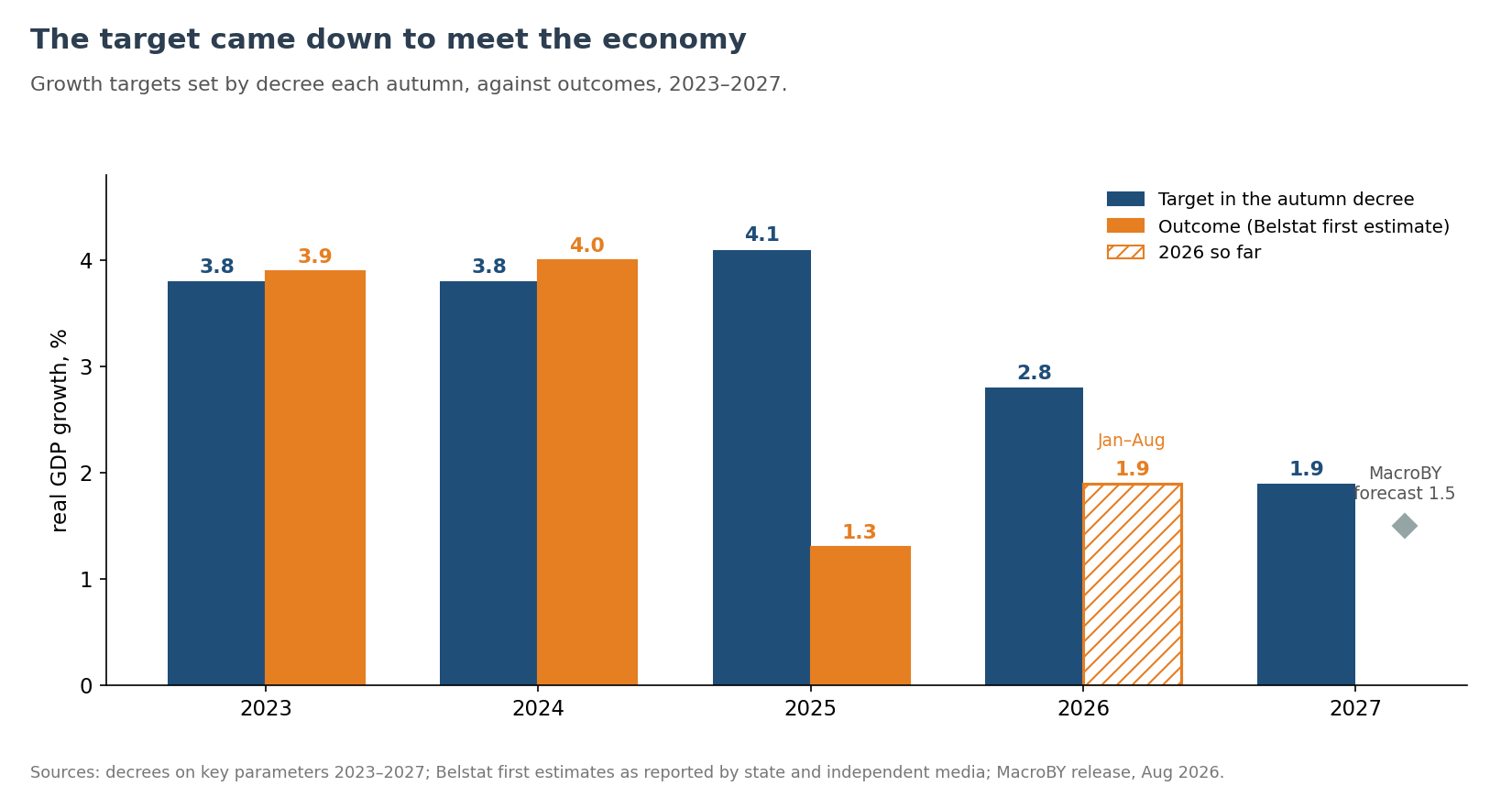
The yearly targets come in a decree signed each autumn. For 2023 and 2024 the decrees set growth at 3.8% (2023, 2024), and the economy beat both. The first official estimates were 3.9% for 2023 and 4.0% for 2024. Belstat later raised 2024. The 2025 edition of its handbook Belarus in Figures put that year’s GDP at 246.6 billion rubles, and the 2026 edition at 255.1 billion. Most of the change came through prices: the deflator moved from 8.8% to 12.2%, and real growth from 4.0% to 4.3%. The decree for 2025 raised the target to 4.1%, and the economy grew by 1.3%.
The targets then came down. The decree for 2026 set 2.8%, and by August the economy had grown 1.9%. The new decree sets 1.9% for 2027, which is the current year’s pace carried forward.
The growth target equals the pace the economy actually reached in January to August 2026.
The other targets fell with it. Compared with the 2026 decree, export growth drops from 3.7% to 2.9% and growth in real disposable incomes from 4.8% to 3%, while investment stays at 3.1% (UDF). The inflation ceiling moves from 7% to 6%. For 2025 it had been 5%, so the ceiling has now moved in both directions in two years.
State and independent outlets read the same decree in opposite ways. The state broadcaster’s site wrote that the authorities certainly do not intend to slow down in 2027, in a report on the lowest target of the last five decrees. UDF’s headline said the economy will slow down, and Zerkalo called the forecast unexpectedly modest.
A floor below the floor
The reserve target is a floor, not a forecast, and it has stayed below the actual level for three years in a row. For the end of 2024 the floor was $6 billion, while the central bank already held $8.86 billion on 1 October 2024. For the end of 2025 it was $7.1 billion, and reserves passed $14.4 billion on 1 January 2026. For the end of 2026 it is $9.2 billion, against $14.63 billion held on 1 October 2026.
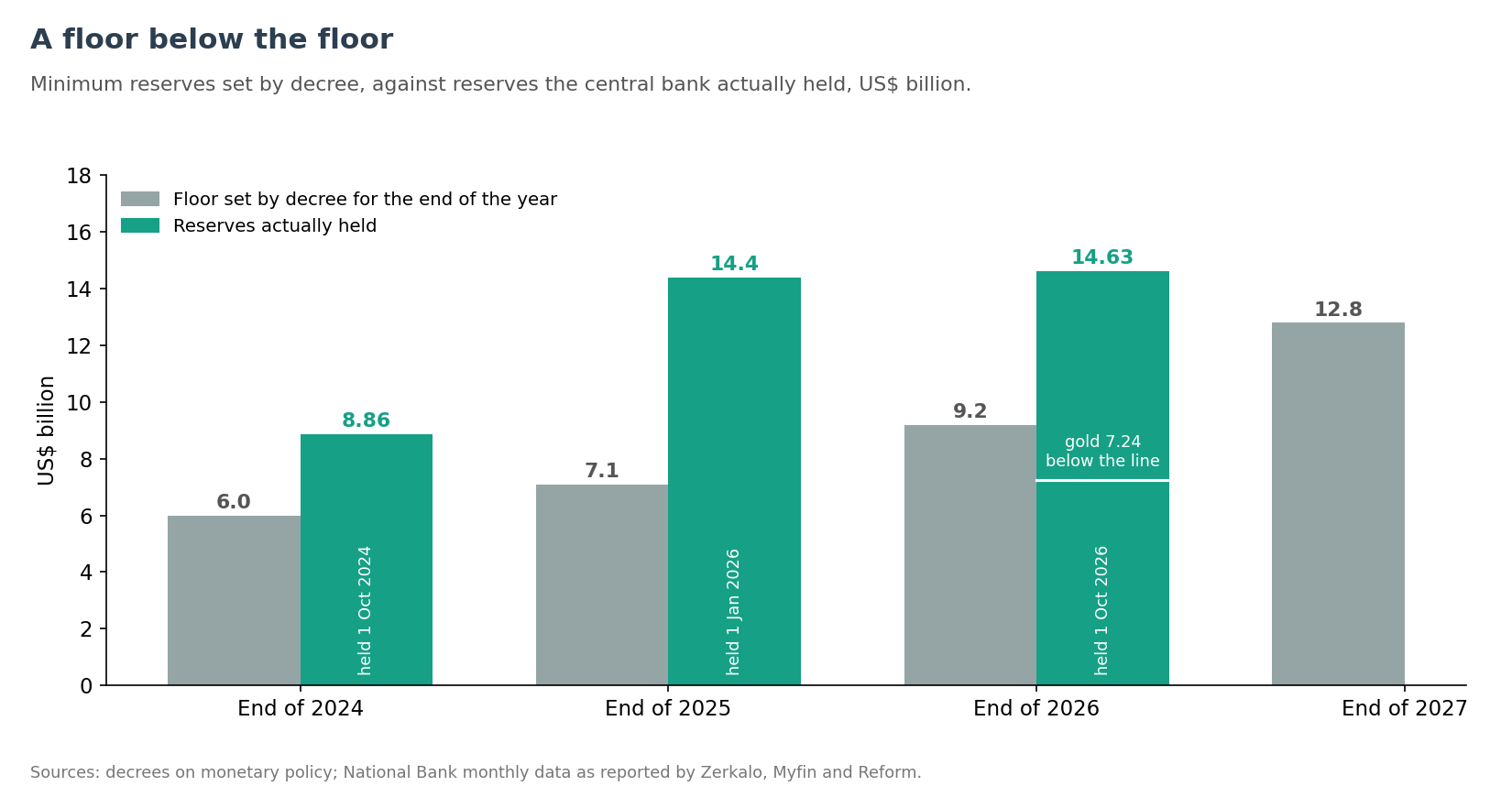
The 2027 floor of $12.8 billion is much closer to the actual level, but it is still below it. The head of the central bank, Roman Golovchenko, said the floor is calculated from the government’s external debt repayments. He added that he expects the real level to be higher. The state broadcaster’s news site described the same number as “unprecedented growth” in reserves. That holds only against the old floor, not against the reserves themselves.
The reserve target is a floor, not a forecast, and it has stayed below the actual level for three years in a row.
What moves the actual level from month to month is mostly gold. In September reserves fell by $609 million: gold lost $675 million in value, while assets in foreign currency grew by $74 million. The central bank put the fall down to the gold price. A similar drop in gold cut reserves by $1.1 billion in March. Gold now makes up $7.24 billion of the $14.63 billion, about half. Over the whole year the balance is different: since January reserves are up by only $210 million, with gold down $231 million and currency assets up $451 million. So the level follows a world price, while the floor follows a repayment schedule. A gap of $1.8 billion is the room between the two.
Two readings
The first reading is realism. An independent economist told Zerkalo that the 2023–2024 growth was a recovery that used up the spare capacity. With about 65% of goods exports going to a Russian market expected to grow by 0–1% a year, he said, faster growth is hard to find. The independent MacroBY project expects only 1.5% for 2027, so the official target is not below the independent forecasts.
So the level follows a world price, while the floor follows a repayment schedule.
The second reading is a lower bar. The decrees also feed the key indicators used to judge the work of state organisations, as the 2025 decree set out. A target at the current pace is easier to report as met. The two readings fit the same numbers. They will part only when the 2027 outcome is known: a result well above 1.9% would favour the lower bar, and a result near MacroBY’s 1.5% would favour realism.
How sure we are
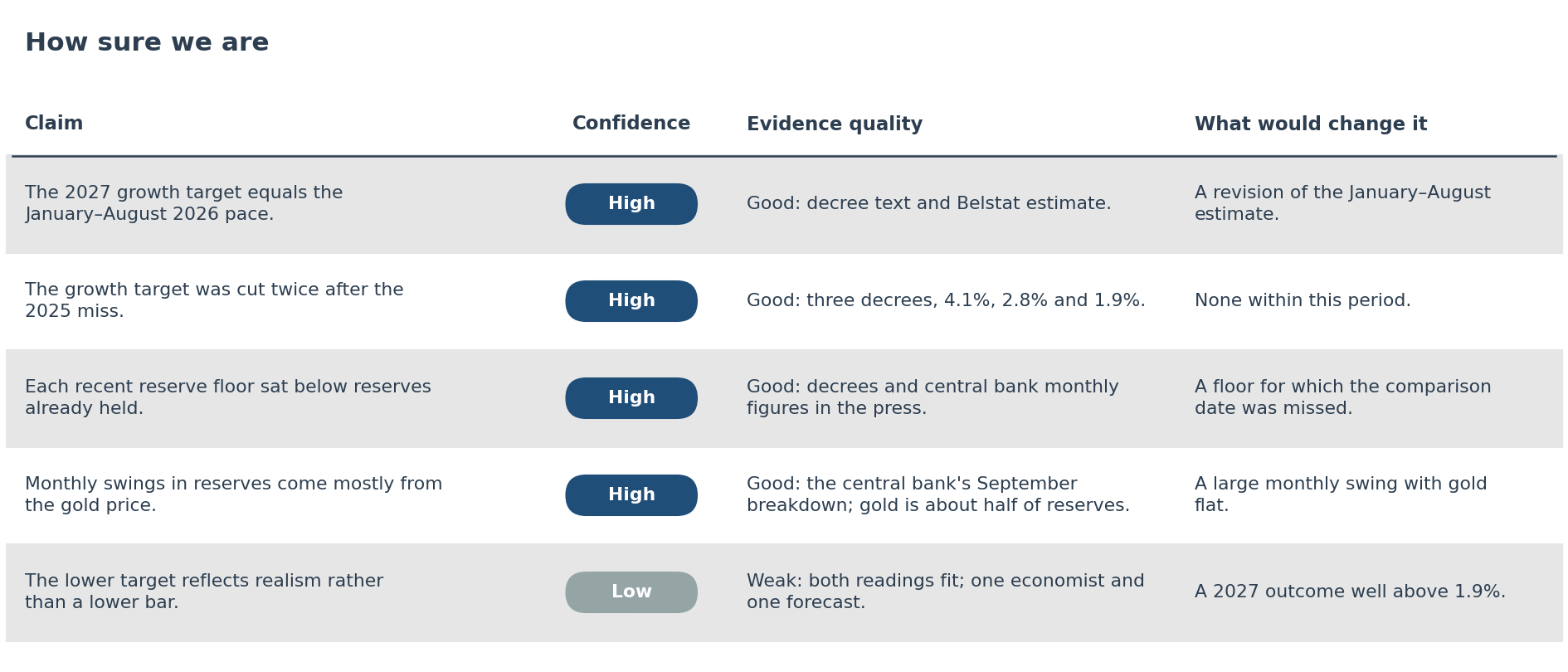
The targets and the reserve levels come from decrees and from central bank figures reported in the press. The weakest row is the one about why the targets fell, since both readings fit the numbers we have.
The two readings fit the same numbers.
What to watch
By 23 October 2026, Belstat’s estimate for January to September stays below 2.1%. We expect this, with Medium confidence.
By 31 January 2027, full-year growth for 2026 comes in below the 2.8% target, the second miss in a row. We expect this, with High confidence: the economy would need more than 4% growth in the last four months to reach it.
By 15 January 2027, reserves on 1 January 2027 stand above the new $12.8 billion floor. We expect this, with High confidence: the gap would close only if gold lost about a quarter of its value.
Method and limits
Targets come from the yearly decrees on key parameters of development and on monetary policy. We used the texts published by state bodies and the reports of state and independent media. Growth outcomes are Belstat’s first estimates. The 2024 revision comes from two editions of Belstat’s handbook Belarus in Figures (2025 and 2026; the summary page and the GDP table), held in our archive of Belstat publications. Real growth for 2024 in each edition is computed from the handbook’s nominal GDP and deflator, so it carries rounding of about 0.1 point. The 2026 figure is the January to August estimate, not a full-year result. Reserve levels are the central bank’s monthly figures as reported by Myfin, Zerkalo and Reform. The reserve floor for each year is the minimum for the end of that year. The “realism” reading relies on one anonymous economist and on MacroBY’s August release. This brief carries no thesis tag.