
On 28 September Lukashenko moved the chief of the General Staff, Pavel Muraveiko, into the Presidential Administration and said he wanted “an alternative point of view” on the army. A week later a decree put the regional heads of the KGB and the State Control Committee into every regional executive committee. Two weeks after that, another decree gave the Security Council secretariat a veto over candidates for the Academy of Sciences. We traced eighteen decisions in the security bloc this year and read how state outlets announced each one. What we cannot see is whether the new seats and checks are used, since executive committees do not publish who speaks at their meetings.
Eighteen decisions
The list runs from January to October. The Special Operations Forces changed commander in January and again in October. The General Staff lost a deputy chief in May, a first deputy in August and its chief in September. The defence ministry gained a deputy minister in July and another in October. The KGB, the Investigative Committee, the Security Council secretariat and the regional police each had their turn. Two decrees added oversight rather than people: No. 351 on the executive committees on 5 October, and No. 367 on the Academy on 19 October.
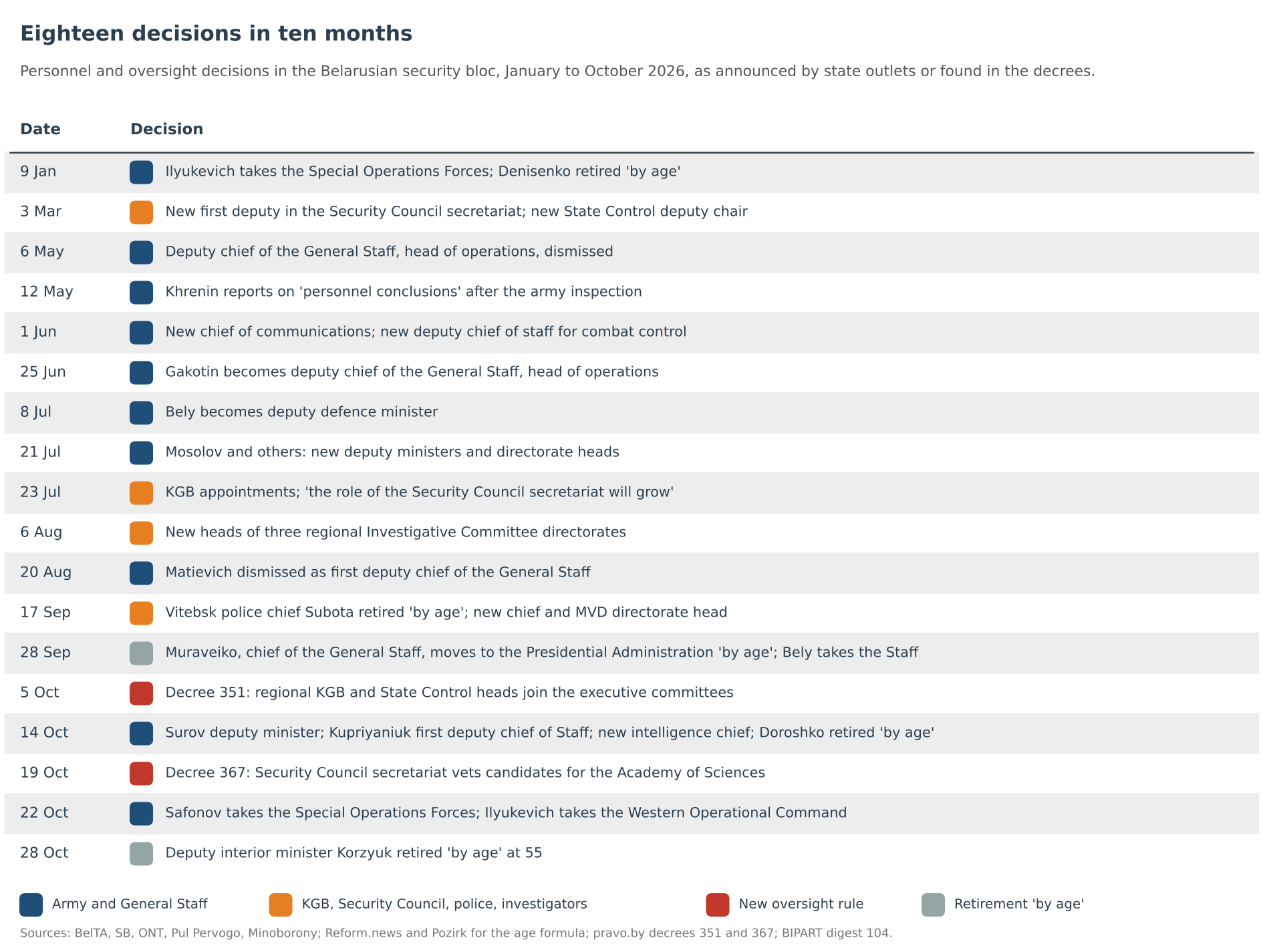
Five of the eighteen used the same formula. Vadim Denisenko left the Special Operations Forces “by age” in January (Charter97, 22 October). Muraveiko left the army “by age” in September, at 55, the limit for a major-general (Reform, via BIPART). The Vitebsk police chief Maxim Subota retired “by age” in September (Nasha Niva, via BIPART). Sergei Doroshko was dismissed from the police “by age” on 14 October (BelTA, 14 October), and the deputy interior minister Dmitry Korzyuk on 28 October, a week before his 55th birthday (BelTA, 28 October; Gazeta.by, 28 October). The formula is old: Muraveiko’s own predecessor, Viktor Gulevich, left “by age” at 54 in May 2024 (Charter97, 30 September). In Belarus a general’s retirement has one official reason, and it is a birthday.
The men at the top of the four pillars did not move. Viktor Khrenin remains defence minister, Alexander Volfovich state secretary of the Security Council, Ivan Tertel chairman of the KGB and Ivan Kubrakov interior minister. The eighteen decisions changed the layer below them, and the rules around them.
The alternative point of view
In Belarus a general’s retirement has one official reason, and it is a birthday.
Muraveiko’s transfer was the one decision that Lukashenko explained in person, and at length. He said nobody had recommended the candidate: “Be free of everyone”, including the Security Council secretariat and the defence ministry. He needed “several, if you like, alternative points of view on the situation in our security units”, and “a competing point of view must exist at the highest level” (BelTA, 28 September, via BIPART). To the new chief of the General Staff he said that the Staff would now be “under the serious gaze, and somewhere perhaps the press, of the president”. That gaze would come “no longer only through the Security Council secretariat but also through the Presidential Administration”. He added: “I must know everything that happens in the Armed Forces.” The Administration had never had a deputy for military matters before.
Lukashenko also answered the reading he expected. People would say that he had “given in to the siloviki”, he said; “if it suits someone to talk and reason that way, please”. But the strengthening of the security sector “is natural, because we see what is happening around our country.” The new deputy head’s announced duties are civilian: coordinating the presidential aides in the regions and handling citizens’ appeals (BelTA, 6 October, via BIPART). The general who commanded the Staff now reads complaints and watches the army from the other side of the square.
His successor, Vladimir Bely, is 49, a major-general who had been deputy minister only since July, and before that commanded the Western Operational Command and ran combat training (Nasha Niva, via BIPART). BIPART’s digest for September and October notes that Muraveiko is the only one of four deputy heads with a security background and that the Security Council already oversees the army and the KGB (BIPART digest 104). Reform.news read the move as Volfovich gaining ground and as preparation for quiet retirements of the “old guard” (Reform, 28 September). In July, announcing KGB appointments, Lukashenko had said the role of the Security Council secretariat would grow (SB, 23 July). The September speech said the same thing with the Administration added.
A seat at the regional table
The general who commanded the Staff now reads complaints and watches the army from the other side of the square.
Decree No. 351 was published on the legal portal on 7 October. From now on the head of the regional KGB directorate and the chairman of the regional State Control Committee sit in each regional executive committee. Their Minsk counterparts sit in the city executive committee. The mayors of the regional capitals lost their seats in the regional committees at the same time (Nasha Niva, 7 October; NEG, 9 October). Before the decree, the regional police chief was already a member, and others could join with Lukashenko’s approval.
Eight independent items reported the decree on the day it appeared: Zerkalo, Reform, Nasha Niva, Mediazona, Euroradio, Charter97, UDF and Belnews (Reform, 7 October; Euroradio, 7 October). We searched every item since 1 October that mentions the KGB or the State Control Committee within 120 characters of an executive committee. The state items that match are about melioration audits, empty village houses and telephone fraudsters who pose as KGB officers. None is about the decree. State outlets announced the sixteen personnel decisions, often on the day; the one decision that changes who sits in regional government they did not announce.
We found the same pattern in The Fine Print (27 October), where Decree No. 367 on the Academy was announced by state outlets with its age limits and without its security vetting. In The Floor Below (15 October) we showed how much of the regions’ business with Russia runs through the executive committees. From this autumn two more people hear it.
The year without a low season
State outlets announced the sixteen personnel decisions, often on the day; the one decision that changes who sits in regional government they did not announce.
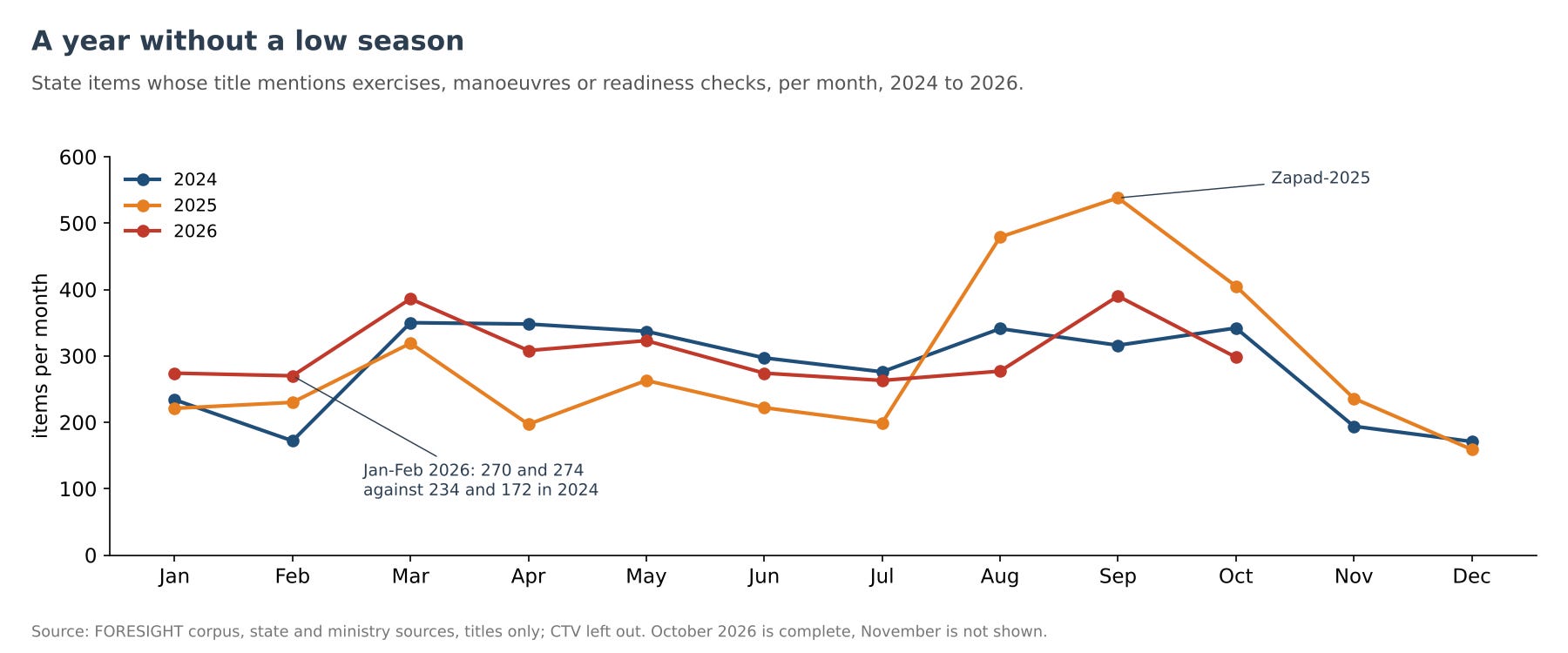
The decisions came against a background that BIPART calls “virtually continuous” exercises and inspections. About twenty command-and-staff exercises, territorial defence drills and readiness checks had been documented by the start of September (Pozirk, via BIPART). Our own count is of state items whose title names an exercise, manoeuvres or a readiness check. It does not show more exercises in 2026 than before. It shows that the low season has gone. In 2024 state outlets published 234 such items in January and 172 in February, then 300 to 350 a month until October, then 194 and 171 in November and December. In 2026 January and February stand at 270 and 274, and no month since has fallen below 260.
Khrenin’s report to Lukashenko on 12 May put the two threads together: “personnel conclusions” after an inspection of the armed forces (SB, 12 May). On 13 October Lukashenko told the military there was “no emergency” behind the frequent readiness checks (Zerkalo, 14 October). The next day he signed five appointments.
It does not show more exercises in 2026 than before. It shows that the low season has gone.
How sure we are
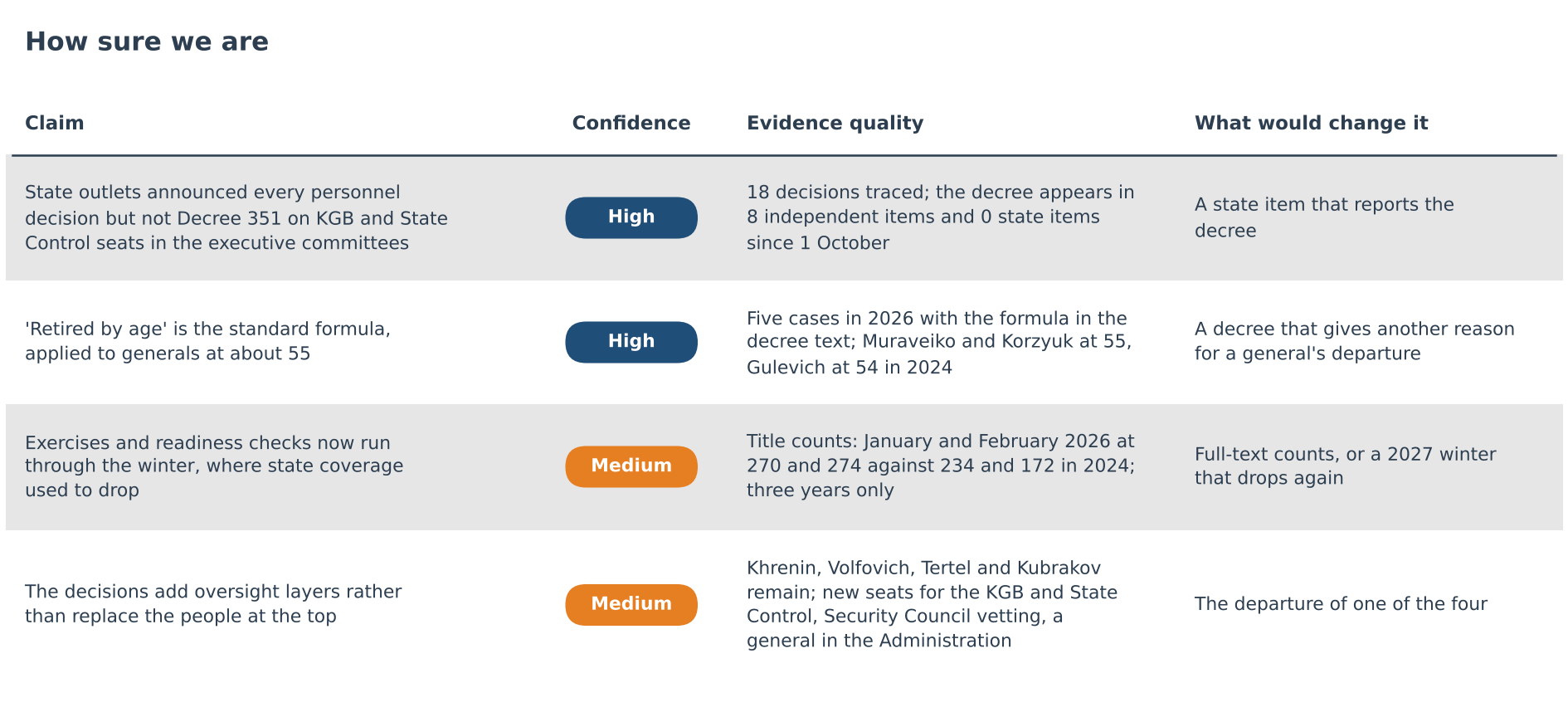
· State outlets announced every personnel decision but not Decree 351 on KGB and State Control seats in the executive committees. High. Eighteen decisions traced; the decree appears in eight independent items and no state item since 1 October. A state item that reports the decree would change it.
· “Retired by age” is the standard formula, applied to generals at about 55. High. Five cases this year with the formula in the decree text; Muraveiko and Korzyuk at 55; Gulevich at 54 in 2024. A decree that gives another reason for a general’s departure would change it.
· Coverage of exercises and readiness checks now runs through the winter, where it used to drop. Low. Title counts for three years; January and February 2026 at 270 and 274 against 234 and 172 in 2024, but 2025 sits between. Full-text counts, or a 2027 winter that drops again, would change it.
· The decisions add oversight layers rather than replace the people at the top. Medium. Khrenin, Volfovich, Tertel and Kubrakov remain; new seats for the KGB and State Control, Security Council vetting, a general in the Administration. The departure of one of the four would change it.
How it fits
This fits T4, silence where a decision has a political part. The eighteen decisions were public. The one that changes the composition of regional government was left to the legal portal and the independent press, as the Academy’s vetting rule was a week later. A simpler reading is that state outlets report people, not regulations: a new deputy minister is news with a face, an amendment to a staffing regulation is not. The Academy decree weakens that reading, because state outlets did report it, and left out one paragraph.
The oversight pattern is an observation, not a thesis test. A general in the Administration, the KGB at the regional table, the Security Council in the Academy and inspections without a season each add a watcher without removing anyone. We will return to it when one of the four pillars moves.
What to watch
· By 31 December. The Security Council’s check of the “people’s militia” that Volfovich promised for the end of the year. Expectation: announced as completed, with a personnel decision attached. Confidence: medium.
· By 31 January 2027. The first published session of a regional executive committee with the KGB head listed among members. Expectation: the name appears in a regional outlet’s list of participants, with no reference to the decree. Confidence: medium.
· By 31 March 2027. Another retirement “by age” at 55 in the army or police at deputy-minister level or above. Expectation: at least one. Confidence: high.
Method and limits
We assembled the eighteen decisions from state announcements in the FORESIGHT corpus since 1 January 2026 whose title names an appointment or dismissal in the defence ministry, General Staff, KGB, Security Council, Interior Ministry, Investigative Committee or State Control Committee. We checked them against the BIPART digest for September and October and the decrees on pravo.by. We left out district-level and ambassadorial appointments. We quote the age formula from the decree texts as BelTA carried them, and Lukashenko’s words of 28 September from the state transcript of the meeting. The search for state coverage of Decree 351 took every item since 1 October whose text places the KGB or the State Control Committee within 120 characters of an executive committee. A state item that reported the decree without naming either body would escape it. The exercise series counts state and ministry items by title only, which undercounts items that name an exercise in the body. It runs for three years, so the seasonal claim rests on two winters. We left out the CTV website throughout. BIPART’s digest reached us by email and is cited from its PDF.
Thesis tag: T4, with the oversight pattern as an observation.