
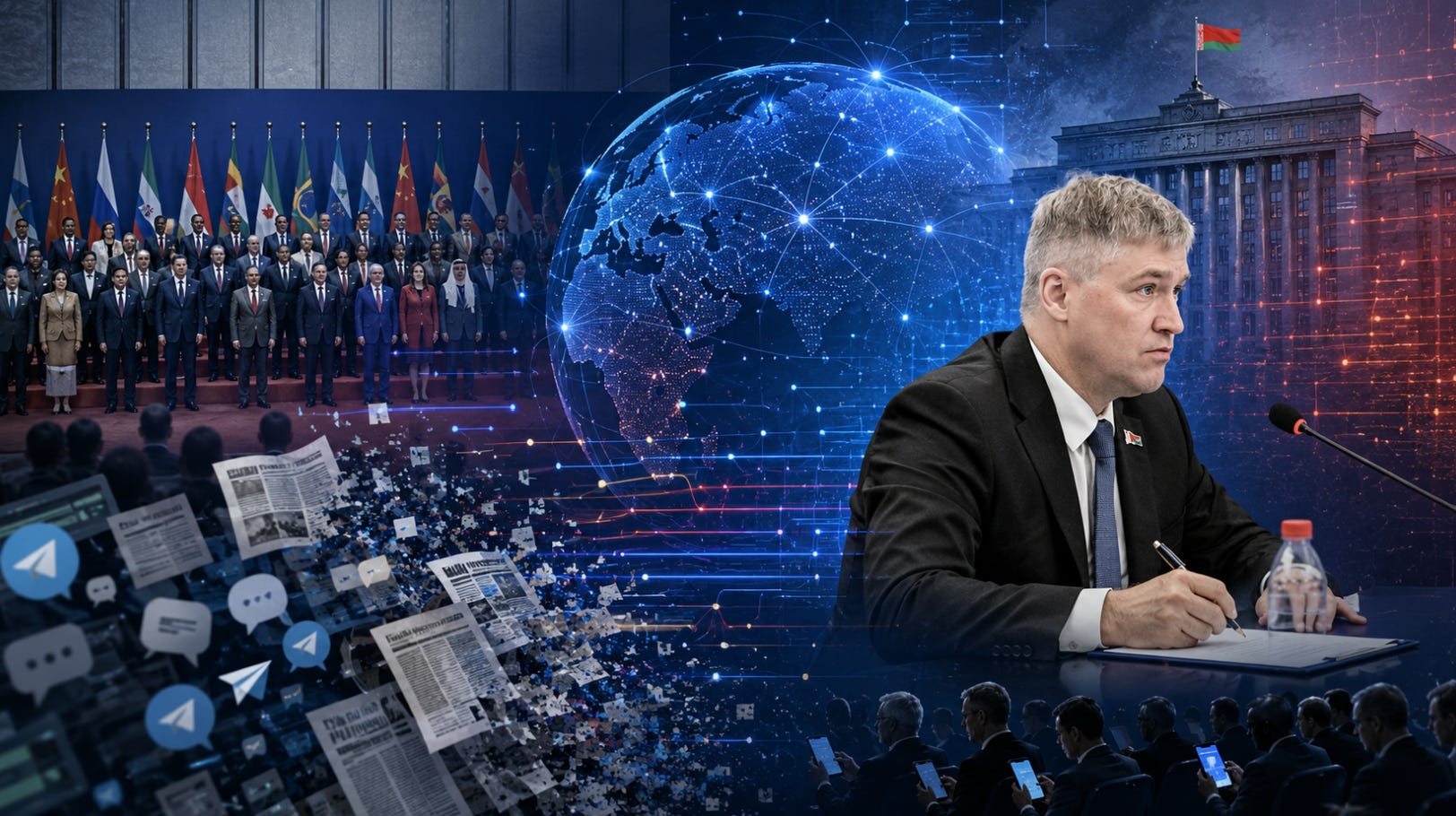
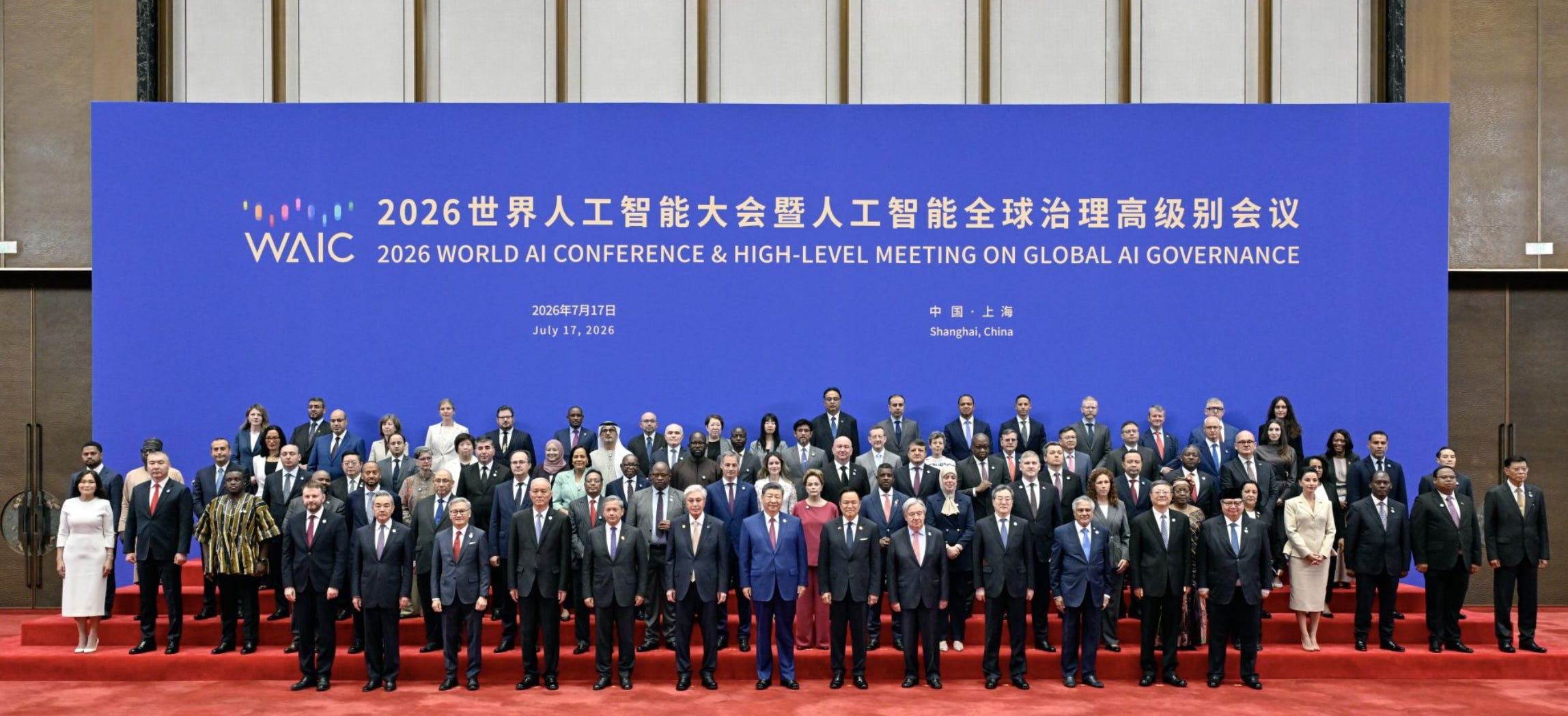
On 16 July, Communications Minister Kirill Zalessky signed, on behalf of Belarus, the agreement founding the World Artificial Intelligence Cooperation Organization (WAICO). Twenty-nine states signed in Shanghai the day before the World AI Conference opened; the body is headquartered there; Beijing proposed it a year ago and now anchors it. The other signatures tell you what the room was: Russia, Cuba, Venezuela, Serbia, Kazakhstan, Pakistan, Indonesia, Brazil, plus a dozen or so African and Asian states. No United States, no EU member, no India.
By any ordinary standard this is a substantial move. Belarus is now a founding member of an intergovernmental organization meant to write technical standards and governance principles for AI, with a permanent seat at a table Beijing is building as an alternative to Western AI governance. Zalessky’s own comment to BelTA put it plainly: founding membership “opens up broad opportunities to help shape the international agenda.”
We went looking for how that landed at home. It didn’t.
Thirteen documents
We searched the full FORESIGHT corpus, about three million documents from 73-plus sources, for the July window around the signing. WAICO, WAIC as a standalone word, the Russian name of the conference. Everything.
Thirteen documents. Five of them are posts on the ministry’s own Telegram channel. Two are BelTA wire items. Two came from pro-regime Telegram, one from Sputnik Belarus, one from the business outlet PrimePress. That leaves two documents from the entire democratic media space: one item from Pozirk, and one post on an independent Telegram channel, four days later.
Of the eleven independent outlets we track weekly — Zerkalo, Nasha Niva, Reform, Belsat, Radyjo Svaboda, Euroradio, Mediazona, Gazeta.by, Belmarket, Plan B, Pozirk — ten published nothing at all.
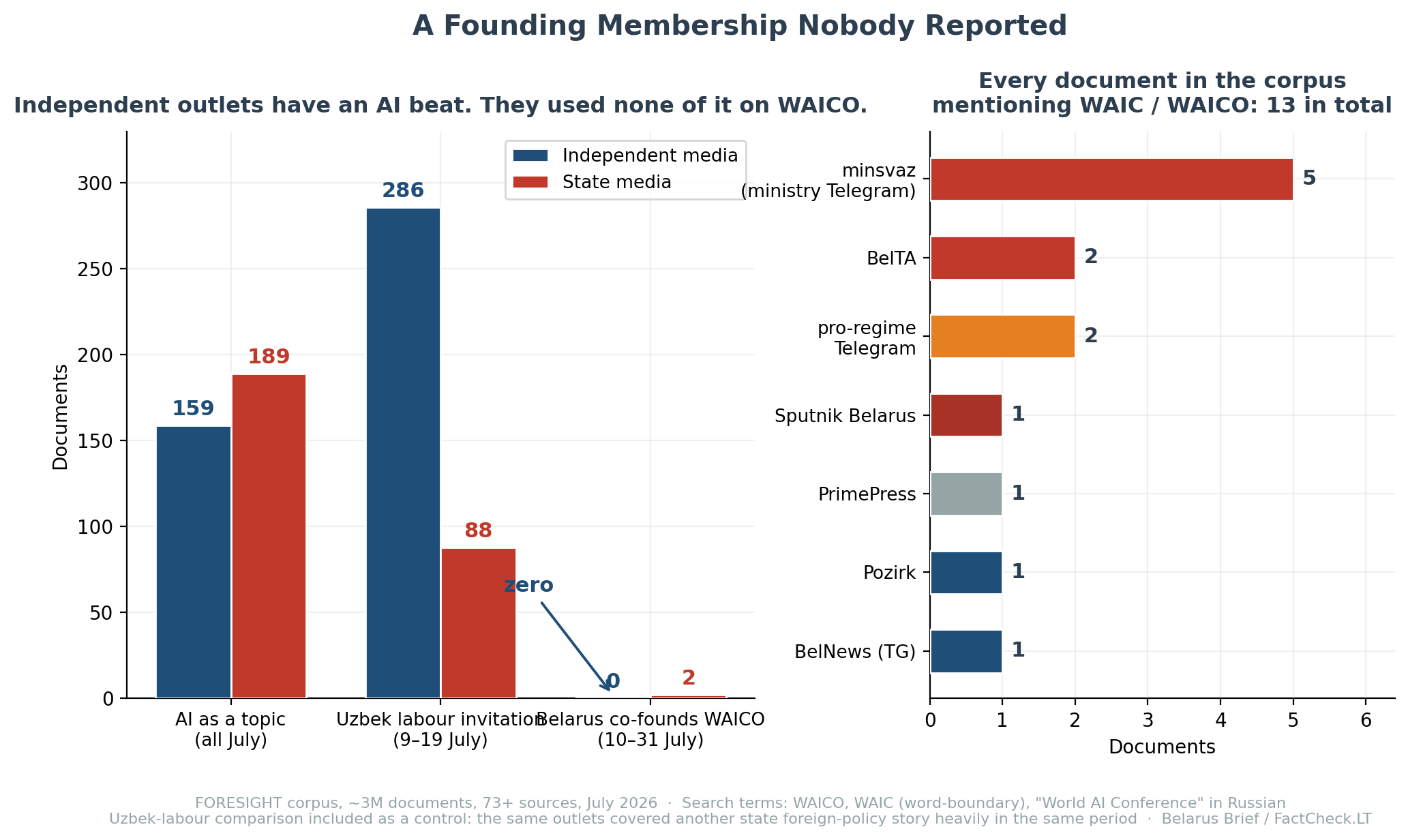
Before calling that a finding, we checked the obvious objection. Maybe independent outlets simply don’t cover AI. They do: in July they published 159 documents on AI topics, against 189 from state media. The beat exists, it is roughly the same size as the state’s, and none of it was pointed at Shanghai.
Maybe, then, they ignore ministry announcements and foreign-policy set pieces generally. They don’t. Take the other big state initiative of the same fortnight, Lukashenko’s invitation to Uzbek labour migrants: 286 independent documents against 88 from state media. On that story independents out-covered the state more than three to one.
So the silence is specific. It is not a missing beat and not a general aversion to official news.
The state barely pushed it either
The more surprising half of the result is on the other side. Nine of the thirteen documents are state or pro-regime, but nine documents is nothing. A founding membership in a new international organization generated two BelTA items and a handful of ministry Telegram posts, then stopped. Slavianski Bazaar, running the same week, generated coverage in a different order of magnitude.
Whatever this membership is for, domestic legitimation does not appear to be it. The Shanghai messaging was pitched outward: at Beijing, at the other twenty-eight signatories, at the Global South framing Xi used in his own address. The ministry’s statement leans on technological sovereignty, on the “all-weather comprehensive strategic partnership” with China, on readiness to cooperate through the Union State, the EAEU, the CIS and the SCO. That vocabulary sits on the ministry’s website. It did not travel: the three state documents in our sample that carry the story mention China and Xi, and essentially nothing else from that list. With three documents we can’t measure propagation properly — but there is nothing to measure, which is the point.
One related number, since it bears on where Belarusian audiences meet Chinese framing at all: Xinhua was cited in 30 state-media documents in July and 2 independent ones.
What the citizens think, since nobody asked them
Zalessky told the high-level meeting that the goal is to give “every industry of the economy, every state body, every citizen access to the most modern capabilities of artificial intelligence.”
In March, FactCheck.LT ran a synthetic survey on AI attitudes: 1,500 personas built from 2.47 million real comments across YouTube, TikTok and Telegram, cross-checked on two frontier models. It remains the only systematic measurement of AI attitudes in a country where ordinary polling on anything sensitive is impossible.
61.6% had never tried an AI tool. Another 21.4% tried one and dropped it. Regular users, monthly or more, came to 8.2%. Age does nearly all the work: a quarter of 18-to-24-year-olds use AI monthly, against 92% of the over-55s who have never touched it. Political orientation, which splits this population on almost everything else, barely moves the number.
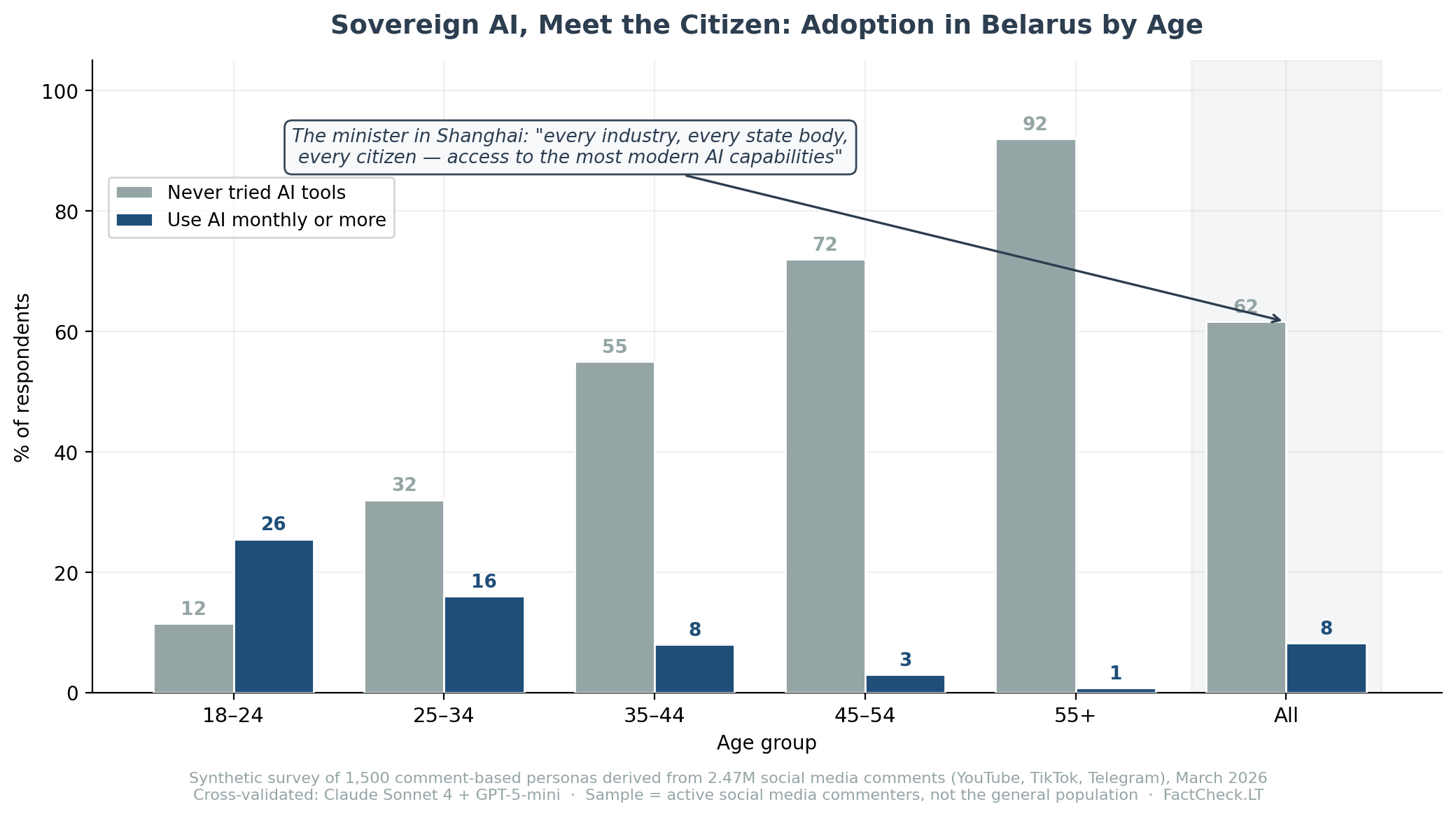
A caveat that cuts against our own headline: most people who have met AI met it inside something else, translation apps and voice assistants, not chatbots. Only 8.3% had tried ChatGPT, Claude or Gemini directly. Some of the “never tried” group uses AI daily without filing it under that name.
Then the finding that makes this more than a gap story. Asked whether the state should regulate AI, 96.3% said yes: 50.2% strict regulation, 46.1% moderate, 3.5% opposed. Nothing else in our survey programme comes back this stable — three independent runs within two percentage points, cross-model agreement within 1.2, and every political segment converging. Ask these same respondents about an election and they scatter. Ask about AI rules and they agree.
Ask what AI should be for and the answer is equally lopsided: healthcare, 88.1%, far ahead of manufacturing at 60.5% and education at 42.1%. Public administration, the priority Zalessky named second in Shanghai, is not where this population is looking.
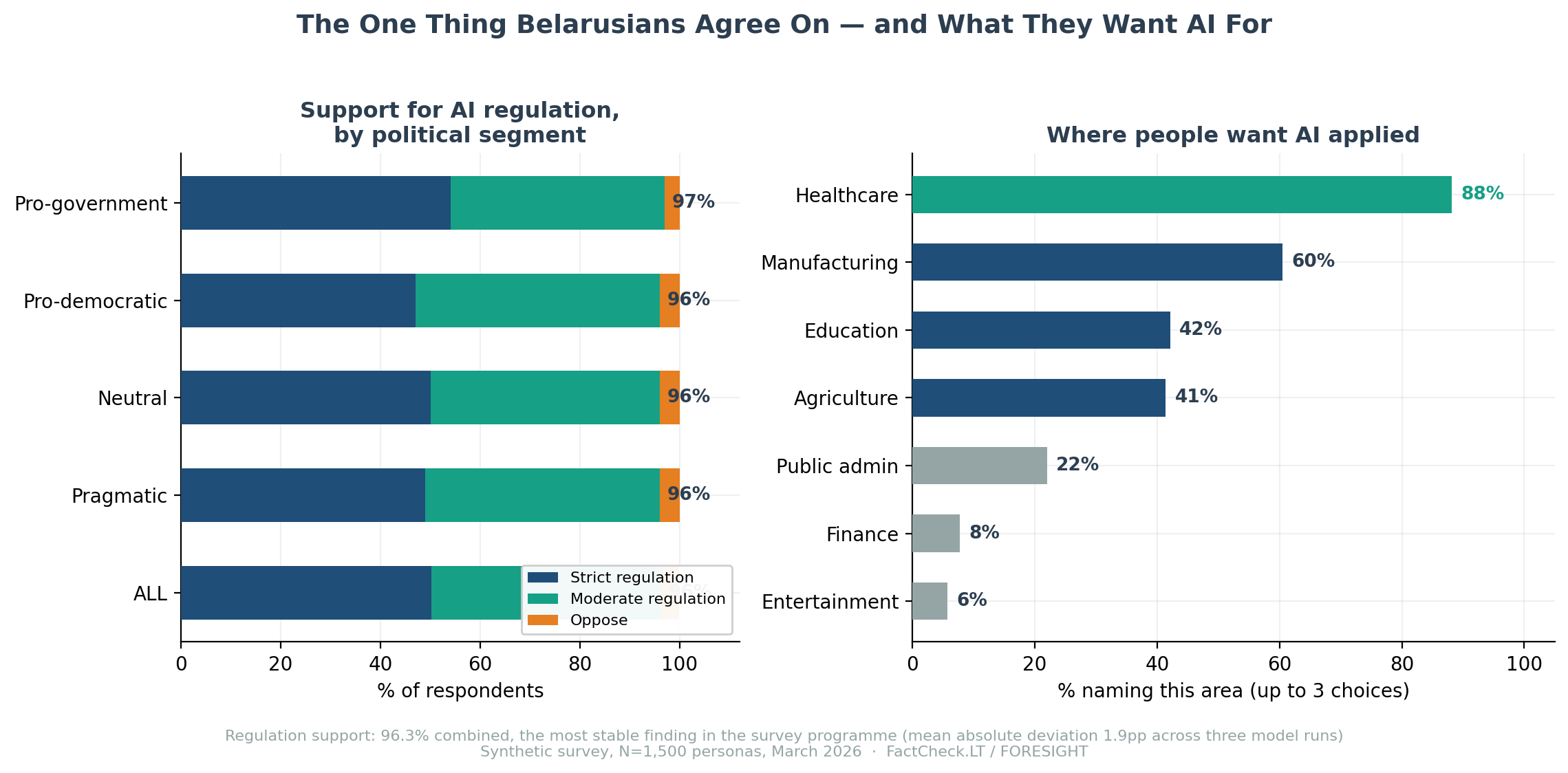
Two agendas that never meet
Put the three pieces together and you get a policy with no domestic audience.
The state’s AI agenda is infrastructural and geopolitical: sovereign data centres, locally hosted models, competence centres, a seat in a China-led body, cooperation offered through the Union State, the EAEU, the CIS and the SCO. The public’s version, as far as 1,500 synthetic personas can stand in for it, is about protection and hospitals: rules first, healthcare first, and almost no expectation that any of it touches their own job — only 2.7% see AI as a serious professional threat within five years, against 47% expressing general anxiety.
And between the two, no transmission belt. The state did not campaign on Shanghai; the independent press did not contest it. A founding membership in the organization that intends to write global AI standards entered Belarusian public discourse as thirteen documents, and left.
That is worth noting for a practical reason. AI governance is one of the very few policy areas where this population agrees with itself across the political divide. If the Belarusian public ever gets a debate about who regulates AI and how, the ground for it is unusually solid. So far, the debate has not started, and neither side of the media system has tried to start it.
Corpus method: search of the full FORESIGHT corpus 3.3M documents, 100+ sources) for 10–31 July 2026 on WAICO, word-boundary WAIC, and Russian-language names of the organization and conference; the AI-beat and Uzbek-labour comparisons cover 1–31 July and 9–19 July respectively. Counts are documents, not articles: syndicated wire copy can appear more than once. Survey: FactCheck.LT synthetic survey of AI attitudes, March 2026, N=1,500 personas from 2.47M comments, cross-validated on Claude Sonnet 4 and GPT-5-mini; three-run mean absolute deviation on the regulation question 1.9pp. The sample is active social media commenters and overstates digital engagement relative to the general population; in this method attitudinal findings are more reliable than behavioural ones. Other sources: Ministry of Communications and Informatization statement, 20 July; BelTA, 17 July; Reuters, Xinhua and Global Times on the signatories.