

In one week Lukashenko gave Vitebsk region a former chief of the General Staff and sent two managers with Brest careers to Grodno, whose chairman he called “a military man” in need of farm support. Two of the three regions on the EU border are now run by men from the security bloc. His own words leave open whether this is a border policy or a short list of trusted names.
On 23 November Lukashenko made four personnel decisions in one sitting, and three of them concerned Grodno region. He explained the Grodno part in plain words. “We have a military man there,” he said of the region’s chairman, Yuri Karaev, and “he needs support in agriculture. He is not a specialist in agriculture” (BelTA, 23 November 2026). A week earlier he had put Pavel Muraveyko, a former chief of the General Staff, in charge of Vitebsk region (BelTA, 16 November 2026). We do not know whether these choices follow a plan for the western border or the small pool of people he trusts.
One week, five moves
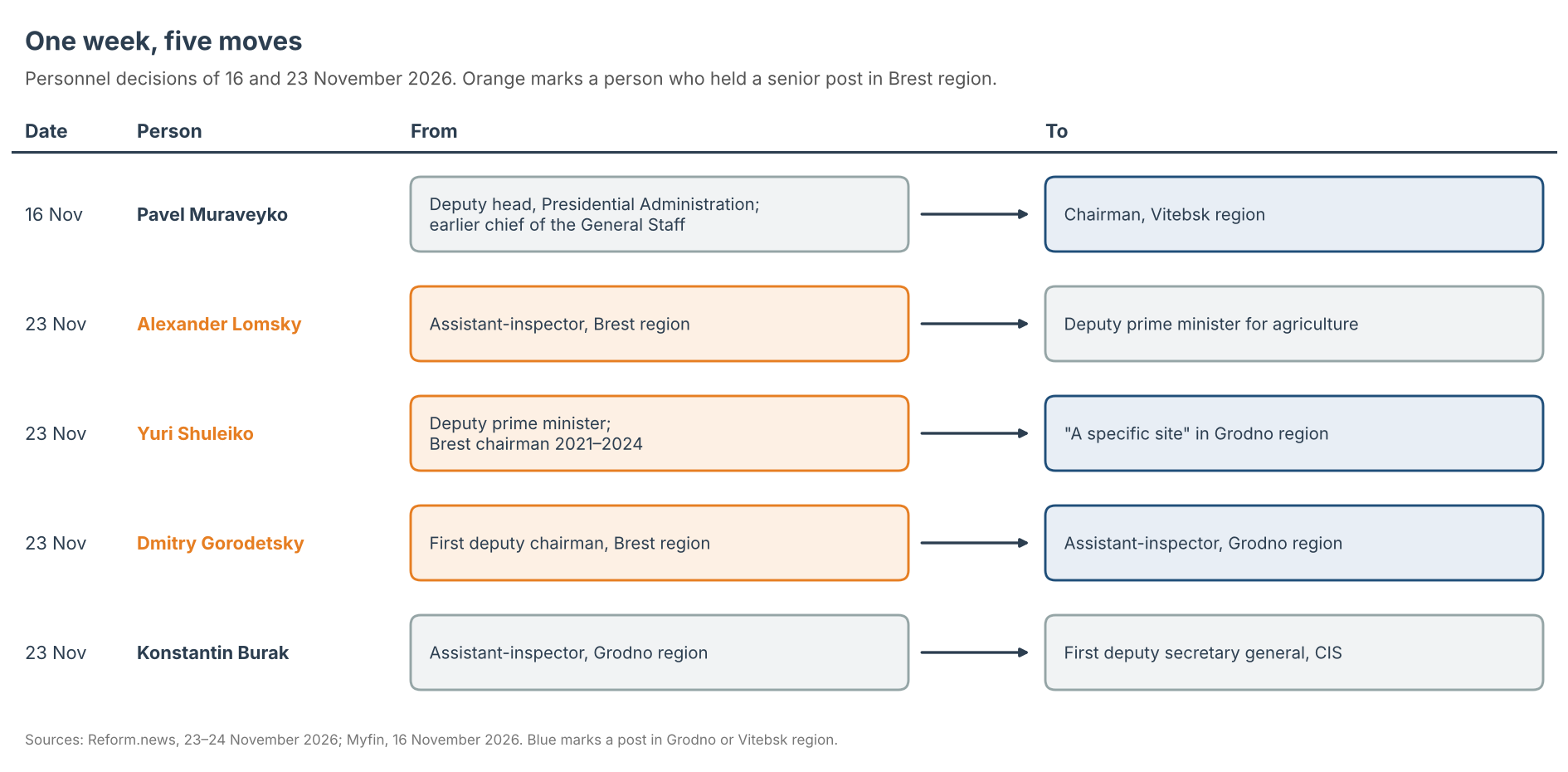
Three of the five people moved that week had held senior posts in Brest region. On a single day Brest lost both its inspector and its first deputy chairman.
Alexander Lomsky, Lukashenko’s assistant-inspector for Brest region and a former first deputy minister of agriculture, became deputy prime minister for agriculture (BelTA, 23 November 2026). His task, Lukashenko said, is to sell farm products and to double the sector’s results (Reform.news, 23 November 2026).
His predecessor, Yuri Shuleiko, was released by decree No. 414 of 23 November (Reform.news, 24 November 2026). Lukashenko said Shuleiko would go to “a specific site” in Grodno region, and not to rest (BelTA, 23 November 2026). He named no post. He also recalled past trouble with butter sales that neither the deputy prime minister nor the ministry could solve (Reform.news, 23 November 2026). For Shuleiko the move is a return. He once ran the Lida meat plant and worked in the Grodno regional executive committee before he chaired Brest region from 2021 to 2024 (Reform.news, 24 November 2026).
Dmitry Gorodetsky, first deputy chairman of the Brest regional executive committee, became assistant-inspector for Grodno region. His job is to support Karaev (BelTA, 23 November 2026). Konstantin Burak, who held that inspector post until now, becomes first deputy secretary general of the CIS (BelTA, 23 November 2026).
Three of the five people moved that week had held senior posts in Brest region.
Six regions, five years
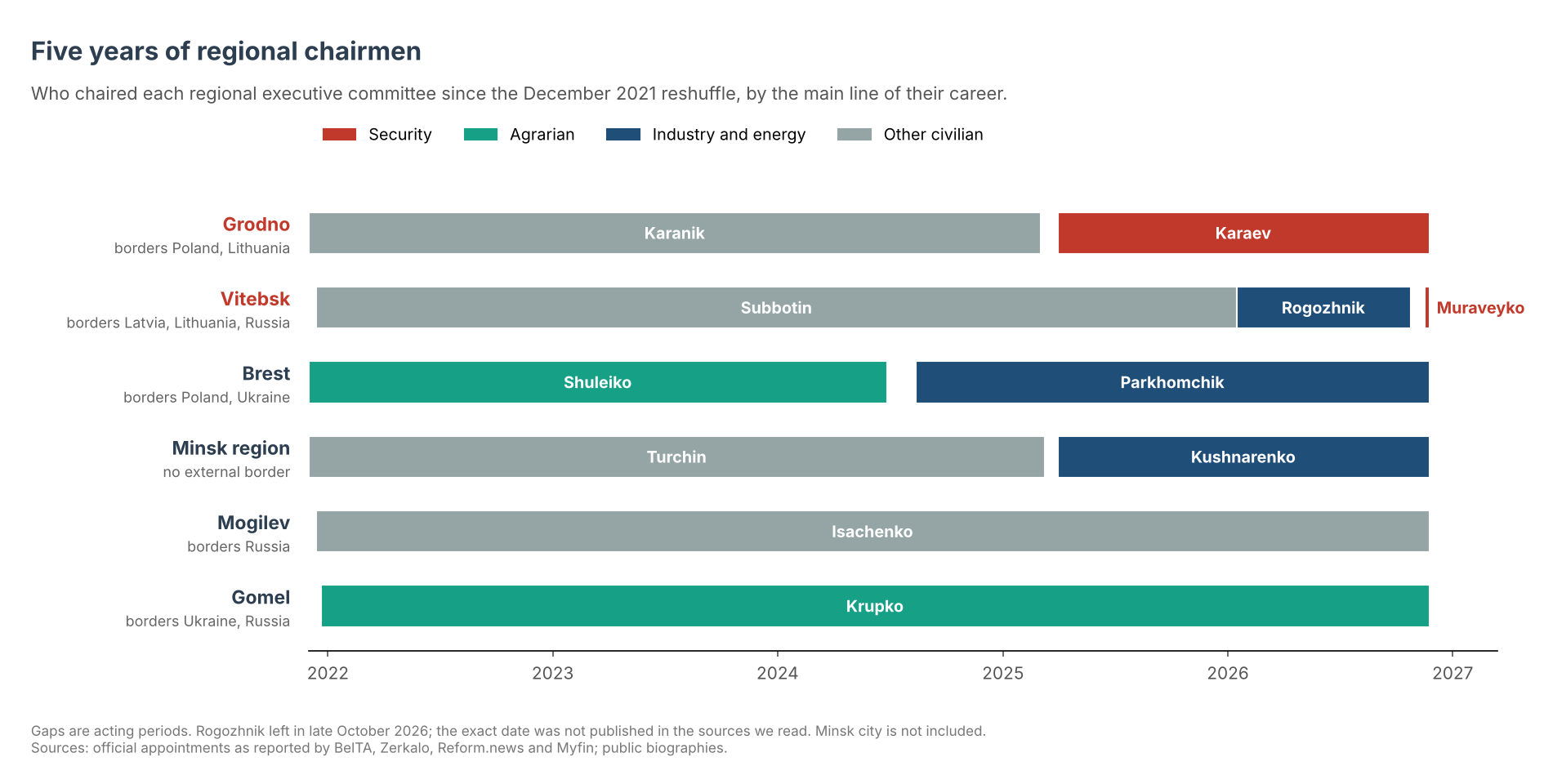
In December 2021 Lukashenko replaced three regional chairmen within eight days. Alexander Subbotin went to Vitebsk and Anatoly Isachenko to Mogilev on 13 December (Wikipedia: Isachenko). Ivan Krupko, an agrarian and a former agriculture minister, went to Gomel on 21 December (Wikipedia: Krupko). The chairmen of Gomel and Mogilev have not changed since. Both greeted their farmers as chairmen at this year’s harvest festival (Newsgomel; Goretskie Novosti).
Every change of chairman since then came in the west or in Minsk region. Brest passed from Shuleiko to Pyotr Parkhomchik, a former industry minister, in the summer of 2024 (Wikipedia: Parkhomchik). Minsk region lost Alexander Turchin to the premiership on 10 March 2025 (Zerkalo, 10 March 2025). On 31 March it got Alexei Kushnarenko, the energy minister, and Grodno got Karaev on the same day (Zerkalo, 31 March 2025).
Vitebsk has had three chairmen this year. Subbotin was removed on 15 January after months of public criticism. Lukashenko, citing the head of his administration, said Subbotin may have “burned out” (Zerkalo, 30 January 2026). Alexander Rogozhnik, a former industry minister and ambassador to Russia, replaced him (Myfin, 15 January 2026). He lasted nine months and left in late October, officially because of illness. Muraveyko arrived on 16 November (Myfin, 16 November 2026).
Of the six regional chairmen, two now come from the security bloc. Karaev was interior minister in 2019 and 2020, and Muraveyko headed the General Staff. Both run regions on the EU border: Grodno borders Poland and Lithuania, Vitebsk borders Latvia and Lithuania. The third region on the EU border, Brest, is run by an industrial manager. None of the other three regions has a chairman from the security bloc.
Every change of chairman since then came in the west or in Minsk region.
The uniform came first as an inspector
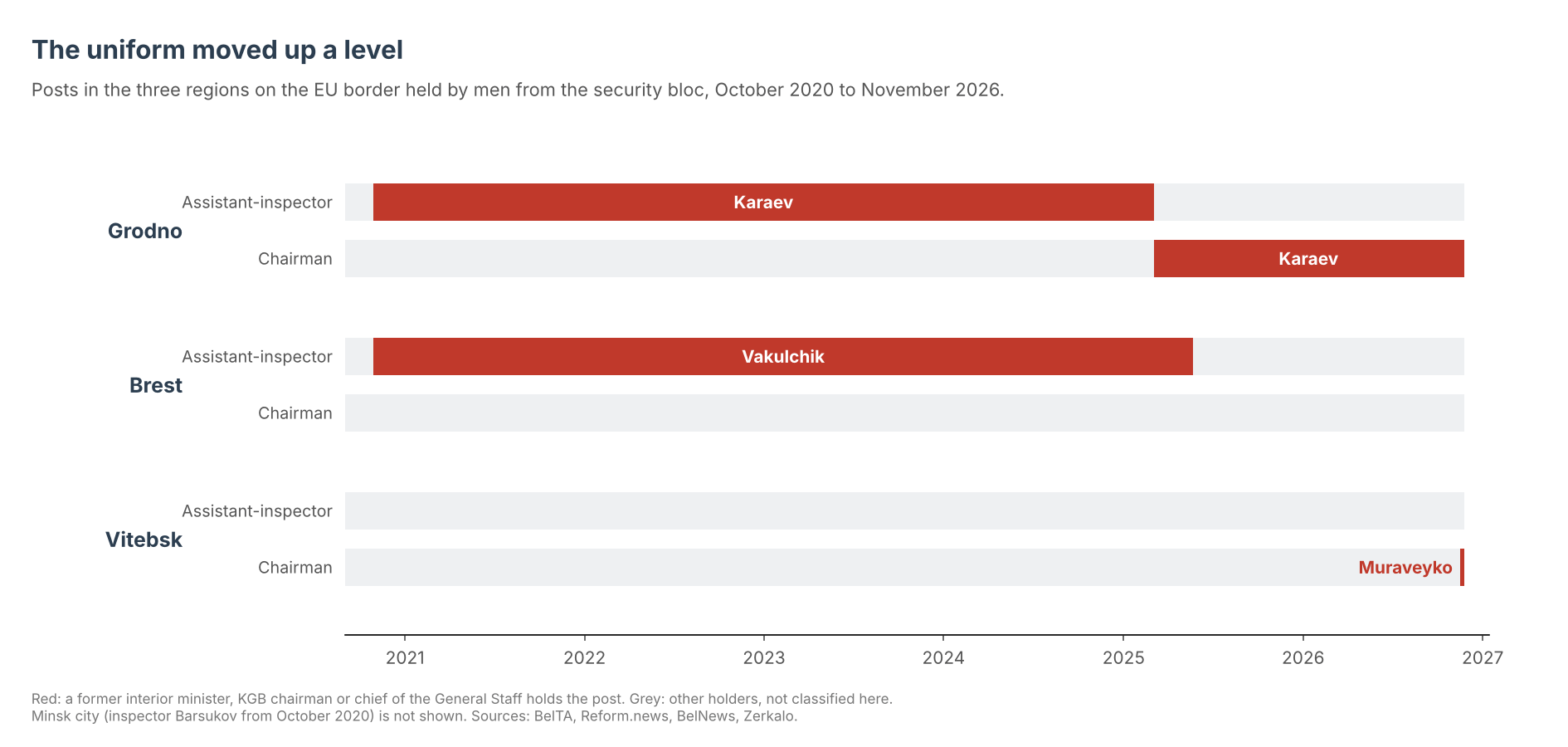
The security bloc reached the western regions before this year, one level down. On 29 October 2020 Lukashenko made Karaev his assistant-inspector for Grodno region. On the same day Valery Vakulchik, who had headed the KGB until September, became inspector for Brest region, and Alexander Barsukov inspector for the city of Minsk (BelTA, 29 October 2020). The next day Reform.news reported that Lukashenko meant to make military men his inspectors in every region (Reform.news, 30 October 2020).
The uniform did not stay where it was put. In Grodno it moved up a level when Karaev became chairman in March 2025. His inspector post went to Burak, who had run the government’s administration (BelTA, 17 April 2025). In Brest it left: Vakulchik became head of the government’s administration in May 2025 (BelNews, 22 May 2025). His post went to Lomsky, an agrarian (BelTA, 30 June 2025). In Vitebsk the uniform arrived at the top directly. As chief of the General Staff, Muraveyko had handed Subbotin the order for a snap check of the region’s territorial defence in March 2025 (CTV, 12 March 2025). Twenty months later he took over the region himself.
What Lukashenko said each time
Lukashenko appointed Karaev on 31 March 2025 and chose him from several candidates. He pointed west and told him: “The situation on the western borders, you know better than me what is happening there.” He also valued the farm experience Karaev gained in nearly five years as inspector for the same region (Mail.ru, 31 March 2025).
For Muraveyko the stated reason was discipline. The appointment followed Lukashenko’s criticism of the harvest in Verkhnedvinsk district on 15 October. He wanted order in Vitebsk region “on the army principle” (Myfin, 16 November 2026). SB headlined the same instructions with a different line: “The main thing is agriculture” (SB, 16 November 2026). The accounts of that appointment we read do not mention the border.
The border reason was named once, for Grodno. Farm support for a military chairman was also named once, for Grodno, on 23 November. In Vitebsk the general has been told that agriculture is the main thing, and no agrarian has yet been named at his side.
State media did not hide the military angle. In our corpus, 43 state items covered Muraveyko’s appointment in its first week, against 17 independent ones. The phrase “a military man” from 23 November appeared in seven state items and three independent ones. On 16 November the independent site UDF called Muraveyko the region’s “general-governor” (UDF, 16 November 2026). Six days later BelTA put the same word into the headline of its weekly round-up of Lukashenko’s activities (BelTA, 22 November 2026).
There is a simpler reading. Valery Karbalevich, in a column for Radio Svaboda that Zerkalo also carried, saw in the Vitebsk move “chaotic personnel policy, a lack of effective managers” and a “growing share of security structures in state administration” (Svaboda, 16 November 2026; Zerkalo, 16 November 2026). The same few people do keep changing chairs. Karaev went from minister to inspector to chairman. Vakulchik went from the KGB to inspector to the government’s administration, and Burak from that administration to inspector to the CIS. Shuleiko went from Lukashenko’s assistant for Gomel region to Brest chairman to deputy prime minister, and now to Grodno. Of the fifteen officials named in this piece, at least eight have held the post of assistant-inspector or are taking it now.
The border reason was named once, for Grodno.
How sure we are
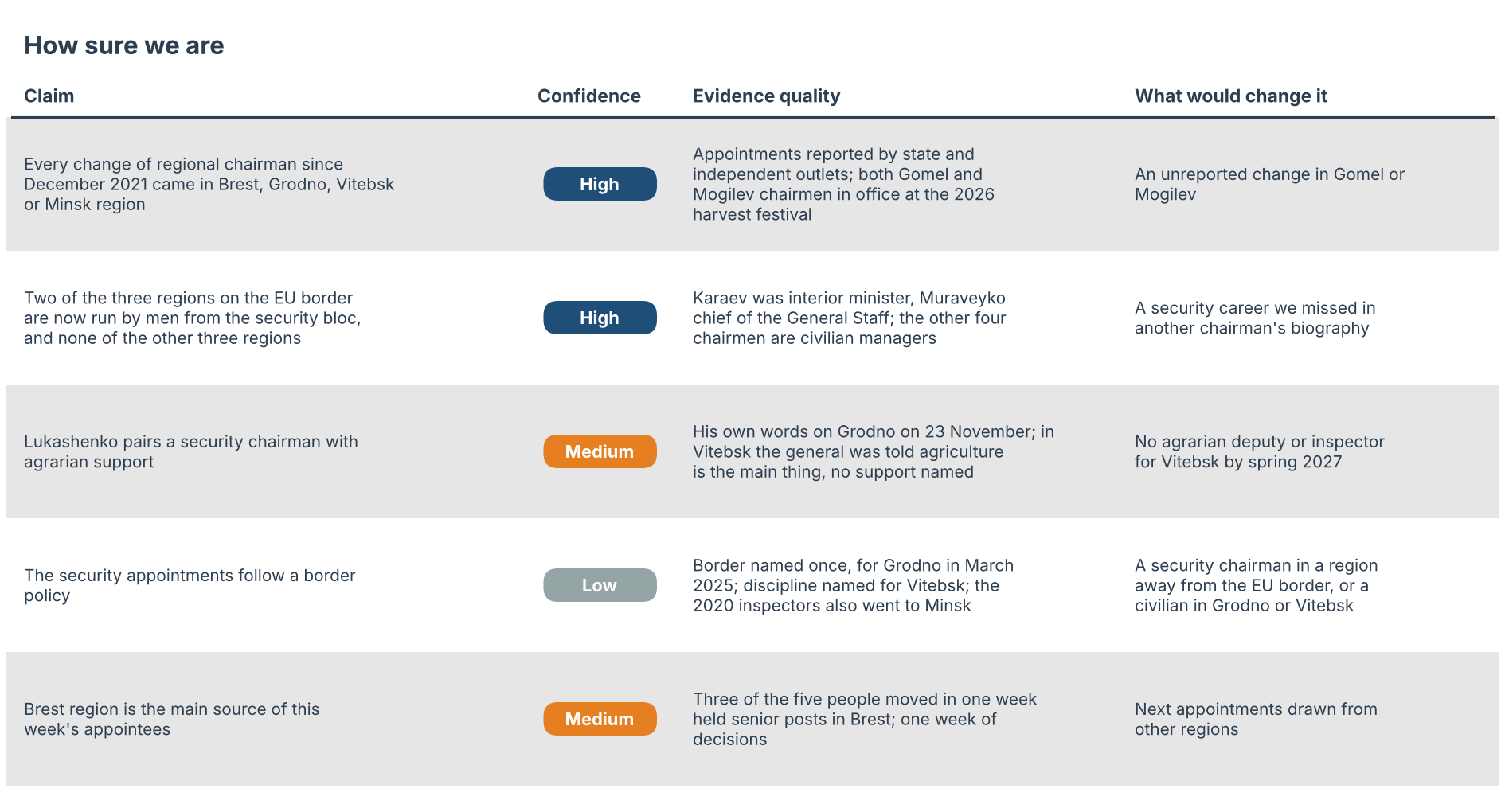
Every change of regional chairman since December 2021 came in Brest, Grodno, Vitebsk or Minsk region. High. Appointments reported by state and independent outlets; the Gomel and Mogilev chairmen were both in office at the 2026 harvest festival. An unreported change in Gomel or Mogilev would change it.
Two of the three regions on the EU border are now run by men from the security bloc, and none of the other three regions. High. Karaev was interior minister and Muraveyko chief of the General Staff; the other four chairmen are civilian managers. A security career that we missed in another chairman’s biography would change it.
Lukashenko pairs a security chairman with agrarian support. Medium. His own words on Grodno on 23 November; in Vitebsk the general was told that agriculture is the main thing, and no support has been named. No agrarian deputy or inspector for Vitebsk by spring 2027 would change it.
The security appointments follow a border policy. Low. The border was named once, for Grodno in March 2025; discipline was named for Vitebsk; the 2020 inspectors also went to Minsk; a short list of trusted managers explains all of it. A security chairman in a region away from the EU border, or a civilian in Grodno or Vitebsk, would change it.
Brest region is the main source of this week’s appointees. Medium. Three of the five people moved in one week held senior posts in Brest; this is one week of decisions. Next appointments drawn from other regions would change it.
How it fits
In “Another Pair of Eyes” we counted eighteen personnel and oversight decisions in the security bloc between January and October. The Vitebsk appointment adds a regional one, in which a security career meets a civilian post. In “Forty-Five Rubles” Lukashenko handed loss-making Vitebsk farms to larger companies, some for one base unit each. The region’s farm sector is still the reason he gives for changes at its top. The chairmen also take part in military training. The defence minister holds an annual military gathering for the leadership of the regional executive committees, held this year in Lida in May (SB, 22 May 2026).
Thesis tag: none (observation).
Of the fifteen officials named in this piece, at least eight have held the post of assistant-inspector or are taking it now.
What to watch
By 31 January 2027. State media name Shuleiko’s post in Grodno region. Expectation: yes. Confidence: medium.
By 31 March 2027. Lukashenko names an agrarian deputy chairman or assistant-inspector for Vitebsk region as support for Muraveyko. Expectation: yes. Confidence: medium.
By 30 June 2027. Krupko and Isachenko still chair Gomel and Mogilev regions. Expectation: yes. Confidence: medium.
By 31 December 2027. A person from the security bloc becomes chairman of Brest region. Expectation: no. Confidence: low.
Method and limits
The roster covers the six regional executive committees from the December 2021 reshuffle to 24 November 2026. Minsk city is not included. Appointment dates come from official decisions as reported by state and independent outlets and from public biographies. Where a region had an acting head, the chart shows a gap. Rogozhnik’s exact last day was not published in the sources we read, so the chart dates it to late October. We classified each chairman by the main line of his career before the appointment: security, agrarian, industry and energy, or other civilian. That is a judgement. Krupko’s two years of conscript service do not count as a security career here. “On the EU border” means an international border with Poland, Lithuania or Latvia. The inspector series comes from personnel items in the FORESIGHT corpus since 2018 that name an assistant-inspector and a region. It covers security-bloc inspectors in Brest and Grodno only, and the other regions’ inspectors are not classified. Coverage counts are FORESIGHT corpus items from 16 to 24 November that name the people moved. Nasha Niva, Belsat and Zerkalo were counted only where a name is in the headline or the opening. The count of officials who held the inspector post rests on the biographies quoted here, so it is a minimum.