
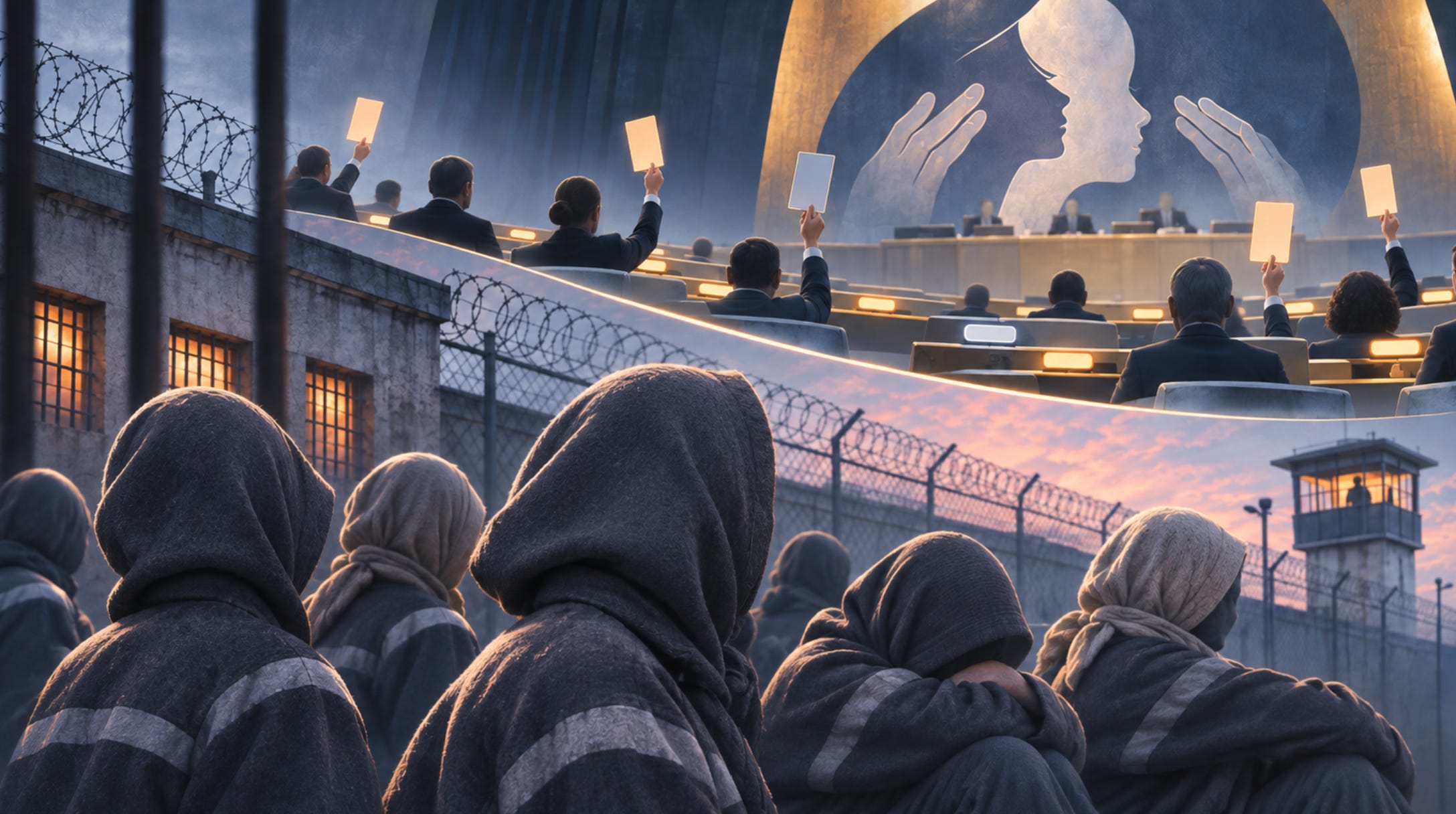
Belarus abstained on a UN resolution on violence against women eight days before 25 November. Around the day, state outlets write about violence in families and abroad. The 115 women held as political prisoners do not appear in that picture.
On 17 November the Third Committee of the UN General Assembly voted on its resolution on violence against women and girls. This year the text is about femicide, the killing of women because they are women. It passed with 175 votes in favour and one against, from Somalia. Belarus was one of six countries that abstained, together with Russia, the United States, Argentina, Cameroon and Burkina Faso.
After the vote, the Belarusian delegate explained the position, as Reform.news reported: “We are deeply disappointed that the resolution is once again being used as a tool to promote a contested agenda.” He called it unacceptable to require all states to adopt legislation. He said Minsk would read the contested passages under its national law. The position is not new. Belarus and Russia also abstained on the same resolution in November 2020.
Eight days later, on the International Day for the Elimination of Violence against Women, Viasna published its own numbers (Viasna). At least 115 women political prisoners are in custody. At least 2,126 women have faced criminal cases since 2020. At least 13 of the women held have serious health problems, and 19 are pensioners. Since the start of 2025, the authorities have pardoned 56 women with US mediation and forcibly expelled them from Belarus.
All of this happens in a year that Lukashenko declared, in his first decree of 2026, the Year of the Belarusian Woman.
What each side writes under the date
The FORESIGHT corpus holds 7.2 million documents. We took every item on violence against women published between 18 November and 10 December in each year from 2018 to 2026. That window covers the day and the 16 days of campaigning that follow it.
State and pro-regime outlets published 48 such items. Thirty-one are about violence in families in Belarus. A typical one comes from the labour ministry. On 25 November 2025 SB explained “what system of countering domestic violence has been created in Belarus”. Another typical item is advice from law enforcement on how to recognise the signs of violence at home. Fourteen items are about violence abroad: protests in Paris, Mexico and Italy, rising violence in Germany. This year the corpus holds two state items in the window so far. The first is a post by a state television channel on 19 November. It quotes Sofia Sapega, a former political prisoner who left for Lithuania in 2020: “I have a domestic violence case.” It then adds: “It is convenient to defend women from the rostrums of the European Parliament.” The second appeared on 25 November on the site of the trade union federation, in its world section. It reported the UN estimate that about five women and girls are killed every hour by partners or relatives (1prof). That is the subject of the resolution on which Belarus abstained.
None of the 48 items mentions a woman held for political reasons.
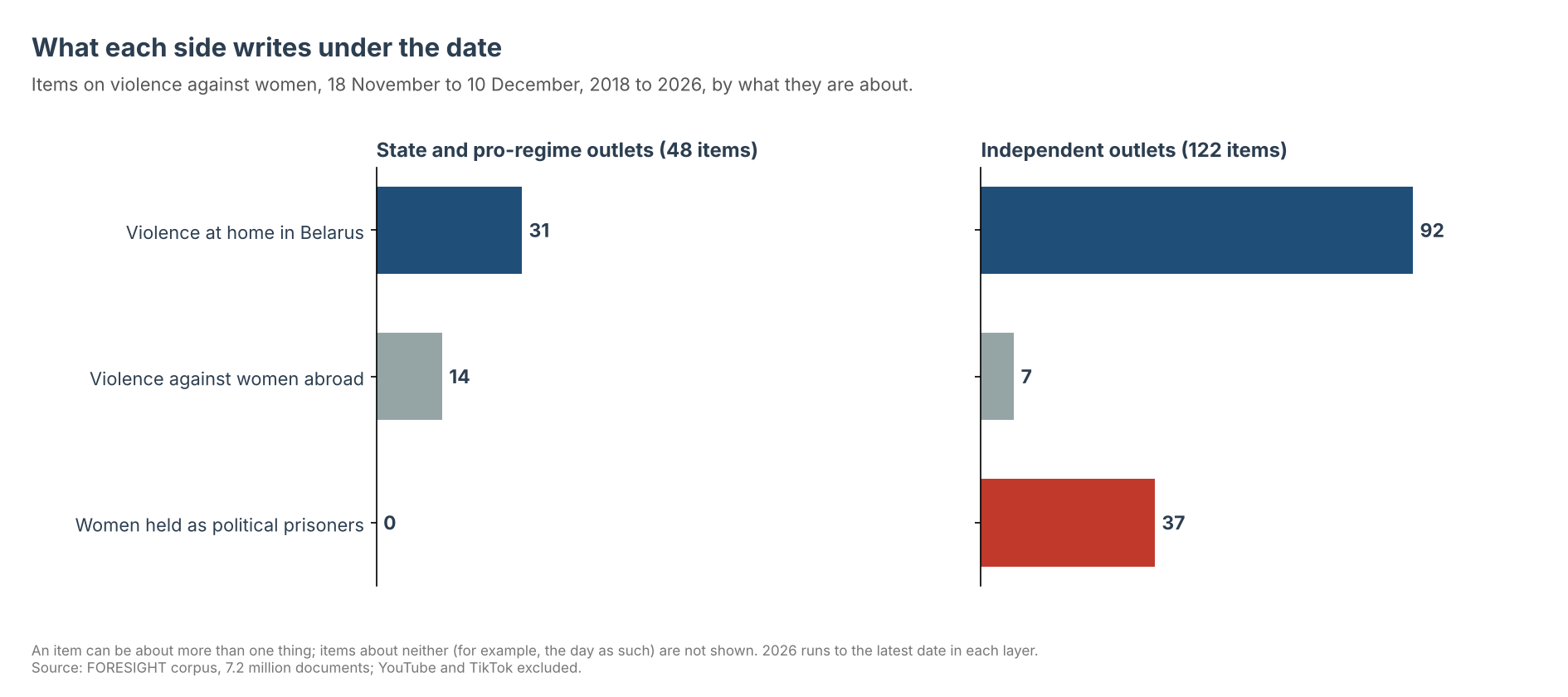
Independent outlets published 122 items in the same windows. Thirty-seven of them are about women political prisoners. In November 2021 the window opened with the hunger strike of Olga Gorbunova, the former head of Radislava, an organisation that helped women who faced violence (Zerkalo). Two months earlier the authorities had moved to close Radislava. On 28 September 2021 the Supreme Court liquidated Gender Perspectives, which had worked on violence in families for eleven years. Viasna’s text of 25 November lists the others: the authorities also closed the Her Rights centre and declared the Girl Power Bel project an “extremist formation” (Viasna).
None of the 48 items mentions a woman held for political reasons.
The state version of the day also has a history. In 2018 the interior ministry drafted a law against domestic violence. On 5 October 2018 Lukashenko rejected it in public, and SB carried his words: “All this is nonsense taken first of all from the West.” He promised to proceed from “our Belarusian, Slavic traditions”. The draft was dropped. Belarus still has no separate law on domestic violence.
The count of women held
Viasna publishes a monthly review with the number of political prisoners held and the number of women among them. Read together, the reviews give a series from December 2020.
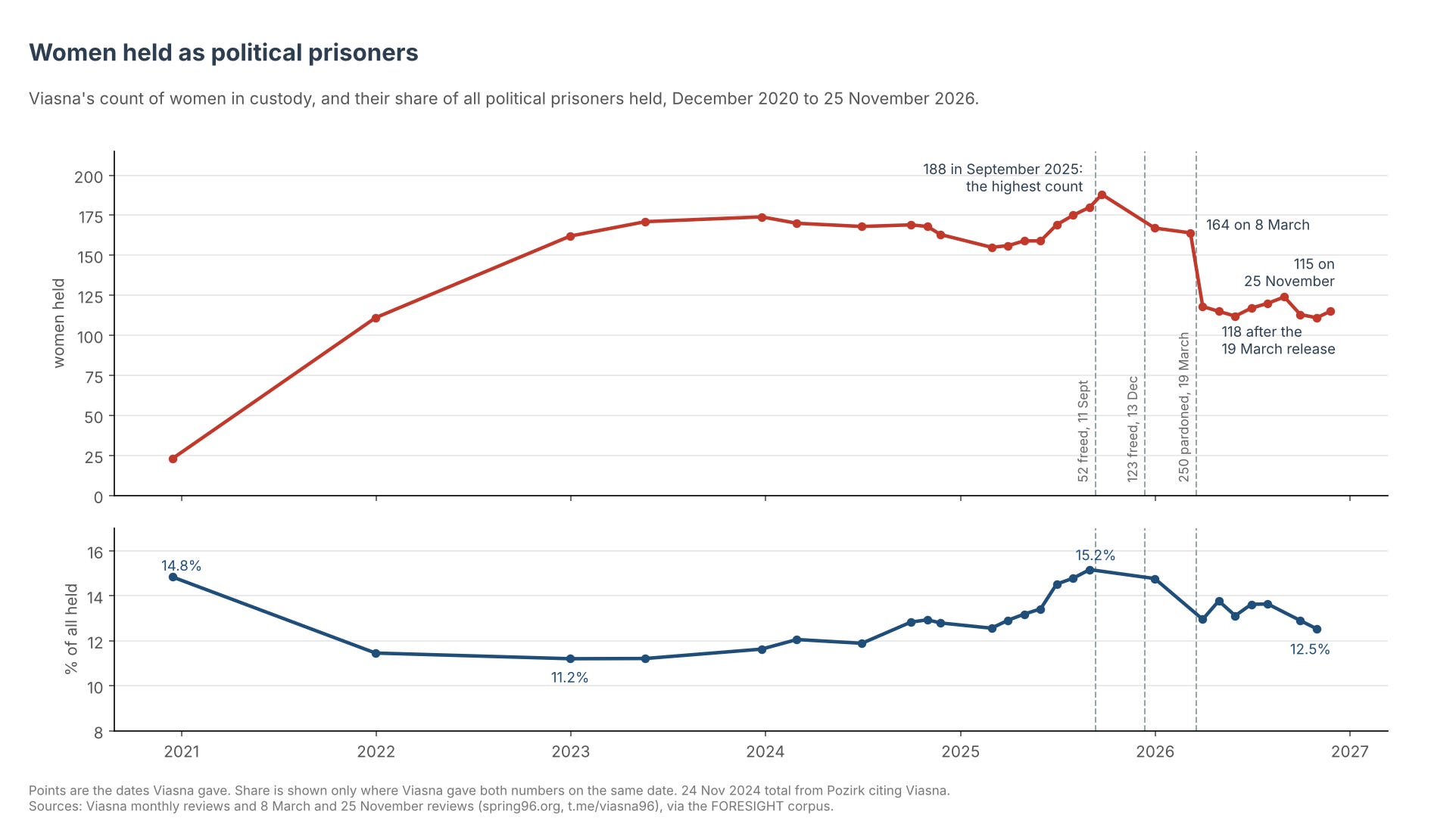
The count rose from 23 women in December 2020 to 162 at the end of 2022. It then stayed between about 155 and 175 for two and a half years. In September 2025 it reached 188, the highest number so far. That was after the release of 52 prisoners on 11 September. On 8 March 2026 Viasna still counted 164.
The large fall came with the pardon of 250 people on 19 March. The list included 51 women, and 50 of them had been sentenced to a colony. At the end of March Viasna counted 118 women among 911 political prisoners. At the end of October it counted 111 among 886, or 12.5%.
Where women are counted
The share of women depends on which count you read. Women are one in eight of the political prisoners held now. They are almost one in five of all the people Viasna has recognised as political prisoners since 2020: 914 of 4,860. In 2025 they were 355 of the 1,254 people convicted in politically motivated criminal cases, or 28%.
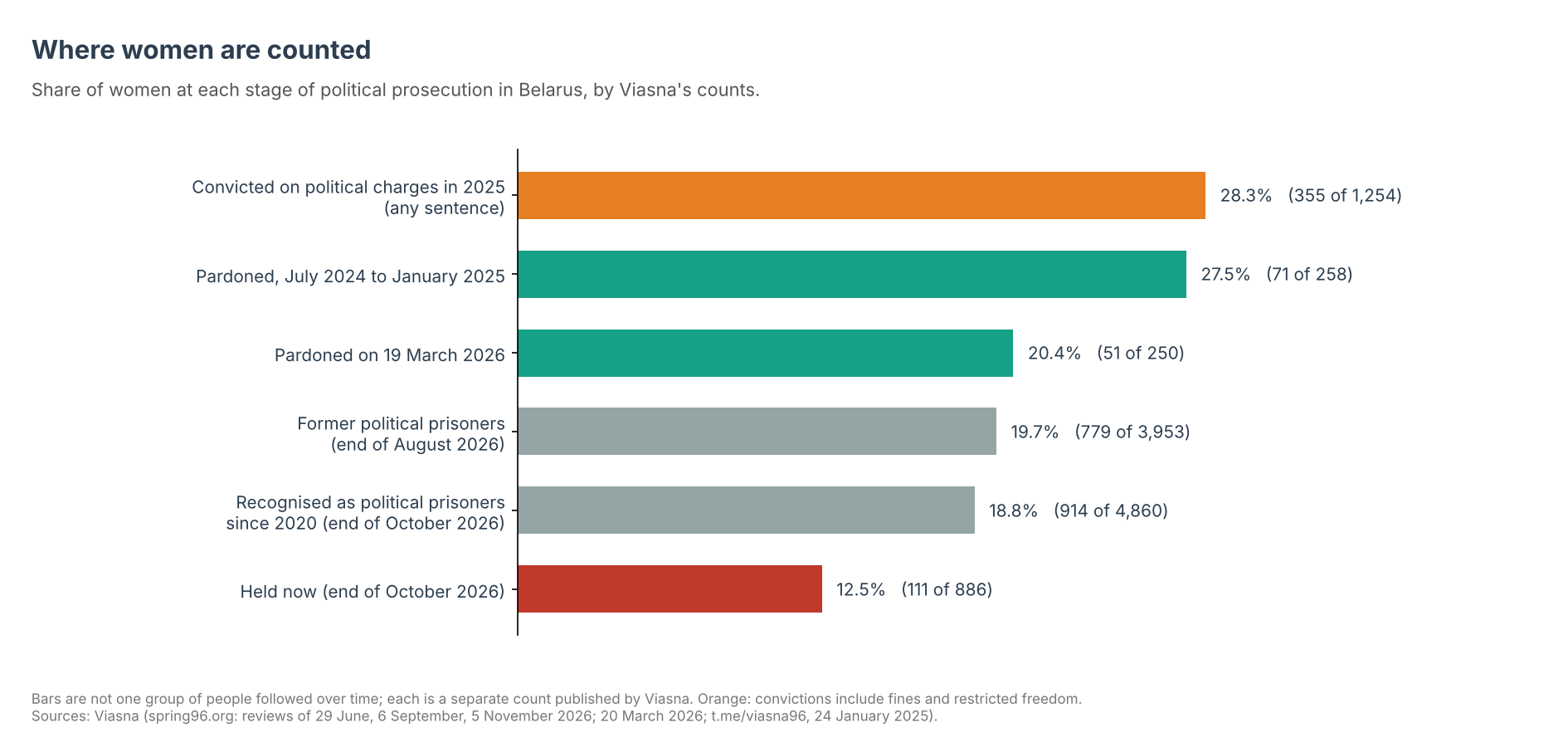
There are two reasons for the gap. The first is the sentence. Most women convicted in these cases do not go to a colony. In August 2024 Viasna counted 1,253 women convicted, and 288 of them were sentenced to a term in custody. The others received fines or restricted freedom.
The second reason is the pardon. Between July 2024 and January 2025, 258 political prisoners were pardoned, and 71 of them were women. That is 27.5%, about twice their share of those held. When 25 people were pardoned on 16 September 2025, the state gave the split itself: “12 women and 13 men”. It added that many of them had children.
Women are one in eight of the political prisoners held now.
So the number of 115 depends on two doors. Pardons take women out at more than their share. New cases bring women in, and in 2025 there were 355 convictions. A sentence served at home can also turn into a colony term. On 25 November Viasna reported the case of Alla Zakharova, 72, from Dobrush district. A court gave her restricted freedom at home for insulting Lukashenko. She did not always reach the district office in time to report, and a court replaced the sentence with eighteen months in a colony. She has been in colony No. 4 since April.
The fall since March came with the large pardon. Viasna’s counts do not yet show whether new cases against women have slowed. On the same day Viasna argued that a shorter list does not mean a thaw.
What the state shows of the colony
Most women political prisoners are held in correctional colony No. 4 in Gomel. In August 2024 Viasna counted 122 of the 153 women there. Three were in colony No. 24 in Zarechye, in Rechitsa district, a colony for repeat offenders.
Since 2020, independent outlets have mentioned these two colonies in 1,747 items. State outlets mentioned them in 29. In state outlets, the colony is a place of correction and of motherhood. Colony No. 4 has the only children’s home inside a Belarusian colony, and state outlets cover the holiday visits there. In August 2021 Natalya Kochanova, chair of the upper house, visited the colony. BelTA quoted her in its headline: the conditions there “allow women to reform and continue their lives with dignity”. A former prisoner of the same colony, whose name Viasna changed, described them on 25 November: “The system is very harsh on women. And the ‘year of the woman’ will not make these conditions better.”
Viasna’s text for 25 November names women whom the state segment does not name as prisoners. Viktoria Kulsha was moved to colony No. 24 in August 2022 and was convicted four more times while in custody. She says she spent more than a year in total in the punishment cell (Novaya Gazeta Europe). Of a colony officer, Denis Nikonenko, she says (Viasna): “He used physical force against me more than once in IK-24. Cruelly and without justification.” In September Viasna published accounts by former prisoners about the same officer, who worked there until March 2026. Kulsha was pardoned and expelled from Belarus on 13 December 2025.
Since 2020, independent outlets have mentioned these two colonies in 1,747 items. State outlets mentioned them in 29.
Two women held were diagnosed with cancer this year. The diagnosis of Tatsiana Kolas became known in July from Maryna Zolatava. The diagnosis of the artist Oksana Shaliapina, in colony No. 4 in Gomel, became known in September. She now spends most of her time in the colony’s medical unit. Both women are still held.
One woman in Viasna’s material for 25 November does appear in state outlets, many times. Natallia Matsveyeva was detained in 2021 in the case of the “civil self-defence units”. In July 2021 state television showed her statement about a plan to set fire to logging trucks. At the trial in October 2022, SB quoted her in a headline: “I had to prove my loyalty. Any terrorist act.” State and pro-regime outlets named her in 61 items. Fifty-five of them came in July 2021 and in the months of the trial.
Sofia Sapega shared a cell with her in 2021. In an interview published on 29 October, she remembered the day Matsveyeva was brought in (Viasna): “There was not a single unharmed spot on her face: she came in all purple.” That account does not appear in the state segment. The state television post about Sapega on 19 November does not mention prison at all.
Two women held were diagnosed with cancer this year.
How sure we are
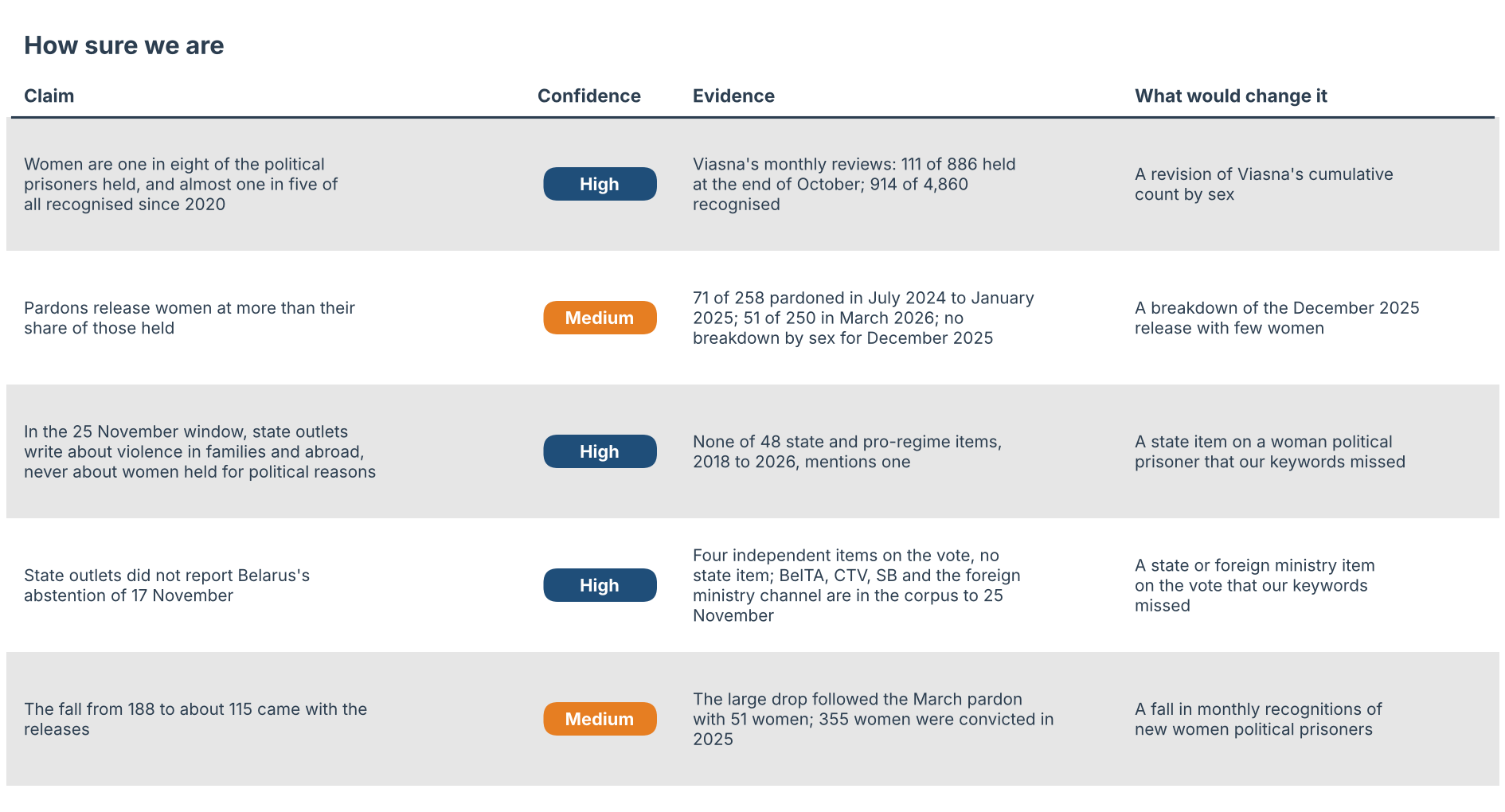
Women are one in eight of the political prisoners held, and almost one in five of all recognised since 2020. High. Viasna’s monthly reviews give 111 of 886 at the end of October and 914 of 4,860 recognised. A revision of Viasna’s cumulative count by sex would change it.
Pardons release women at more than their share of those held. Medium. Women were 71 of 258 pardoned in July 2024 to January 2025 and 51 of 250 in March 2026; the December 2025 release has no breakdown by sex in our data. A breakdown of that release with few women would change it.
In the 25 November window, state outlets write about violence in families and abroad, never about women held for political reasons. High. None of 48 state and pro-regime items from 2018 to 2026 mentions one. A state item on a woman political prisoner that our keywords missed would change it.
State outlets did not report Belarus’s abstention of 17 November. High. The corpus holds four independent items on the vote and no state item. BelTA, CTV, SB and the foreign ministry channel are in the corpus to 25 November. A state or foreign ministry item on the vote that our keywords missed would change it.
The fall from 188 to about 115 came with the releases. Medium. The large drop followed the March pardon, which included 51 women, while 355 women were convicted in 2025. A fall in monthly recognitions of new women political prisoners would change it.
How it fits
Earlier briefs looked at the same two doors for all political prisoners. “Recognised Later” tested how quickly Viasna recognises new political prisoners. “What the Apparatus Is Owed” showed that releases did not slow the production of new cases. This brief adds the view by sex. Women make up a larger share of the people prosecuted than of the people held.
This violence also has a digital form. In September FactCheck.LT published “The State as Perpetrator”, a study of technology-facilitated gender-based violence (TFGBV) in the same corpus. Of 222 items that were themselves acts of such violence, 220 came from state and pro-regime channels. The largest single form, in 850 items, was the coerced “repentance video”: a detainee filmed apologising, then shown on pro-government channels. The typology of the UN Population Fund has no separate category for it. Matsveyeva’s statement of July 2021 was recorded after her arrest and shown on state television. The study also found that the state segment discusses digital violence only as crime news or as protecting children. In September 2025 the journalist Larysa Shchyrakova, a former political prisoner, said that after her detention security officers had posted intimate photos of her on a dating site.
The vote of 17 November sits beside the decree on the Year of the Belarusian Woman. Belarus did not support a text against femicide, and its state outlets did not report the vote. We found four independent items on it, among them Euroradio and Racyja. Around 25 November, state outlets write about violence in families and abroad, as they have every year since 2018.
What to watch
By 31 December 2026. The General Assembly adopts the resolution in plenary. Belarus abstains again. Expectation: yes. Confidence: medium. A vote against would mean the position has hardened.
Early December 2026. Viasna’s review for November puts the number of women held between 105 and 125. Expectation: yes. Confidence: medium. A number below that would mean women were released faster than new cases came in.
By 10 December 2026. A state item in this year’s window names a woman held for political reasons. Expectation: no. Confidence: high.
By 31 December 2026. A pardon announced with the number of women released, as in September 2025. Expectation: yes. Confidence: low.
Method and limits
The window counts use the FORESIGHT corpus of 7.2 million documents, with YouTube and TikTok excluded. Items were selected by keywords in Russian, Belarusian and English for violence against women, violence at home, the day and the 16-day campaign. Women political prisoners were counted by keyword as well, and an item can belong to more than one group. The Viasna site layer in the corpus runs to 25 November and the Telegram layer to 22 November. On the state side, the websites of BelTA, CTV, SB, Zviazda and the trade union federation run to 25 November, and so do the minis
try channels, among them the foreign and labour ministries. State news channels on Telegram run to 22 November. Viasna’s counts are minimums. The share of women is shown only where Viasna gave both numbers on the same date. The stages chart puts separate counts side by side, and they do not follow one group of people. The December 2025 release has no breakdown by sex in our data. The colony counts include every item that names colony No. 4 or No. 24, and some may be about other prisoners held there.