

A FREE Network study finds that Belarus covered about 30% of Russia’s gasoline shortfall this summer, a shortfall caused by Ukrainian drone strikes on Russian refineries. Belarusian state media named the strikes in 12 of 295 items on fuel for Russia. Their busiest month on the subject was a denial copied across 87 channels.
On 9 November the FREE Network published a policy brief by Dzmitry Kruk of BEROC and Yahen Makarchuk of iSANS on Belarus and Russia’s gasoline crisis (FREE Network, 9 November 2026). Ukrainian strikes cut Russian gasoline output by about a fifth. Belarus ran its two refineries close to full capacity and sent more than a million tonnes of gasoline to Russia in January to September. Since 2023 our corpus holds 1,241 independent items and 295 state items on Belarusian fuel going to Russia. Independent outlets named the strikes in 42% of them. State outlets named them in 4%. What we cannot see is the volume itself: Minsk does not publish its oil-product exports to Russia, and the study’s figures are estimates from open sources.
What the study finds
The authors put Russia’s gasoline underproduction at about 0.7 million tonnes a month. Belarusian supplies of about 0.2 million tonnes a month covered roughly 30% of it and made up about half of Russia’s gasoline imports. They were still only about 6% of Russian consumption. Supplies peaked at a record 212,000 tonnes in July. Much of the flow ran through tolling: Russian companies sent crude to Belarusian refineries and took back the products, paying a processing fee. Goods returned after processing were worth USD 50 to 60 million a month until mid-2025 and USD 400 to 570 million a month in March to July 2026.
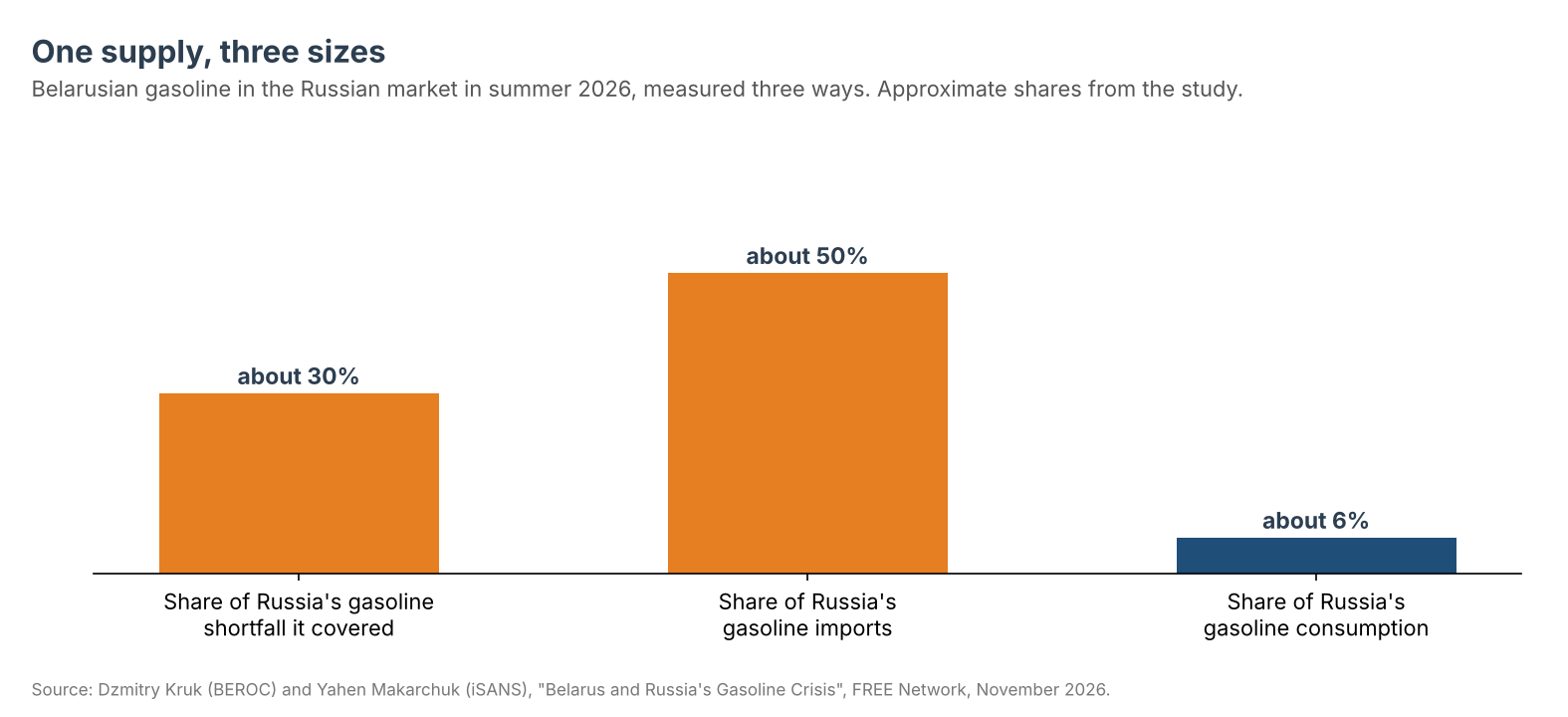
A report from 18 November carries the story into the autumn. Reform.news retold a Financial Times report: Russia has imported more than 600,000 tonnes of gasoline from Belarus since July, which makes Belarus its largest foreign supplier (Reform.news, 18 November 2026; Financial Times). July alone was 212,000 tonnes by the study’s count, so the monthly pace after July was lower. The same report shows Russia buying elsewhere too. Seaborne imports began in July and reached a record 390,000 tonnes in October, according to Kpler. That is almost twice Belarus’s best month. A Finam analyst estimates that Russian gasoline output is still 13 to 18% below its level at the start of 2026.
For Belarus, the authors call it a sizeable but short-lived boost. GDP fell by 0.25% in the first quarter and grew by about 3.2% in the second, then slowed to 0.7% in August. Macroby’s later estimate, published on 12 November, puts growth at 2.9% in the third quarter and 2% for January to September. It credits consumer demand, fed by loose budget and monetary policy, and estimates exports as roughly flat, with Russian demand held back (Macroby, 12 November 2026). The refineries have no spare capacity left, and major repairs at Naftan constrained supplies in September and October. The authors warn against reading the supplies politically. In their view, the supplies are evidence neither of Belarus’s strategic value to Russia nor of a durable windfall for the authorities in Minsk. The contribution came from a mix of commercial windfall and tolling deals that favour Russian oil companies, “rather than by any deliberate effort to stabilize the Russian market”.
The reason for the supplies appears in 12 of 295 state items.
The export duties that rose this month cover liquefied gases only, and the study does not discuss them. A Council of Ministers resolution, in force from 1 November, raised the duty on liquefied petroleum gas from USD 17.4 to USD 61.5 a tonne, and on ethane, butane and isobutane from USD 15.6 to USD 55.3 (Neg.by, 13 November 2026; Prime-TASS, 6 November 2026). Belarus has long followed Russia’s formula for duties on oil and oil products, and Russia set those duties at zero from January 2024.
What state media said
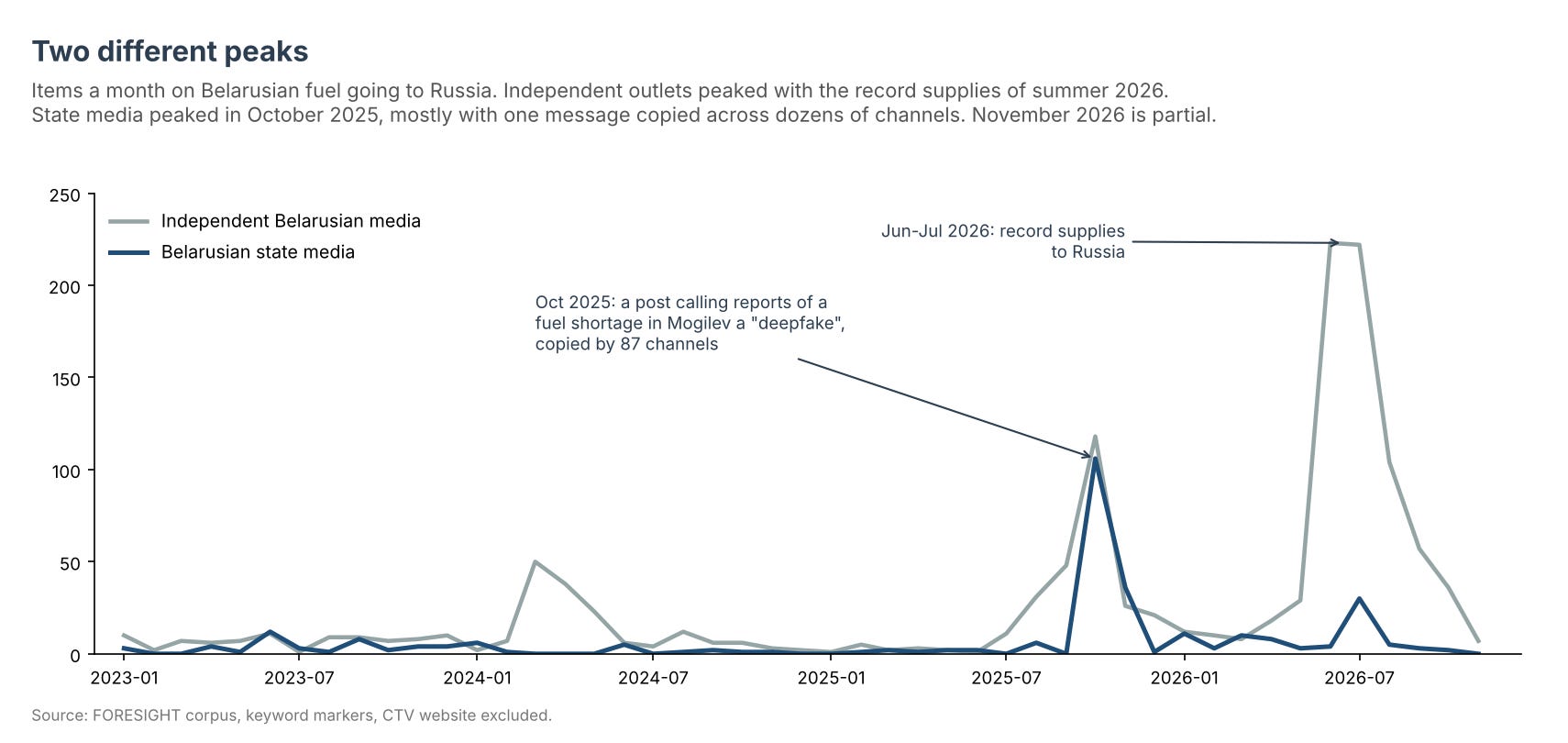
The reason for the supplies appears in 12 of 295 state items. The busiest month for state items on the subject was October 2025, when Russia’s fuel shortage of that year was in the news. Of the 106 state items that month, 86 repeated one message. On 9 October the Information Ministry’s Telegram channel warned of “another deepfake” sent to district and regional newspapers. The fake claimed that supplies to Russia had caused a fuel shortage in Mogilev. “In Mogilev, as across Belarus, there are no interruptions with fuel and there were none,” the ministry said (Information Ministry, 9 October 2025). Within two days 87 channels had posted the same text, from Belorusneft (Belorusneft, 9 October 2025) to universities, a theatre and a sugar plant.
A second wave followed on 12 to 14 November 2025. Thirty-seven channels posted a message saying that “there was and is no fuel shortage in Russia” (Information Ministry, 13 November 2025). By the study’s account, Russia had banned gasoline exports for most of the second half of 2025. Three smaller copied messages followed in October 2025 and January 2026. Together, five copied messages make up about 155 of the 402 state and pro-government items on fuel for Russia. The state’s busiest month on the subject was a denial.
Outside those waves, state media wrote mostly to reassure. In July 2026, at the peak of supplies, the BTRC news channel posted that the problems with gasoline in Russia were “not as terrible as the internet makes out” (BTRC News, 10 July 2026). Our markers found six state items that mentioned what Belarus earned. In November 2025 SB quoted Dmitry Krutoy, head of Lukashenko’s administration, saying that tolled crude was being refined at both refineries, with the products going to Russia, and that the refineries were returning to a steady profit (SB, 30 November 2025). Mlyn, which we class as state media, went furthest on scale. A July piece on the rouble said Belarus was selling “huge volumes” of gasoline and diesel to Russia, 20 to 30 times more than a year earlier. By its account, Belarus had covered more than 10% of the Russian market in June and was earning “big rouble revenues” (Mlyn, 20 July 2026). The piece did not mention the strikes. The study warns against reading the supplies politically. State media follow that advice by saying very little.
The state’s busiest month on the subject was a denial.
What independent outlets said
Independent coverage peaked with the supplies, at 223 items in June 2026 and 222 in July. These outlets named the strikes in 520 of 1,241 items and wrote about Belarusian gains in 82. In September the head of Belneftekhim, Ilya Ikan, told the concern’s in-house journal that “the industry worked profitably”. Euroradio reported that, thanks to the shortage in Russia, Belarusian refineries had made their highest profit in a decade (Euroradio, 9 September 2026). Pozirk carried it the same day (Pozirk, 9 September 2026). No state item on fuel for Russia mentioned the interview. The study itself reached our corpus through Pozirk and Svaboda on 10 November (Pozirk, 10 November 2026; Svaboda, 10 November 2026). No state item mentioned it either.
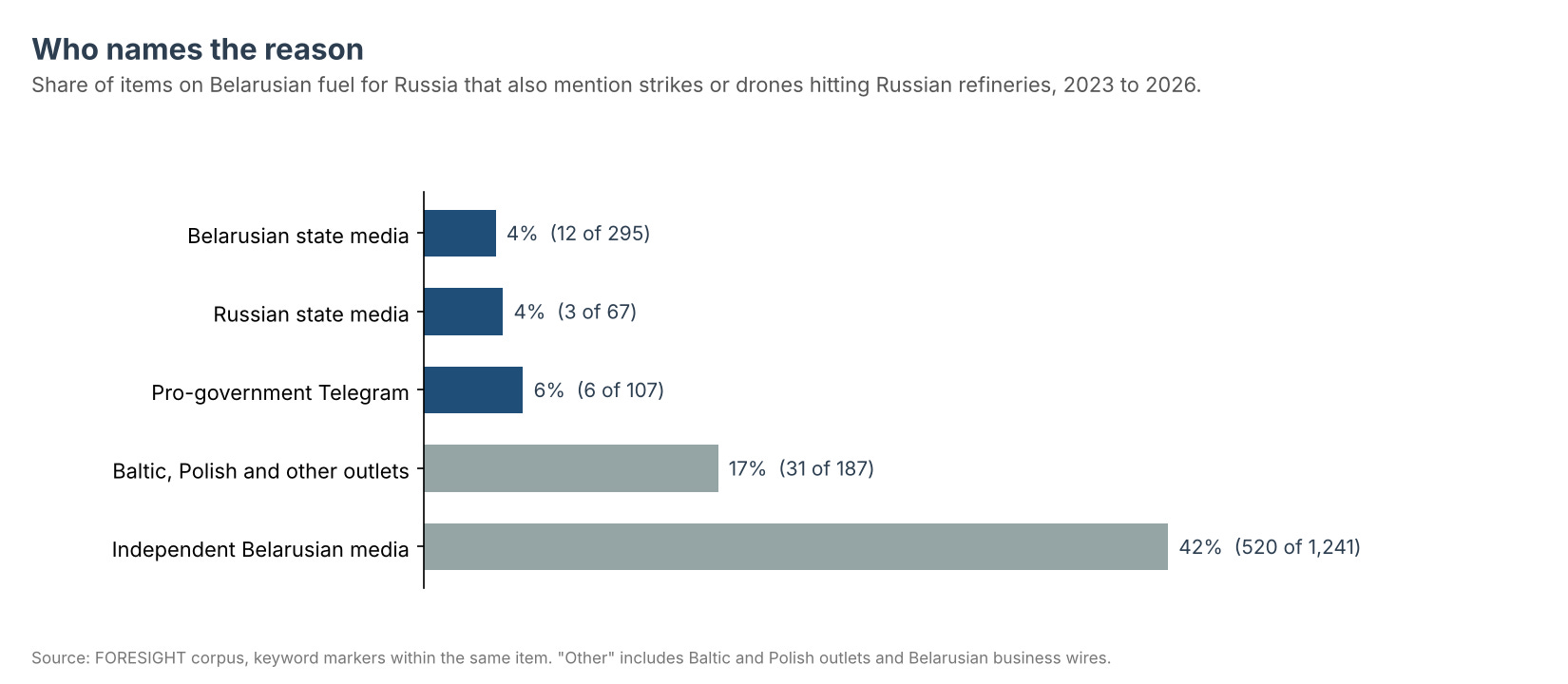
Belarus earned from Russia’s shortage, and its state media rarely say why there was one.
How sure we are
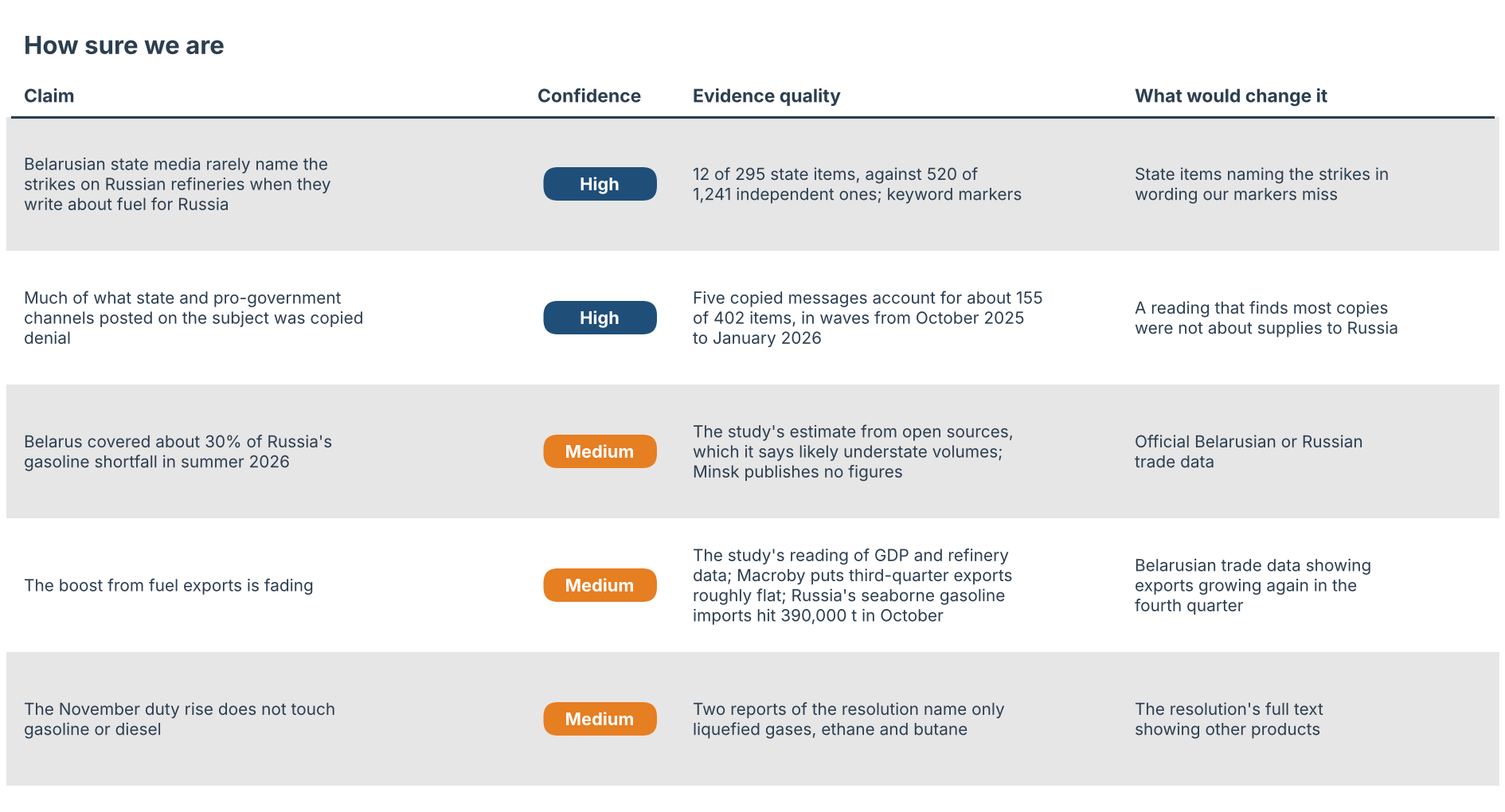
Belarusian state media rarely name the strikes on Russian refineries when they write about fuel for Russia. High. We found 12 of 295 state items naming them, against 520 of 1,241 independent ones, with keyword markers. State items naming the strikes in wording our markers miss would change it.
Much of what state and pro-government channels posted on the subject was copied denial. High. Five copied messages account for about 155 of 402 items, in waves from October 2025 to January 2026. A reading that finds most copies were not about supplies to Russia would change it.
Belarus covered about 30% of Russia’s gasoline shortfall in summer 2026. Medium. This is the study’s estimate from open sources, which it says likely understate volumes; Minsk publishes no figures. Official Belarusian or Russian trade data would change it.
The boost from fuel exports is fading. Medium. It is the study’s reading of GDP and refinery data. Macroby estimates third-quarter exports as roughly flat, while growth of 2.9% came from consumer demand. Russia’s seaborne gasoline imports reached 390,000 tonnes in October, almost twice Belarus’s record month. Belarusian trade data showing exports growing again in the fourth quarter would change it.
The November duty rise does not touch gasoline or diesel. Medium. Two reports of the resolution name only liquefied gases, ethane and butane. The resolution’s full text showing other products would change it.
How it fits
This bears on T4, that incidents come with synchronous information activity. Here the incident was a claimed deepfake. The response was one text posted by 87 channels within two days, then another posted by 37 channels a month later. Both also ran on the Information Ministry’s channel, and the copies kept the wording unchanged. Belarus earned from Russia’s shortage, and its state media rarely say why there was one.
State media follow that advice by saying very little.
What to watch
By 31 December 2026. A Belarusian state outlet publishes official figures, in tonnes, for gasoline exports to Russia in 2026. Expectation: no. Confidence: medium.
By 28 February 2027. Belstat’s first estimate puts GDP growth for 2026 within Macroby’s forecast range of 2 to 2.3%. Expectation: yes. Confidence: medium.
By 31 January 2027. Another message on fuel is copied by more than 20 state channels within two days. Expectation: yes, if Russian shortages return. Confidence: low.
Method and limits
Counts come from the FORESIGHT corpus from January 2023, with the CTV website left out. An item counts as being on fuel for Russia when two conditions hold. Gasoline, diesel, fuel or oil products appear in the same sentence as Russia as a destination or buyer, within 120 characters. Belarus or its refineries are named somewhere in the item. An item names the strikes when strikes, attacks or drones appear within 120 characters of refineries in one sentence. Gains mean words such as profit or income in one sentence with refineries or fuel. Copied messages were grouped by identical opening text. The study’s figures are its own estimates; we did not check them against trade data, which Minsk does not publish. Duty rates come from two reports of the resolution, not from its text. The Financial Times, Kpler and Finam figures are taken as Reform.news reported them.
Thesis tag: T4.