

WIPO published the GII 2026 economy profiles at the end of September. The Belarus profile (PDF) gives the country 88th place among 139 economies, with a statistical confidence interval of 78 to 95. Among the 35 upper middle-income economies it is 28th. Among the 39 economies WIPO files under Europe it is 39th, the last line of the regional table.
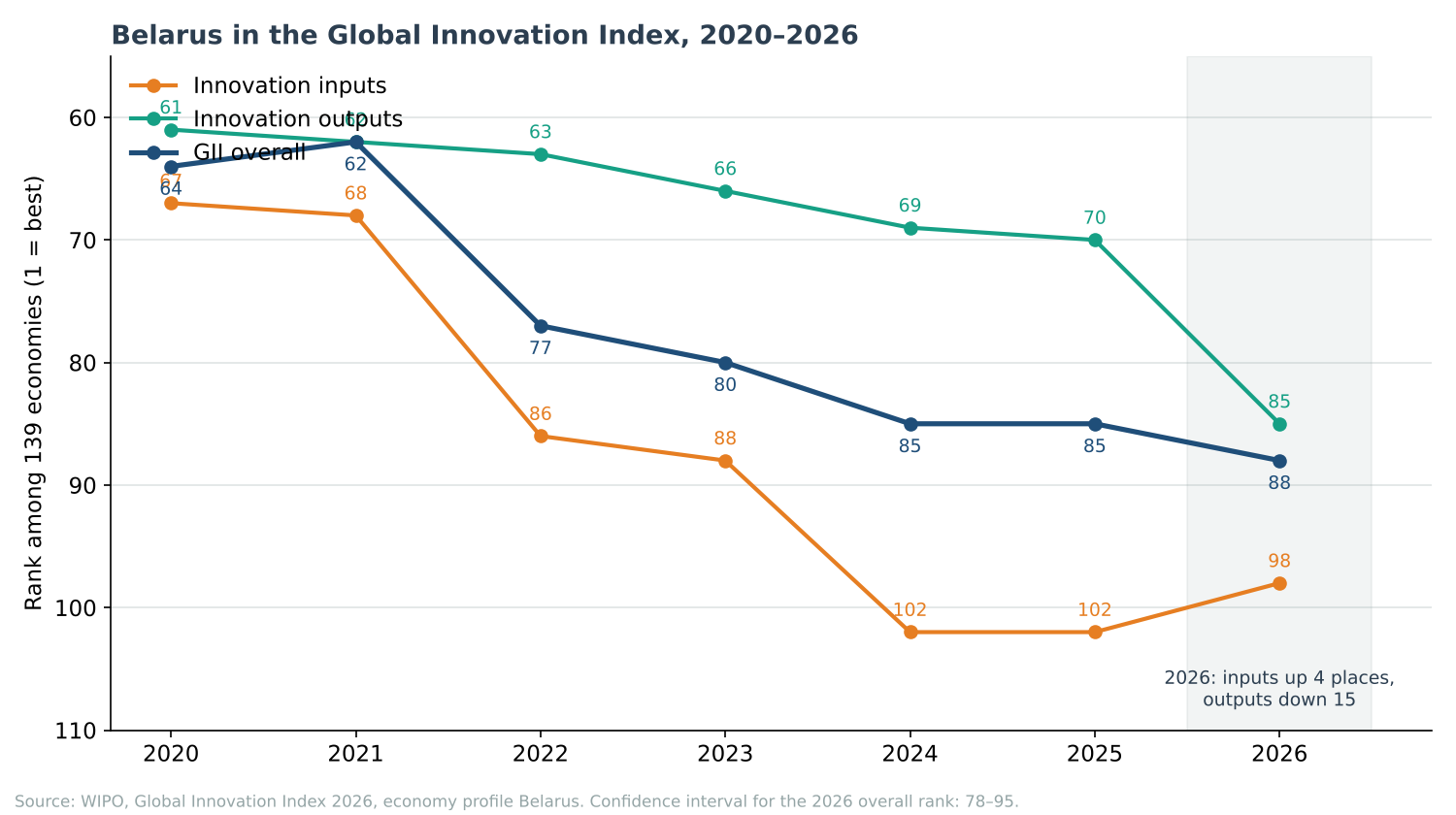
The overall rank has moved in one direction for five editions. Belarus was 64th in 2020 and 62nd in 2021, then 77th, 80th, 85th, 85th and now 88th. The profile warns that data availability and framework changes affect year-on-year comparisons. With that warning in place, the 2026 step down still has a clear source.
Where the three places went
The index is the average of two sub-indices. On innovation inputs, Belarus improved this year, from 102nd to 98th. On innovation outputs it fell from 70th to 85th. The three-place loss in the overall rank is the net of a four-place gain on one side and a fifteen-place loss on the other.
Inputs improved by four places. Outputs fell by fifteen. The overall rank records the difference.
The output side of the profile names the indicators that moved. Production and export complexity fell 8.1% to a score of 0.79 in 2024. Patents by origin fell 9.3% to 342. Scientific publications fell 8% in the 2024–2025 window of the Innovation Tracker. The count of national feature films went from three to two. None of these is large on its own. Together they take the output sub-index from a rank it had held within a ten-place band since 2020 and drop it into the eighties.
The input side moved the other way for reasons the profile also lists. R&D investment rose 6.5% in the 2023–2024 window, international patent filings rose 46.2% in 2024–2025, and expenditure on education reached 5.05% of GDP in 2024. So the two halves of the index diverged. The inputs recovered a little from the 102nd place of the previous two editions. The outputs lost the advantage that had kept Belarus in the “efficient” part of WIPO’s input-output chart. The profile still places Belarus above the fitted line on that chart, and below the trend line on the chart of GII score against GDP per capita, at 34,069 PPP dollars.
The widest spread in the table
Belarus is 38th in the world on human capital and research and 134th on institutions. That is a spread of 96 places between the strongest and the weakest of the seven pillars. On institutions, only five economies rank below Belarus.
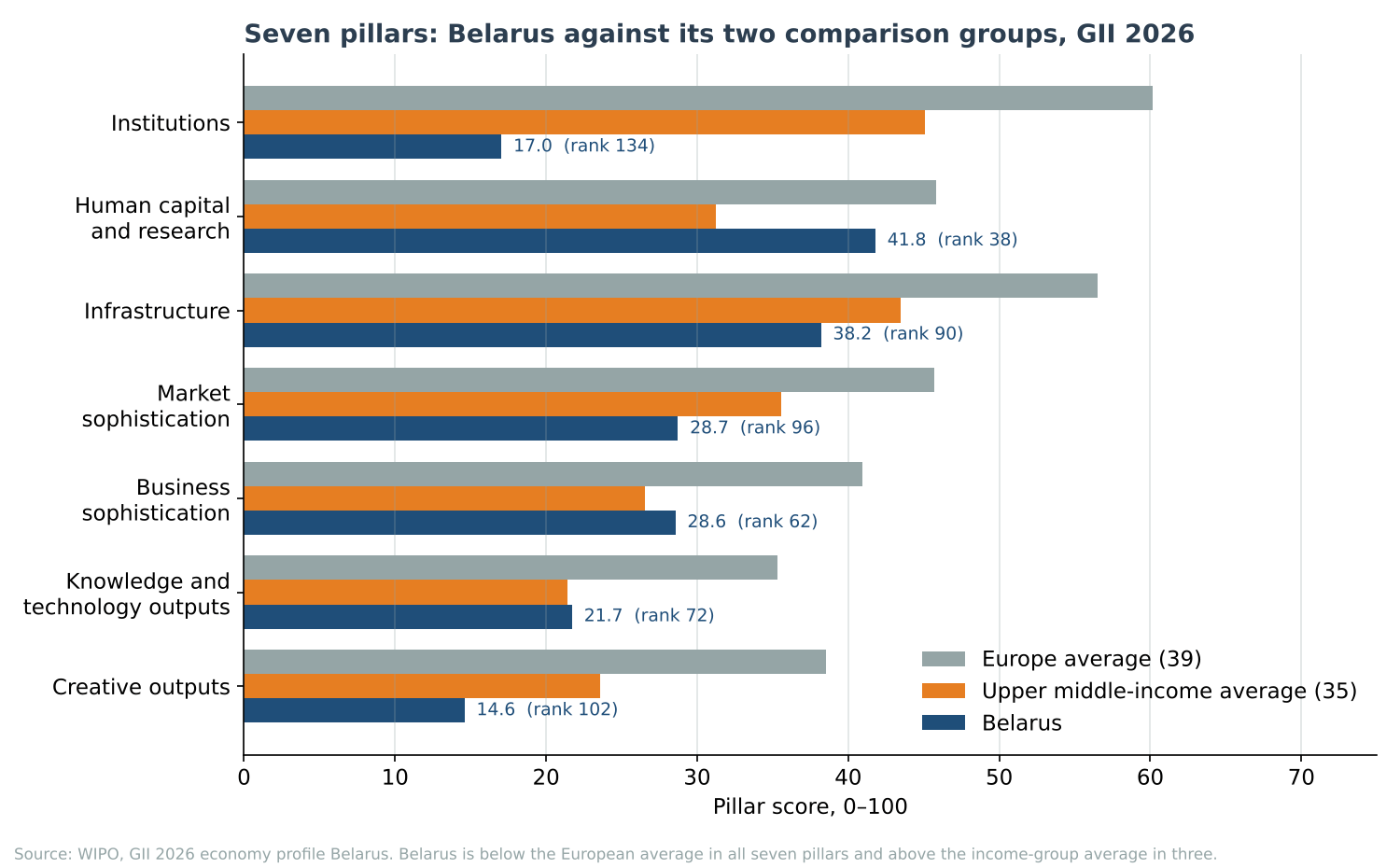
The human-capital pillar is built on indicators where Belarus scores near the top of the index: government funding per secondary pupil at 34.5% of GDP per capita (4th), graduates in science and engineering at 35.4% of all graduates (7th), and research talent in businesses at 59.4% (17th). These are the figures state officials quote.
Fourth in the world on funding per pupil, 134th on regulatory quality: the same country, the same table.
The institutions pillar is built on four index-based indicators, and all four place Belarus near the bottom: regulatory quality 134th, rule of law 130th, operational stability for businesses 123rd, government effectiveness 116th. The pillar score is 17.0, against a European average of 60.2 and an upper middle-income average of 45.1. The third sub-pillar of institutions, business environment, is printed in square brackets, which means the data coverage requirement was not met.
Against its income group Belarus is above average in three pillars: human capital and research, business sophistication, and knowledge and technology outputs. Against Europe it is below average in all seven.
What the state cited in January
On 26 January 2026 pravo.by reported the year-end briefing of Tatyana Stolyarova, deputy chair of the State Committee on Science and Technology. She gave the 2025 rank, 85th, and then four indicators on which Belarus was in the world’s top twenty: 3rd on ISO 9001 quality certificates, 3rd on graduates in science and engineering, 11th on mobile app creation, 20th on utility models.
One edition later, the same four indicators read 69th, 7th, 32nd and 20th.
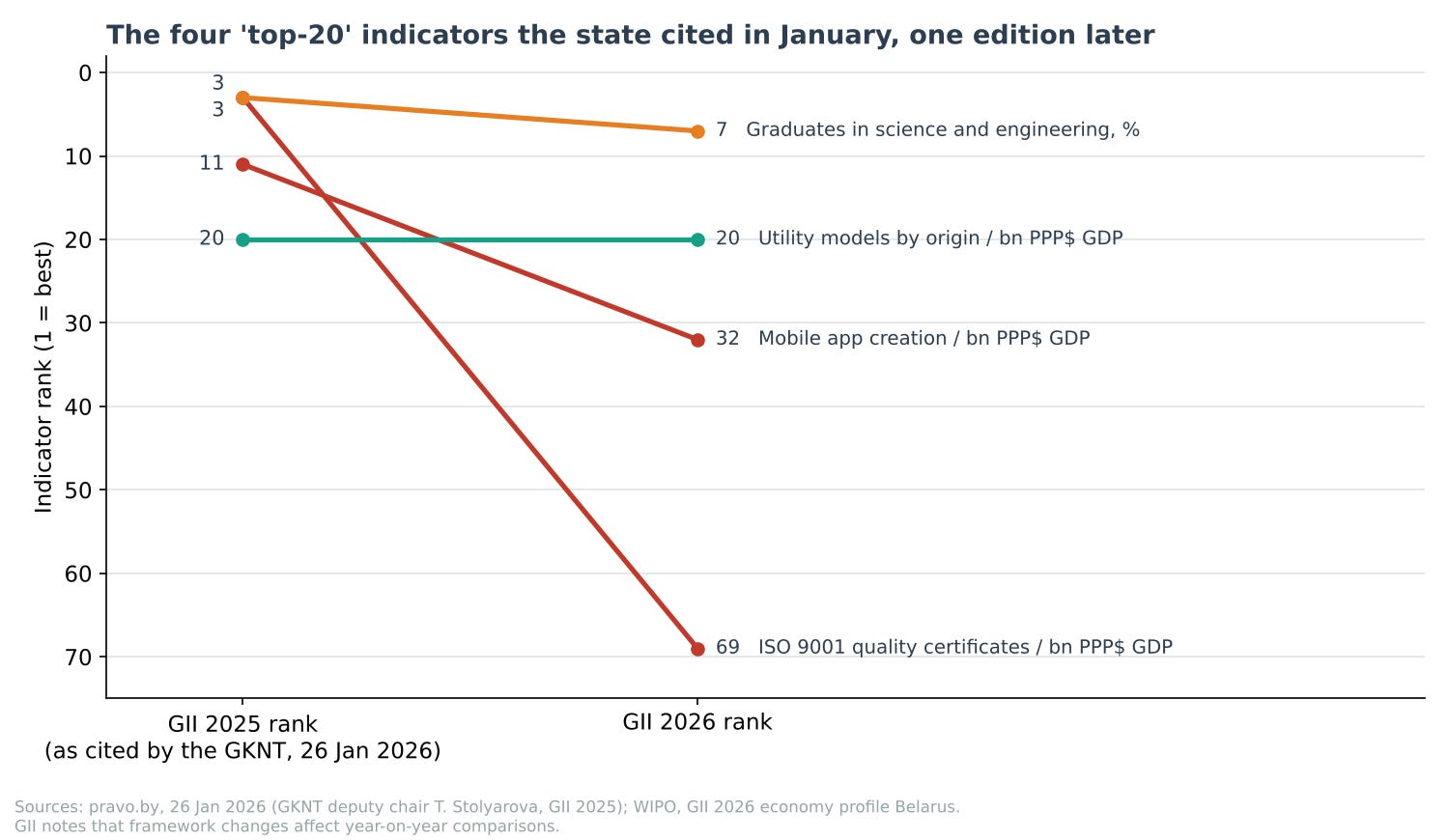
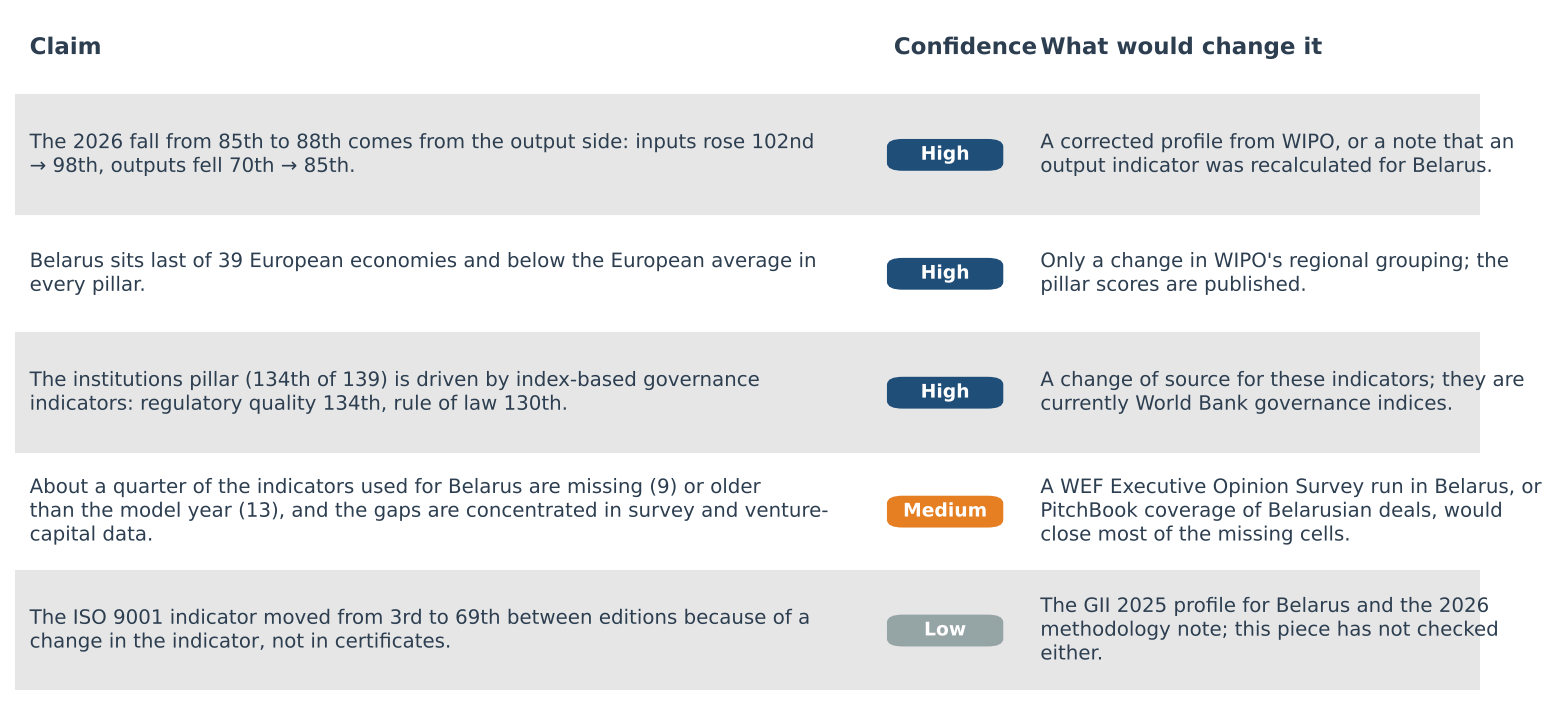
The utility-models rank held. The graduates rank slipped four places. The mobile-app rank fell by 21 places even though the underlying figure rose 5.2% to 188.9 million downloads, which means other economies moved faster. The ISO 9001 rank went from 3rd to 69th. A fall of that size in one year is more likely a change in how the indicator is built than a change in the number of certificates, and the profile does not say which. This piece has not checked the 2025 profile against the 2026 methodology note; the claim stays at low confidence in the table below.
The ISO 9001 rank went from third to sixty-ninth in one edition. The profile does not say why.
How much of the index is missing
The profile lists nine missing indicators and thirteen outdated ones. Three of the missing cells come from one source: the World Economic Forum’s Executive Opinion Survey, which supplies policy stability, university-industry R&D collaboration and the state of cluster development. Belarus has no survey data. Three more cells are venture-capital measures from PitchBook, one is the Brand Finance intangible-asset measure, and one is the PwC entertainment-and-media market figure. The ninth is aviation import dwell time.
The outdated cells are older in a different way. PISA scores are from 2018 against a model year of 2022. Domestic credit to the private sector, high-tech imports, high-tech exports and creative goods exports are all from 2021 against 2024. High-tech manufacturing and domestic industry diversification are from 2020 against 2023.
Nine indicators are missing and thirteen are older than the model year. Several of the stale ones are the ones that fell.
The second list matters for the first section of this piece. Some of the output indicators that moved this year rest on data from 2020 or 2021. The rank shift is real inside the index. Whether it describes 2025 is a separate question that the profile cannot answer.
The special theme of GII 2026 is deep-science entrepreneurship. The Belarus table has one entry: Cropfleet, food and agritech, Minsk, founded 2020, 0.1 million dollars of venture funding raised, valuation shown as 0.00 billion.
Confidence
Watch items
GII 2027, expected September 2027. If the output sub-index returns above 80th while inputs stay near 98th, the 2026 output drop was a data artefact. If outputs stay in the eighties, it was a trend.
Same edition. Whether the three Executive Opinion Survey indicators remain n/a for Belarus. They have been missing since the survey stopped covering the country, and their absence caps the institutions pillar from below.
QS World University Rankings 2027. The Belarusian State University stands at 447 with a score of 34.60; the profile’s QS indicator rose 21.6% this year on that basis. A move of BSU out of the top 500 would reverse it.
Next GKNT year-end briefing, January 2027. Which indicators are cited, and whether ISO 9001 is still among them.
Method and limits
The piece uses one document, the WIPO GII 2026 economy profile for Belarus, plus one state report of the previous year’s figures. Ranks and scores are copied from the profile’s tables. The 2025 ranks for the four cited indicators come from the pravo.by report of the GKNT briefing and were not checked against the GII 2025 profile. The GII changes its indicator set and sources between editions, and the profile’s own note on year-on-year comparison applies to every comparison made here. No corpus query was run for this piece; media coverage of the release was not counted.