

This spring a phone survey and an online survey asked Belarusians whether their finances had improved over the year, a month apart. They got opposite answers. Official statistics put real incomes up by about 8%, and state media spent the spring writing about rising prices in other countries.
In May the Center for New Ideas (CNI) asked Belarusians by phone how their finances had changed over the past year. A third said better and 16% said worse. A month earlier the MacroBY project asked city dwellers online about their family’s finances against a year ago, and 20% said better while 32% said worse. Belstat put real disposable income up 7.9% in January to May. What we cannot see is how the people who declined CNI’s call, more than nine in ten of those reached, would have answered.
Two samples, one question
CNI reached 1,003 adults by random digit dialling in May, and half of them, 508 people, got the questions on domestic life (CNI, PDF). Asked how their personal financial situation had changed over the past year, 23.5% said it had improved and 9.3% that it had somewhat improved. Half said nothing had changed. 10.8% said it had worsened and 4.9% that it had somewhat worsened. The response rate was 7%, and the authors treat their loyalty figures as upper bounds. They also write that the economic questions are likely the most reliable part of the survey.
The first report on the survey came from Euroradio on 12 November. It led with the 87% who are satisfied and with the response rate: only one person in fourteen agreed to answer (Euroradio, 12 November 2026). From the economic block it carried the 43% who named rising prices and the 16% whose finances had worsened. It did not mention the third who said they were better off. On 13 November it was still the only item on the survey in our corpus, and no state outlet had reported it.
MacroBY runs a quarterly online survey of 1,005 city dwellers aged 18 to 64. In April, 32% said their family’s material situation had worsened compared with a year earlier, and 20% said it had improved (Zerkalo, 19 May 2026; MacroBY, 18 May 2026). In October 2025 the split had been 34% worse and 19% better, with 43% reporting no change (Belmarket, 20 December 2025).
The balance of better over worse is plus 17 points by phone and minus 12 online. The surveys differ in mode, in who they cover and in wording. CNI asks all adults about their personal finances. MacroBY asks urban residents under 65 about their family. None of these differences is small, and the published figures cannot show which one matters most.
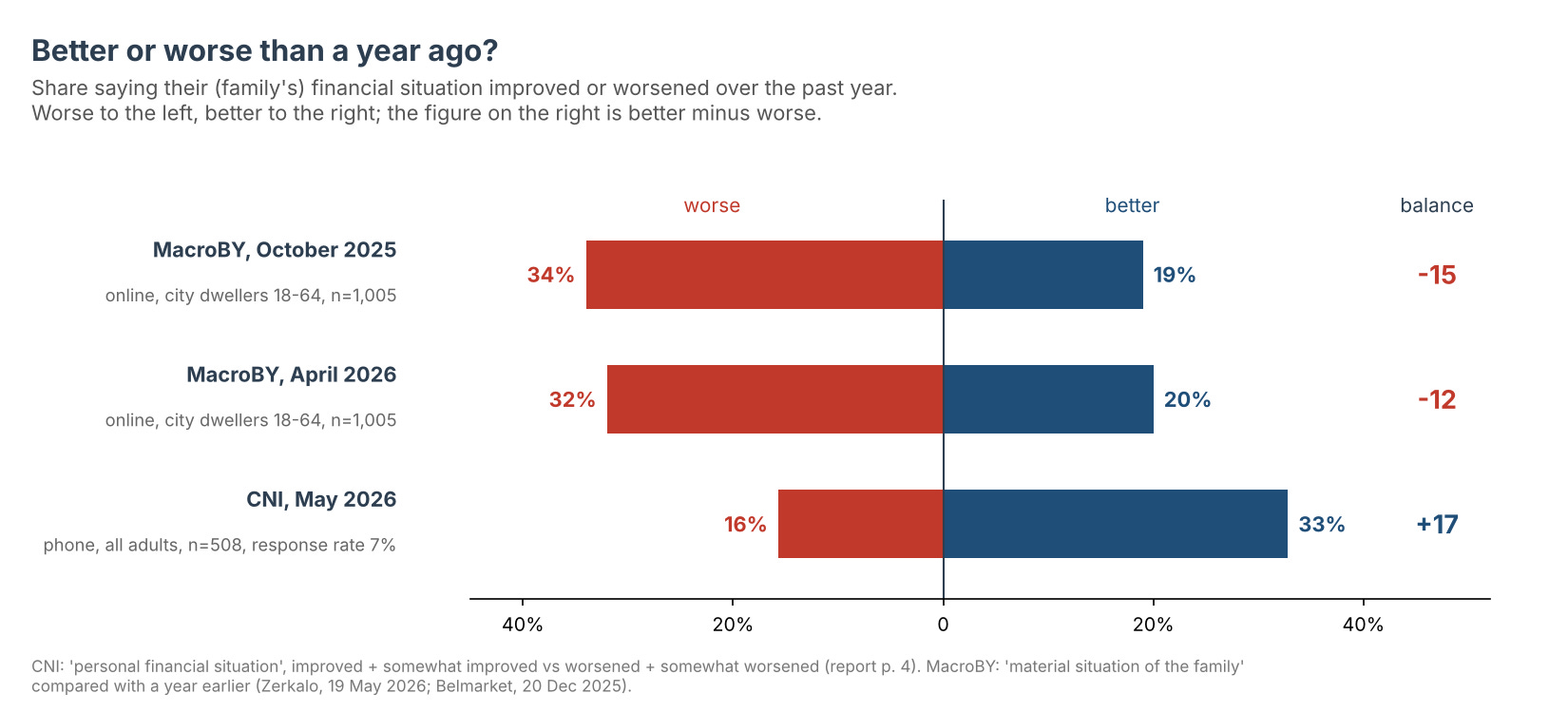
Neither survey shows a majority who feel the growth.
What Belstat counted
Over the same months, official statistics show households growing richer. Real disposable money income rose 7.9% in January to May against the same months of 2025 (Belstat, 15 July 2026), after 9.6% for 2025 as a whole (Belstat, 17 February 2026). Real wages were up 7.1% year on year in May (Prime-TASS, 24 June 2026). Consumer prices rose 4.8% over the year to May (Prime-TASS, 10 June 2026). In February Lukashenko complained that real wages, up 9% in 2025, were growing faster than productivity, up 1% (BelTA, 17 February 2026).
Neither survey shows a majority who feel the growth. Even in the phone sample, which leans loyal by its authors’ own account, half reported no change. MacroBY asked those who now spend more why they do: 82% named rising prices and 8% a pay rise (Zerkalo, 19 May 2026). In February, about half of its respondents expected prices to rise faster than their income, and 7% expected the opposite (Belmarket, 15 March 2026).
The capital lags the average. Real wages in Minsk rose 5.1% in May, against 7.1% for the country, and 3.9% in February, against 6.5% (Prime-TASS, 24 June 2026; Prime-TASS, 24 March 2026). CNI found the strongest wish for change in Minsk, 30% against 16% in smaller towns, though it calls that difference not robust.
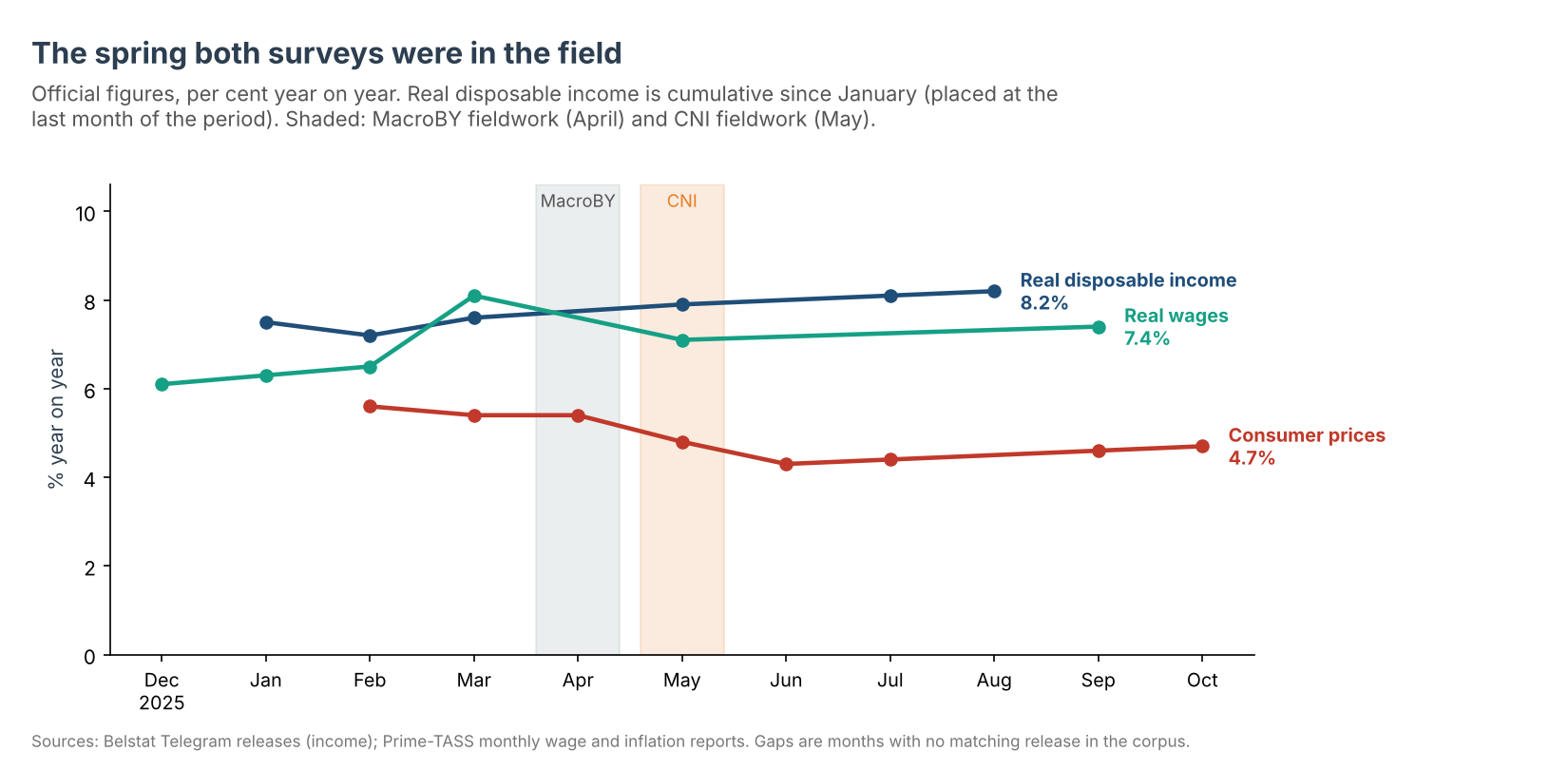
The balance of better over worse is plus 17 points by phone and minus 12 online.
Rising prices, mostly abroad
Rising prices topped CNI’s list of the country’s problems at 43%, well ahead of military threats at 17% and health care at 16%. Among respondents only somewhat satisfied with the situation in the country, the share was 55%.
The survey went into the field after two months in which Belarusian media wrote about rising prices more than at any point since our count begins in January 2025. In March, 1.05% of all state media items mentioned rising prices, against 0.30% in January. In independent outlets the share went from 1.50% to 2.30%.
The state spike had a foreign address. Of 805 state items on rising prices in March and April, 58% mentioned Iran or the Middle East and 63% named a foreign country. Only 16% named Belarus next to the price rise. For 896 independent items the shares were 23%, 47% and 21%. BelTA ran “The conflict in the Middle East hits Europeans’ wallets” (BelTA, 4 March 2026). It followed with a story on fuel prices at German filling stations (BelTA, 4 March 2026) and one on how most Latvians felt the rise in fuel prices (BelTA, 17 March 2026).
Belarusian prices moved too, in small steps. Petrol rose by four kopecks on 28 March and by three more on 4 April (BelTA, 27 March 2026; BelTA, 4 April 2026). Belneftekhim called it a “step-by-step adjustment” (Sputnik Belarus, 27 March 2026). State media also showed the price controls at work, with a BelTA feature on how the antimonopoly and trade ministry tracks prices along the supply chain (BelTA, 10 March 2026).
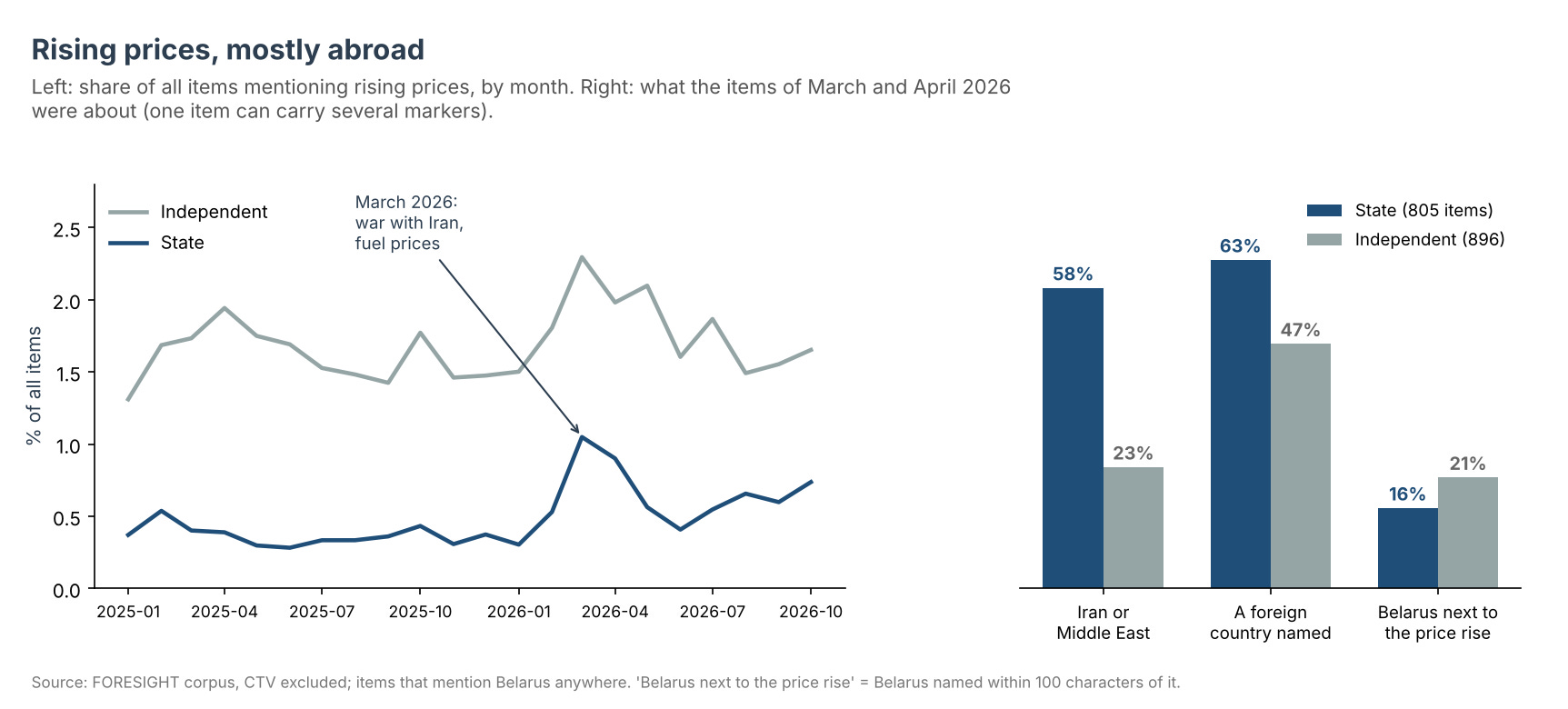
The state spike had a foreign address.
A comparison to leave out
CNI’s report sets the 47% who expect improvement next year against the 33% who say their situation improved last year. It reads the gap as optimism, possibly fed by official media. The two figures come from different halves of the sample: the past-year question was in Version A, and expectations were in Version B. They also ask about different things. The first is about personal finances, while the second is about the socioeconomic situation of the country. MacroBY asks about the family both ways. Its April figures were 32% expecting improvement and 15% expecting worse. Within that one sample the balance runs from minus 12 looking back to plus 17 looking ahead. The tilt toward hope that CNI describes does appear when the same people answer both questions.
Belarusian prices moved too, in small steps.
How sure we are
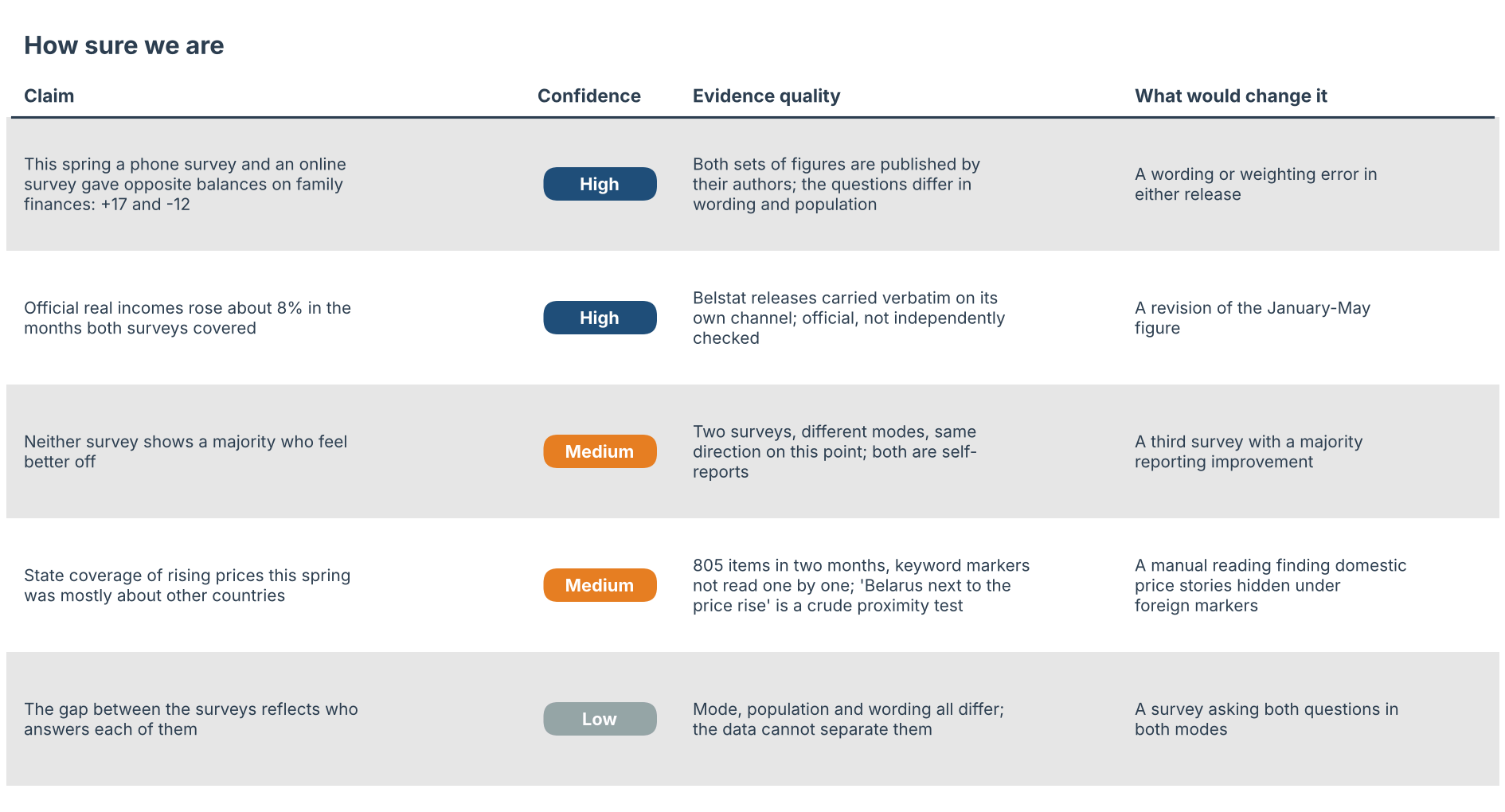
This spring a phone survey and an online survey gave opposite balances on family finances: +17 and −12. High. Both sets of figures are published by their authors, but the questions differ in wording and population. A wording or weighting error in either release would change it.
Official real incomes rose about 8% in the months both surveys covered. High. The Belstat releases are carried verbatim on its own channel; they are official and not independently checked. A revision of the January to May figure would change it.
Neither survey shows a majority who feel better off. Medium. Two surveys in different modes point the same way on this, and both are self-reports. A third survey with a majority reporting improvement would change it.
State coverage of rising prices this spring was mostly about other countries. Medium. It rests on 805 items in two months with keyword markers, not read one by one, and the test for Belarus next to the price rise is crude. A manual reading that finds domestic price stories under foreign markers would change it.
The gap between the surveys reflects who answers each of them. Low. Mode, population and wording all differ, and the data cannot separate them. A survey asking both questions in both modes would settle it.
How it fits
We read MacroBY’s July wave in “Household Finances Under Pressure” in September, and price coverage against record-low inflation in “What Belarus’s Record-Low Inflation Doesn’t Cover” in July. This piece adds a second survey and a different method. CNI’s own conclusion is that comparisons inside one survey are more reliable than its levels, and the comparison with MacroBY bears that out. Anyone who quotes the phone figure that a third of Belarusians are better off should quote the online figure of one in five next to it. The official 8% belongs next to both. The thesis model does not cover this; we record it as an observation.
What to watch
By 18 November 2026. Belstat publishes real disposable income for January to September. Expectation: between 107.8% and 108.5% of the same months of 2025. Confidence: medium.
By 10 December 2026. Belstat publishes November consumer prices. Expectation: annual inflation between 4.5% and 5.2%. Confidence: medium.
By 31 December 2026. MacroBY publishes its autumn wave. Expectation: more city dwellers again say their family’s finances worsened than improved. Confidence: medium.
Method and limits
The survey figures are the authors’ own, taken from the CNI report and from MacroBY releases as carried by Zerkalo and Belmarket. Official figures come from Belstat’s Telegram releases and Prime-TASS monthly reports; months without a matching release are left blank. Coverage of the CNI survey was searched across the whole corpus from 1 November by the centre’s name, its abbreviation and the survey’s figures. Price-rise shares count items in the FORESIGHT corpus that mention rising prices and Belarus anywhere, with the CTV website left out. Topic markers are word stems, and one item can carry several. “Belarus next to the price rise” means Belarus is named within 100 characters of it.
Thesis tag: none (observation).