
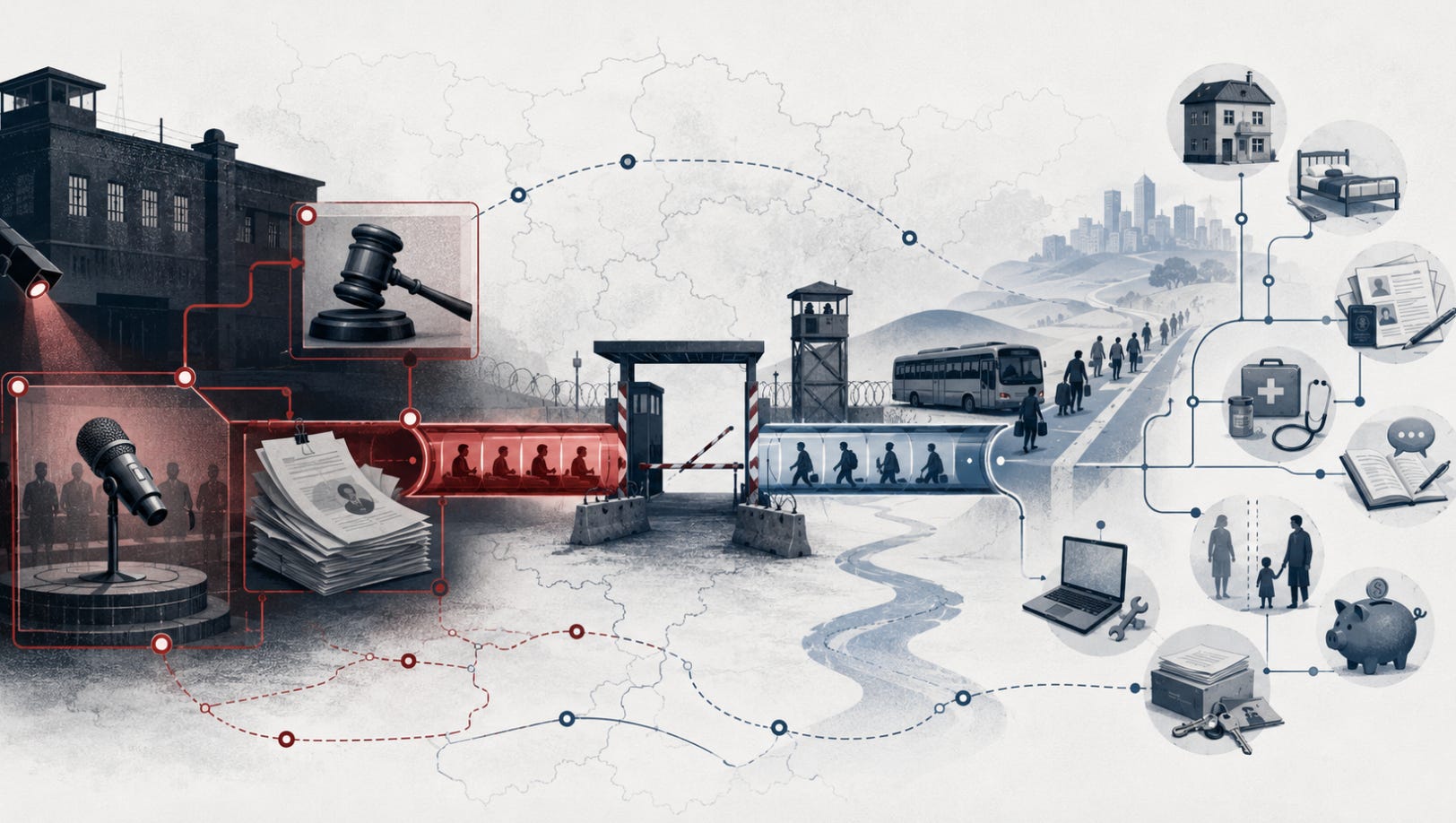
There is a comfortable way to read the past eighteen months. In 2025, negotiations between Minsk and Washington produced the release of 192 prisoners, most of them recognised political prisoners, among them 14 journalists and two bloggers. In March 2026, after US Special Envoy John Cole visited Minsk, another 250 were released, 15 of whom — including journalist Katsiaryna Bakhvalava (Andreyeva) and blogger Eduard Palchys — were moved to Lithuania. On that reading, the cells are emptying and the trend line points down.
The Belarusian Association of Journalists has now published the uncomfortable reading. Its report, Release into Exile: The Expulsion of Imprisoned Journalists from Belarus, makes a claim that is legal rather than rhetorical: what happened in five stages between February 2025 and March 2026 was not release but deportation. Deportation of a state’s own nationals is prohibited in international law, and where it forms part of a widespread or systematic attack on a civilian population it is a crime against humanity under Article 7(1)(d) of the Rome Statute — aggravated, BAJ argues, into persecution under Article 7(1)(h), because the group being removed was defined by political opinion.
That is a heavy charge, and the report earns it slowly: first the factual record, then the international qualification, then the domestic-law audit, then the human-rights inventory, then the consequences in exile. It is worth following in that order, because the argument’s force comes from the pattern rather than from any single case.
The record
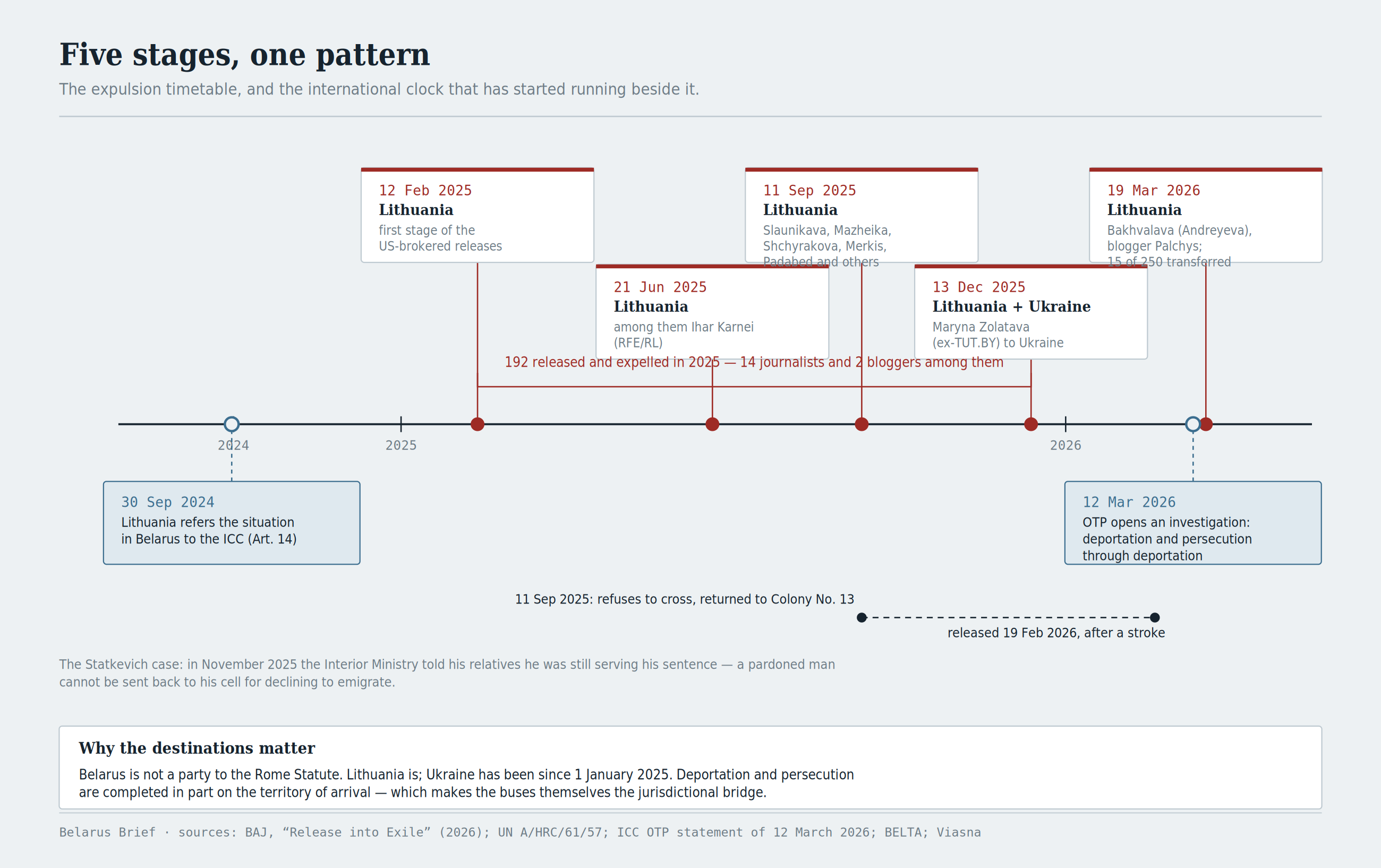
The stages were 12 February, 21 June, 11 September and 13 December 2025, and 19 March 2026. Four sent people to Lithuania; the December operation split between Lithuania and Ukraine. What makes them a pattern rather than a series of separate deals is that the procedure repeated itself with almost no variation.
Nobody was told in advance. Most of those released had never signed a petition for pardon. At no point was consent requested, formally or informally, and where journalists said out loud that they did not want to leave Belarus, the objection was disregarded. Officers of the KGB who took them from the colonies did not identify themselves and produced no documents; in several cases detainees were moved handcuffed, with bags over their heads, along country roads to buses waiting at the border. Some were held overnight in the KGB pre-trial facility in Minsk on the way out.
Then the paperwork problem, which is not a clerical detail but the mechanism that makes the punishment permanent. None of the expelled received a document confirming their status. That means a released journalist cannot answer the only question that matters — whether crossing back would mean re-arrest as a fugitive with a sentence still running. Some left without passports at all. The travel documents of journalist Viachaslau Lazarau and bloggers Dzmitry Kazlou and Eduard Palchys were subsequently annulled. Larysa Shchyrakova, expelled in September 2025 at 52, put the resulting position plainly: she wants to go home, to where her mother is buried.
The hole where the legal basis should be
The strongest chapter of the report is the one that will be hardest for Minsk to answer, because it is written entirely in Belarusian law.
Belarusian law offers a closed list of ways to leave a colony early: parole, commutation to a lighter punishment, release for serious illness or pregnancy, amnesty, pardon. The first four run through a court, with a prosecutor present. No court examined these cases, and in most of them the statutory conditions — portion of sentence served, medical grounds — were not met. The May 2025 amnesty excluded people convicted of “extremist” offences, which covers the majority of political prisoners. That leaves pardon, which is what Lukashenka’s press service and Lukashenka himself have said happened.
But a pardon normally begins with an application from the convicted person, and many of the released say they filed none. The report concedes that this alone would not be decisive — pardons without applications have precedent in Belarus, in 2011 and again in 2015. What is decisive is that no pardon decree covering these groups was ever published, although every other pardon has been announced on the president’s website, and not one of the expelled has received a document confirming one.
And then there is Mikalai Statkevich, whose case functions as a control experiment. On 11 September 2025 he was taken from Colony No. 13 in Hlybokaye to the Kamienny Loh crossing and moved across the border; he refused to enter Lithuania and spent hours in the buffer zone. Belarusian forces took him back into custody and returned him to the colony. In November the Interior Ministry told his relatives he was serving his sentence under the December 2021 judgment. He left prison only on 19 February 2026, after a stroke, in what the president’s press secretary described as a response to his relatives’ appeals. A pardoned man cannot be returned to his cell for declining to emigrate. Either the pardon was not what happened, or a pardon in Belarus is conditional on emigration — and no provision of Belarusian law permits the second reading.
Article 30 of the Constitution guarantees citizens the right to remain in the country, to leave it, and to return without impediment; the only exception is extradition under treaty, which as a rule does not apply to Belarusian nationals. The report walks through the removal procedures that do exist — deportation as an administrative sanction, expulsion on national-security grounds, transfer under readmission agreements — and notes that every one of them applies only to foreign nationals and stateless persons. That is also why the removal of the foreign citizens travelling in the same convoys looks procedurally defective rather than merely harsh: expulsion requires advance notice and a decision, and none of them reports being told the question was even under consideration.
Strip out every lawful procedure and what remains has a name in the Criminal Code. Detention without grounds after release from the facility, followed by forcible transport elsewhere, is the definition of kidnapping under Article 182 — punishable by up to fifteen years.
The other gate
Now set that beside a courtroom in Minsk on 26 June 2026.
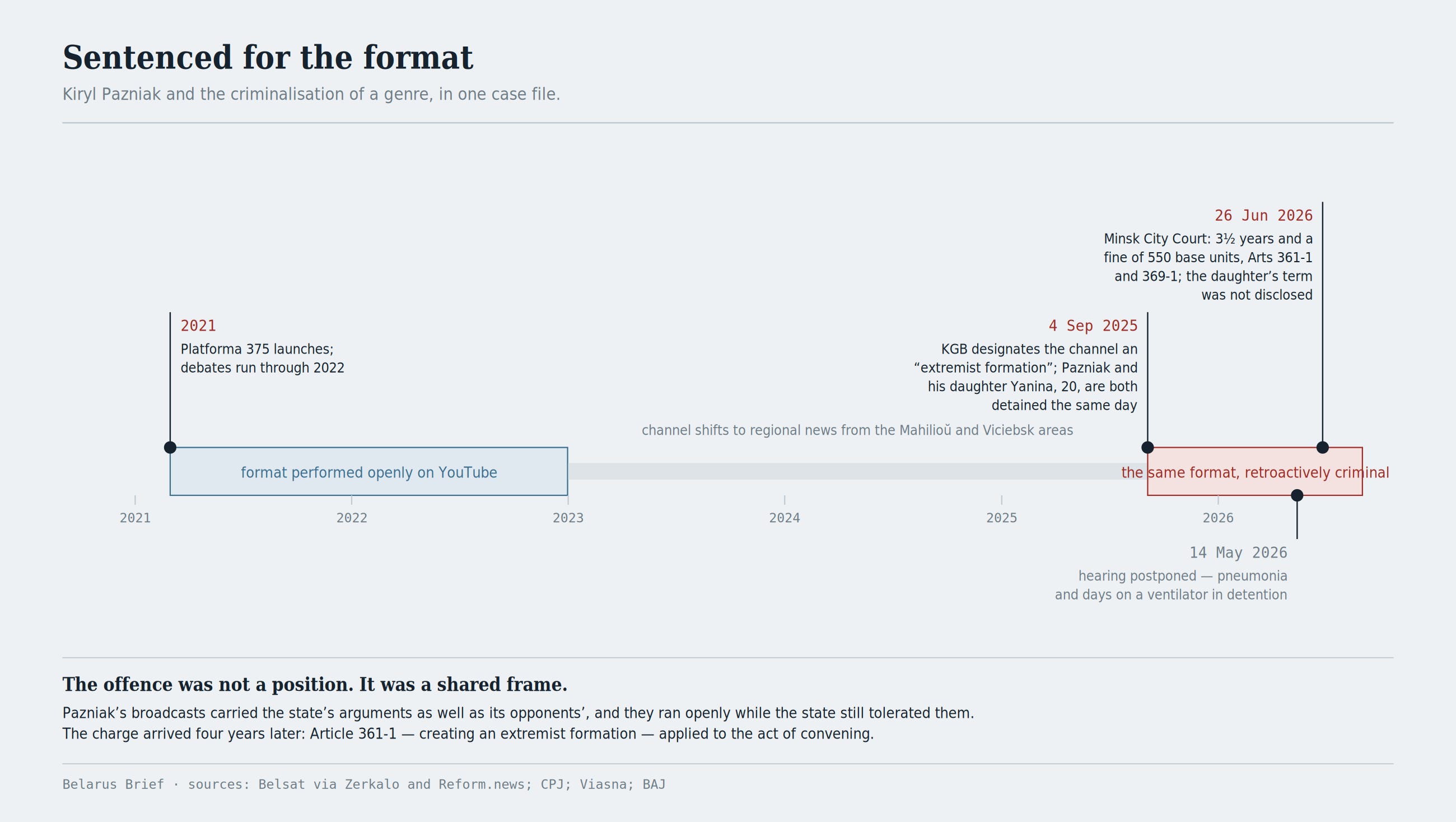
Kiryl Pazniak was sentenced to three and a half years plus a fine of 550 base units, some 24,750 rubles, for creating an “extremist formation” and discrediting Belarus. The formation was Platforma 375, a YouTube channel he launched in 2021 which became known for something now unimaginable in Belarus: debates in which pro-government speakers argued with opponents who had left the country. Pazniak moderated. He described the project at the time as a place where opponents might hear each other and the audience could see more than one position. The channel later moved on to regional news from the Mahilioŭ and Viciebsk areas.
He was detained on 4 September 2025 — the same day the KGB designated the channel an extremist formation and named him its organiser. His daughter Yanina, 20, was detained the same day and convicted alongside him; according to Belsat, the charge against her rests on her having registered the channel’s TikTok account. Her sentence was not disclosed. The trial had to be postponed in May because Pazniak, who contracted pneumonia in detention and spent days on a ventilator, was too ill to attend.
State what was punished here precisely, because the precision is the story. Not a position: Pazniak’s broadcasts carried the state’s arguments as fully as its opponents’. Not clandestine work: the debates ran openly on YouTube in 2021–22, when the authorities still tolerated them. Not foreign funding, the usual pretext. What drew the sentence, four years after the fact, was the format — bringing both sides into a single frame. Article 361-1, creating an extremist formation, was applied to the act of convening. The genre of dialogue was lawful while it was being performed and criminal in retrospect.
One machine
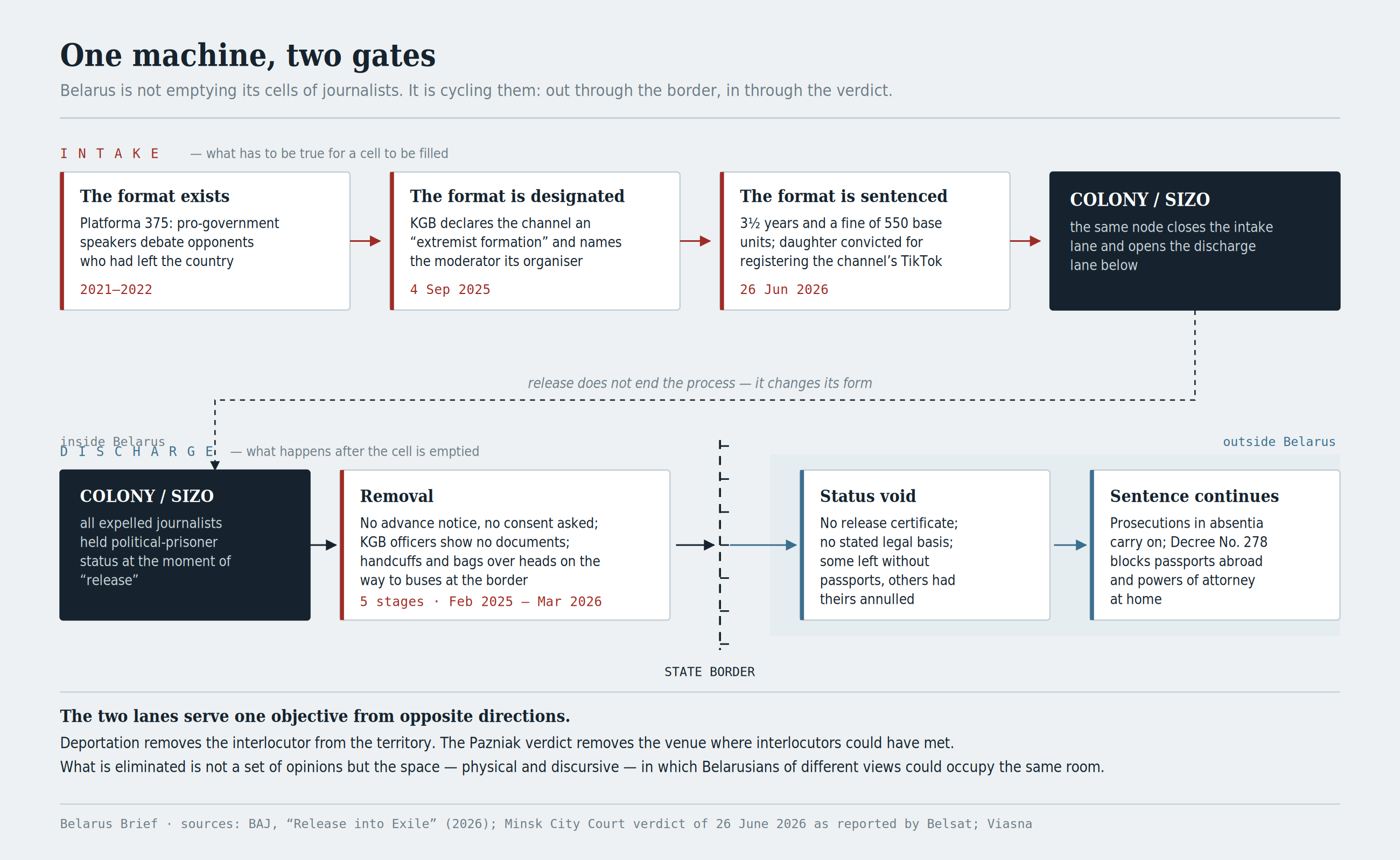
Read together, the report and the verdict stop looking like a thaw and a crackdown running in parallel. They look like discharge and intake on the same conveyor.
At the discharge end, punishment does not end with release; it changes form. The body is relocated across the border, where the sentence continues as loss of family, income, profession, pension, property and legal identity. BAJ’s newsletter records the detail that makes the “release” framing untenable: prosecution of deported journalists continues in absentia. The state that expelled them has not closed their files.
At the intake end, the criteria have been rewritten so that less is needed to fill the cells that emptied. Six journalists were convicted in the three-month window around the March 2026 deportations. The Pazniak verdict shows how little that now takes: not an editorial line, not money from abroad, but a shared frame — and, in Yanina Pazniak’s case, a TikTok registration.
The two operations serve one objective from opposite directions. Deportation removes the interlocutor from the territory. The Pazniak verdict removes the venue where interlocutors could have met. What is being eliminated is not a set of opinions but the space, physical and discursive, in which Belarusians holding different views could occupy the same room. In that light, releasing journalists into exile and jailing a man for putting propagandists and their opponents on one screen are not contradictory policies. They are the same policy, executed at different gates.
The second sentence
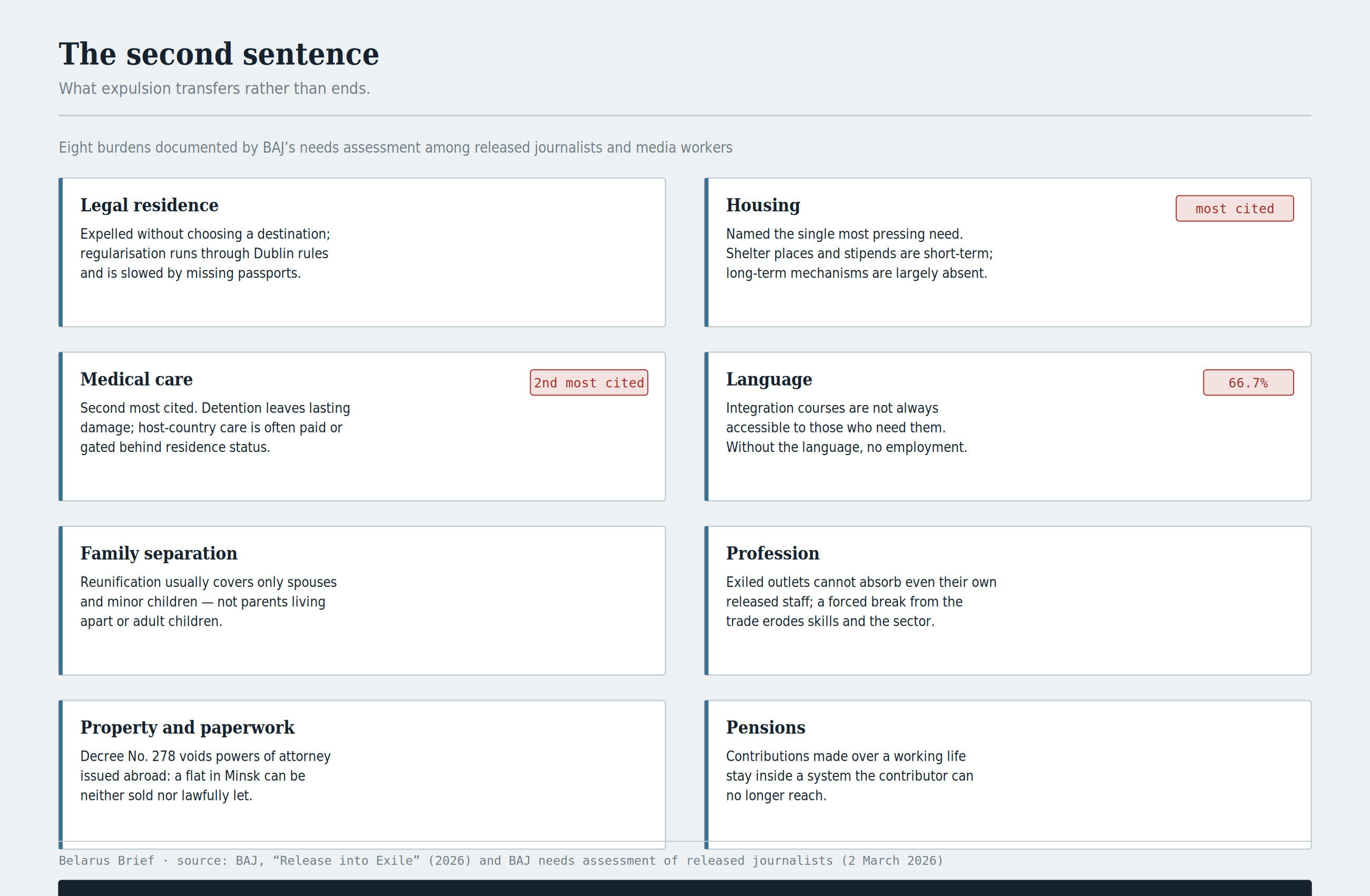
The report’s final section is the least legal and the most immediately actionable, because it rests on BAJ’s needs assessment among the released.
Housing is the most cited need. Medical care is second: detention leaves lasting damage, and host-country care is frequently paid or gated behind residence status the new arrival does not yet have. Two-thirds of respondents — 66.7% — need language training, without which employment is closed off. Legalisation has to be sorted out in a country nobody chose, under Dublin rules, and missing or annulled passports lengthen every procedure. Reunification usually reaches spouses and minor children, not parents living separately or adult children, so part of each family stays behind by operation of law rather than by choice. Exiled outlets cannot absorb even their own released staff, so experienced journalists leave the trade — a loss the report treats as systemic rather than personal. Presidential Decree No. 278 of September 2023 completes the design: no passports issued abroad, no powers of attorney honoured at home, so a flat in Minsk can be neither sold nor lawfully let, and a certificate the host authorities are asking for cannot be obtained. Pension contributions made across a working life stay inside a system the contributor can no longer reach.
The report adds one observation that support organisations should read twice: released journalists tend to underestimate their own need for psychological help, which means assistance has to be offered rather than waited for.
Why the ICC section is not decorative
BAJ’s legal framing has a live addressee. Following Lithuania’s Article 14 referral of 30 September 2024, the ICC Prosecutor announced on 12 March 2026 the opening of an investigation into the Lithuania/Belarus situation, on a jurisdictional theory that fits this fact pattern exactly. Belarus is not a party to the Rome Statute; Lithuania is. Deportation and persecution through deportation are extraterritorial by nature, completed at least in part on the territory of arrival. The buses are the jurisdictional bridge — which is why the expulsion of journalists sits inside the investigation’s subject-matter scope rather than beside it.
The report then pushes on the natural next question. The December 2025 stage sent prisoners — among them Maryna Zolatava, former editor-in-chief of TUT.BY, held four and a half years — to Ukraine, a state party since 1 January 2025. Drawing on the Georgia, Afghanistan and Myanmar/Bangladesh decisions, BAJ argues that a situation’s territorial parameters can widen where the additional acts are sufficiently linked to it, and that for crimes against humanity the link runs through the contextual element rather than through an armed conflict. Lithuania’s own referral anticipated this, stating that part of the elements of these crimes was committed on the territory of other states parties.
Whether the Prosecutor takes that step is the concrete thing to watch. It determines whether the victims of the December transfer have a forum at all.
The awkward question the report raises without answering
There is a policy problem underneath all of this that nobody has solved.
The releases are real. People who would still be in Belarusian colonies are not, and some of them were seriously ill; Pazniak’s own condition is a reminder of what remaining inside can mean. The negotiators were not choosing between deportation and freedom — they were choosing between deportation and continued imprisonment, and it is not obvious that a released journalist in Vilnius would trade places with one in Colony No. 13.
BAJ’s position is that the humanitarian objective does not launder the method: a transfer that would otherwise be unlawful does not become lawful because it was agreed between governments and framed in humanitarian terms. That is orthodox international law, and the report cites the case law for it. But the corollary deserves saying out loud, because it is the part diplomats will resist. If the exchange rate for a release is a citizen’s right to remain in their own country, then every successful negotiation validates the price, and a state that can convert prisoners into exiles has found a way to be rewarded for having held them. Naming the transaction as deportation is the one move that raises its cost — which is exactly what BAJ asks foreign states to do: keep negotiating, and simultaneously treat the removal as an international crime.
What to watch
Whether the OTP extends the territorial scope of the Lithuania/Belarus investigation to acts partly committed in Ukraine. Without it, the December cohort has no forum.
Whether any pardon decree covering the expelled groups is ever published. It is the single document that would falsify BAJ’s core claim, and its continued absence is itself evidence.
Whether the intake rate holds. New convictions of journalists over the next two quarters, measured against the release cohorts, is the cleanest available test of the conveyor thesis.
Whether prosecutions for format rather than content recur — and what sentence Yanina Pazniak is actually serving.
Whether any receiving state builds a legalisation route that does not assume the arrival chose the country. Bakhvalava’s subsequent move from Lithuania to Poland shows the flexibility exists; nothing yet shows it is systematic.
Sources: Belarusian Association of Journalists, “Release into Exile: The Expulsion of Imprisoned Journalists from Belarus” (2026), funded by the European Union; BAJ needs assessment of released journalists (2 March 2026); BAJ e-newsletter Mass Media in Belarus No. 2 (83) 2026; UN Human Rights Council A/HRC/61/57 and A/HRC/58/68; ICC Office of the Prosecutor statement of 12 March 2026; Lithuania’s Article 14 referral of 30 September 2024; Viasna political prisoner database; CPJ; Belsat via Zerkalo and Reform.news; BELTA; Belarusian Helsinki Committee.