

The 21st package went through on 23 July after ambassadors had failed to agree on it twice. It covers 218 entities, includes the Mozyr refinery, shadow-fleet vessels and ports, and is described in European reporting as the strictest in four years. Around the same time, a company linked to the Belarusian Steel Works came off the US Treasury’s list.
Two Western capitals, one week, opposite directions. That is not a paradox to be explained away; it is the operating environment Belarusian policy now has, and it is worth measuring rather than asserting. So we went back through six years of the corpus to see when the two tracks came apart.
Relief stopped being a European subject
We separated documents that discuss lifting or easing sanctions from those about imposing them, then asked which side each one names. Restricted to independent media, where volume is steady enough to compare across years, the pattern is unambiguous.
Through 2024 the conversation about relief was roughly balanced. In 2023 the EU was actually named more often than the US, 79 documents to 51. Then 2025: 313 documents naming the United States, 37 naming the European Union. Eighty-nine per cent of single-actor relief coverage became American. The first seven months of 2026 hold at 84%.
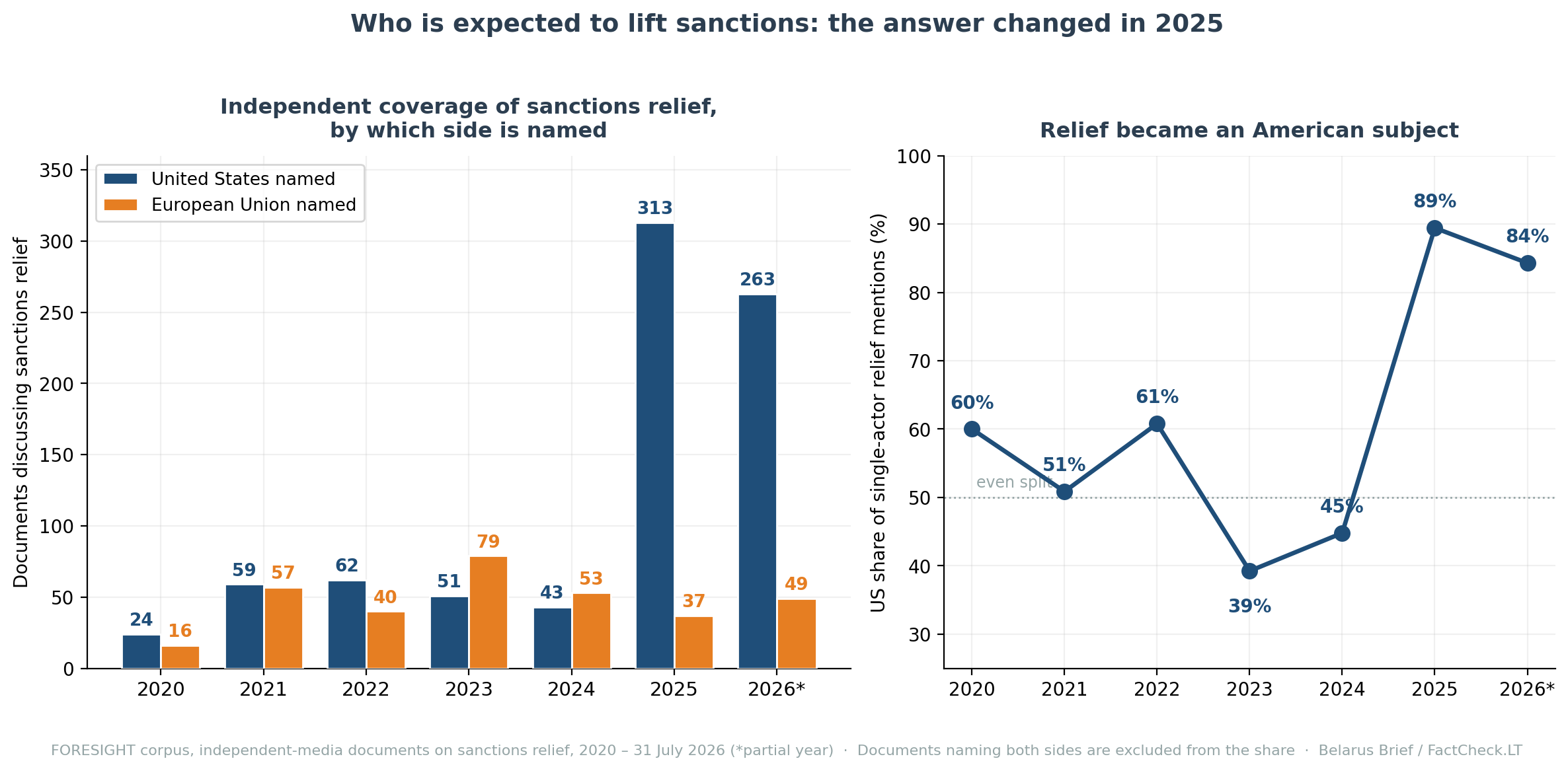
The EU did not stop being discussed. It remained the main subject of the imposition conversation throughout, which is what the 21st package confirms. What changed is that it stopped being the address for hope. When Belarusian media discuss the possibility of pressure easing, they now overwhelmingly mean Washington.
That is what makes the “one week, two signals” framing more than a coincidence of the calendar. The divergence has a start date, and it is not this July.
The state’s relief talk comes in bursts
State and pro-regime coverage of relief behaves differently from independent coverage, and the monthly series shows it plainly.
Through most of 2025 the state produced a couple of dozen relief documents a month, sometimes fewer than the independents. Then November: 408. December: 2,310, twenty times the independent count in the same month. January 2026: 531. Then collapse, back to double and single digits, and by July 2026 five documents for the entire month.
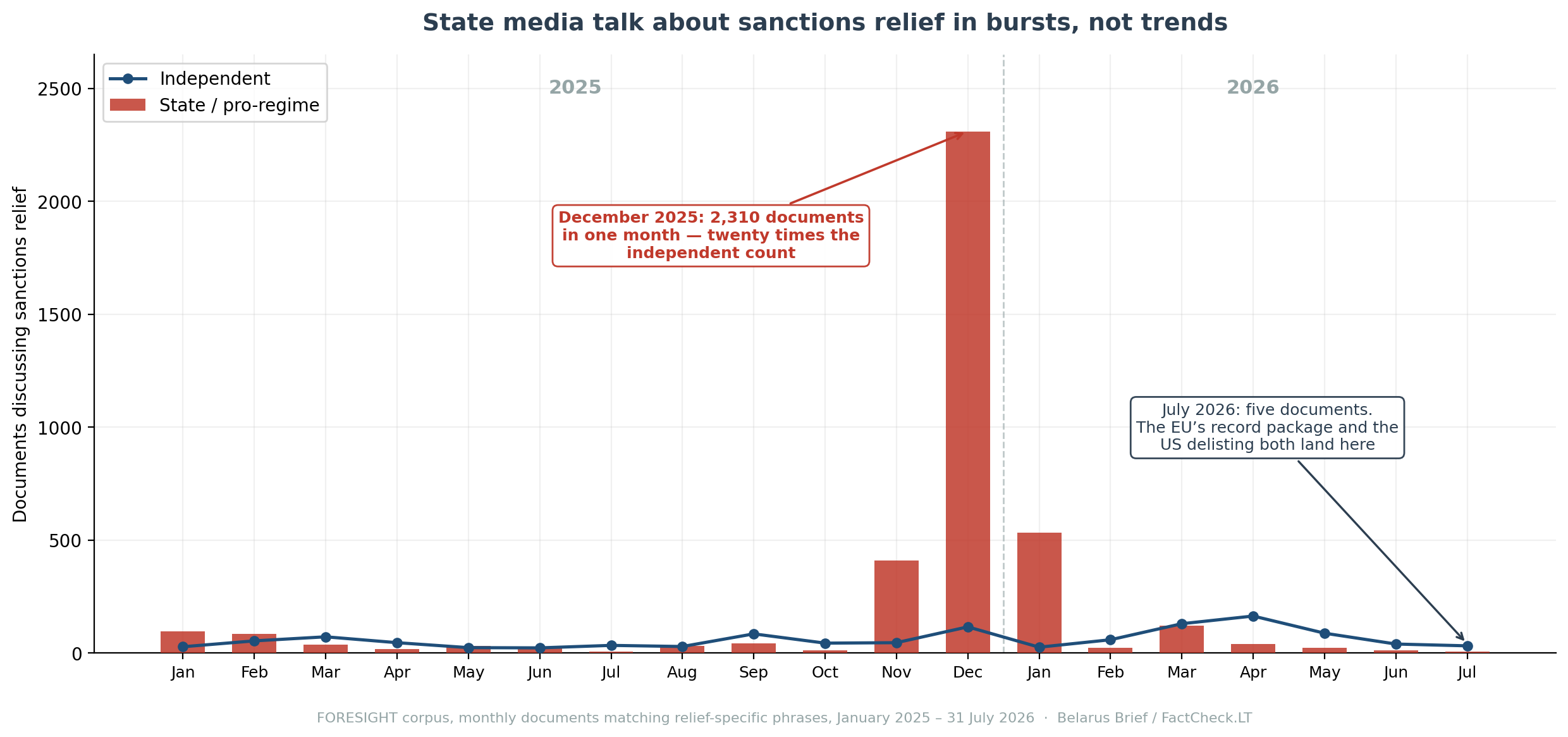
The late-2025 spike coincides with the release period and the US contacts of that autumn, and its size tells you what it was: a campaign, not coverage. Relief was a story the state chose to tell loudly for about ten weeks and then stopped telling.
Which brings us to what happened in July. Among sanctions-related documents, Belarusian state media produced zero on the Mozyr refinery. On the US delisting they produced one, three days late. Independent outlets produced 33 on Mozyr and 13 on the delisting, most of the latter in a single day.
The state was not absent from the story earlier in the week. On 20 July BelTA reported that several EU states were demanding exemptions and that support for new sanctions was falling; CTV reported that six countries were blocking the package. On 22 July BelTA reported that ambassadors had again failed to agree. Then the package passed, and the coverage stopped. The deadlock was news. The adoption was not.
Two vocabularies
The framing counts across the whole corpus since 2020 show how differently the two sides have learned to talk about this.
State and pro-regime outlets own the language of endurance: “sanctions pressure” appears in 3,661 of their documents against 1,919 independent ones, despite the smaller state corpus; import substitution, 1,536 against 520. Independent outlets own the language of consequence and workaround: sanctions evasion and parallel imports, 1,155 against 92; political prisoners, 3,486 against 131. That last ratio, twenty-seven to one, is the sharpest divergence in the whole sanctions vocabulary — the link between sanctions and prisoners is essentially absent from state coverage.
So the two segments are not arguing about sanctions. They are describing separate objects: one a pressure to be absorbed, the other a mechanism attached to a political price.
What this means for the balancing account
In our half-year review we argued Belarus had settled into managed balancing: releases continuing, negotiation channels open, discursive control loosening, all without any strategic reorientation. The sanctions data adds a mechanism to that account, and it is not the one usually offered.
The room to manoeuvre is not being created by concessions from Minsk. It is being created by the two Western tracks moving apart, and it has been widening since early 2025 regardless of what Minsk does in any given month. A state that expects relief from Washington and pressure from Brussels does not need to satisfy Brussels.
The silence then makes a certain sense. Covering the 21st package would mean explaining that the EU had just hit the country’s refining sector harder than at any point since 2022, which sits badly beside a narrative of adaptation and pressure absorbed. Covering the delisting loudly would mean crediting an American process that has produced, so far, one firm. The deadlock was the only part of the story that fit, so the deadlock was the part that was told.
Watch for
Whether the American track produces anything beyond single-entity delistings, and whether state media pick it up when it does. The December 2025 spike shows they will amplify relief when there is a campaign to run. Five documents in July says there was nothing to run yet.
Method: FORESIGHT corpus, ~3M documents from 73+ sources. Sanctions documents are matched on adjectival and prepositional forms (”санкционный”, “санкции против”, “под санкциями”) rather than the bare stem, which in Russian also matches the legal idiom “с санкции прокурора”; imposition and relief are matched on adjacent exact phrases, not scattered fragments. An earlier looser pass over the same data returned three to five times more documents, almost all false positives; those figures were discarded. Corpus depth varies by year, so comparisons are made within years or between segments, not on raw volumes across years. Package contents and the delisting as reported by BDG, Euroradio, Pozirk, Charter97, Delfi and Reform.