

Belstat published its first estimate for January to July on 18 August: GDP up 2.1%, 180.5 billion roubles in current prices. The number is unremarkable until it is put in its own year. January came in at minus 1.2%, the first quarter at minus 0.4%, and every month since has added roughly six tenths of a point — 0.2, 0.9, 1.5, 2.1. The target set by decree for the year is 2.8%. A year that opened in contraction is now four months into a climb that has never faltered, and it needs to keep climbing to arrive.
The shape of the year
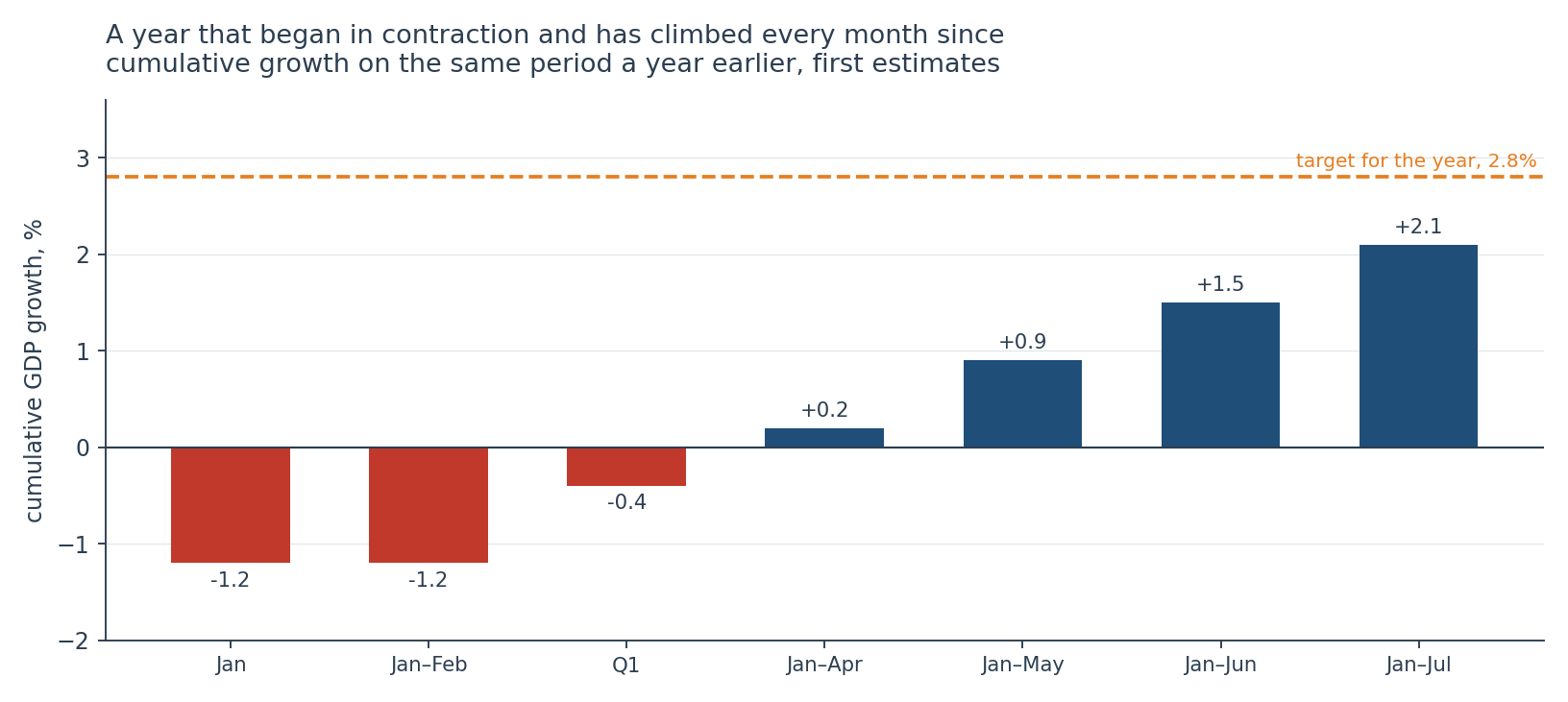
Cumulative growth of this kind cannot move far in a month, which is what makes the regularity worth noticing. Each release since April has lifted the running figure by about the same amount, in the same direction, out of a first quarter that was below zero. Nothing in the sequence reverses, pauses or overshoots.
Last year offers the comparison. The target for 2025, repeated in monthly agency copy throughout the year, was 4.1% against 2024. The outturn published on 19 January was 1.3%. Belmarket headlined it plainly: instead of 4.1%, 1.3%. The gap was 2.8 points — the same size as the whole of this year’s target.
The 2025 miss was 2.8 points. The 2026 target is 2.8 per cent.
What is carrying it
The components arrive before the aggregate. On 17 August BelTA reported industrial output for the seven months at 126.7 billion rubles; PrimePress reported retail turnover up 8.1% and agricultural output up almost 13%. The GDP figure followed on 18 August.
Industry over those seven months came to 100.1% of a year earlier. On the state’s own numbers, the largest sector of the economy contributed essentially nothing, and the growth is carried by the harvest and by household spending. No item in the corpus places the two facts side by side, which is unsurprising: they are published on different days, by different desks, under different headlines.
The number nobody leads with
Alongside the growth figure Belstat publishes a deflator, and it has moved more than anything else in the release. January to March, 109.5%. January to April, 110.0%. January to May, 110.1%. Then January to June, 113.3%, and January to July, 113.2% — a step of more than three points in a single month.
Consumer inflation over the same period runs near 4.4%. A deflator of 113.2% means the price level used to convert nominal output into real output is rising roughly three times faster than the prices households see. MacroBy, tracking the monetary environment for the second quarter, put the deflator at 13.6% year on year and flagged the acceleration.
In nominal terms the economy grew about 15.6% over seven months. In real terms, 2.1%. The distance between those two numbers is the deflator, and it is the least quoted line in the release.
Nominal growth of about 15.6%, real growth of 2.1%. The distance between them is the number nobody leads with.
Industry gave nothing. The harvest and the shops gave the rest.
Who mentions the target
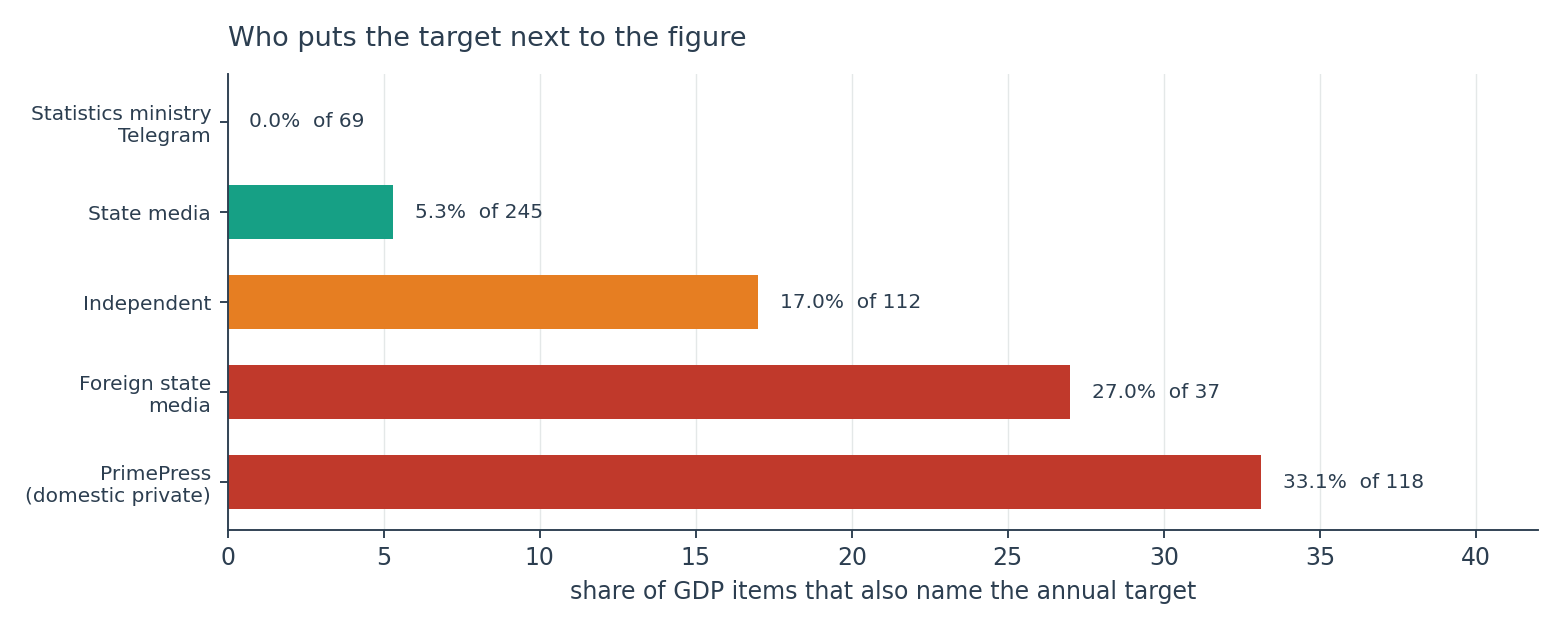
Across three and a half thousand items carrying the GDP figure since 2018, the annual target appears beside it unevenly. The statistics ministry’s own Telegram channel names it in none of its 69 posts. State media name it in 5.3% of 245. Independent outlets, 17% of 112. Foreign state media, 27%. PrimePress, a domestic private agency, names it in a third of its 118 items — it carries the target as a standing line in every monthly report.
The pattern is the one this newsletter keeps finding on economic indicators. The figure travels everywhere; the benchmark that would let a reader judge the figure travels with whoever is not responsible for meeting it.
The statistics ministry names the target in none of its sixty-nine posts.
Confidence
Watch items
By 17 September 2026: whether the January–August estimate continues the six-tenths step, which would put it near 2.7% and within reach of the target.
By 19 January 2027: what the 2026 outturn is, and whether the gap to 2.8% resembles last year’s gap to 4.1%.
Through the autumn: whether industrial output leaves 100% in either direction, since a flat industry and a rising aggregate cannot both continue indefinitely.
At the next release: whether the deflator holds above 113%, and whether any outlet outside the specialist ones treats it as news.
Method and limits
The series was assembled from coverage of Belstat’s monthly first estimate across a corpus of Belarusian state, independent, exile, Telegram and foreign sources, 2018 to date, one row per URL, excluding documents dated in the future. Every figure quoted above was checked against a named report rather than taken from the extraction.
That check mattered. A first pass at the same data produced twenty-five apparent revisions to past periods, all of them false: the pattern that captures the reporting period was picking up the comparison base instead, so a May 2019 report about January–April 2019 was filed alongside a 2018 report about January–April 2018. A second pass separated the two and found no revisions at all — but it also reached only about a hundred documents across eight years, one or two per period, which is too thin for a period to appear twice. So the question of whether GDP first estimates are later revised upward, as investment figures demonstrably are, is not answered here. It is not tested.
One same-day disagreement remains unexplained: on 17 April 2024 two outlets reported the first quarter at 104.1% and 106.5%. And a smaller thing, noted because it recurs: Reform has published the phrase “the GDP deflator in January–April was” three times running, on 17 June, 17 July and 18 August, each time with a different number and the same unchanged period label.