
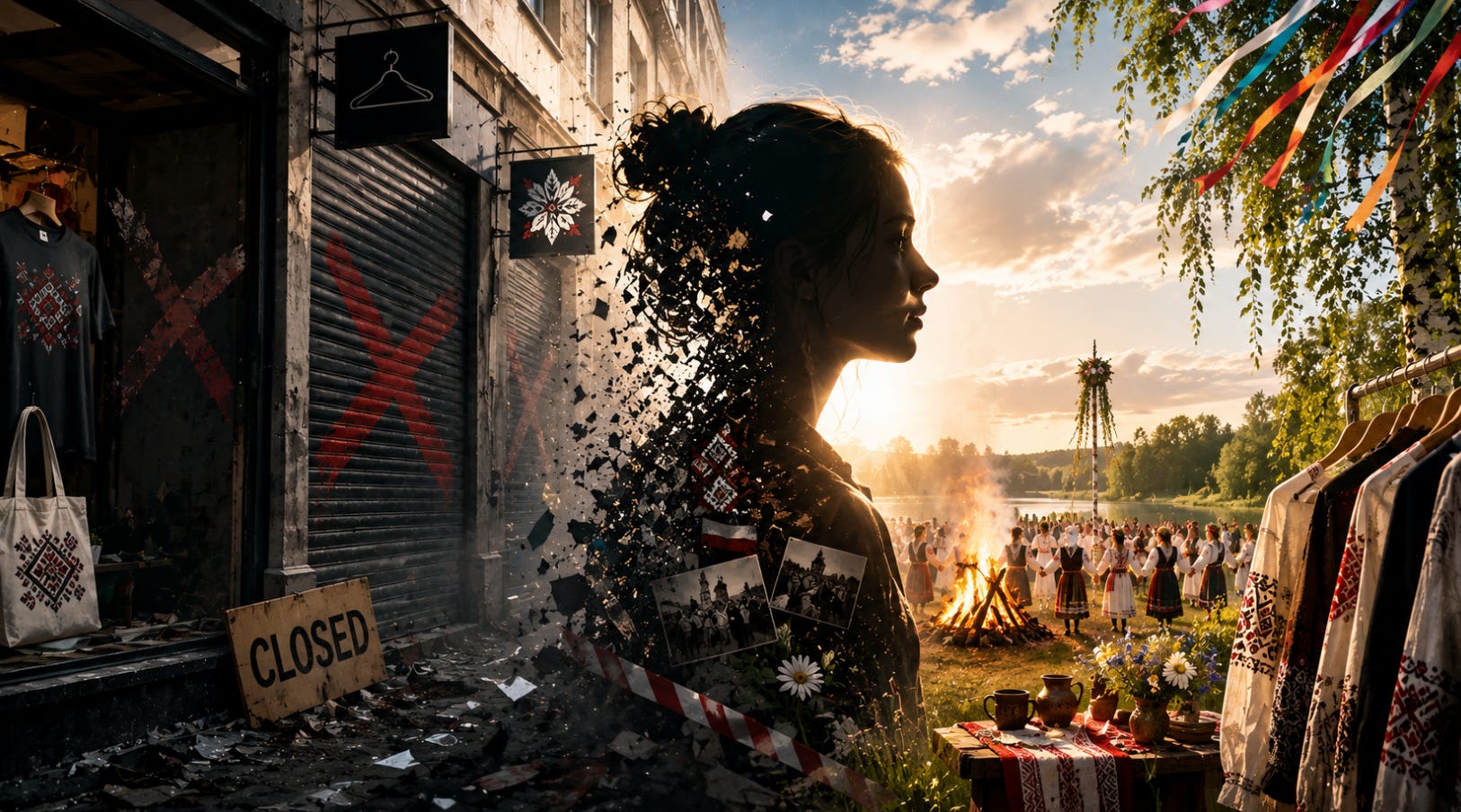
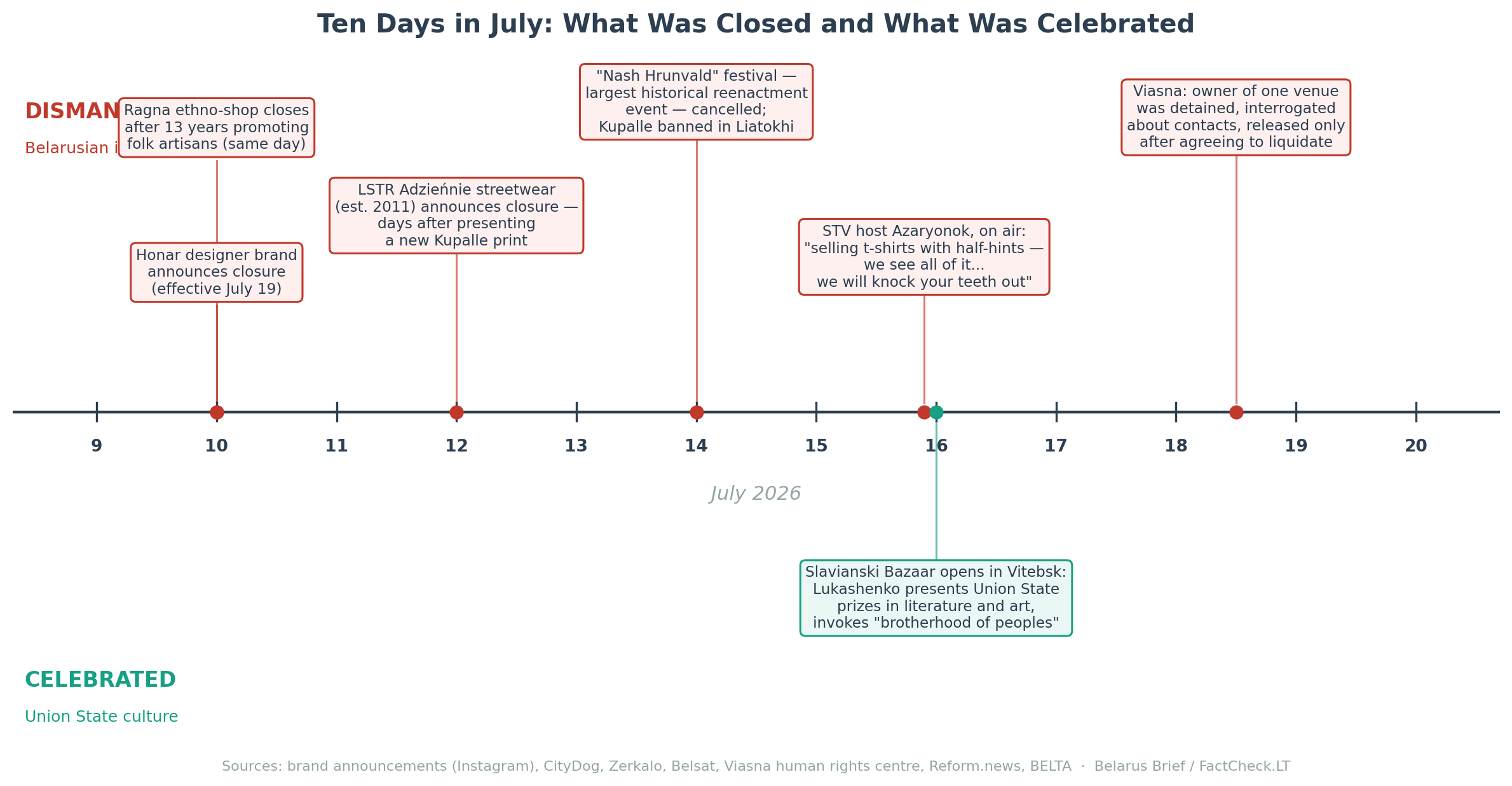
On 10 July, the designer clothing brand Honar announced it would close by the 19th. The same day, Ragna — the Minsk ethno-shop that had promoted folk artisans for thirteen years — shut its doors on Sukhaya street. Two days later, LSTR Adzieńnie, the streetwear label that had put historical and national prints on Belarusian shoulders since 2011, announced its own closure — days after presenting a new print for Kupalle, the midsummer festival. That festival, meanwhile, was banned outright in the village of Liatokhi near Vitebsk, and “Nash Hrunvald,” the country’s largest historical reenactment event, was cancelled.
None of it, by the available evidence, was voluntary. The Viasna human rights centre reports that the owner of one of the venues was detained by security officers, interrogated in detail about his personal contacts and social media, and released only after agreeing to liquidate the business.
And in the same week, across Vitebsk, the state opened the Slavianski Bazaar festival, where Lukashenko personally presented Union State prizes in literature and art and invoked the brotherhood of the Belarusian and Russian peoples.
The confession
Usually, attributing intent to a purge requires inference. Not this time. On the pro-regime STV channel, host Ryhor Azaryonok — joined by MP Vadzim Hihin — explained the closures on air, in his own words: “All these attempts of yours to sell little t-shirts with half-hints — we see all of it. As we once incinerated the Knihauka bookshop, so we will continue... if you hope to drop anchor somewhere, dig in your teeth somewhere — we will knock your teeth out.”
Strip the menace and a precise doctrine remains: the regime reads apparel as identity signaling. A vyshyvanka print is a “half-hint.” A Kupalle t-shirt is a political act. The security services’ interrogation questions — contacts, social media — confirm the same reading: this was not commercial regulation but the removal of nodes in an identity network.
The July closures extend a chain running back to 2020: Symbal.by (its founder Pavel Belous still imprisoned), the Hrodna shops Admetnasць and Tsudounia, Orsha’s Tsudounaya Krama, Minsk’s Moy Modny Kut (now operating in Warsaw as Vyraj), the Knihauka bookshop Azaryonok boasted of “incinerating.” What is new is the tempo — three brands in ten days — and the explicitness of the accompanying commentary.
What our data adds: the purge follows a measured defeat
Here is where the corpus earns its keep. In our H1 2026 review we reported the most counterintuitive finding of the half-year: in Q2 2026 — the Victory Day quarter, when Soviet-nostalgic framing historically peaks — Soviet nostalgia collapsed from 39.8% to 23.4% of identity discourse, while “European Belarusian” identity surged from 34.2% to 43.1%, retaking a commanding lead across a corpus of ~3 million documents.
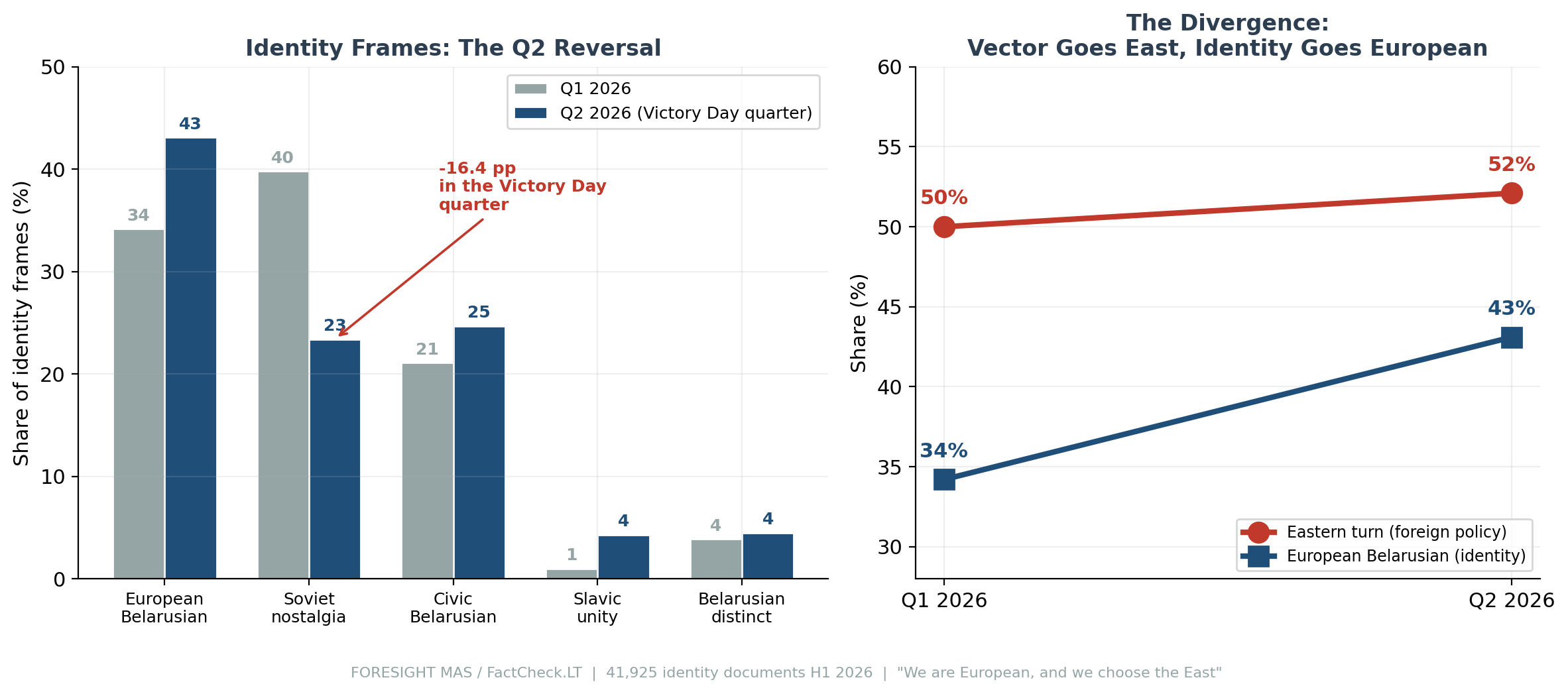
Read the July purge against that curve and the timing stops looking incidental. The regime is losing the semantic field of Belarusian identity — measurably, quarter by quarter — and it is responding where it still holds unchallenged power: in the physical layer. Unable to out-narrate “European Belarusianness,” it closes the shops that sell it, cancels the festivals that perform it, and bans the rituals that embody it. Azaryonok’s “half-hints” line is the doctrine’s plain-language version: the discourse cannot be won, so the infrastructure must go.
The weekly topic data adds a coda: in the culture topic, state media out-published independent outlets 42 to 23 this week (+30% state balance). On the surface, the regime dominates cultural coverage. But that dominance is Slavianski Bazaar and Union State prizes — the celebration track — while the identity track it cannot control is handled by the police.
What this does to the balancing thesis
Our H1 report argued that Belarus has entered “managed balancing”: releases continue, dialogue channels stay open, discursive control softens (the civil-society Substitution Index fell to 0.86). The July purge does not contradict that thesis — it refines it, in the instrumental direction we flagged. The regime can afford to loosen its grip on discourse precisely because it is tightening its grip on discourse’s material substrate. Semantic softening for the Western interlocutors; physical dismantling for the domestic identity infrastructure. Both halves of the tightrope, walked simultaneously.
For our Predictions Ledger, this cuts both ways. Prediction #8 holds that “European Belarusian” framing above 40% signals the balancing configuration is intact — and at 43.1% it is. But the purge introduces the mechanism that could bend the curve: if the infrastructure removal succeeds, the identity discourse it sustained may erode with a lag. Whether measured Belarusianness in the information space can survive the demolition of its physical carriers is now, involuntarily, a live experiment — and we are positioned to measure it, quarter by quarter.
Sources: brand announcements via Instagram; CityDog, Zerkalo, Belsat, Reform.news reporting (13–19 July 2026); Viasna human rights centre on the circumstances of the closures; STV broadcast statements as reported by CityDog. Identity-frame data: FORESIGHT corpus (~3,5M documents, 100+ sources), national identity agent, Q1–Q2 2026 runs. Belarus Brief / FactCheck.LT, Vilnius.