

On 19 August Viasna put a number on a practice that has run for years without one: at least 83 current political prisoners have been convicted a second time, inside the institutions holding them, for disobeying the administration. The same day a court began trying a 33-year-old Ukrainian citizen on that charge in a Belarusian prison. The provision it rests on is article 411 of the criminal code, and its structure is worth reading closely, because the condition that makes the charge possible is created by the body that brings it.
The chain
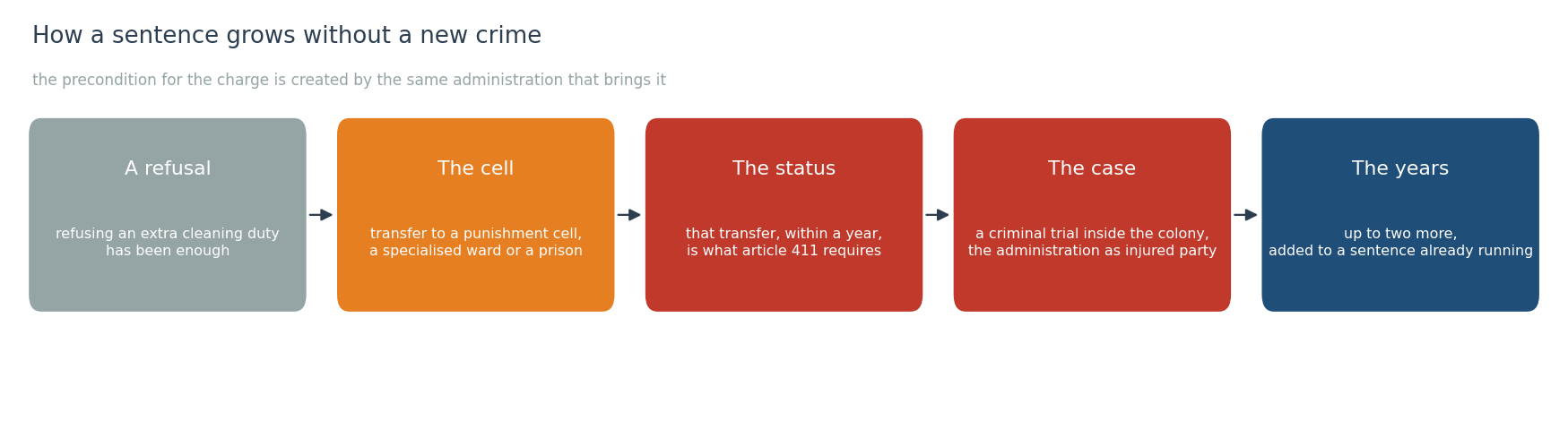
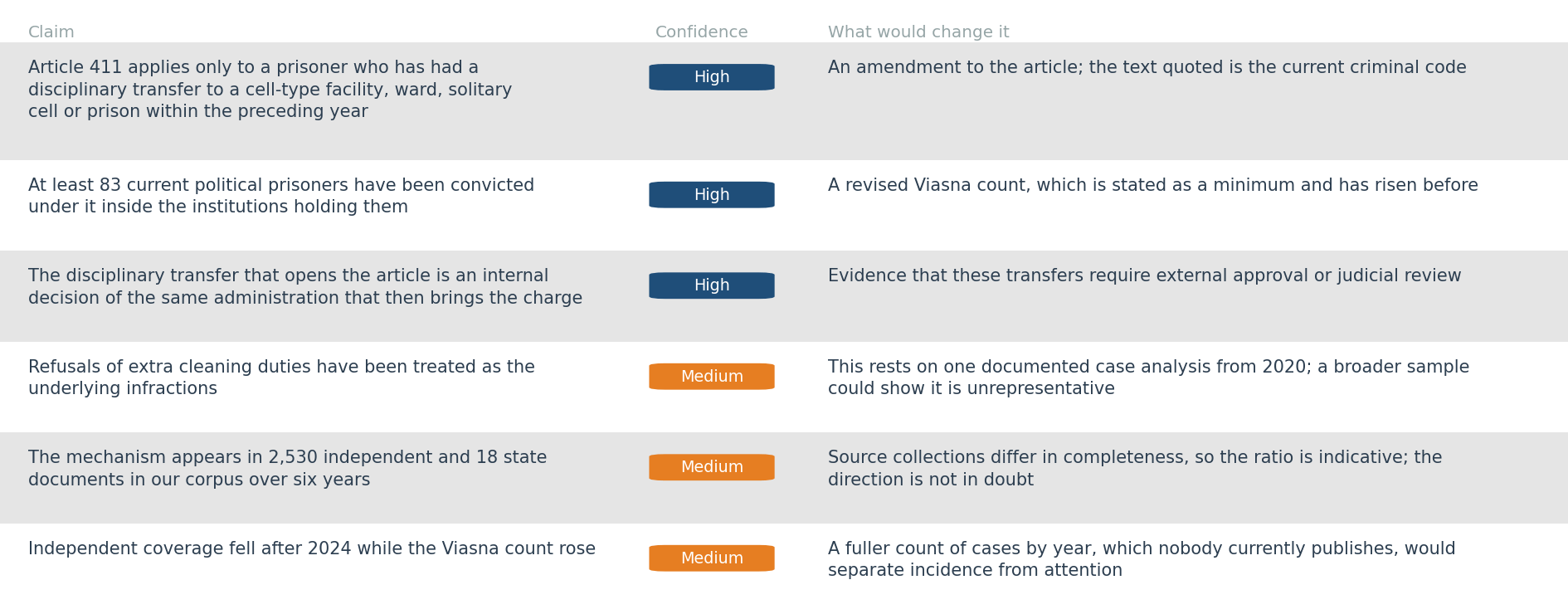
Article 411 punishes persistent disobedience of an administration’s lawful demands, or other obstruction of its functions, by someone serving a custodial sentence. It applies only if that person has, within the preceding year, been subject to a disciplinary transfer to a cell-type facility, a specialised ward, a solitary cell, or to a prison. For those already convicted of grave or especially grave offences, the second part of the article carries up to two years.
So the article has a gate, and the administration holds the key to it. A disciplinary transfer is an internal decision, made by the institution, without a court. Once made, it opens a year in which any further refusal can be prosecuted as a crime.
What fills that year has been documented. In a 2020 analysis of the article’s use, a prisoner’s three infractions consisted of refusing extra cleaning duties — the washroom, the barracks room. One sent him to a cell-type facility, the others to a punishment cell. The verdict recorded that the infractions were proven and did not explain why they amounted to persistent disobedience. His term grew by nearly two years.
A refusal to clean a washroom is the first link in a chain that ends in additional years.
What the prisoners say it is for
On the same day as Viasna’s count, Marfa Rabkova and Nasta Loika described the choice as it is put to people inside: cooperation, or the punishment cell and a new case. That is the mechanism stated from within it, and it matches the legal structure exactly. The cell is not only a punishment. It is a qualification.
The record shows the stages separately. Ivan Vierbicki has spent more than 1,065 days in punishment and cell-type facilities. Alena Lazarchyk, serving nine and a half years, was sent to a cell-type facility for six months in early August, again. Andrei Buday, serving fifteen, was tried a second time in his colony in July and had eighteen months added.
Our own count of the mechanism’s appearances names 94 institutions: colonies 2, 7, 11, 14, 15, 17, 22 and 24, penal colonies 1, 2, 14, 15 and 24, prisons 8 and 25, among others. This is not one harsh administration. It is a procedure available everywhere.
The cell is not only a punishment. It is a qualification.
This is not one harsh administration. It is a procedure available everywhere.
The silence around it
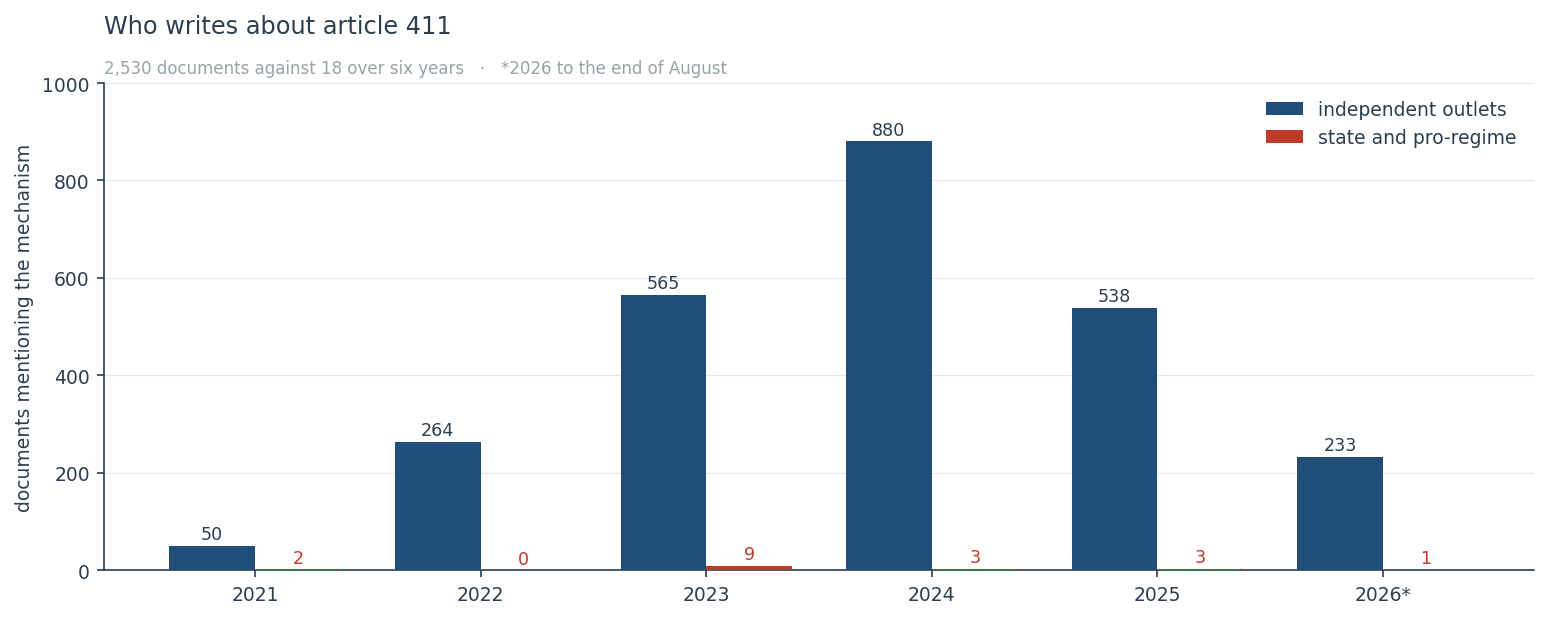
Across our corpus from 2021 to the end of August 2026, the mechanism appears in 2,530 documents from independent, exile and private outlets, and in 18 from the state and pro-regime segment. Eighteen, over six years, for a practice that has added years to at least 83 people’s sentences.
Eighteen documents in six years, for a practice that has lengthened at least eighty-three sentences.
The independent curve has its own shape: 50 documents in 2021, 264 in 2022, 565 in 2023, 880 in 2024, then 538 in 2025 and 233 in the first eight months of 2026. That is coverage, not incidence, and the fall since 2024 could mean fewer cases, fewer people left free to report them, or a subject that has stopped being new. Viasna’s count went up over the same period, which argues against the first reading.
Confidence
Watch
The next Viasna count exceeds 83. It was published on 19 August and the article’s use has not been reported as stopping.
The trial of the Ukrainian citizen begun on 19 August produces a verdict, and the term added is stated.
Any state or pro-regime outlet describes an article 411 prosecution of a political prisoner in its own words. Eighteen documents in six years is the base rate to beat.
A published court decision explains why a specific refusal amounted to persistent disobedience, which the 2020 analysis found the verdicts do not do.
Method and limits
The count of 83 is Viasna’s, as of 19 August 2026, and refers to people. Our corpus figures count documents mentioning the mechanism between 1 January 2021 and 30 August 2026, which is a different quantity: a single case generates many documents, and weekly repression digests bundle several cases into one. The two numbers should not be combined.
Matching required either the article number written as an article reference, or the statutory wording, together with a custodial context in the same passage — the number alone would have caught years, sums and street numbers.