
The border crisis that began in 2021 is in its sixth year. Our archive shows how the story moved from Poland to Latvia, how state outlets mark each November, and how Washington now speaks to the Baltic states in more than one voice.
In November 2021 several thousand people stood at the Polish fence near Kuźnica, and Belarusian state outlets published two thousand items on the border in a month. Five years on, the crossings have not stopped: Latvia counted 1,006 attempts in October, 87 per cent of all attempts into the EU from Belarus. Our archive holds 35,558 items on the crisis since June 2021, and we read them for who is named, who writes, and what each November brings. What we cannot see is the decision behind the flows, since neither side’s border service publishes how people reach the fence.
One peak, a long plateau
The crisis has one peak in our archive. In November 2021 independent outlets, state outlets and pro-government channels and the neighbours’ media together published 5,610 items on migrants at the three borders. No month since has reached a fifth of that. The series then settles at 200 to 500 items a month, with four smaller peaks. August 2023, when Wagner fighters arrived in Belarus and Poland closed crossings. June 2024, when a Polish soldier died at the fence. July 2025, the balloons over Lithuania. August 2026, when Latvia reported armed escorts and a thousand attempts a month.
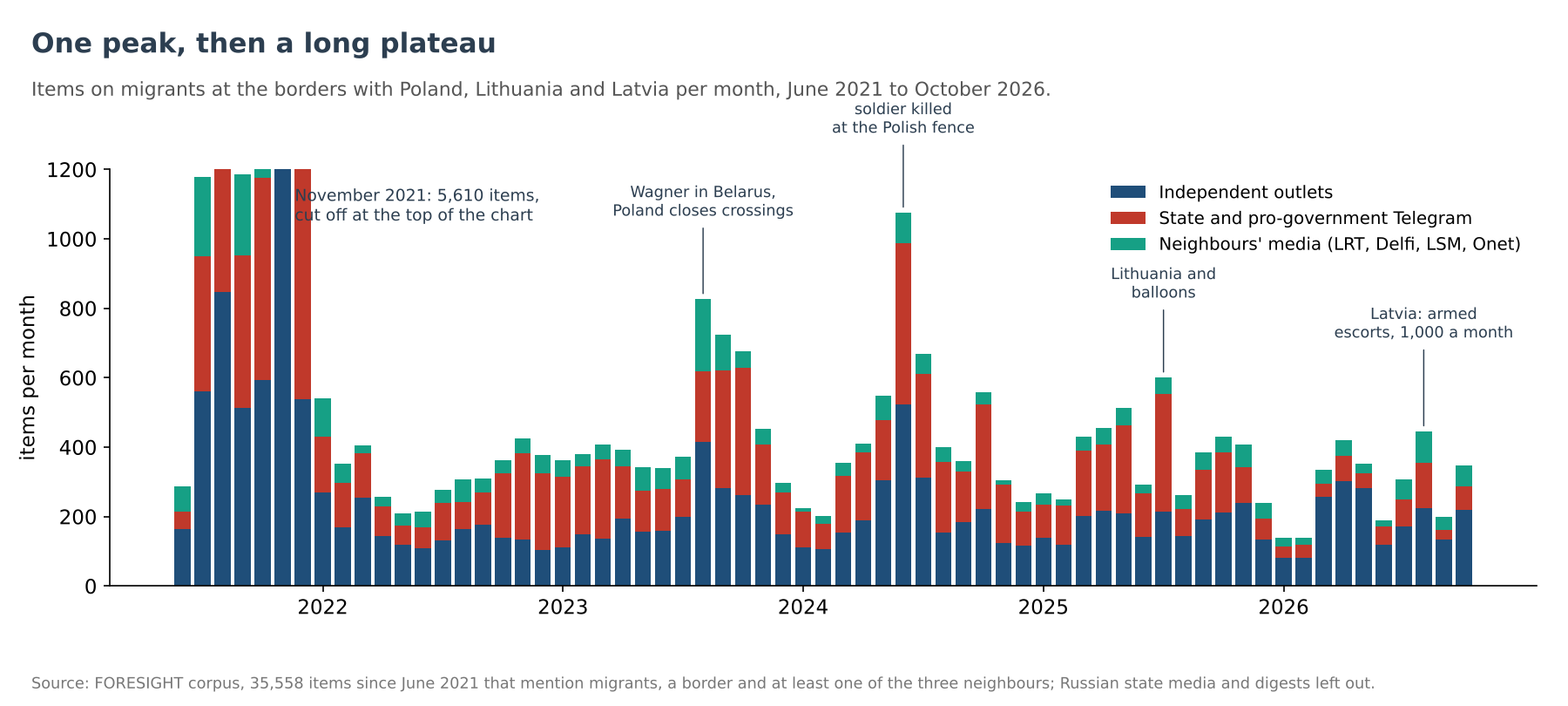
The plateau is the point. Five years is long enough for a crisis to leave the news, and this one has not. Each side has reasons to keep it there. Independent outlets report deaths and pushbacks; state outlets report the same deaths as Polish or Latvian cruelty. In 2024 the two sides published almost the same number, 2,495 against 2,386.
The pressure moved north
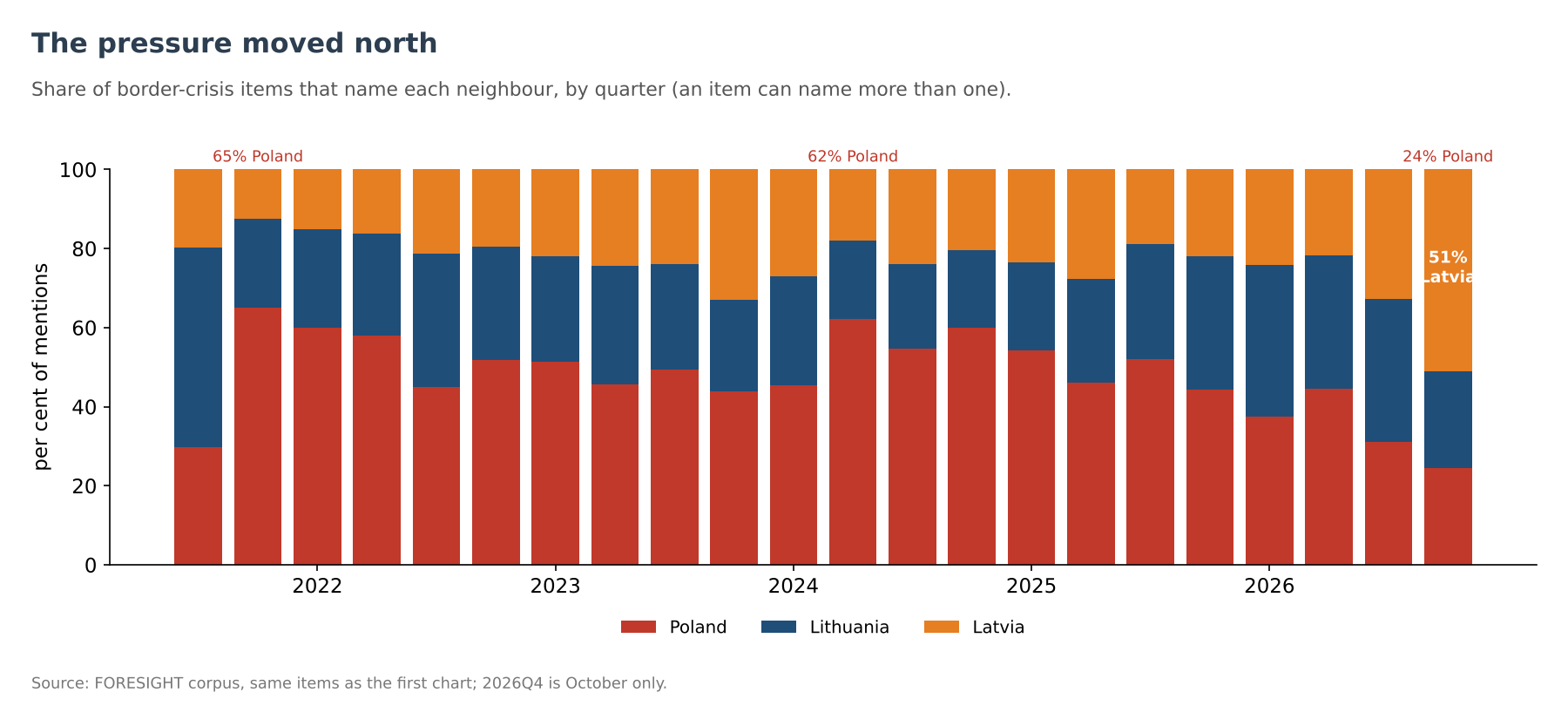
The second series codes each item by the neighbour it names. In 2021 Poland was named in 52 per cent of items, Lithuania in 33 and Latvia in 15. The order held for four years. In 2026 it broke: Poland 36 per cent, Lithuania 35, Latvia 30. In October Latvia alone took 51 per cent of mentions against Poland’s 24. The crossings followed the same path. Pozirk’s reading of Polish border data found no attempts for thirty days in a row to mid-October (Pozirk, 16 October). Latvia meanwhile reported 696 attempts by 24 October and 1,006 by the end of the month (Euroradio, 24 October; Pozirk, 28 October).
Five years is long enough for a crisis to leave the news, and this one has not.
We wrote about this turn in July, when Latvia first became the main target. October added a legal layer. A Latvian prosecutor said there were grounds to suspect Belarusian border officials of organising the crossings and of damaging the fence (Svaboda, 27 October). The Saeima let border guards use weapons without warning against “hybrid attacks” (Pozirk, 29 October). Minsk has not answered the prosecutor. A year ago state outlets were already writing about the Latvian border as a place where Cuban citizens are found beaten (SB, 18 November 2025), the same frame they used for Poland in 2021.
What November brings
In October Latvia alone took 51 per cent of mentions against Poland’s 24.
We checked what state and pro-government outlets publish in the first weeks of each November, the anniversary of Kuźnica. The pattern is stable. In 2022 ONT wrote that “a whole year has passed” since Poland used water cannon (ONT, 8 November 2022), and Grodnenskaya Pravda ran “a lesson in democracy at the border” (11 November 2022). In 2024 the border committee reported 60 people found dead at the EU border since 2021 (BelTA, 6 November 2024) and called the neighbours’ treatment of migrants “fascist” (SB, 6 November 2024). In 2025 it reported 96 deaths and 129 “channels of illegal transit migration” cut since 2021 (BelTA, 5 November 2025; SB, 5 November 2025). A pro-government channel added that Minsk had asked the EU sixteen times to resume cooperation (5 November 2025).
Each November the border committee adds a year to its totals, and the totals start in 2021. What the anniversaries never carry is the origin: no state item in our archive dates the crisis to a decision taken in Minsk. The origin is on record elsewhere. In October 2021 the BBC followed four Syrians who flew from Irbil to Minsk on tourist visas; the group said Belarusian soldiers took them to the fence in a military truck and showed them the way into Poland (BBC, 21 October 2021). The dead are counted from the Belarusian side of the fence, and the “channels” are the work of Belarusian guards against smugglers. In this telling Belarus is the country that finds the bodies.
Voices from Washington
The fifth anniversary falls in a different diplomatic season. On 7 October the US Secretary of State wrote to Latvia’s foreign minister. The United States, he said, valued Riga’s “commitment to controlling your national borders” and its readiness to engage the Belarusian authorities on migration (Pozirk, 7 October; Reform, 7 October). Three weeks later Politico reported that the US envoy John Cole had been sounding out Lithuanian diplomats on reopening Klaipėda to Belarusian potash. That would run against EU sanctions (LRT, 30 October; Svaboda, 30 October). Apollo.lv added that Cole had raised the same question in Riga (Apollo, 30 October); he had visited the Latvian capital in September (UDF, 18 September). Lithuania’s prime minister said nobody was pressing him and called the story “an attempt to measure the temperature” (Pozirk, 30 October).
Each November the border committee adds a year to its totals, and the totals start in 2021.
The two messages reached the same two capitals within a month: hold the border, open the port. A third arrived the same day as the Politico story. Reuters reported that Pentagon officials, among them the policy chief Elbridge Colby, had asked Lithuania, Latvia and Estonia in bilateral meetings to tone down their public statements on the Russian threat, with no “poking” at the Russians; a European official summarised the message as “we are helping you, the Americans are there, just don’t be loud” (Reuters via CTV News, 30 October; DW, 30 October). The same report noted that German prosecutors had arrested two Belarusians that week for planning arson near Nuremberg. The Pentagon said private conversations among allies stay private.
Belarusian outlets took what suited them. State television carried the potash story as settled (BTRC, 30 October). A pro-government channel wrote that “a well-known furry animal is creeping up on Nausėda, a red one, not a white one” (Zheltye Slivy, 30 October). Sputnik Belarus reported that Vilnius “does not want” to revisit the sanctions (30 October). Minsk’s own foreign minister had said on 6 October that Belarus should “think a hundred times” whether it needs the Baltic ports at all (Reform, 6 October). The state outlets did not report the first message, the letter to Riga, at all.
How sure we are
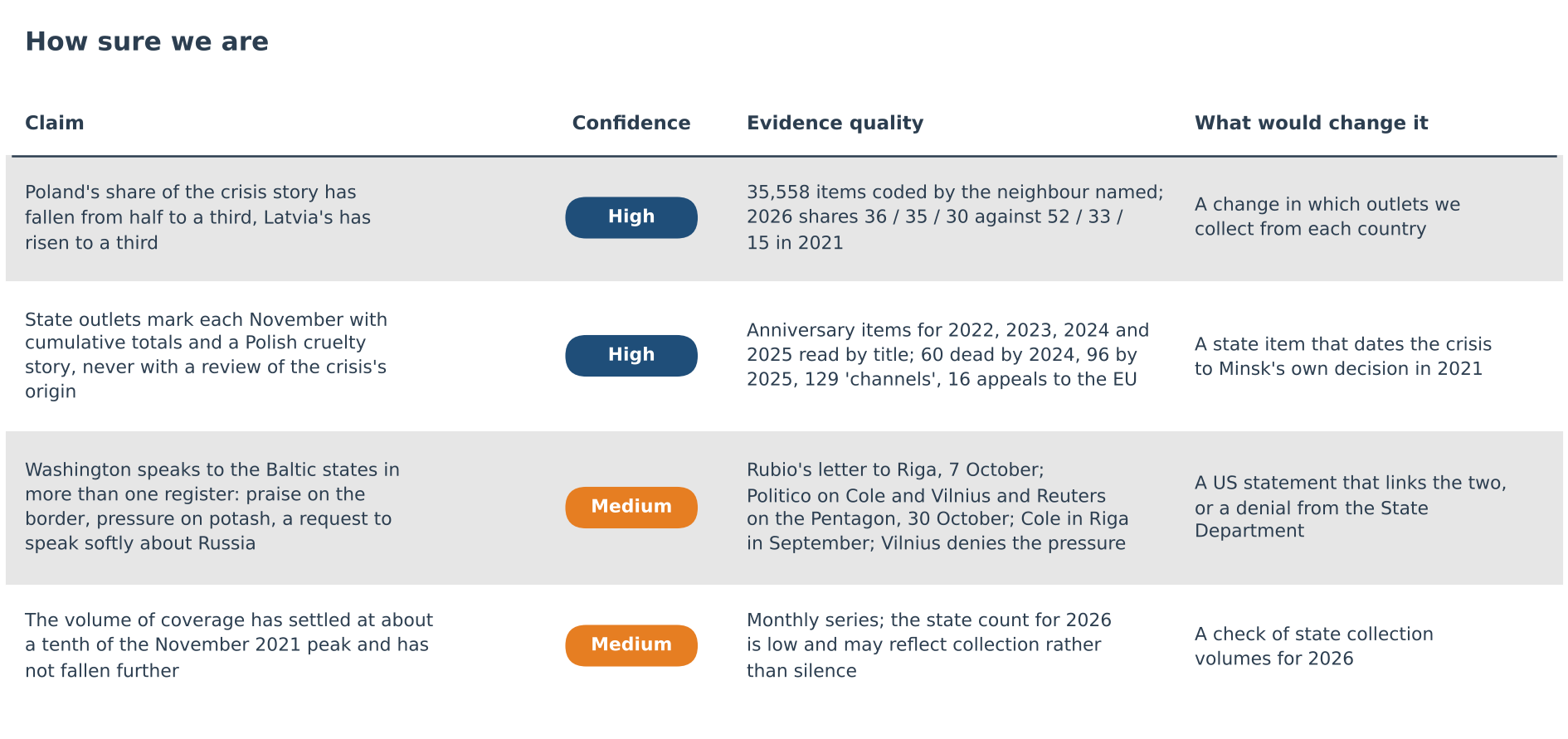
Poland’s share of the crisis story has fallen from half to a third and Latvia’s has risen to a third. High. 35,558 items coded by the neighbour named; 2026 shares are 36, 35 and 30 per cent against 52, 33 and 15 in 2021. A change in which outlets we collect from each country would change it.
State outlets mark each November with cumulative totals and a story of Polish cruelty, never with a review of the crisis’s origin. High. Anniversary items for 2022 to 2025 read by title: 60 dead by 2024, 96 by 2025, 129 “channels”, sixteen appeals to the EU. A state item that dates the crisis to Minsk’s own decision in 2021 would change it.
Washington now speaks to the Baltic states in more than one register: praise on the border, pressure on potash, a request to speak softly about Russia. Medium. Rubio’s letter to Riga on 7 October; Politico on Cole and Vilnius and Reuters on the Pentagon, both 30 October; Cole in Riga in September; Vilnius denies the pressure. A US statement that links the two, or a denial from the State Department, would change it.
Coverage has settled at about a tenth of the November 2021 peak and has not fallen further. Medium. The monthly series; the state count for 2026 is low and may reflect collection rather than silence. A check of state collection volumes for 2026 would change it.
How it fits
The two messages reached the same two capitals within a month: hold the border, open the port.
This fits T3, a neighbour’s crisis as material for a story of decline: five Novembers of Polish and Latvian cruelty, and in 2026 the added pleasure of Washington leaning on Vilnius. A simpler reading is that the crisis is simply news on both sides of the fence, and neither side needs a reason to keep reporting it. The anniversary items separate the readings: a wire service would date the crisis, and the state outlets do not.
It also extends two earlier briefs. The Weapon Points North (21 July) found the pressure shifting to Latvia. A Test Called a Fake (13 October) showed state channels calling the Latvian armed-escort incident staged, in unison. The shift is now visible in a full year of data, not a month.
What to watch
By 15 November. The border committee’s anniversary totals for 2026. Expectation: a figure above 96 deaths and above 129 “channels”, published in the first week of November as in 2024 and 2025. Confidence: high.
By 30 November. Latvia’s share of mentions in November. Expectation: above 40 per cent, since the Saeima law and the prosecutor’s case keep the story in Riga. Confidence: medium.
By 31 December. An official Lithuanian or Latvian statement on Belarusian potash transit, beyond the denial of pressure. Expectation: none before the EU sanctions renewal in February. Confidence: medium.
Method and limits
The series counts items in the FORESIGHT corpus from 1 June 2021 to 1 November 2026 whose title or first 6,000 characters mention migrants or refugees, a border, and at least one of Poland, Lithuania and Latvia, in Russian, Belarusian or English. Digest titles were removed, the CTV website was left out because its widget repeats text, and each URL was counted once. Segments follow the source type. The charts show independent outlets, state outlets with pro-government and ministry channels, and the neighbours’ media that we collect in translation (LRT, Delfi, LSM, Onet). Russian state media and unclassified channels are in the totals but not on the charts. The neighbour shares count an item under each country it names, so the three shares sum to 100 per cent of mentions, not of items. The Reuters report on the Pentagon’s request is quoted from the CTV News syndication and DW’s account; neither is in our corpus. The anniversary check reads titles of state and pro-government items published between 1 and 25 November that mention Kuźnica, Bruzgi or 2021. The state count for 2026 is well below earlier years in every month, including months with large events. We cannot yet tell collection from coverage and say so in the confidence table. US statements are quoted from the outlets that reported them; we did not see the letter to Riga.
Thesis tag: T3.