

On 27 August Lukashenka told a government meeting that loss-making farms in Vitebsk region would go to stronger companies, including private ones. “Bluntly put, privatisation,” he said. He has refused that word for thirty years. State outlets quoted him, and then spent the same day explaining that this is not privatisation. What is being handed over is priced at one base unit, which today is 45 rubles, and what comes with it is debt.
What is changing hands
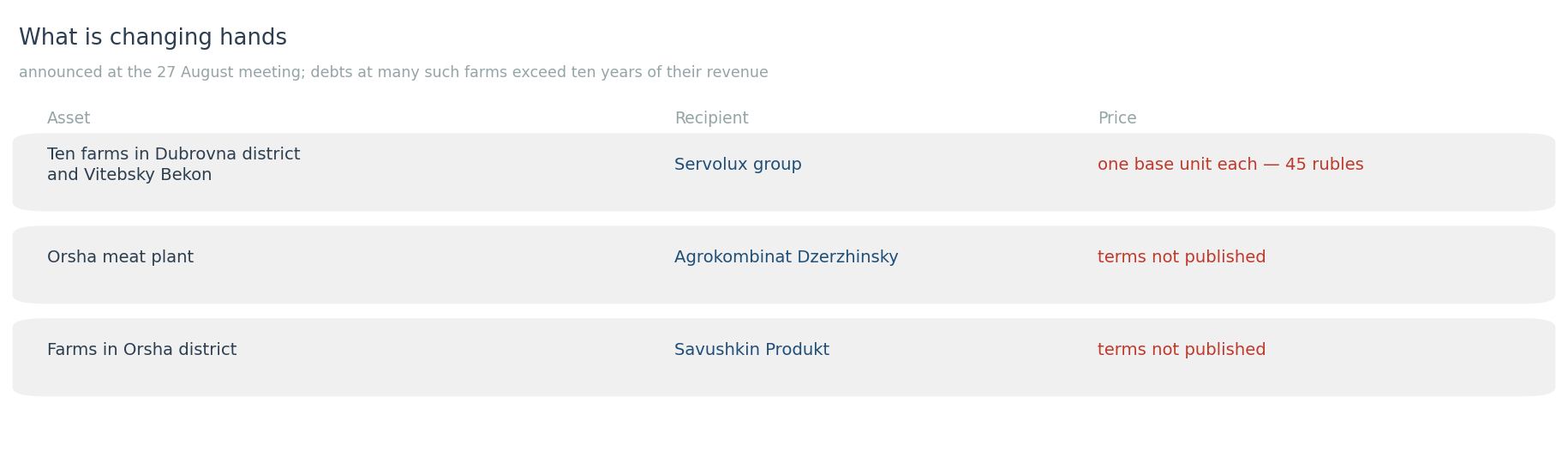
Ten farms in the Dubrovna district, together with the Vitebsky Bekon enterprise, go to the Servolux group. Each is priced at one base unit: 45 rubles, about 13 euros. The Orsha meat plant has already passed to the Dzerzhinsky agricultural combine, and farms in the Orsha district to Savushkin Produkt. Nobody published the terms of those two.
Uladzimir Kavalkin, who runs the Kosht Urada project, told Zerkalo what the price reflects. Many of these farms carry debts worth more than ten years of their own revenue. On his reading this is not a sale but a transfer of liabilities: the buyer is not getting an asset cheaply, the buyer is taking on the debt.
He also traces what came before. The same farms have been attached to the National Bank, handed to industrial enterprises, merged into holdings with profitable firms, and had their debts converted into local-authority bonds. Each attempt aimed to fix them. The debts kept growing.
Forty-five rubles buys a farm and the ten years of revenue it owes.
The word, said and unsaid
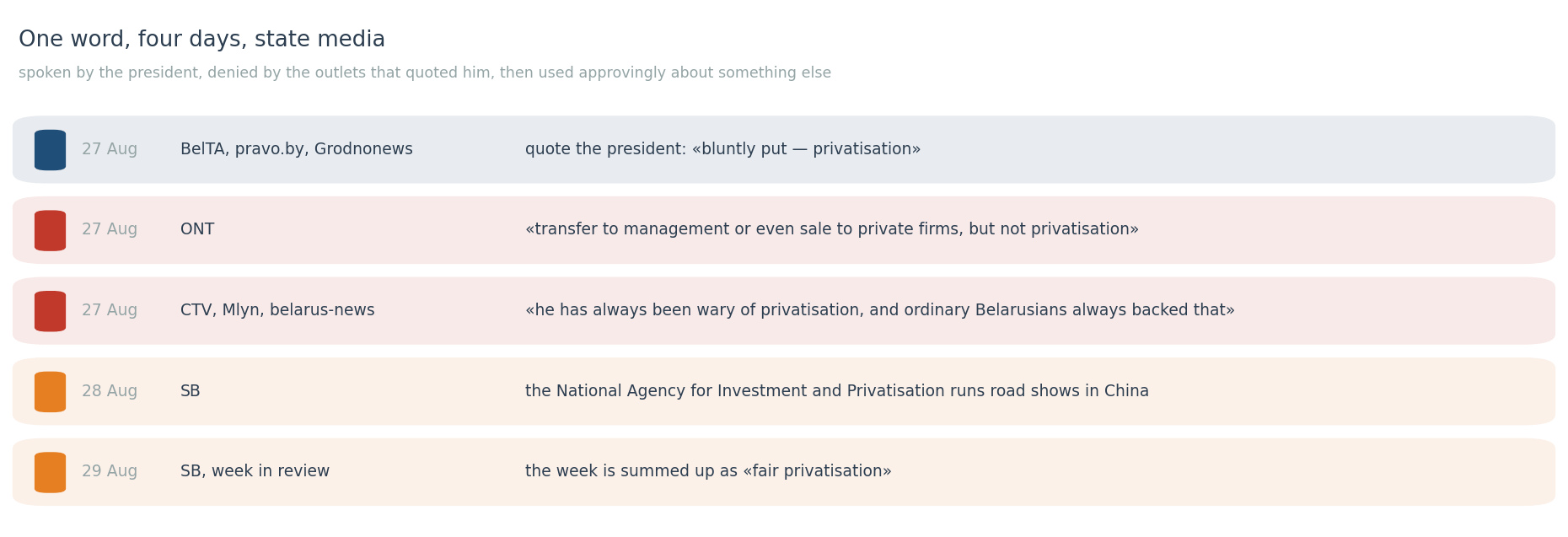
The vocabulary around the announcement is worth reading closely, because state outlets did not avoid the word. They quoted it and then took it back.
BelTA, pravo.by and Grodnonews all carried the sentence in full. ONT reported the same meeting and wrote that this is a transfer to management, or even a sale to private firms, but not privatisation. CTV, Mlyn and belarus-news each ran the same line: Lukashenka has always been wary of privatisation, and ordinary Belarusians have always backed him in that.
Then the word turns up again, approvingly, about other things. On 28 August SB reported that the National Agency for Investment and Privatisation is running road shows in China. On 29 August the same paper summed up the president’s week as one of fair privatisation.
So in four days the president said the word, the outlets that quoted him denied it, and the same outlets applied it approvingly to something else.
Spoken, denied, and then used approvingly about somebody else.
The buyer is not getting an asset cheaply. The buyer is taking on the debt.
Why the denial is not only spin
The denial has a case behind it, and it deserves a fair hearing.
Privatisation in the ordinary sense needs a price set by competition, a published procedure, and a buyer who wants the asset. None of that appears here. There was no auction. The price is a token. The recipients are three large processors that already buy from these farms, and the meeting’s own logic said they should now carry the farms that supply them.
But that argument cuts both ways. If this is not privatisation because there is no price discovery and no willing buyer, then it is a state directing private companies to absorb public debts. Kavalkin puts it plainly: there is nothing to privatise here except the debt, and doing it this way can only damage private business.
Both readings agree on the facts. They disagree about which word makes the state look better.
Both readings agree on the facts. They disagree about which word flatters the state.
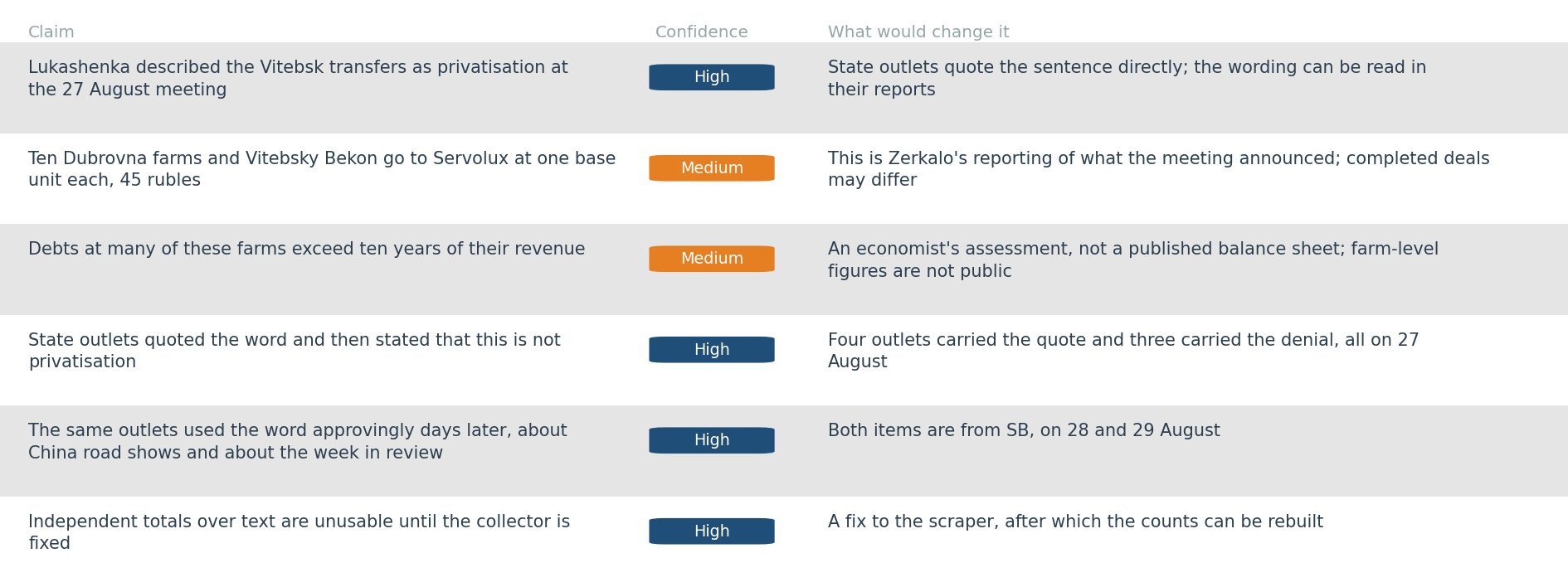
Confidence
Watch
Servolux, Savushkin Produkt or the Dzerzhinsky combine state publicly what they are taking on, and on what terms.
The debts of the transferred farms are published, or written off, before the transfers complete.
A second region is handled the same way. The meeting described Vitebsk as a model, and the president said the approach would be scaled to the whole country.
State media use the word for a Belarusian transaction without a sentence explaining that it is not that.