
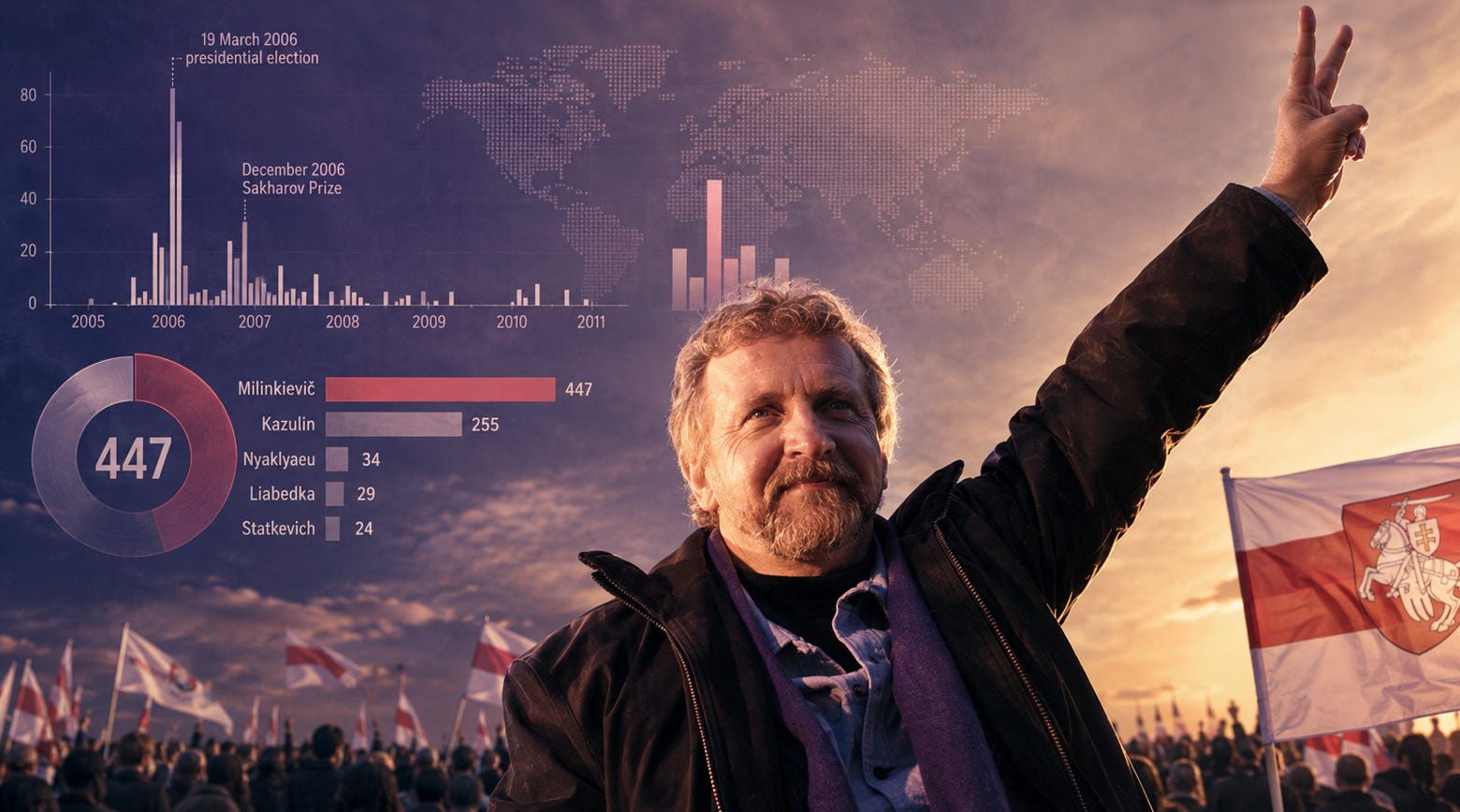
Aliaksandr Milinkievič died on 11 August. He was the single opposition candidate in the 2006 presidential election and the 2006 laureate of the Sakharov Prize.
This brief does not assess his politics or his legacy. It uses an archive that happens to cover exactly his years — 21,392 English-language documents about Belarus published between 2005 and 2011 — to answer a narrower question that cannot be answered from anywhere else: what did Belarusian politics look like to the English-speaking world when it had one recognisable face.
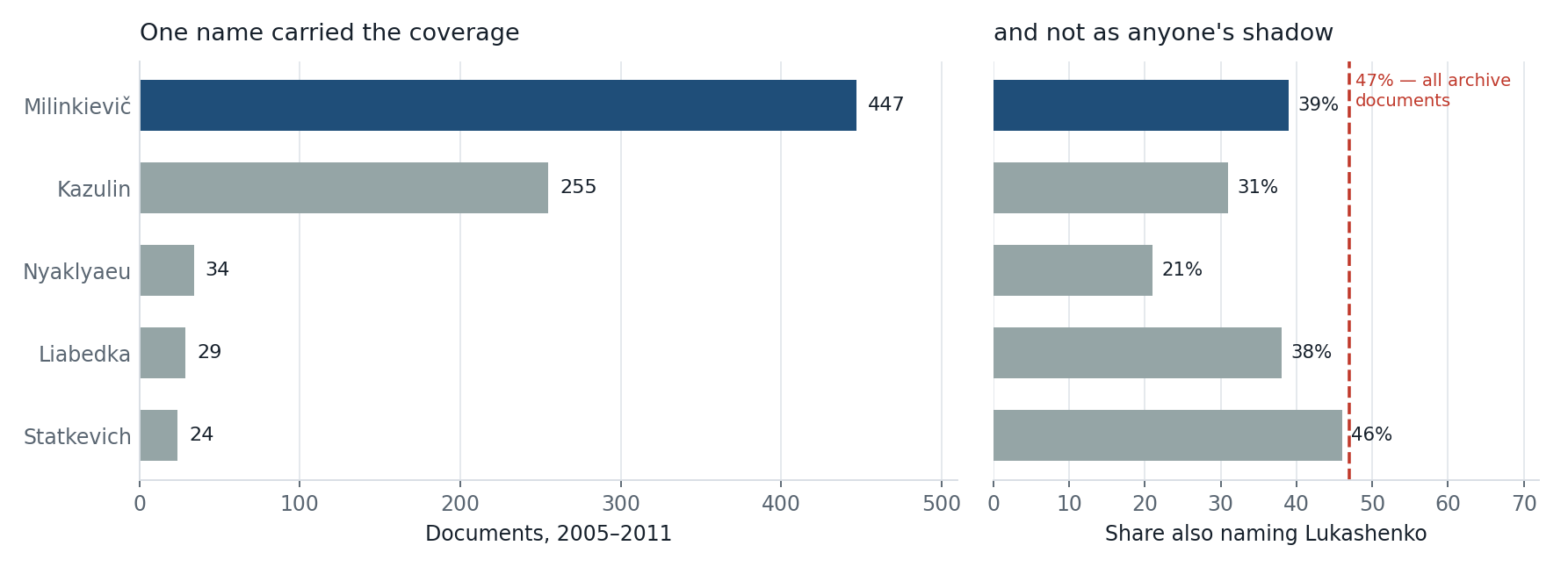
The short answer is that it looked like one man. Of the 21,392 documents, 447 name Milinkievič in the headline or the opening lines. Four other opposition figures of the same period — Aliaksandr Kazulin, Uladzimir Nyaklyaeu, Anatol Liabedka, Mikalai Statkevich — account for 342 between them.
Being named and being written about
The count of leads is the less interesting number. The more telling one is the ratio between being mentioned and being the subject.
Milinkievič’s name appears somewhere in 1,253 archive documents, and 447 of those — 36 per cent — are led by it. For Kazulin the ratio is 29 per cent, for Nyaklyaeu 19, for Statkevich 14, for Liabedka 13.
For Zianon Pazniak, the founder of the Belarusian Popular Front and an exile since 1996, it is zero. His name occurs in 44 documents across seven years, and not once in a headline or an opening paragraph. In this archive he exists entirely in subordinate clauses.
That gap is the finding. It is not about who mattered in Belarus; it is about which Belarusians the English-language press treated as people to write about rather than names to list.
The hypothesis that failed
I expected to find something else, and said so before running the numbers: that Milinkievič would appear in this archive mainly as Lukashenko’s antonym — described through the man he was running against rather than through anything of his own. It is the convergence pattern we have measured before in foreign coverage of Belarus.
It does not hold. Lukashenko is named alongside him in the opening lines of 39 per cent of his documents. Across the whole archive, 47 per cent of all documents mention Lukashenko somewhere. Among his peers the share runs from 21 per cent for Nyaklyaeu to 46 for Statkevich; Milinkievič sits in the middle of that spread and below the archive’s own average.
Whatever else can be said about how the West covered Belarus in those years, the single candidate was not written about as anyone’s shadow.
March 2006
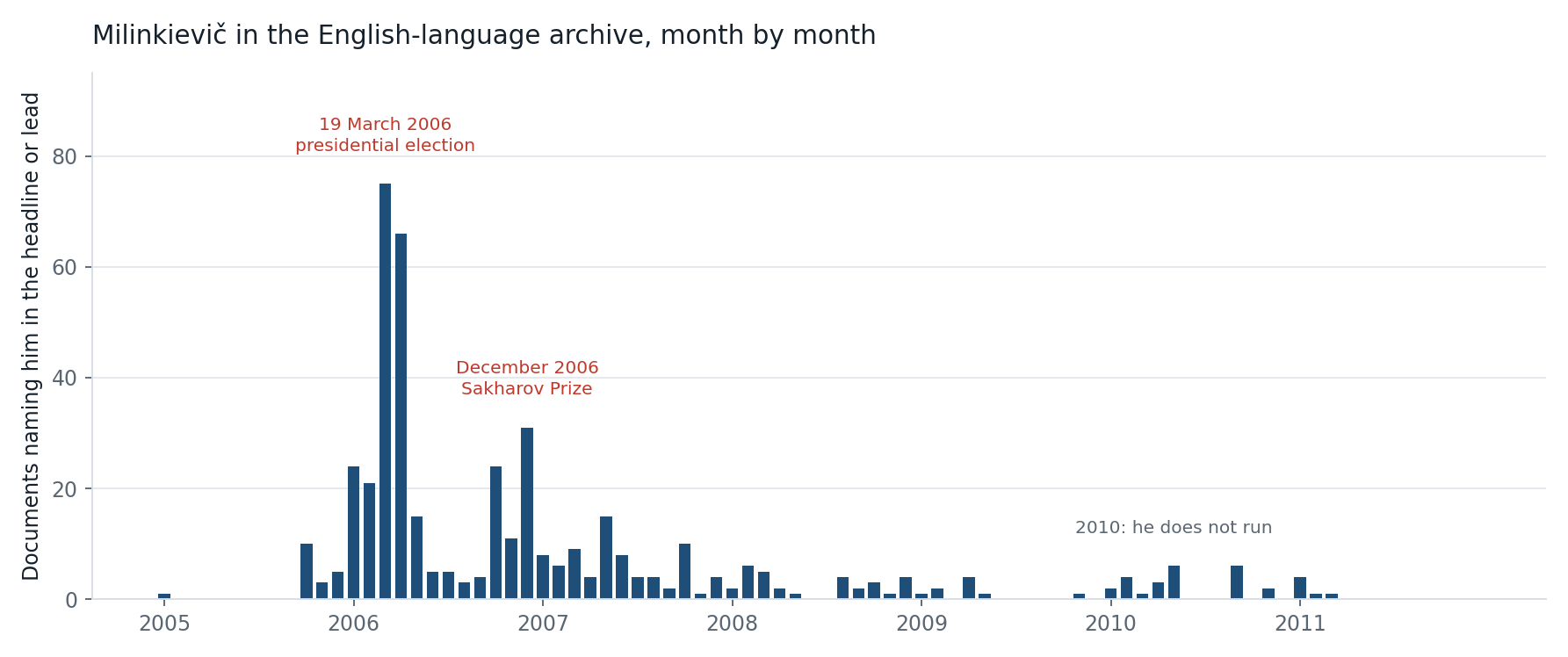
The archive is empty of him until October 2005, when the Congress of Democratic Forces chose him as the single candidate: ten documents that month. Then the campaign.
March 2006 produced 75 documents — one roughly every ten hours through the month of the election, Kalinouski Square and the arrests. April held at 66. Then the fall is immediate: fifteen in May, five in June, three in August.
December 2006 brings the second peak, 31 documents, when the European Parliament awarded him the Sakharov Prize. After that the line never again rises above fifteen in a month. 2007 gives 75 documents across the whole year, 2008 gives 30, 2009 gives nine.
There is a reading of that curve as a personal decline, and it would be cheap. What the shape actually shows is how coverage of a country without elections works: attention arrives with the event, attaches to whoever is standing where the cameras are, and leaves with it. The Sakharov Prize bought six weeks. Nothing else in five years bought more than a fortnight.
What this brief does not cover
The archive ends in 2011. What happened to his name after that — in Belarusian-language and Russian-language media, through 2020, and in the last four years — is a different measurement on a different corpus, and it deserves its own brief rather than a paragraph here. That one will follow next week, when the coverage of his death has entered the corpus and can be counted alongside everything before it.
Confidence
Conclusions
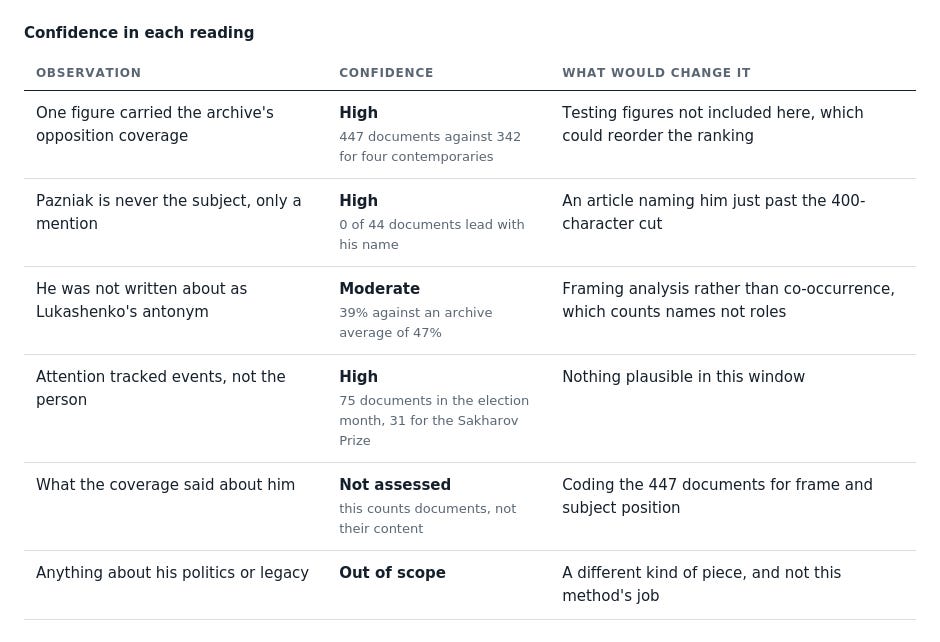
In seven years of English-language coverage, one Belarusian opposition figure was written about more than all his contemporaries together: 447 documents against 342.
The sharper measure is not volume but treatment. Thirty-six per cent of the documents that mention him are about him; for the founder of the Belarusian Popular Front, the figure is zero out of 44.
He was not covered as Lukashenko’s antonym. At 39 per cent co-occurrence against an archive average of 47, the convergence pattern that shapes so much foreign writing about Belarus does not appear here.
Attention followed the calendar, not the person. The election month produced 75 documents and the Sakharov Prize 31; no other month in five years reached sixteen.
Method and limits
The archive is two English-language collections inside the FORESIGHT corpus, 22,321 documents in total, of which 21,392 fall between 2005 and 2011; the remainder carry corrupted dates and are excluded. It is a collection about Belarus, not a sample of the world press, so it says what these sources published, not what English-language media as a whole did.
Names were matched on their root with word boundaries, which covers Milinkevich, Milinkievič, Milinkiewicz and Milinkevic; Pazniak, Pozniak, Paźniak and Poznyak; and the Cyrillic forms. A document counts as “led by” a name when the name appears in the headline or the first 400 characters, and as “mentioning” it when the name appears anywhere in the text. That distinction is the whole of the lead-ratio measure and it is coarse: an article can name someone at character 401 and still be about them.
Co-occurrence with Lukashenko is measured in the same opening 400 characters and means only that both names appear there. It does not measure framing, and a low share is not evidence of independent treatment — only evidence against the specific claim that he was introduced through Lukashenko.
Six figures were compared. Others active in the period were not tested, and a different set might change the ordering.
This brief counts documents. It does not evaluate what any of these people did.