
In April, we published our first full-spectrum analysis of the Belarusian information space, built on 16 AI agents and 1.2 million documents. We made specific, checkable predictions. Today, with the corpus grown to nearly 3 million documents and the first half of 2026 complete, we return to score our own forecasts — and to report a structural shift that none of the individual metrics could show alone.
The headline: Belarus has moved from oscillation to managed balancing. The scenario engine’s probability for “managed balancing” jumped from 35% to 48%, while “intensified repression” collapsed from 26% to 13%. Every fragility indicator improved. The civil society discourse softened. Media freedom metrics turned positive for the first time in our tracking. And yet — FIMI volumes hit an all-time record, and the Oreshnik missile discourse doubled.
This is not liberalization. It is a regime learning to walk a tightrope, and getting better at it.
1. Scoring Our April Forecasts: What We Got Right and Wrong
Transparent forecast verification is core to the FORESIGHT methodology. Here is the honest scorecard:
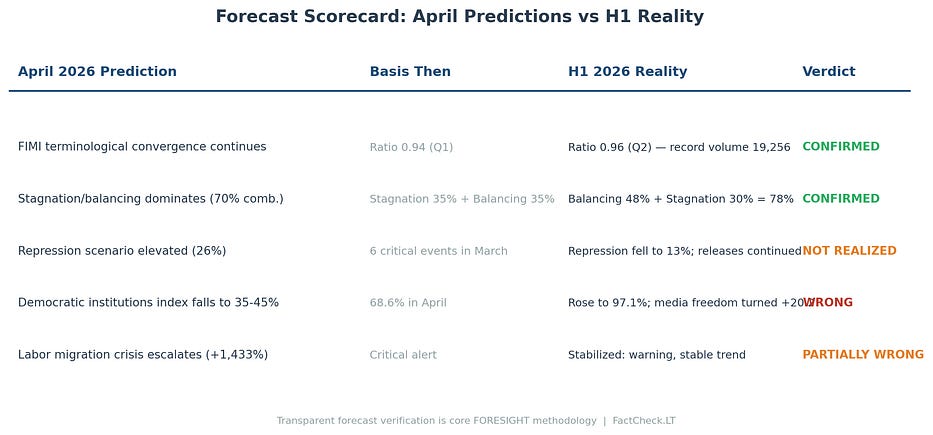
Transparent forecast verification: two confirmed, one not realized, two wrong.
Our biggest miss deserves explanation. In April, we predicted the “democratic institutions” discourse index would fall back as the Q4 2025 anomaly left the analytical window. Instead it rose to 97.1%, and the media freedom dimension flipped from -34.7 to +20.2. We underestimated the durability of the dialogue track: prisoner releases continued, negotiation channels with Washington and Warsaw stayed open, and the regime’s discourse followed. The error was treating Q4 2025 as an anomaly when it was the beginning of a trend.
2. The Balancing Shift: Scenario Probabilities
The scenario engine, fed by fragility, FIMI, and European choice data, produced a dramatically different distribution than three months ago:
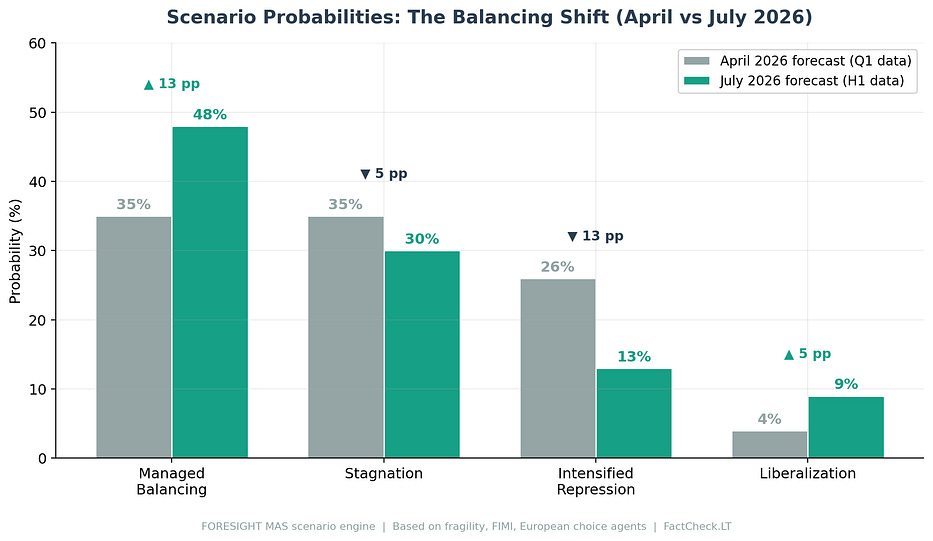
Probability mass moved from repression (-13 pp) to managed balancing (+13 pp).
The probability mass moved decisively from repression to balancing. Liberalization, while still marginal, more than doubled — the first time this scenario has moved at all since we began tracking.
3. FIMI: The Convergence Completes
The “fake” vs “disinformation” distinction — populist versus institutional labeling of information threats — is nearly gone. The ratio reached 0.96 in Q2 2026, up from 0.72 in early 2025. Combined volume hit a record 19,256 mentions in a single quarter.
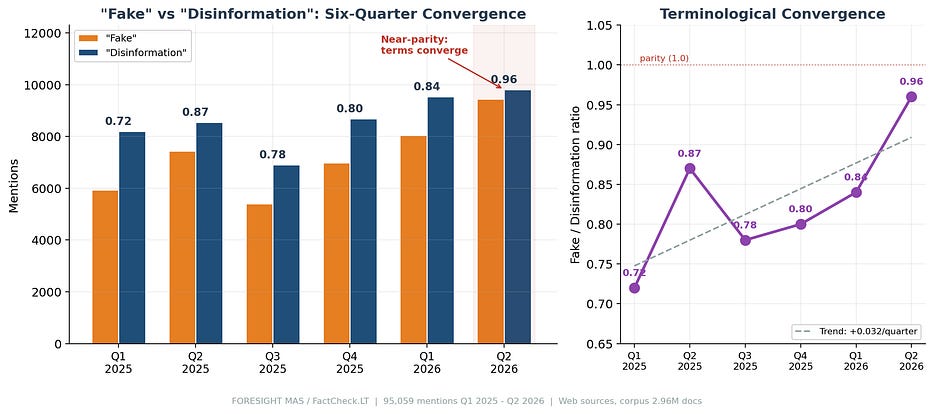
Left: record volumes. Right: the ratio approaches parity (0.96) — the two-term system collapses into one.
What does convergence mean? In 2025, “fake” was the regime’s weapon against internal opponents, while “disinformation” framed external threats. By mid-2026, both terms point overwhelmingly West. The information-defense apparatus has unified its vocabulary into a single external-threat narrative — even as the diplomatic track with the West deepens. This is the tightrope in miniature: negotiate with Washington while narratively mobilizing against “Western disinformation.”
4. Fragility: The Regime Feels Safer
All five dimensions of the Fragility Pentagon improved between the Q1 and H1 measurements:
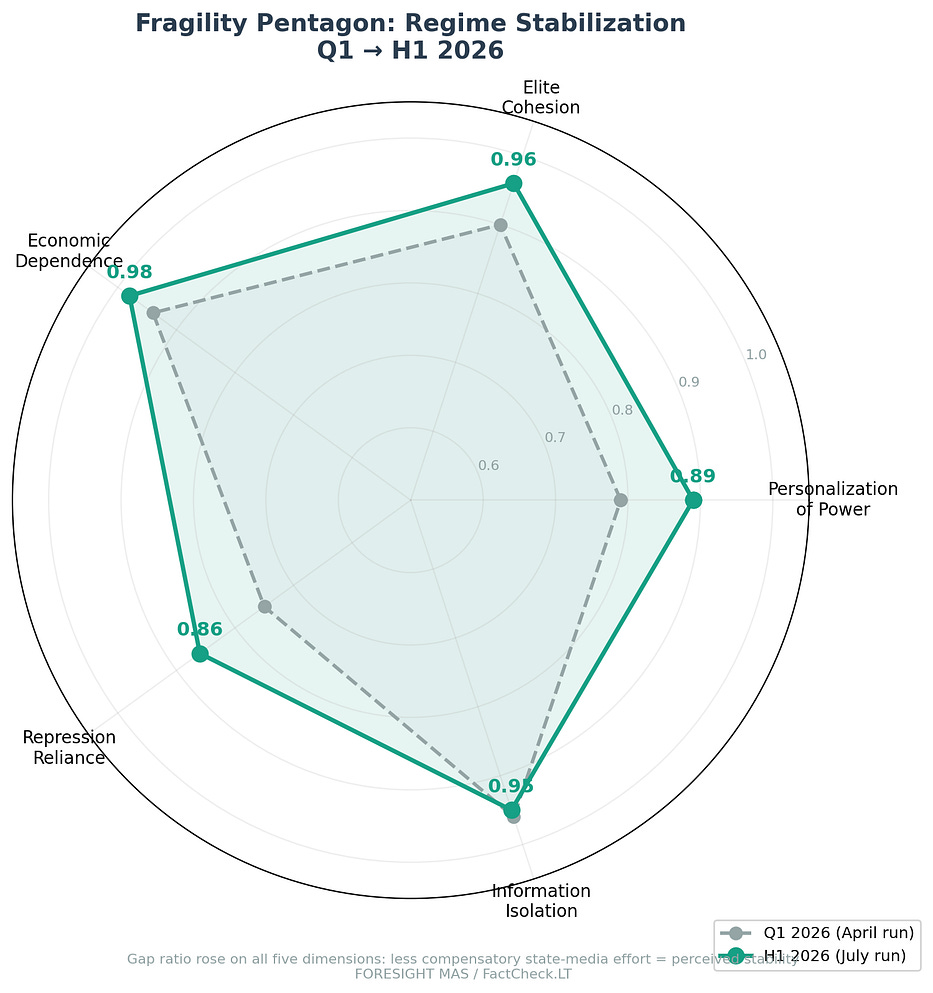
The teal contour (H1) sits outside the gray one (Q1) on four of five dimensions.
Higher gap ratios mean less compensatory state-media effort: the regime is spending less narrative energy defending its weak points. The largest improvements came exactly where April showed the deepest vulnerabilities — repression reliance and personalization. A regime that releases prisoners needs to talk about repression less.
5. Civil Society: The Capture Softens
The Substitution Index — measuring regime appropriation of the term “civil society” — fell to 0.86 in 2026, the second-lowest value since tracking began in 2021 and well off the total-capture peak of 1.00 (H1 2023, the Bialiatski sentencing period).
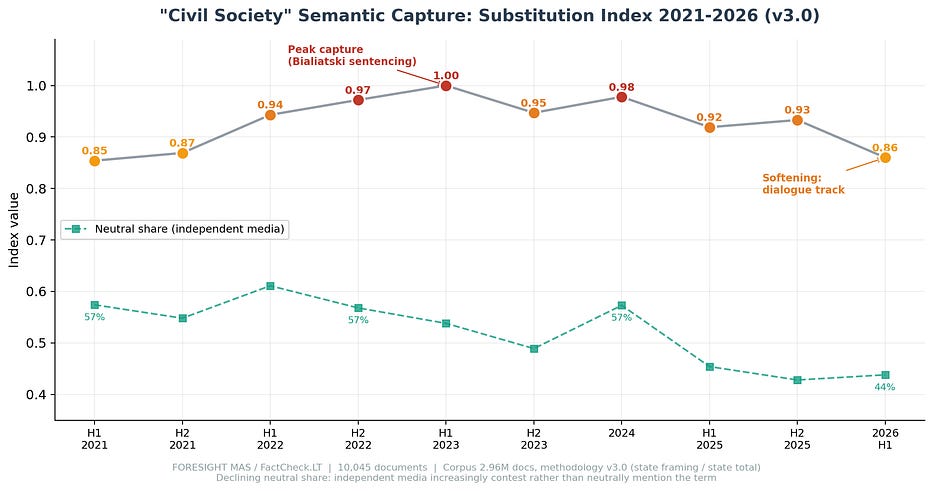
The index (dots) retreats from total capture while the neutral share of independent coverage (teal) falls — both sides intensify the contest.
Two readings are possible. The optimistic one: the dialogue track requires loosening discursive control, and independent voices are regaining semantic ground. The instrumental one — suggested by our LLM interpretation layer — is that the retreat is itself part of the operation: a regime demonstrating “openness” to Western interlocutors by softening its most visible discursive monopolies.
A supporting signal favors the second reading: the neutral share of independent media coverage fell from 57% to 44% over the same period. Independent outlets are not relaxing — they are contesting the term more actively than ever. The softening is asymmetric: the regime loosens, the opposition escalates.
6. Economy: Normalization With One New Alarm
Of the eleven tracked economic indicators, the two critical alerts from Q1 — inflation and labor migration — both de-escalated to warning level. Sanctions pressure coverage went quiet (normal). The IT sector continues its anomalous positive-sentiment rise.
The one new critical alert: Business Climate (rising volume, sentiment -0.43). As macro-panic subsides, discourse is shifting to structural complaints — regulatory pressure, inspection campaigns, the operating environment for what remains of private business. This is a slower-burning signal than inflation, but historically a more reliable predictor of elite-level friction.
7. The Media Ecosystem at Half-Year Scale
The 11-source independent media analysis now covers 62,879 publications across H1, clustered into 44,143 events:
Multi-source coverage rose to 12.2% (from 9.1% in the Q1-only run) — the shared news agenda is growing
State dependency stable at 4.3% (v3 context-aware detection)
A structural novelty: STV became the #2 most-cited state source (227 citations), displacing SB — worth monitoring as a possible shift in which state outlets independent media treat as newsworthy
Belsat remains the volume leader (99% exclusivity); Mediazona remains the most overlapped specialist (47%)
8. The European Choice: The Tightrope, Quantified
With Q2 2026 data complete, the European choice picture resolves — and it complicates any simple liberalization reading:
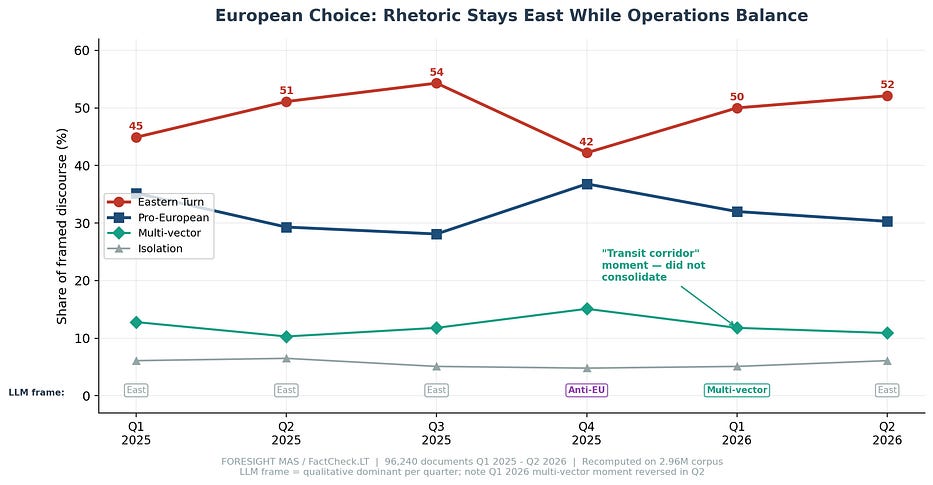
Eastern turn holds 42–54% throughout. The Q1 2026 multi-vector moment (LLM layer) reversed by Q2.
The Q1 2026 “multi-vectorism” moment — when the LLM layer flagged a qualitative shift and the regime debuted its “transit corridor between the EU and the East” formula — did not consolidate. By Q2, the dominant frame returned to Eastern turn both quantitatively (52.1%) and qualitatively. Our own agent’s Scenario A indicator (multi-vector rising above 15%) failed: it fell to 10.9%.
The Q2 assessment is blunt: partnerships with Russia, China, North Korea, Uzbekistan, the UAE dominate; “European path” mentions are rhetorically defensive (“Belarus is already Europe”), aimed at deflecting Western narratives rather than signaling integration; contacts with Lithuania and Poland are confined to border management.
How does this square with the balancing shift in every other indicator? This is the central finding of H1: the regime has separated its rhetorical vector from its operational track. The words go East — Union State, EAEU, Global South. The actions balance — releases continue, negotiation channels stay open, fragility compensation drops. Eastern rhetoric is not the opposite of balancing; it is its domestic cover. A regime walking a tightrope toward Western sanctions relief cannot afford to say so in its own media.
8a. The Identity Divergence: Europe Wins Where It Wasn’t Expected
The national identity agent delivered the most counterintuitive result of the half-year:
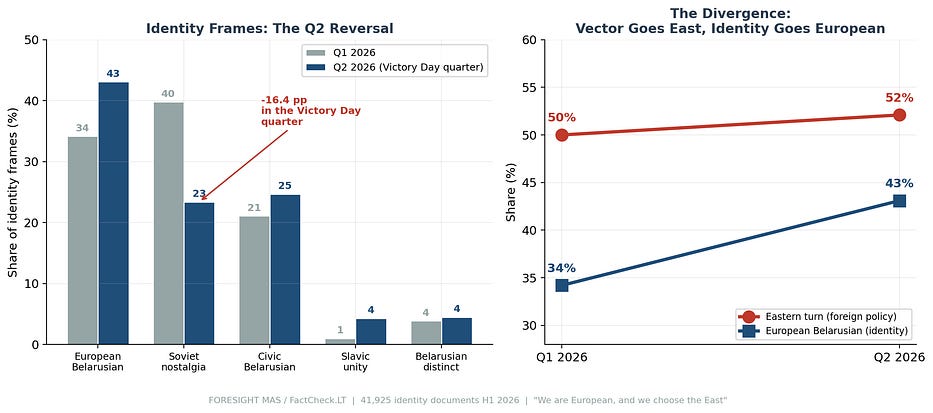
Soviet nostalgia collapsed 16 pp in the Victory Day quarter; European Belarusian identity took a commanding lead.
In Q1 2026, Soviet nostalgia led the identity discourse for the first time in our tracking. In Q2 — the Victory Day quarter, when nostalgia frames historically peak — it collapsed by 16 percentage points, and “European Belarusian” identity retook a commanding lead.
Put both agents side by side and the divergence is stark: the foreign-policy vector went East while the identity discourse went European. The regime appears to be decoupling geopolitical alignment from civilizational identity — “we are European, and we choose the East” — a formula that keeps both the domestic pro-European majority and the Russian ally manageable. Whether this is a deliberate construction or an emergent property of balancing pressures, it is the discursive signature of the tightrope.
9. Forecast for H2 2026
Based on the full H1 dataset, the scenario engine and our analytical layer project:
Base case (48%): Managed balancing consolidates — in actions, not words. The dialogue track survives and continues through possible Ukraine negotiation windows in Q3. Expect further selective releases and continued FIMI escalation against “Western disinformation” — while Eastern-turn rhetoric holds above 45% of vector discourse. Do not expect the rhetoric to soften: H1 demonstrated that Eastern framing is the domestic cover for Western-facing balancing, not its contradiction. The indicator to watch is not the multi-vector share (which failed as a signal in Q2) but the identity layer: if “European Belarusian” holds above 40% while releases continue, the tightrope holds.
Key risks to the base case:
Oreshnik discourse doubled in H1 (32 → 64 critical-event documents). If deployment moves from discourse to demonstrated capability, the balancing act becomes untenable for Western interlocutors.
Business Climate critical alert: structural economic friction could force a choice between further economic opening and elite protection.
NATO-Baltics escalation remains the largest critical-event cluster (134 documents). A border incident is the scenario-breaker neither side controls fully.
What would falsify the base case: repression scenario indicators (mass arrests resuming, SI returning above 0.95, fragility gap ratios falling), or conversely, genuine institutional steps (legal re-registration of liquidated NGOs, media law changes) that would mark actual liberalization rather than managed balancing.
We will score these predictions in January 2027.
Methodology
FORESIGHT is a Multi-Agent System built on PostgreSQL with pgvector, now processing 2.96 million documents from 73+ sources — the corpus more than doubled since April through the addition of new independent outlets, YouTube state-TV transcripts, and expanded Telegram coverage. The H1 2026 full pipeline ran 16 agents in 3.75 hours. Historical metrics have been recalculated on the expanded corpus; where April and July values differ (e.g., European choice frame shares), the current corpus is authoritative and comparisons use recomputed baselines.
In addition to quarterly and semi-annual deep-dives, FORESIGHT produces automated weekly 12-actor monitoring reports via an n8n workflow.