
On Monday afternoon (2026-10-26) in Vilnius, an adviser at Lithuania’s Ministry of National Defence named the Russian narrative she finds most painful for her country. Agnė Žekonytė told the cognitive-warfare panel at Defending Baltics 2026 that it is one sentence: the war must end, but Russia cannot lose. In Lithuania, she said, that sentence turns upside down everything people have built their lives around for the last few years.
The same sentence has a Belarusian life, and it is a strange one. Ten months of the FORESIGHT corpus show that in Belarus nobody says it whole. Lukashenko says the first half, often and loudly. The pro-regime Telegram pyramid says the second half, in Russian words. The two halves meet in the same document about fifteen times a year, and when they do, Lukashenko is not in the room.
What the count was looking for
The method was simple. Half A is any call to stop the fighting: a ceasefire, peace talks, “end this war”, “peace in Ukraine”. Half B is any claim that Russia cannot be defeated: “Russia cannot lose”, “strategic defeat of Russia” used as a Western delusion, or the standard phrase “to the last Ukrainian”. A document counts as the full sentence only when both halves sit inside one window of about two hundred characters and that window also names Russia or Ukraine.
Across 2026, the first filter found 469 documents carrying Half B. The second filter cut them to 28. After removing the same post forwarded through four channels of the Zhyoltye Slivy cluster, two Nevolfovich reposts, and four CTV pages where the match came from a related-headlines block, about fifteen genuine cases remain in the Belarusian state field. Not one of those fifteen names Lukashenko inside the window.
The two halves meet about fifteen times a year, and Lukashenko is never in the room.
Who says the first half
A second pass took every 2026 document with Lukashenko in the title, 46,620 of them, and asked how often Half A appears next to his name. The answer is 260 times, with one big spike. In June, his Al-Arabiya interview produced 124 documents in which he says the conflict between Russia and Ukraine “can be ended this year”, and the state apparatus repeated it from BelTA to the regional papers and from ONT’s Telegram to Nasha Zemlya.
The same 46,620 documents were checked for Half B. It appears eleven times. It appears together with Half A in two documents all year. The closest Lukashenko comes to the second half is a BelTA headline of 15 June: why Russia did not win quickly, and that “Russians at the front are more successful”. That is a claim that Russia is ahead. It is not a claim that Russia cannot lose.
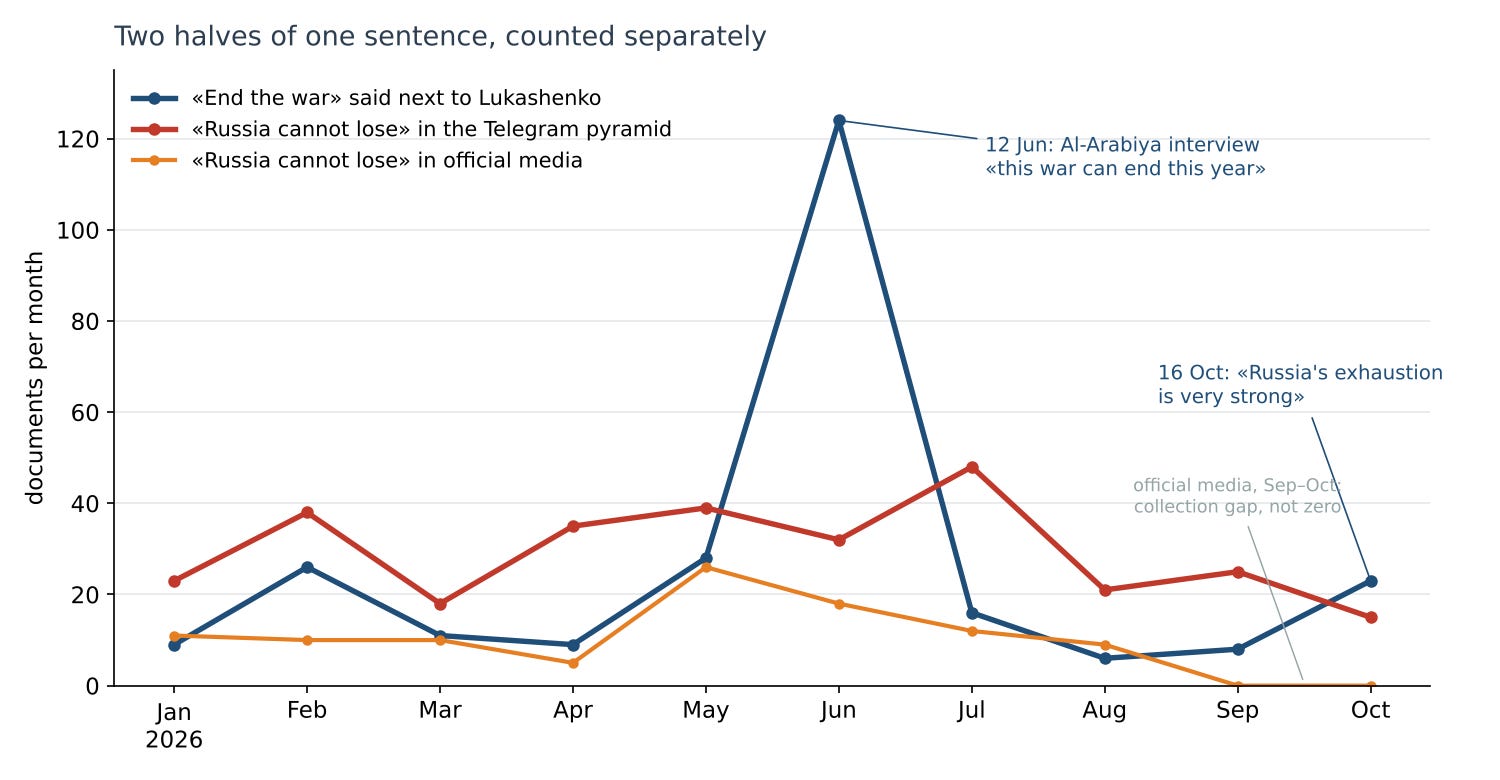
Then came 16 October. In the Verkhnedvinsk district Lukashenko said that peace “will come, if not this year then next”, and gave his reason: Russia “can still fight for a long time”, but “the exhaustion is very strong, the effect on the economy is enormous, and the Russians understand this”. The line travelled through the whole state segment that day. SB carried the exhaustion wording in two of three items, BelTA and CTV in one each, and so did the pyramid: Belarus VPO, Zhyoltye Slivy, Nasha Zemlya, Grodno Sliv. The independent outlets put the exhaustion in the headline: Euroradio, Reform, Pozirk.
So ten days before the Vilnius panel, the Belarusian version of Half A came with its own second half, and that second half was the opposite of the Lithuanian one. End the war, because Russia is tired.
End the war, because Russia is tired.
Who says the second half
Half B lives one floor down. The Telegram pyramid carried it in 294 documents this year, between 15 and 48 a month. Official media carried it in 101, the independent outlets in 66, mostly while quoting Medvedev or Peskov. The ministries’ channels carried it zero times.
The wording is not Belarusian. Of the 28 paired windows, 19 use “to the last Ukrainian” and 10 use “strategic defeat of Russia”. Not one uses a plain Belarusian or Russian form of “Russia cannot be defeated”. These are Kremlin formulas, and the pyramid applies them to Western actors, never to the war’s outcome itself. Belarus VPO on 18 June: the West “decided to fight to the last Ukrainian”, so no peace settlement is possible. Nevolfovich on 7 February: Zelensky “chose a war to the last Ukrainian” in 2022, when Belarus offered a venue for talks. Nasha Zemlya on 16 February: Boris Johnson “sabotaged peace talks” and pushed the idea of war to the last Ukrainian.
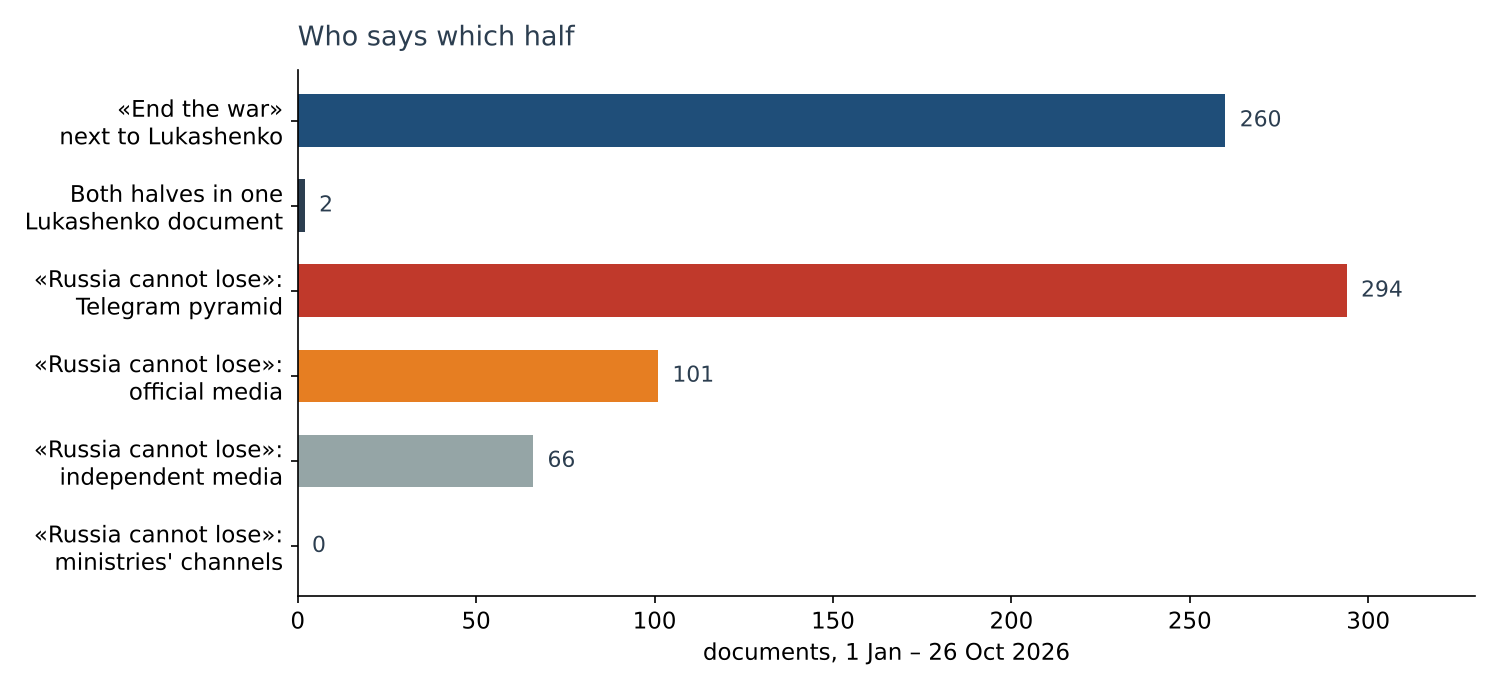
Read together, the pyramid’s sentence is a different sentence again. The war must end; the West will not let it; therefore the West is the enemy of peace. Russia’s invincibility is assumed in the background, not stated. The one state outlet that said it in its own voice was SB on 11 June, in a column about EU resource hunger, and even there the subject was Europe’s war aims, not Russia’s strength.
The pyramid’s sentence is a third sentence: the war must end, and the West will not let it.
Why this matters for the panel’s question
Žekonytė’s point was that Lithuania hears the sentence whole, and that its two halves together do the damage. The Belarusian data suggest the sentence is assembled differently for different audiences. The regime’s own voice carries the peace half with an economic argument about Russia. The anonymous channels carry the invincibility half in borrowed Russian vocabulary, aimed at Europe. A Belarusian reader who follows both gets the full Lithuanian sentence; a reader who follows only the president does not.
There is one more negative result worth stating. Lithuania is named in none of the 28 paired windows. The pyramid’s version of the sentence is addressed to Brussels, London and Kyiv, not to Vilnius. When the Baltic states appear in Lukashenko’s October remarks, it is in a separate CTV item about them behaving “insolently”, with no peace sentence attached.
A reader who follows only the president never hears the second half.
Confidence
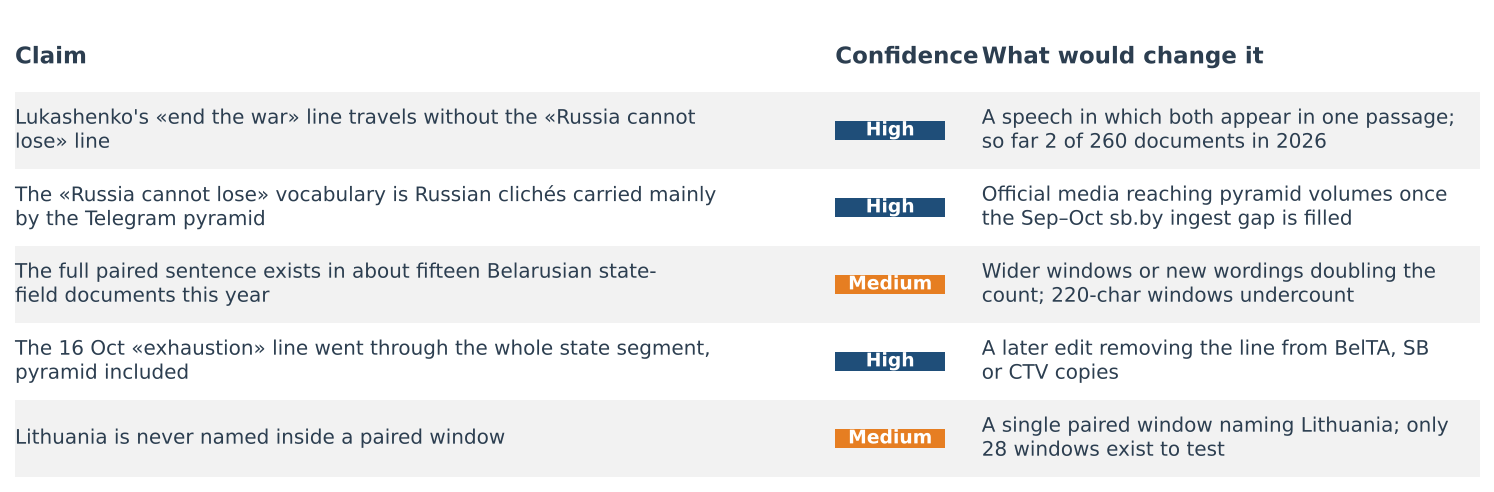
Five claims carry this piece, and they do not rest on equal ground.
Lukashenko’s “end the war” line travels without the “Russia cannot lose” line. High. The two halves share a document in 2 of 260 cases this year, and neither is a speech of his own. One passage from him that holds both would change this.
The “Russia cannot lose” vocabulary is Russian clichés carried mainly by the Telegram pyramid. High. 294 pyramid documents against 101 in official media, with every pairing worded as “to the last Ukrainian” or “strategic defeat”. The ranking could still move once the SB.by gap for September and October is filled.
The full paired sentence exists in about fifteen Belarusian state-field documents this year. Medium. Windows of 220 characters miss pairs split across a paragraph, and new wordings are not caught. Wider windows could double the count without changing who says it.
The 16 October “exhaustion” line went through the whole state segment, pyramid included. High. SB, BelTA, CTV, ONT’s channel and four pyramid channels carried it the same day. Only a later edit removing it from those copies would change this.
Lithuania is never named inside a paired window. Medium. The baseline is zero of 28, which is a small set. A single window naming Lithuania would end the claim.
Watch items
By 31 December 2026: whether any Lukashenko statement puts “exhaustion” and a “Russia cannot lose” formula into one passage. The count so far in 2026 is two of 260, and neither is a speech of his own. One such passage changes the reading of the first section.
By 31 January 2027: the pyramid’s monthly count of “to the last Ukrainian” and “strategic defeat” against this year’s median of about 30. If talks resume and the count falls below 15 for two months, the second half is being retired; if it rises above 50, the pyramid is preparing readers for a settlement it will call a Western defeat.
By 31 March 2027: whether Lithuania appears inside a paired window at all. Zero of 28 is the baseline.
Method and limits
Source: the 2026 slice of the FORESIGHT corpus, 1 January to 26 October, web, YouTube and Telegram layers, deduplicated by URL. Half A and Half B are regular-expression markers; a pairing requires both inside one window of up to 220 characters that also names Russia or Ukraine. Windows undercount: a pair split across a paragraph is missed, and new wordings are not caught. Telegram channels that live in two sources were assigned by handle, not by source name. The Lukashenko pass used a title filter, so statements reported without his name in the headline are outside the 260. Forwarded copies of one post were removed by hand from the 28; the fifteen is a judgement, not a query result.