
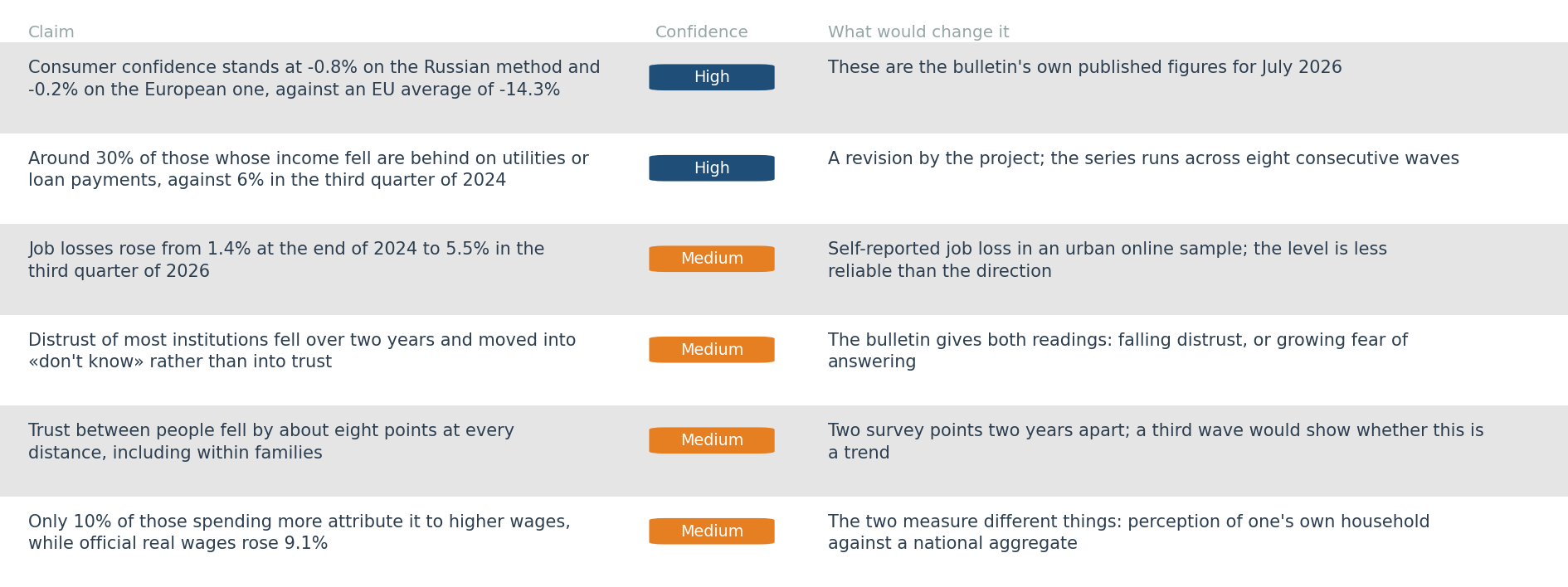
Belarusian consumer confidence is now close to zero: −0.8% on the Russian method and −0.2% on the European one, against an EU average of −14.3%. On paper, urban Belarusians feel better about their economy than Poles, Greeks or Russians do. The same survey shows that a third of those whose income fell are behind on their bills, and that job losses have almost quadrupled in two years. The figures come from the quarterly survey of the Monitoring of the Belarusian Economy project, run by MacroBY.org, which has polled about a thousand urban residents eighteen times since December 2021.
What people say
The index sits where it does for a reason. Negative views of the past year fell in the third quarter: 28% say the country’s economy got worse, down six points, and 27% say their family’s position got worse, down five. Expectations are the strongest part. Only 13% expect their household finances to worsen, while 31% expect them to improve.
Compared with Europe this looks strong. It is also almost unchanged: the Belarusian index rose by 0.9 points over the quarter while the EU average rose by 5.1. Belarus is not improving faster than Europe. Europe moved and Belarus did not.
What people do
A quarter of respondents say their income fell over the past month. Take out those who blame only the exchange rate and it is 22%; take out rising prices as well and 18% still report a fall for other reasons.
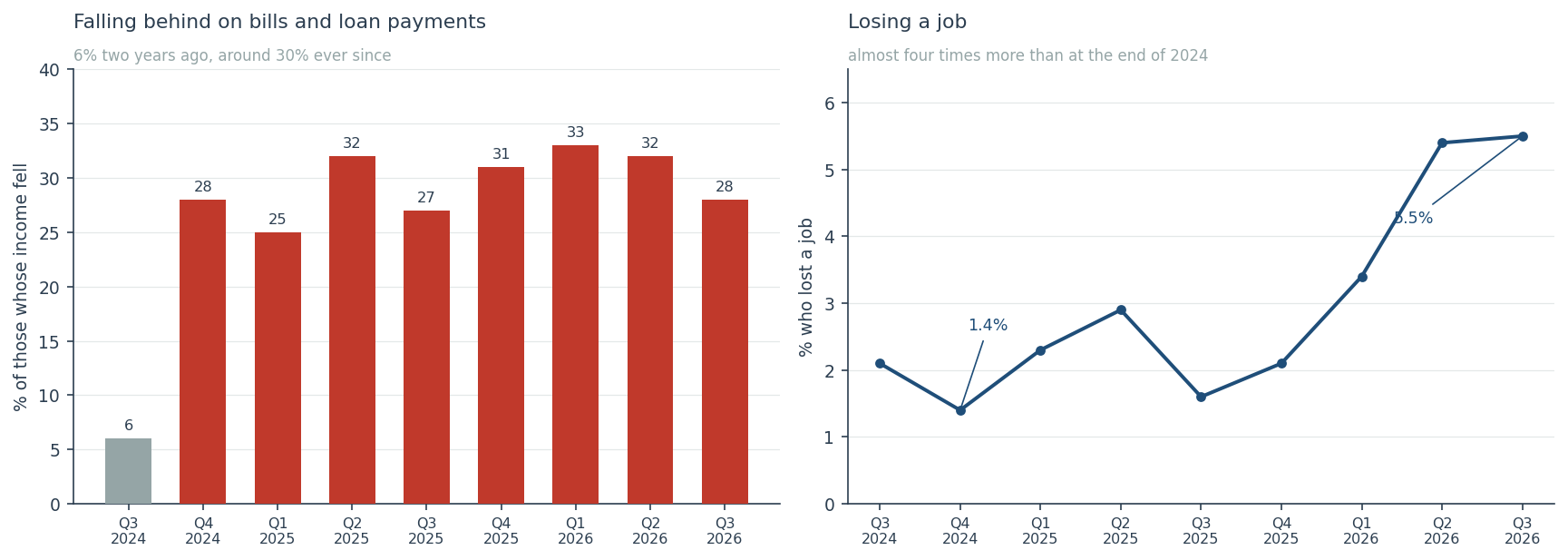
Ask that quarter how they coped, and the answer has changed. In the third quarter of 2024, 6% of them had fallen behind on obligatory payments such as utilities and loan instalments. In every wave since, the figure has run near 30%, and stands at 28% now. Delaying a large purchase used to be the common response. Missing a payment has replaced it.
Job loss has moved too. At the end of 2024, 1.4% of respondents said they had lost a job. In the second and third quarters of 2026 it is 5.4% and 5.5%. Almost four times as many.
Spending tells the same story from the other side. Half of respondents, 51%, say they have spent more over the past six months, and 77% of them attribute this to prices. Ten per cent attribute it to higher wages. That last figure is worth holding next to the official one: the Eurasian Development Bank reported real wages in July up 9.1% year on year. One in ten households noticed.
Six per cent were behind on payments two years ago. Around thirty per cent have been ever since.
Real wages rose 9.1%. One household in ten noticed.
The gap is not a contradiction
Both halves can be true, and the survey shows why.
The index is built mostly from expectations, and expectations in Belarus are held up by one component: how households think their own finances will go. That reading is 9.6%, the most positive part of the whole index. Views of the past year are negative, at −3% for the economy and −3% for family finances. The best time for a large purchase scores −9.5%.
So people are not saying that things are good. They are saying they expect their own situation to hold. Meanwhile 63% still expect prices to outrun their income, and only 6% expect the reverse. Confidence here means the absence of expected deterioration, not the presence of improvement.
Confidence here means no expected deterioration, not expected improvement.
Where the distrust went
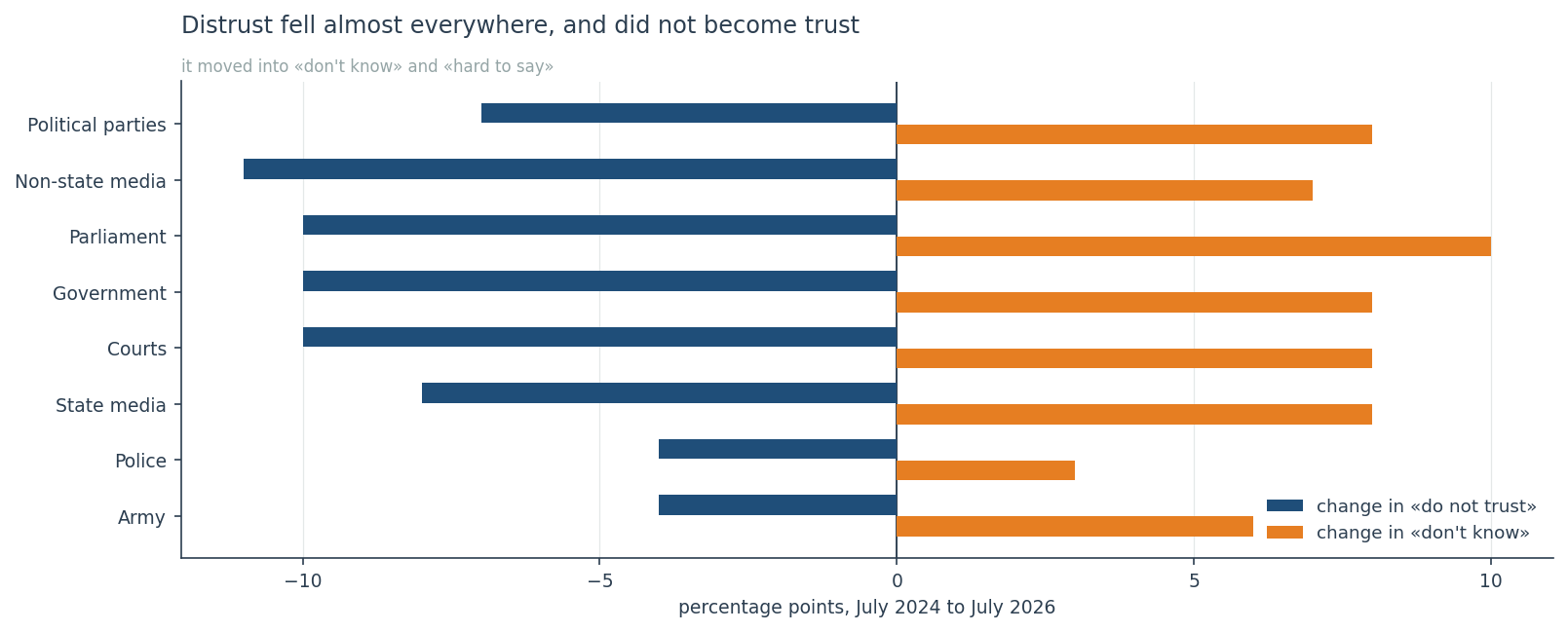
The survey repeated its trust questions from July 2024, and the two-year comparison is the most careful part of the bulletin.
Distrust fell almost everywhere. Fewer people now say they distrust the courts, down ten points, the government, down ten, parliament, down ten, non-state media, down eleven, state media, down eight. That reads like a state regaining legitimacy.
It did not become trust. It became “don’t know”. Uncertainty about parliament rose ten points, about political parties eight, about state media eight, and the bulletin notes that distrust of state media redistributed into that answer entirely. Its authors state the two possible readings plainly: either distrust really has fallen, or people have become more afraid to answer a question about trusting institutions.
Something similar happened between people. Two years ago 23% agreed that most people can be trusted; now 15% do. Trust in one’s own family fell from 94% to 86%, in personal acquaintances from 78% to 69%, in neighbours from 50% to 42%. Eight points at every distance, including the closest one. The share who found the question hard to answer rose from 17% to 30%.
Distrust did not turn into trust. It turned into “hard to say”.
Confidence
Watch
The arrears figure falls back toward its 2024 level of 6% in the next wave. It has not in eight waves.
Job losses stay above 5% in the October wave, which would make two quarters a trend rather than a season.
The share answering “don’t know” on institutional trust keeps rising in the next repeat of those questions.
Real wage growth and the share of households noticing it converge. In July the gap was 9.1% against one in ten.
Method and limits
All figures come from the Monitoring of the Belarusian Economy project run by MacroBY.org: eighteen online waves of about a thousand urban residents aged 18 to 64 since December 2021, weighted to the urban population by sex, region and age.
Two limits are the project’s own. The sample is urban, so rural households are not represented. And the responses are self-reported at a time when a rising share of people decline to answer questions about trust, which the bulletin itself flags as a possible sign of fear rather than of changed opinion.
The comparison with EU countries uses the European method, which drops the question about the current state of the economy. The bulletin explains why: for EU countries that version predicts behaviour better. It is still a comparison between a survey conducted in Belarus and surveys conducted in states where answering carries no risk.