
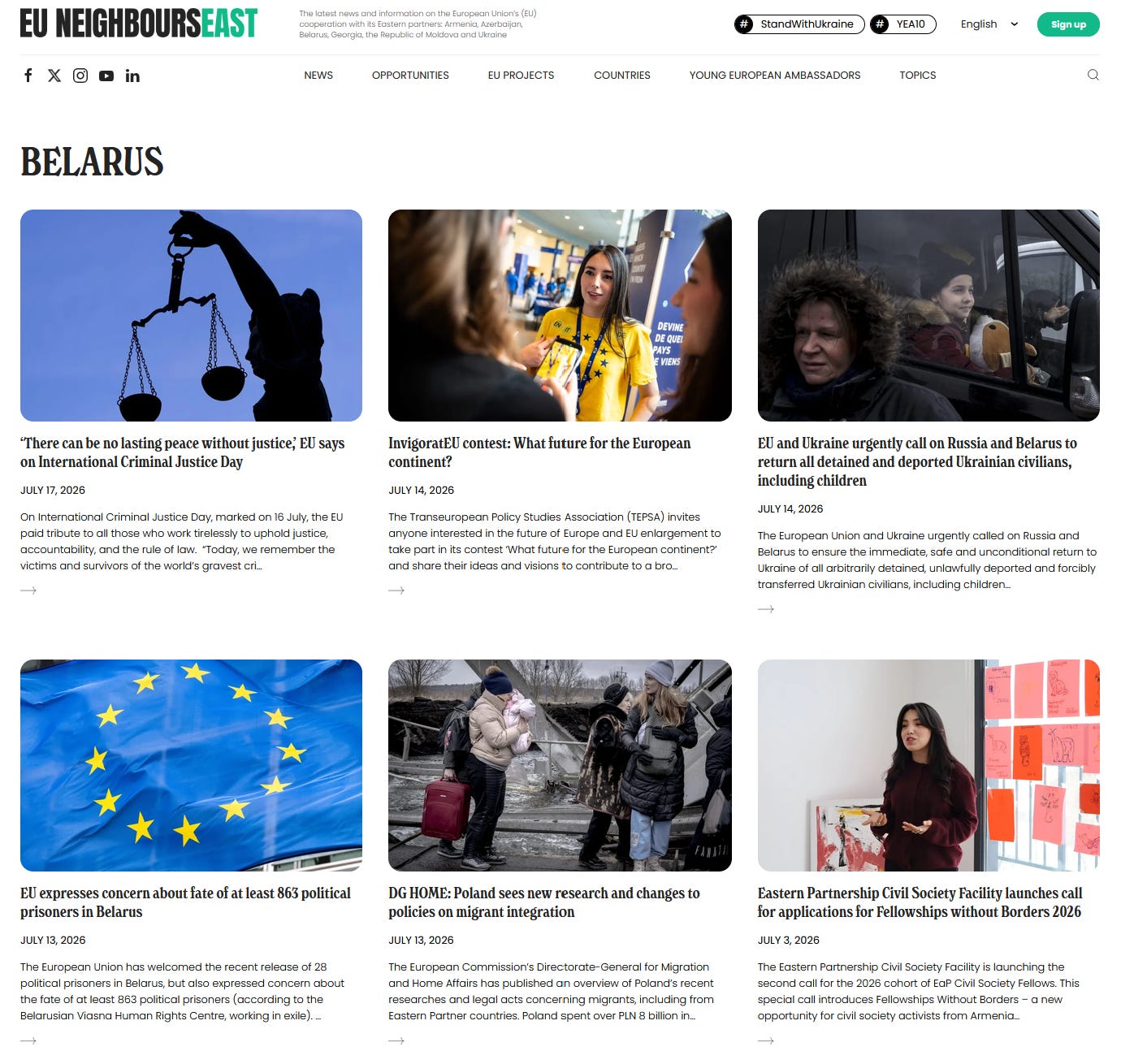
Most analysis of EU–Belarus relations reads what Brussels decides. We read what Brussels says — all of it. The EU Neighbours East portal (euneighbourseast.eu) is the European Union’s official communication channel for the Eastern Partnership region: news, statements, sanctions announcements, grant calls, human stories, a youth ambassador programme. We scraped its Belarus section completely — every listing page, every item, 2016 through July 2026 — and loaded all 2,129 documents into the FORESIGHT corpus.
One channel, ten years, zero gaps. Here is what the dataset shows.
1. The attention arc: the real response came a year late — and has since compressed to a third
The 2020 protests doubled the portal’s Belarus output (121 items against 72 in 2019). But the institutional surge arrived only in 2021: 513 items, driven by the sanctions waves, the Ryanair interception, and the border migration crisis. Bureaucracies communicate on bureaucratic time.
Then the pattern most Belarus watchers will recognize: Russia’s full-scale invasion of Ukraine in 2022 did not crowd Belarus out of this channel (494 items, nearly flat). The compression came later and steadily — 319 in 2023, 209 in 2024, 229 in 2025. The portal now runs at roughly a third of its peak, though still well above the pre-2020 baseline of 60–70 items a year.
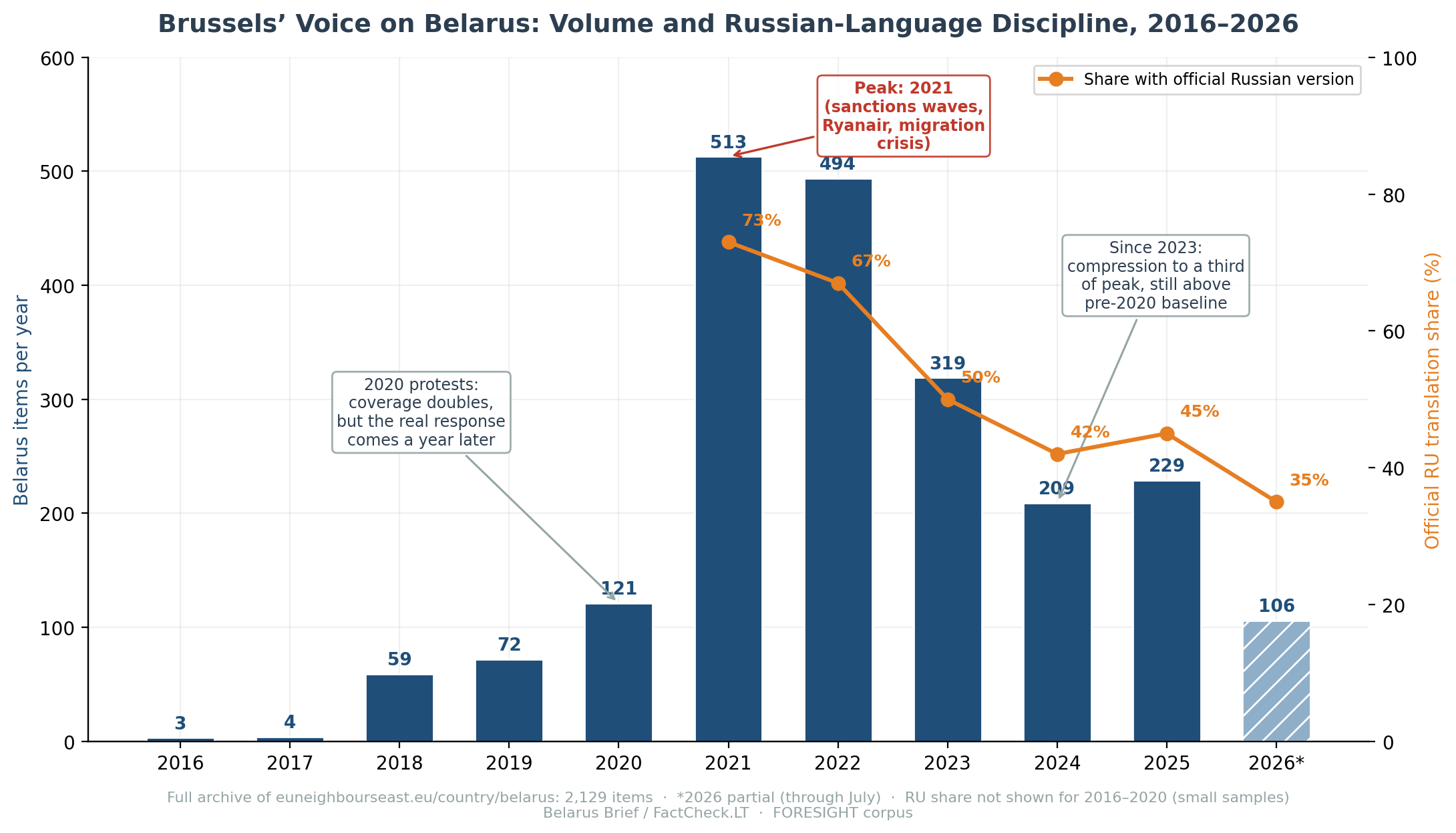
A necessary caveat before anyone quotes this as “the EU forgot Belarus”: this is one communication channel, not EU policy. EEAS statements, Parliament resolutions, and Council decisions travel through other pipes. What this curve measures is the public-facing communication effort aimed at the region itself — and by that measure, Belarus commands a third of the attention it did in 2021.
2. Belarus is a political story here, not a grants rubric
The portal’s front pages give the impression of a funding notice board. The full corpus says otherwise: pure grant-and-opportunity items are only 17% of the archive (370 of 2,129). The core is news (45%) and analytical publications (20%). On the EU’s own regional channel, Belarus figures primarily as a political subject — sanctions, political prisoners, statements of concern — with the funding layer wrapped around it, not the other way about.
3. The language map: who each genre is for
The portal publishes in English and translates selectively into Russian. That selectivity, mapped across 2,129 items, amounts to an audience declaration:
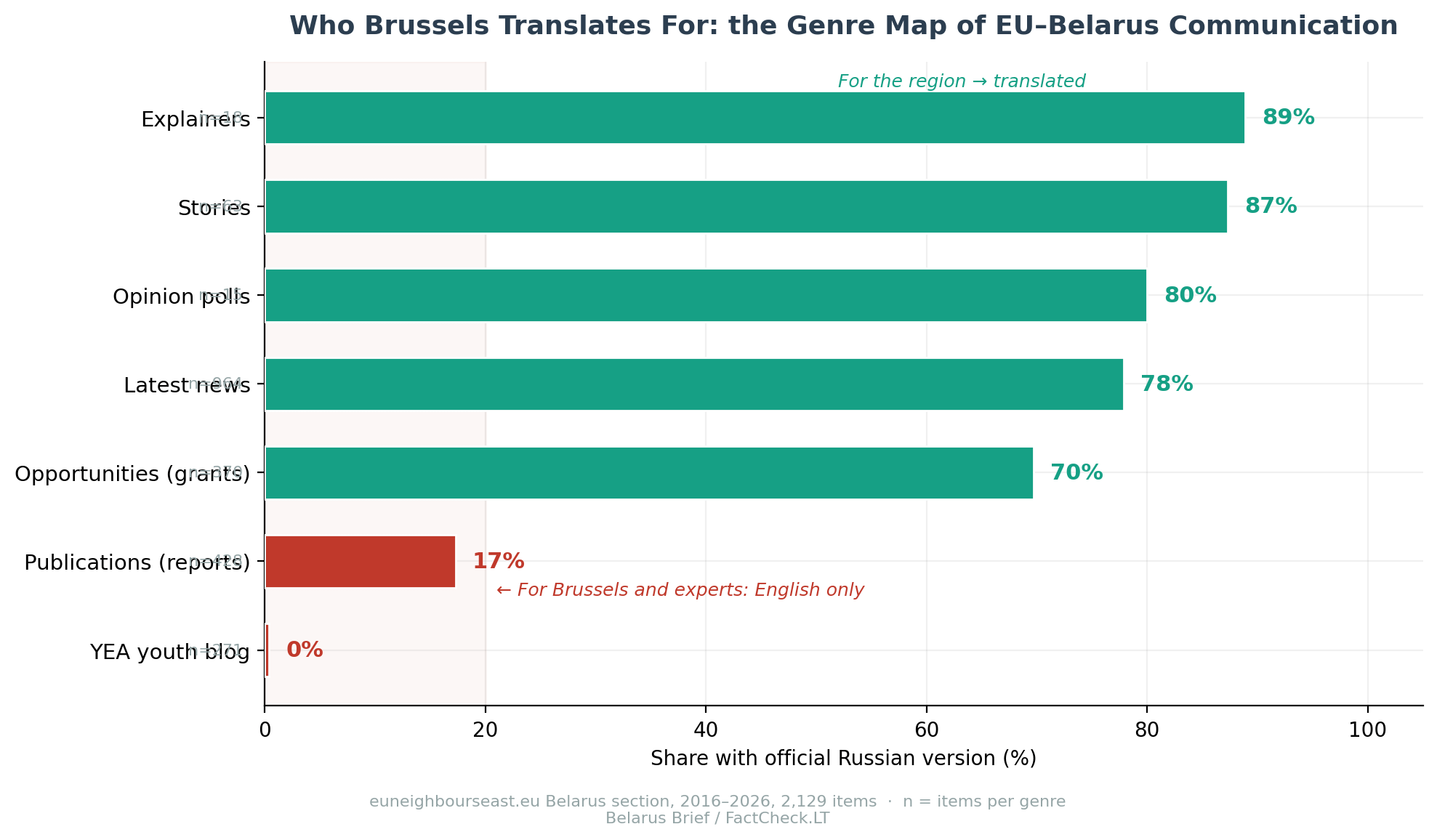
Everything aimed into the region gets translated: explainers (89% have an official Russian version), human-interest stories (87%), opinion polls (80%), news (78%), grant calls (70%). Two genres conspicuously do not. Analytical publications stay overwhelmingly English (17%) — the reports are a genre written for Brussels and the expert community, not for the societies they describe. And the Young European Ambassadors blog is English-only almost without exception (1 of 271 items): the EU’s youth outreach programme for the region operates, linguistically, as an English-language club.
There is a temporal layer too, visible in the first chart: the discipline of Russian translation has slid from 73% of items in 2021 to 35% in 2026. Two readings fit the data, and we can’t separate them from this corpus alone: a resource shift as the portal’s Russian editorial capacity lost priority, or a deliberate de-russification of EU communication. Both would produce the same curve; naming only one would be storytelling, not analysis.
Why this corpus matters beyond the three findings
FactCheck.LT has published monthly monitoring of how Belarusian state media talk about the EU and its neighbours since 2025. This dataset supplies the missing mirror: how the EU talks to Belarus, over the full decade, in a form that can be queried, compared, and joined against the rest of the 3-million-document FORESIGHT corpus. When Minsk’s media claim that “Brussels has written Belarus off” — or, in the other mode, that “the West is obsessed with Belarus” — there is now a measurable baseline for what the EU’s actual communication effort looks like.
Methodology: complete crawl of euneighbourseast.eu/country/belarus (143 listing pages, 2,129 items, no gaps), July 2026. Genre labels are the portal’s own taxonomy; the news category was introduced in 2021, so cross-genre comparisons spanning that year carry a caveat, while total-volume comparisons do not. Translation shares for 2016–2020 are omitted from the chart due to small samples. 2026 is a partial year (through July). Publication dates are the portal’s published-time metadata (±1 day vs. displayed dates). Part of the FORESIGHT corpus (~3M documents, 73+ sources) built by FactCheck.LT, Vilnius.