

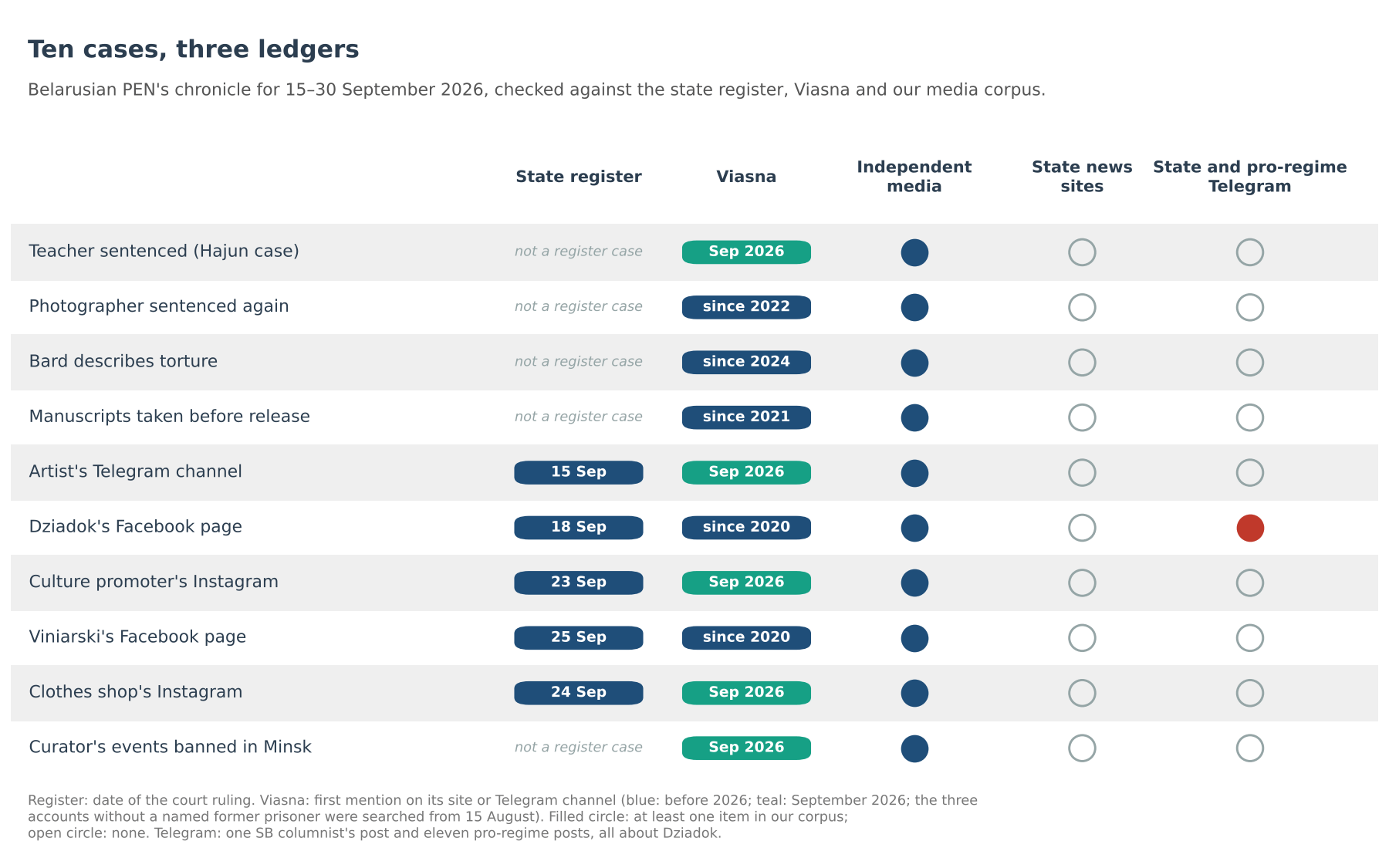
Belarusian PEN’s chronicle for 15–30 September lists ten cases: two sentences, an account of torture, confiscated manuscripts, five social media accounts designated “extremist” and a ban on cultural events. The state register confirms all five designations. Viasna had written about five of the seven people we checked long before the latest chronicle. Independent outlets mentioned all ten cases, but state news sites in our collection reported none of them. What we cannot see is how many cases none of the three ledgers records.
What the state wrote down
The five designations are all in the Information Ministry’s register, with the same courts that PEN named. Every one took effect on the day of the ruling, as almost all entries have since 2021. One is the Telegram channel of the artist Niki Sandras. Two are the Facebook pages of former political prisoners who write about prison, Mikola Dziadok and Maksim Viniarski. The other two are the Instagram accounts of a man who promotes Belarusian culture and of a shop that sells clothes with Belarusian designs.
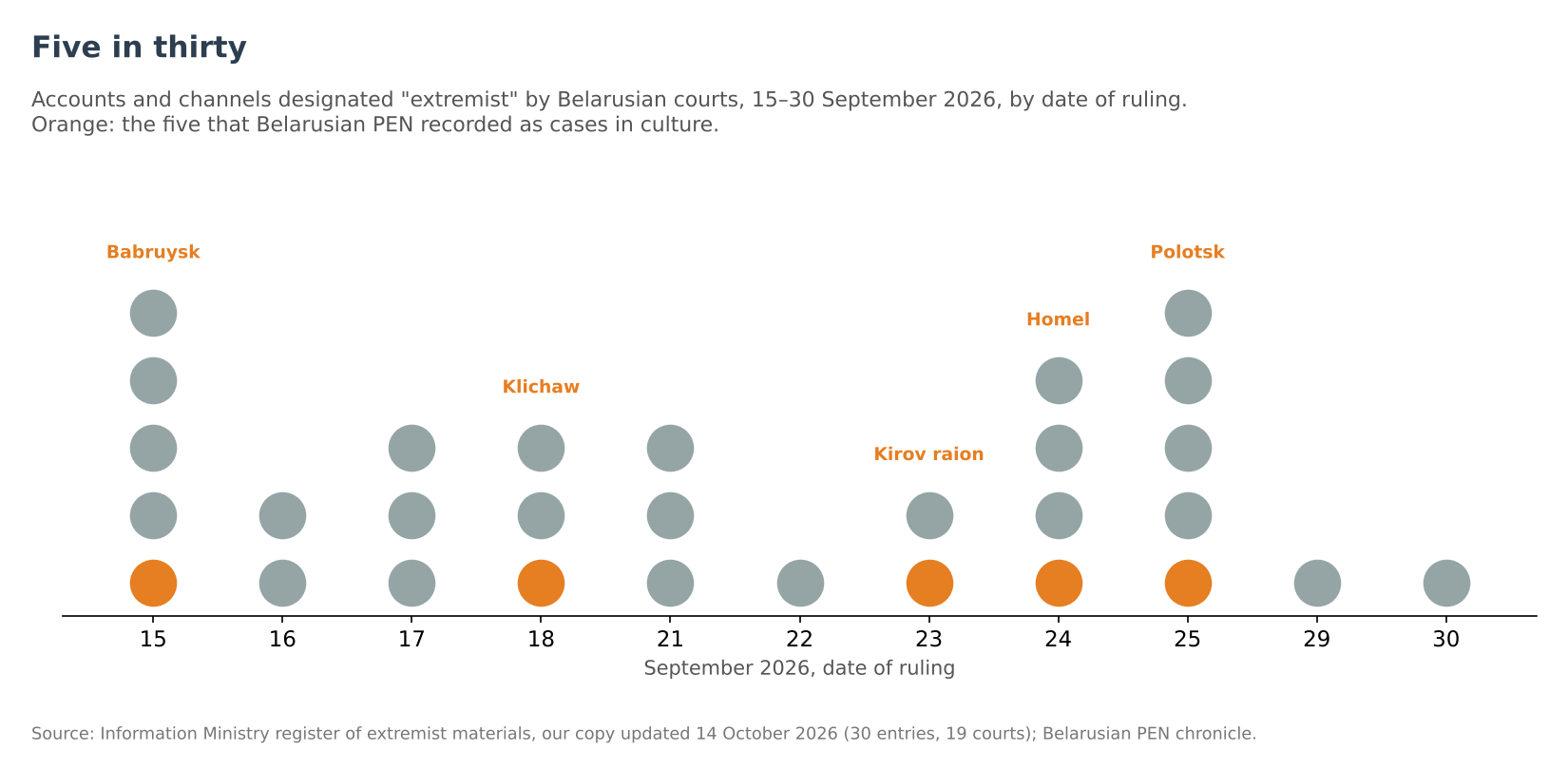
PEN’s five are a small part of the register’s fortnight. Between 15 and 30 September, 19 courts designated 30 accounts and channels, most of them on Instagram, Facebook and TikTok. Two of the five sat inside larger rulings. The court in Klichaw designated three Facebook pages on 18 September, one of them Dziadok’s, and the court in Polotsk did the same on 25 September, one of them Viniarski’s.
The state register confirms all five designations.
For Dziadok, September’s ruling was not the first. The register shows his Telegram channel designated by a court in Lida in December 2023, his Threads account by a Minsk court in March 2026 and now his Facebook page in Klichaw. Each time a different court in a different region took up the case. Dziadok was freed and sent to Lithuania in September 2025, and in April 2026 he was put on the wanted list, Zerkalo reported.
What Viasna already knew
We checked seven of the people in the chronicle against the Viasna archive in our corpus. Five appear well before September. The photographer Vadzim Zdaravenau appears from February 2022, the bard Ales Chumakou from February 2024. The Viasna list of current political prisoners shows Zdaravenau’s new sentence of four years and seven months, dated 29 September, the same date as PEN’s.
Viasna had written about five of the seven people we checked long before the latest chronicle.
Two of the ten cases are accounts given after release. Chumakou was among 25 political prisoners released and taken to Lithuania on 16 September. Afterwards he described burns and beatings during the investigation. Sviatlana Yakubovich, a Viasna volunteer, said that her manuscripts, diaries and court papers were taken from her before her release.
The two newest names reached Viasna only in late September. The history teacher Volha Vostrykava, whose sentence of restricted freedom in the so-called Hajun case was reported on 23 September, appears in one Viasna post that day. The ban on the curator Siarhei Filipau’s events in Minsk appears in one post on 28 September, the day Euroradio reported it.
Who else noticed
Independent outlets other than PEN mentioned every one of the ten cases. Mediazona and Reform followed each update of the register, and that is how most of the designations reached readers.
On state news sites we found nothing. The only state voice we found was the channel of the SB columnist Lyudmila Gladkaya, whose 7 October post we cited in our Latvia brief. On 11 September she mocked Dziadok, calling him an extremist and an anarchist who would be better off “in a cosy cell in a Belarusian colony” than in Europe. A week later a court designated his Facebook page. Pro-regime channels mentioned Dziadok eleven times from late August, and the posts we read were abuse, not news. None of them mentioned the other nine cases.
Independent outlets mentioned all ten cases, but state news sites in our collection reported none of them.
How sure we are
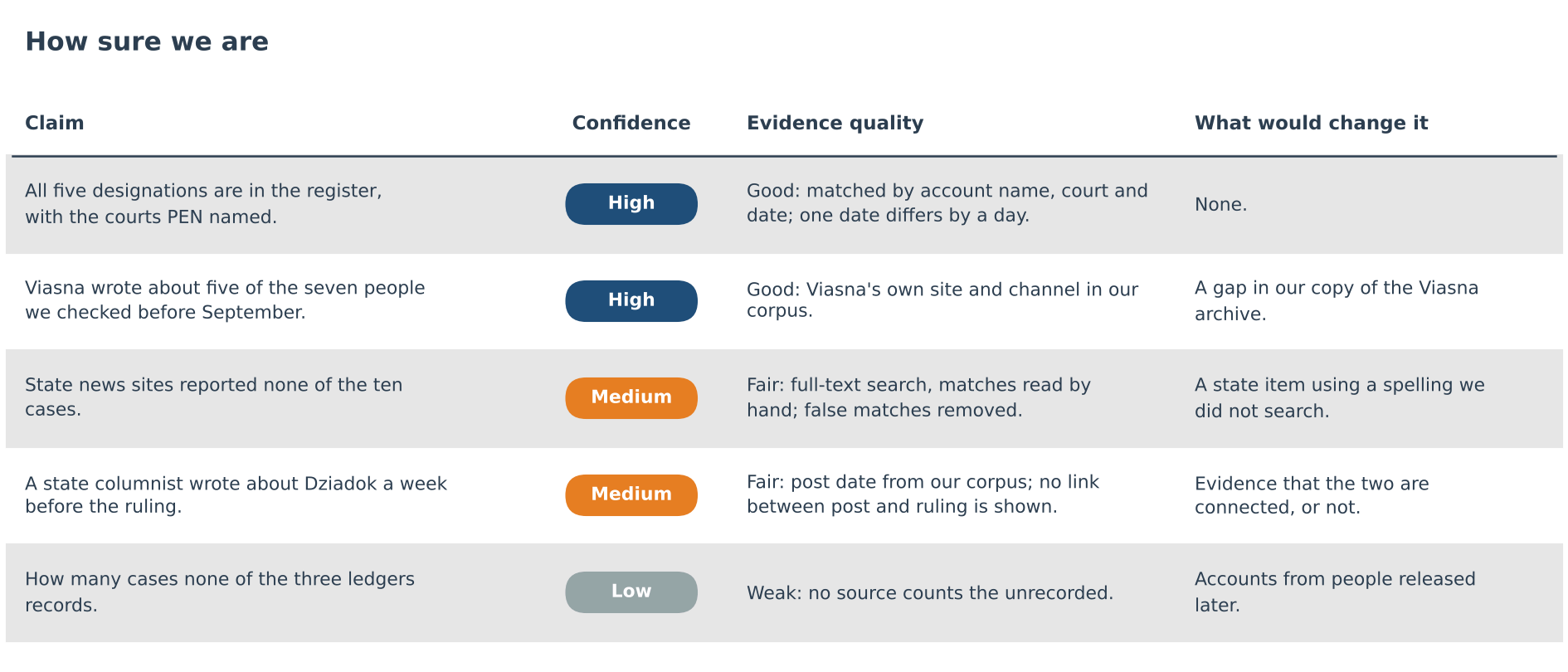
The match between PEN and the register is High: names, courts and dates agree, with one date a day apart. The weakest row is the one that matters most, the cases nobody recorded. Three ledgers that agree may still miss the same people.
How it fits
How it fits. The register records each designation as a separate court act, with no sign that some targets are writers or artists. PEN gives them back their names and roles, and Viasna gives the people behind them a history. This fits T7: the state manages exile through cases that reach people abroad, such as repeated designations of an expelled writer’s accounts, while its news sites say nothing about them. A simpler reading is that small court acts are not news for any state editor. That reading does not explain why a state columnist wrote about Dziadok a week before the ruling.
Two of the ten cases are accounts given after release.
What to watch
By 31 December 2026, a Belarusian state news site reports any of the ten cases in the chronicle. We expect none, with Medium confidence.
By 31 December 2026, a court designates another account of Dziadok or Viniarski. We expect at least one, with Low confidence.
The PEN chronicle for 1–15 October records at least three new “extremist” designations of cultural figures’ accounts. We expect this, with Medium confidence.
Method and limits
We split the PEN chronicle for 15–30 September 2026 into ten cases. We matched the five designations against our copy of the Information Ministry’s register, updated on 14 October, by account name, court and date. We searched the Viasna site and Telegram channel in our corpus from 2020 for the six people, and read the Viasna export of current political prisoners. We searched our corpus from 15 August to 14 October for every case and read the state and pro-regime matches by hand. Several were false matches, among them a man with the same surname and a Russian word that resembles another, and we removed them. The PEN site itself is not counted as independent coverage. PEN dates Viniarski’s ruling 24 September, while the register gives 25 September. The register names the account, not the person, so we rely on PEN for who stands behind it. The banned-book counter on the PEN site (390) differs from the figure in the chronicle (378). Thesis tag: T7.