
GLOBSEC Trends 2026, released this week, asked 13,730 people in 14 countries whether they accept the Kremlin’s account of the war. Nine of those countries are also on our monitoring list, so the survey can be set beside what Belarusian state sources published about each of them before and during the fieldwork. The countries that these sources discuss most turn out to be the ones whose publics reject the Kremlin’s account most firmly. We cannot say whether this coverage reaches those publics: we count what is published, and readership is outside our data.
Three statements, asked one at a time
The survey ran on online panels from 11 to 19 May 2026, with about 1,000 people per country and 600 in Estonia GLOBSEC Trends 2026 report page, to fetch. Respondents saw three statements about who is responsible for the war and answered each one separately. Most agreed that Russia invaded Ukraine and is primarily responsible: 85% in Poland, 82% in Lithuania, 65% in Slovakia. Agreement with the two Kremlin statements ran the other way. In Hungary 55% agreed that the oppression of Russian speakers justified the invasion. In Slovakia 44% agreed that Europeans and Americans provoked it. In Lithuania the figures were 23% and 25%.
These numbers are ceilings. Because each statement was asked on its own, people could agree with all three. In Germany at least 16% of respondents agreed both that Russia is primarily responsible and that the West provoked the war. One more detail matters for this publication. The survey asked whether Russia, China, Iran, North Korea and the United States threaten each country. Belarus was not on the list, even in the four surveyed countries that border it.
Where the attention went
We counted documents from Belarusian state sources that name each country in the headline or in the first 600 characters. The set covers state media websites, state and pro-government Telegram channels and state YouTube channels: 271,671 documents between 1 January and 19 May. The counts are given per 1,000 documents, so one large outlet does not decide the result.
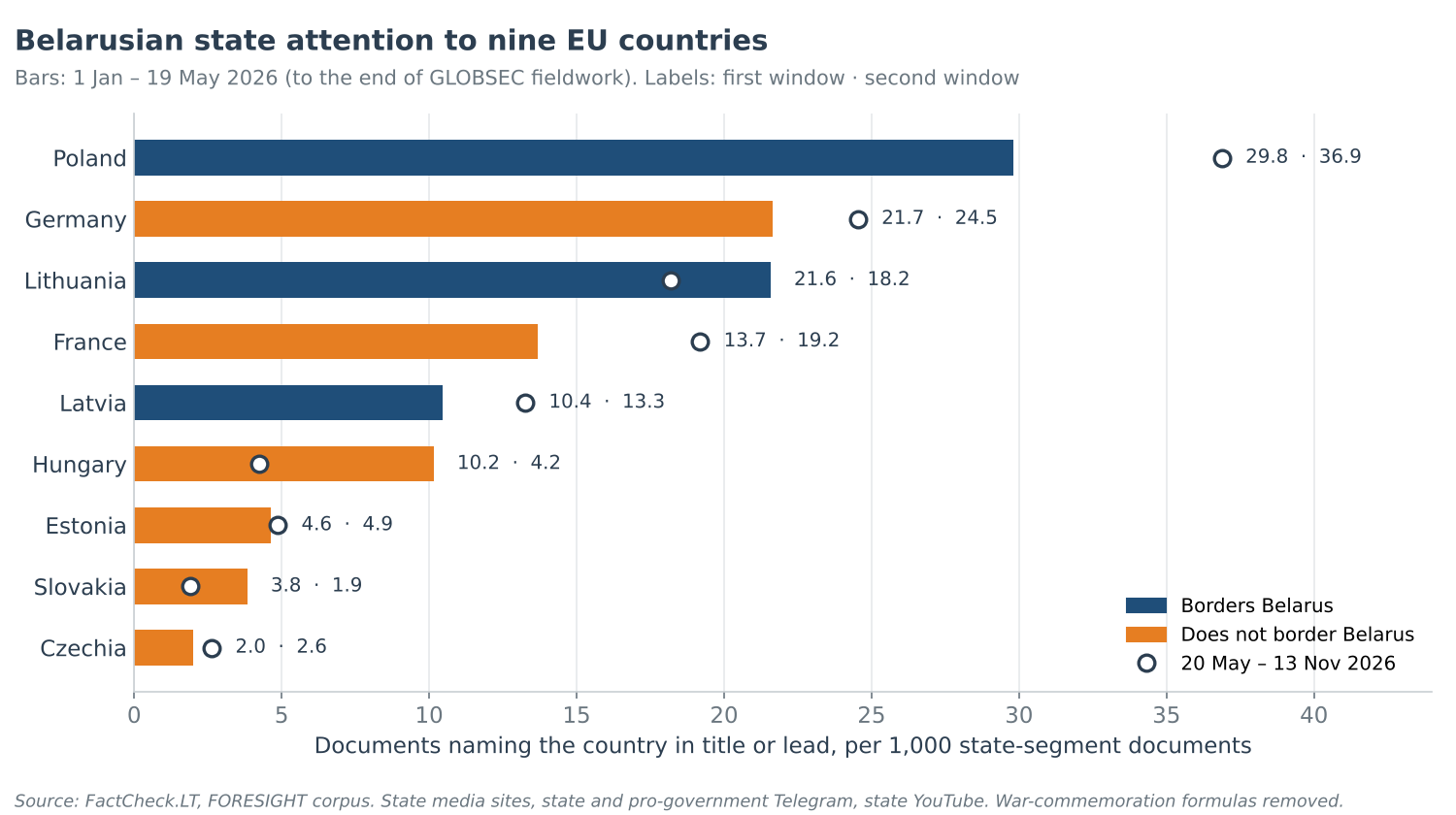
Poland led with 29.8 documents per 1,000. Germany and Lithuania were level, at 21.7 and 21.6. France had 13.7, more than Latvia with 10.4, although Latvia borders Belarus and France does not. Czechia and Slovakia were at the bottom, with 2.0 and 3.8. These figures leave out war-commemoration formulas, which the section on Germany explains.
The second window, from 20 May to 13 November, kept almost the same order at the top and at the bottom. Germany pulled ahead of Lithuania, 24.5 against 18.2, and France moved above Lithuania as well. Hungary fell from 10.2 to 4.2 after the April election that ended Viktor Orbán’s government.
The items themselves are routine for this segment. Poland appears through job losses and military plans: a CTV item counted 98,000 lost jobs, and a CTV Telegram post carried the headline “NATO is pushing Poland toward provocations”. Slovakia appears mostly through Robert Fico and energy, as in a BelTA post on Slovakia stopping emergency electricity supplies to Ukraine.
In the second window Germany drew a third more state attention than Lithuania.
Set side by side
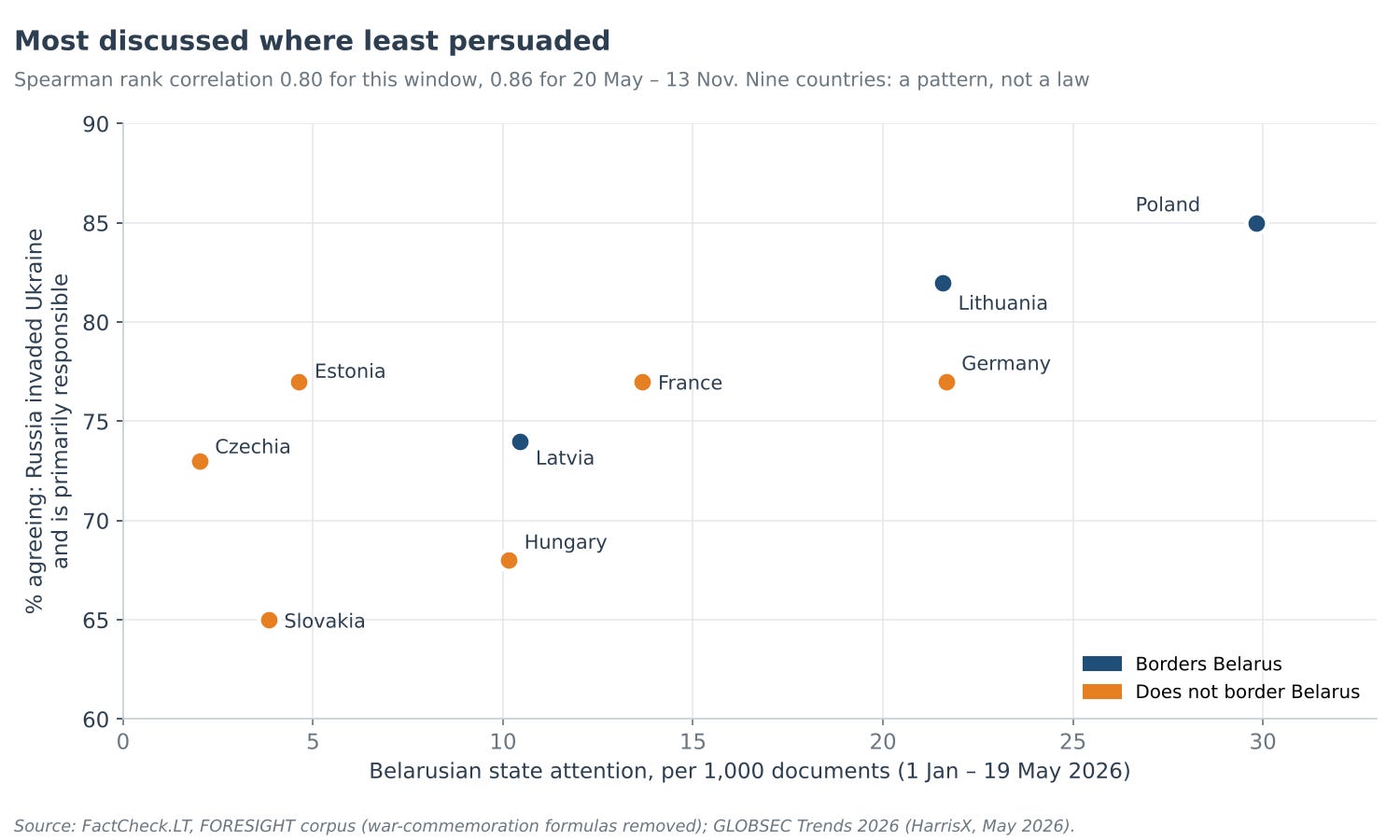
The two measures move together. The more state attention a country received, the more firmly its public rejected the Kremlin’s account. Across the nine countries, the Spearman rank correlation between state attention and agreement that Russia is responsible was 0.80 for the first window and 0.86 for the second. It was positive in each of the three layers taken separately. The link with the two Kremlin statements was negative and weaker, between −0.40 and −0.53.
Nine countries are a small set. At this size a correlation below about 0.7 is hard to separate from chance, so only the result on responsibility is firm. Bulgaria, where the survey found the most agreement with the Kremlin statements, is not in our monitoring and could change the picture.
Attention was highest where the public was least open to the Kremlin’s account of the war.
The news agenda explains much of it
A competing explanation is simple. Poland, Germany and France are large and newsworthy, and every Belarusian newsroom writes about them. To test this, we counted the independent segment in the same way: 81,947 documents from exile and independent outlets.
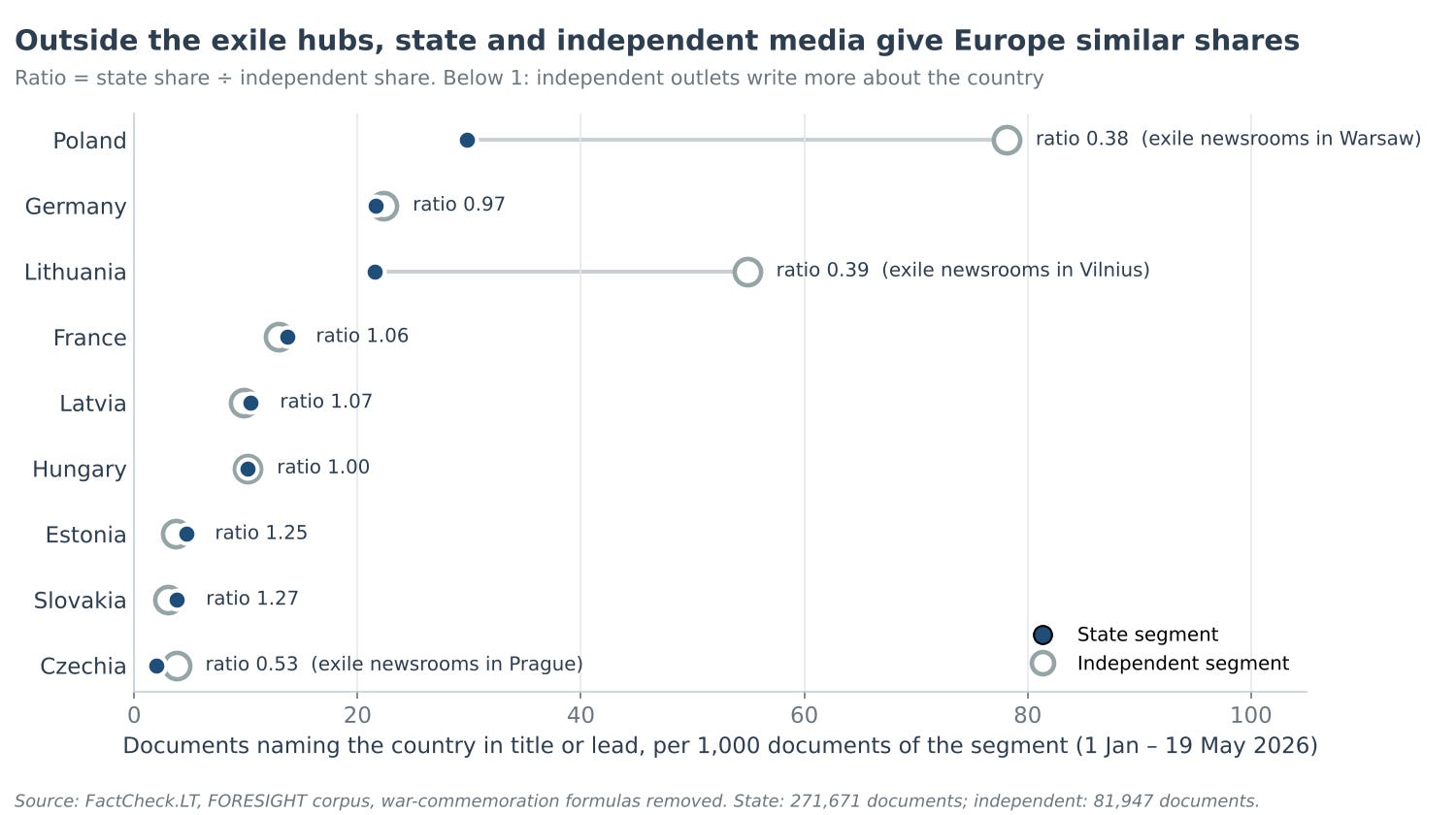
For six of the nine countries, state and independent sources gave almost the same share of their output to the country. The ratio of the two shares was between 0.97 and 1.07 for Germany, France, Hungary and Latvia, and 1.25 and 1.27 for Estonia and Slovakia, where the numbers are small. Poland, Lithuania and Czechia are the exceptions. There the independent outlets wrote two to two and a half times as much about the country as the state ones did, with ratios of 0.38, 0.39 and 0.53. Many Belarusian exile newsrooms work in Warsaw, Vilnius and Prague, so for them these countries are local news. The drop in attention to Hungary after April also appeared on both sides, from 10.2 to 4.0 per 1,000 in the independent segment. Outside the countries that host exile newsrooms, state attention follows the general news agenda. We found no separate emphasis on the publics that are most open to the Kremlin’s account.
Germany up close
Germany is the largest EU state in this comparison, so we looked at its coverage in more detail. Between 1 January and 13 November, 14,053 state documents named Germany in the headline or lead. In 1,005 of them, or 7.2%, the only mention was a war-time formula such as “German-fascist invaders”. These are Belarusian commemorations of Victory Day, of liberation anniversaries and of 3 July, Independence Day, which marks the liberation of Minsk in 1944. In July they made up one in five state documents that named Germany. We removed these formulas from every count in this brief. Another 930 documents were sports results. They stay in the country comparison, because every country has them.
After the correction, state and independent sources gave Germany almost the same share of their output: 21.7 and 22.3 per 1,000 before the survey, 24.5 and 24.8 after it. The picture of Germany was different.
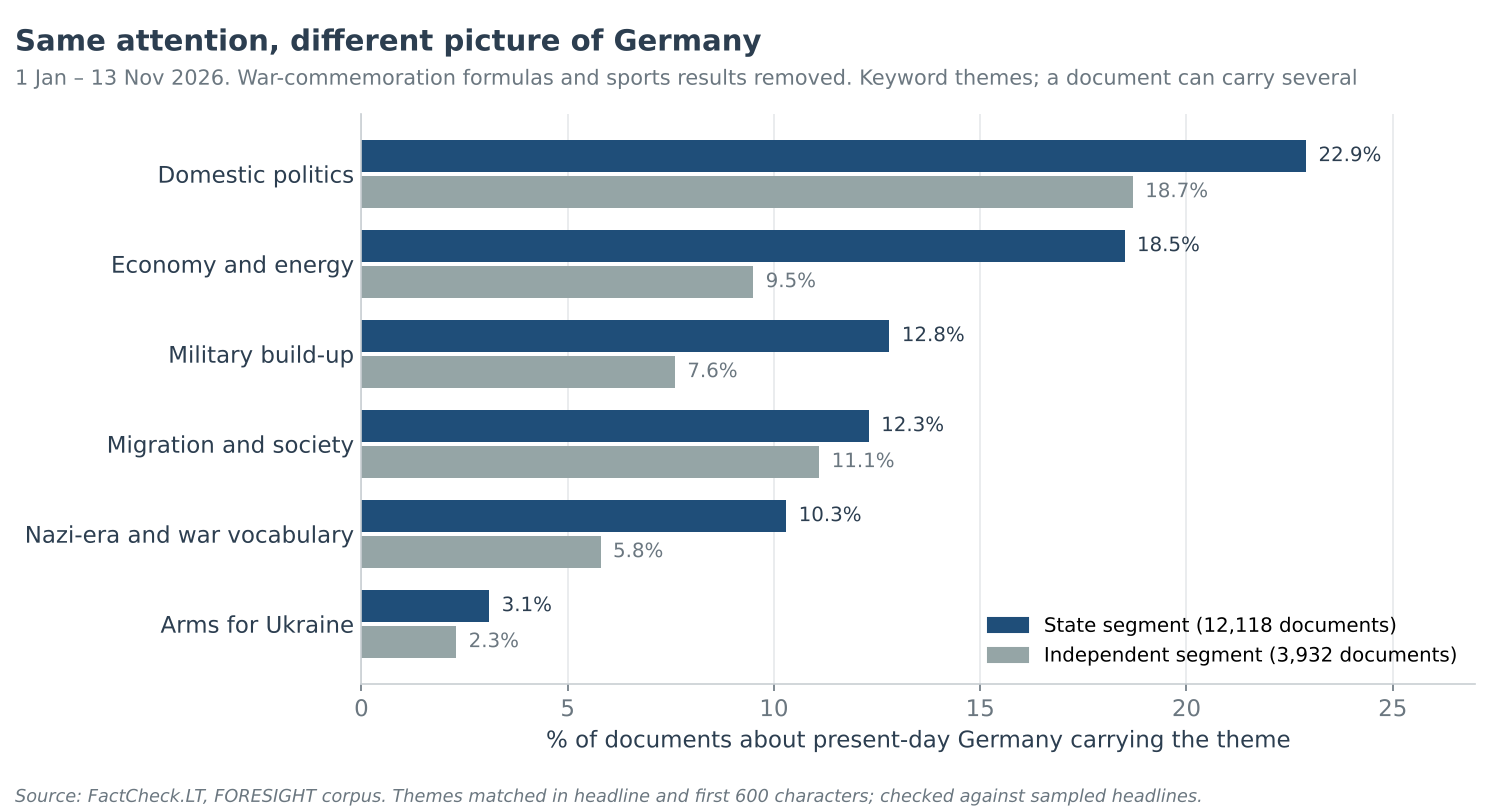
We sorted the 12,118 state documents about present-day Germany by keyword themes. Economy and energy appeared in 18.5% of them, twice the independent share of 9.5%. A post on SB’s Telegram channel about record electricity prices opened with the words “So sanctions do work after all!”. Military build-up appeared in 12.8% against 7.6%. Examples include the German brigade’s first exercise near the Belarusian border and defence spending set against parental benefits. Nazi-era and war vocabulary remained in 10.3% of these items, against 5.8% of independent ones, and it often links the present to the past. Azarenok’s channel posted footage of German armour on its way to Lithuania and called it “just like in Leni Riefenstahl’s films 85 years ago”. Migration and society were close in both segments, at 12.3% and 11.1%.
One in five state documents that named Germany in July did so only through a war-time formula.
Friedrich Merz was named in 10.5% of state documents on Germany and in 6.8% of independent ones. Alice Weidel of the AfD appeared in 1.1% against 0.3%. ONT’s channel reported that 45% of voters in eastern Germany support the AfD and only 12% Merz’s party. Pro-government Telegram channels covered Germany most densely. Belarus_VPO named Germany in 73 of every 1,000 posts and nikitin73 in 53, against 25 for SB.by and 28 for BelTA.
The survey gives its own picture of German opinion. Germany is the only surveyed country where a majority, 52%, sees the United States as a security threat. Some 40% agreed that the oppression of Russian speakers justified the invasion, and 39% that the West provoked it, the highest shares in Western Europe. At the same time, 68% see Russia as a threat. In June a NEWS.BY post told Belarusian readers that “70% of people in Germany do not consider Russia an enemy”. The two figures answer different questions, and the post’s headline does not name a source. We do not know how many people in Germany read any of these channels.
Where the Baltic material sits
Telegram channels aimed at Baltic audiences look very different. Three Russian-language channels, @tenipribaltiki, @alekseystefanov and @BalticBridge, are each forwarded by eight to thirteen channels of the Belarusian pro-government network, by our September count. In the first window they named Latvia in 306 of every 1,000 posts, Lithuania in 175 and Estonia in 156. For Belarusian state sources the figures were 10.4, 21.6 and 4.6. Most of the Baltic-facing material sits in channels that the network forwards.
Where no exile newsroom is based, state and independent outlets gave Europe almost the same share of their output.
Latvia also stands out in the survey. It had the highest daily Telegram use among the EU countries surveyed, at 20%. It also had the highest agreement with the two Kremlin statements among the three Baltic states, at 31% and 34%. With three countries this is only a pointer for further work.
We also tested two groups of words inside country coverage. One covered Russian speakers and “Russophobia”, the other words about militarisation and provocation. The second group appeared most often in coverage of Estonia, Lithuania, Latvia and Poland, in 4.0 to 4.9% of documents. It was least common for Slovakia and Czechia, at about 1%. A sample check found more false hits for the countries with low counts, so we treat this result as weak.
Most of the Baltic-facing material sits in channels that the network forwards.
The first state item on the survey
In the corpus run on 14 November, one Belarusian state item mentioned the survey. BelTA’s report of 13 November retells a story by the Russian agency TASS and names it as the source. It leads with the finding that only 49% of European respondents believe Europe could ensure its own security without strong US support. It then names five countries with lower figures, from Latvia at 38% to Poland at 48%. None of the seven European countries above the average appears, including Germany at 53% and Lithuania at 52%. Germany is named once, for the 52% who see the United States as a security threat. The report describes the sample as 14 countries, “including 11 EU states, the UK and Ukraine”; the fourteenth, the United States, is not listed. It closes with Pete Hegseth’s statement that the US is ending its subsidies for European defence. Nothing in it concerns responsibility for the war, or the two thirds of respondents who see Russia as a security threat. So far, the Belarusian state reading of the survey is a Russian one.
How it fits
Observation: Belarusian state sources give most of their foreign attention to neighbours and large EU states whose publics reject the Kremlin’s account most clearly. Outside the countries that host exile media, the amount of attention matches independent coverage; for Germany, the choice of themes does not.
Fit: This is a test of thesis T5, that much of the state media audience is outside Belarus. The output itself shows no tilt toward the publics most open to the Kremlin’s account, so it adds no support to T5.
Alternative: State material may still reach foreign readers through the Baltic-facing channels and Russian media that carry it. Attention to a country is a different thing from an audience in it.
What would separate them: audience geography, meaning views of state YouTube videos and Telegram posts by country. We do not have these data.
Confidence
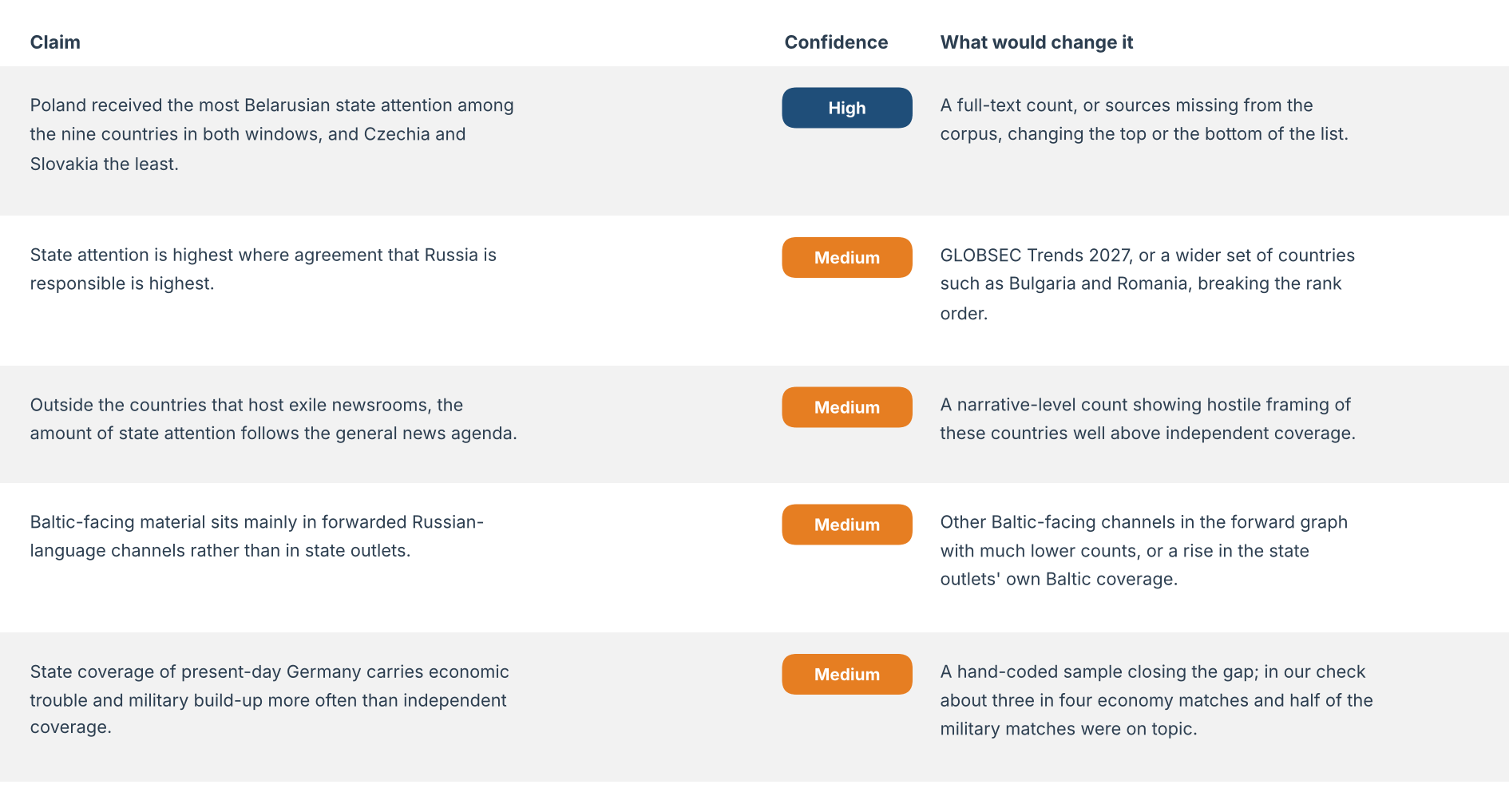
Poland received the most Belarusian state attention among the nine countries in both windows, and Czechia and Slovakia the least. Level: High. What would change it: a full-text count, or sources missing from the corpus, changing the top or the bottom of the list.
State attention is highest where agreement that Russia is responsible is highest. Level: Medium. What would change it: GLOBSEC Trends 2027, or a wider set of countries such as Bulgaria and Romania, breaking the rank order.
Outside the countries that host exile newsrooms, the amount of state attention follows the general news agenda. Level: Medium. What would change it: a narrative-level count showing hostile framing of these countries well above independent coverage.
Baltic-facing material sits mainly in forwarded Russian-language channels rather than in state outlets. Level: Medium. What would change it: other Baltic-facing channels in the forward graph with much lower counts, or a rise in the state outlets’ own Baltic coverage.
State coverage of present-day Germany carries economic trouble and military build-up more often than independent coverage. Level: Medium. What would change it: a hand-coded sample closing the gap; in our check about three in four economy matches and half of the military matches were on topic.
Watch items
By 31 December 2026: Belarusian state items citing GLOBSEC Trends 2026 stay below five in total, and none of them quotes the findings on responsibility for the war. Expected: yes. Confidence: Medium.
By 31 March 2027: in state documents about present-day Germany, economy and energy stay at least one and a half times as common as in independent ones, for November to March. Expected: yes. Confidence: Medium.
By 31 March 2027: the three Baltic-facing channels keep naming Latvia in more than 250 of every 1,000 posts for November to March. Expected: yes. Confidence: Medium.
By 31 December 2027: in GLOBSEC Trends 2027, the rank correlation between our attention measure (1 January to the end of fieldwork) and agreement that Russia is responsible stays above 0.6 for the same nine countries. Expected: yes. Confidence: Medium.
Method and limits
Source: the FORESIGHT corpus, deduplicated by URL, with future-dated items removed. Windows: 1 January to 19 May 2026, which ends with the GLOBSEC fieldwork, and 20 May to 13 November 2026. The state segment covers state media websites, state and pro-government Telegram channels and state YouTube channels; regional state YouTube channels are excluded. The independent segment covers exile and independent outlets. A document counts for a country if the country’s name or adjective appears in the headline or in the first 600 characters, in Russian or Belarusian. Capitals and politicians’ names were not used, because they often refer to EU or NATO institutions. War-commemoration formulas (”German-fascist invaders”, “Polish lords” and similar) were removed before counting. They made up 7.2% of state documents naming Germany over the whole period and under 1% for Poland, and removing them left the rank correlations unchanged. Roundup titles (1,199 in the first window) and a keyword-selected Telegram layer (7,013) were excluded, and Telegram channels were assigned by their handle. CTV texts were cleaned of an embedded feed of other headlines on 13 November, and SB.by texts for January to June were reloaded on 10 November, so earlier EU Neighbours counts for these outlets are not comparable. Three regional state newspapers show more country names in leads than in headlines; their weight in the total is small. Host-country coverage raises the independent baseline for Poland, Lithuania and Czechia. The Germany themes are keyword groups matched in documents about present-day Germany, with sports results removed; a document can carry several themes, and the shares are approximate. The GLOBSEC figures measure agreement with statements asked one at a time on online panels, and GLOBSEC’s averages are unweighted. Correlations rest on nine countries, and neither measure shows who reads the coverage. Thesis tag: T5.