

Zerkalo marked six years of pressure on Belarusian civil society this week with a figure: more than 2,060 organisations forcibly liquidated or closed by their own decision. Underneath that total, Lawtrend’s running register shows something the total conceals. In the most recent quarter, more organisations shut themselves than were shut by the state.
The two columns
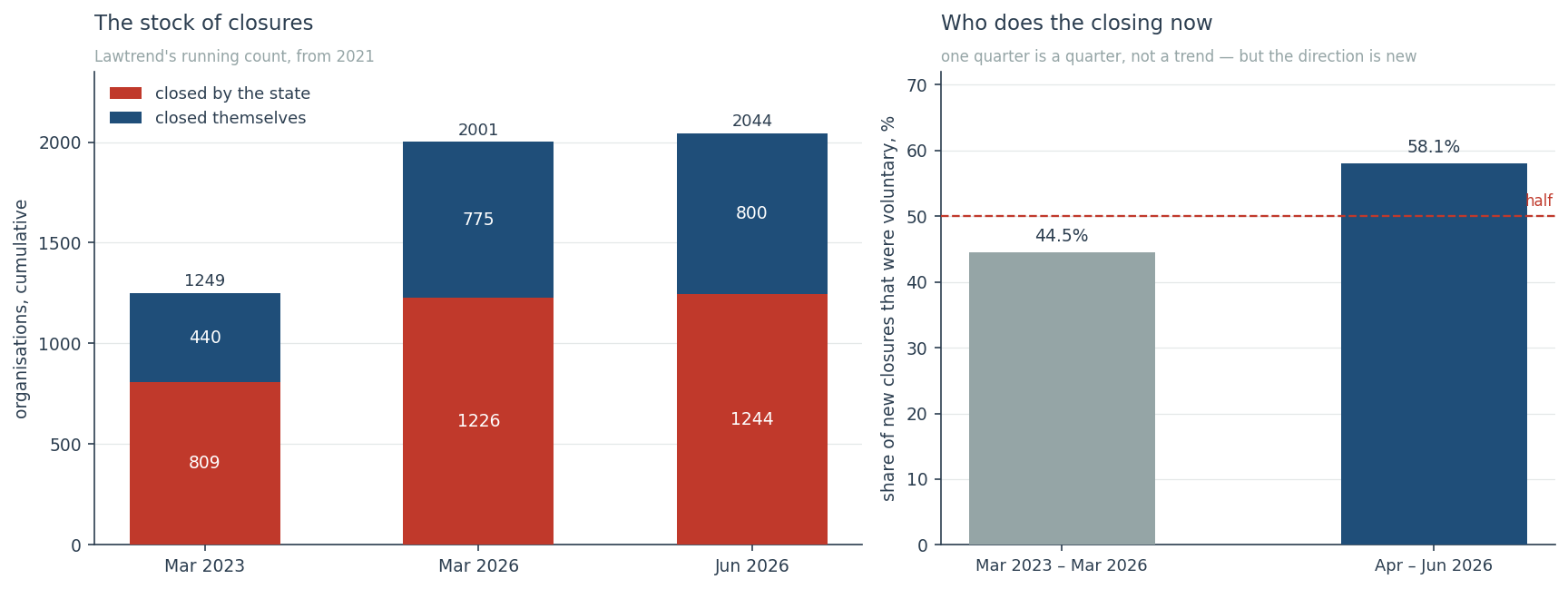
Lawtrend has kept a monthly count since 2021, separating organisations liquidated by order from those that resolved to dissolve themselves. At the end of March 2023 the two columns stood at 809 and 440. Three years later, in March 2026, they read 1,226 and 775. At the end of June 2026: 1,244 and 800.
Read as stocks, those are two lines rising together. Read as increments, they are not.
Over the three years to March 2026, 417 organisations were closed by order and 335 closed themselves — voluntary closures were 44.5% of the total. Over the single quarter to the end of June, the figures were 18 and 25, and the voluntary share was 58%.
Eighteen closed by order. Twenty-five closed themselves.
One quarter is one quarter, and forty-three organisations is a small number to reason from. The direction is what is new: for the first time in this series the state is not the main agent of its own campaign.
What that costs the state
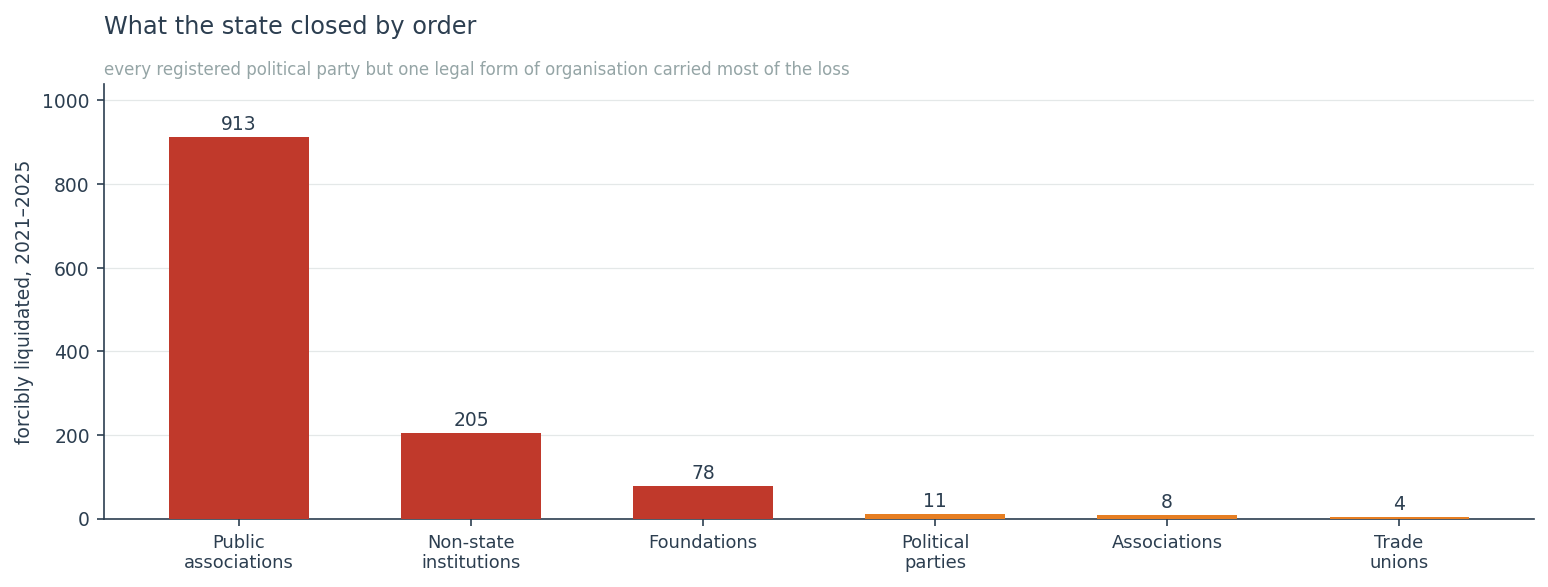
The earlier phase was administratively expensive. Between 2021 and the end of 2025 the state issued orders against 913 public associations, at least 205 non-state institutions, 78 foundations, eleven political parties, eight associations and four trade unions — each requiring a case, a court, a decision, a published record. Against roughly 1,943 non-commercial organisations of the three main legal forms now on the register, that is a campaign the size of two thirds of what remains.
Self-liquidation costs the state none of that. There is no order to sign, no case to file, and no entry in any register attributing the closure to anyone. The organisation dissolves itself, for reasons Lawtrend describes as pressure on members and staff, the legal environment and the general situation, and the outcome is the same.
The order was the expensive part. Attrition is free.
For the first time in this series the state is not the main agent of its own campaign.
Where the losses fell
The composition is the argument against reading this as politics narrowly defined. Among the organisations closed are Ahova Ptushak Batskaushchyny, which spent decades on wild birds and their habitats, the animal-protection group Chatyry Lapy and twelve more organisations of the same kind, and over a hundred sports and charitable bodies. Eleven political parties were dissolved, which is all of them; but parties are eleven out of more than 1,200 forced closures.
Eleven parties out of more than twelve hundred closures.
What the record describes is not the removal of an opposition. It is the removal of the independent form itself, whatever the organisation happened to do. Belonging to the sector became the risk.
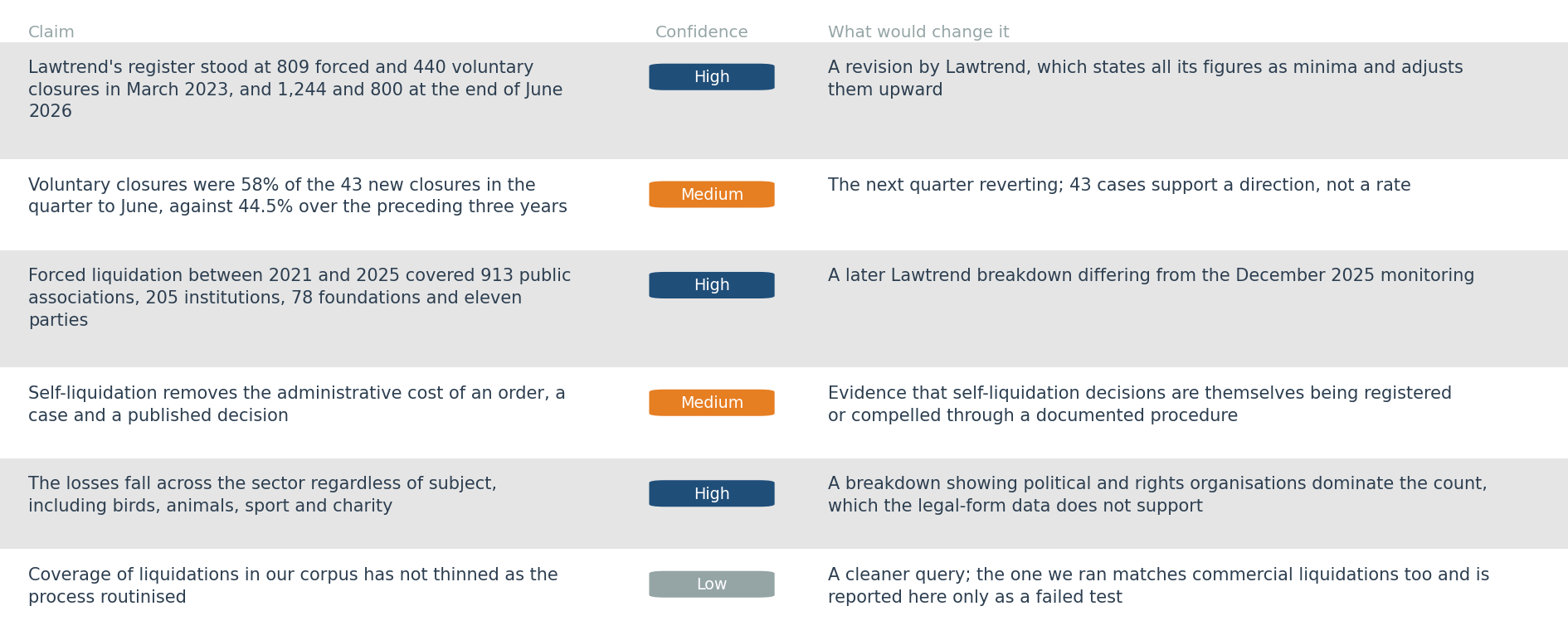
Confidence
Watch
The Lawtrend monitoring for the third quarter shows voluntary closures above forced ones again. Two consecutive quarters would make the crossover a pattern rather than an incident.
The total passes 2,100 before the end of 2026. It moved from 2,001 to 2,044 in one quarter.
A month arrives with no closures of either kind, which has not happened in this series.
Registered non-commercial organisations of the three main forms fall below 1,900 in the next official count.
Method and limits
Figures are Lawtrend’s, whose monitoring runs monthly from the start of 2021 and is the only continuous public register of this. Lawtrend states its counts as minima, so every figure here is a floor. The Zerkalo total of more than 2,060 covers six years and is not on the same basis as Lawtrend’s 2,044 to the end of June; the two should not be differenced.
The quarterly comparison rests on 43 closures. That is enough to state a direction and not enough to state a rate, which is why the watch item asks for a second quarter before the crossover is called a pattern.
We also tested whether coverage of liquidations has thinned as the process routinised, by counting documents on the subject in our own corpus month by month since 2021. It has not, and the series was too noisy to publish: independent coverage runs at 74 documents in 2021, 117 in 2023, 61 in 2025 and about a hundred at the 2026 rate, with no decay visible. The hypothesis was ours, and it did not survive its own test.