

Between 13 and 26 August four separate claims were made about Belarusian territory and the Belarusian army: burned lorries at the Russian border, a border guard dragged across the Lithuanian one, a dozen Russian drone-missiles crossing Belarusian airspace, and an army raised to heightened readiness with reservists called up. How much independent substance each acquired varies enormously. What does not vary is the response from Minsk, which in all four cases has been nothing at all.
The four, in order of what is known
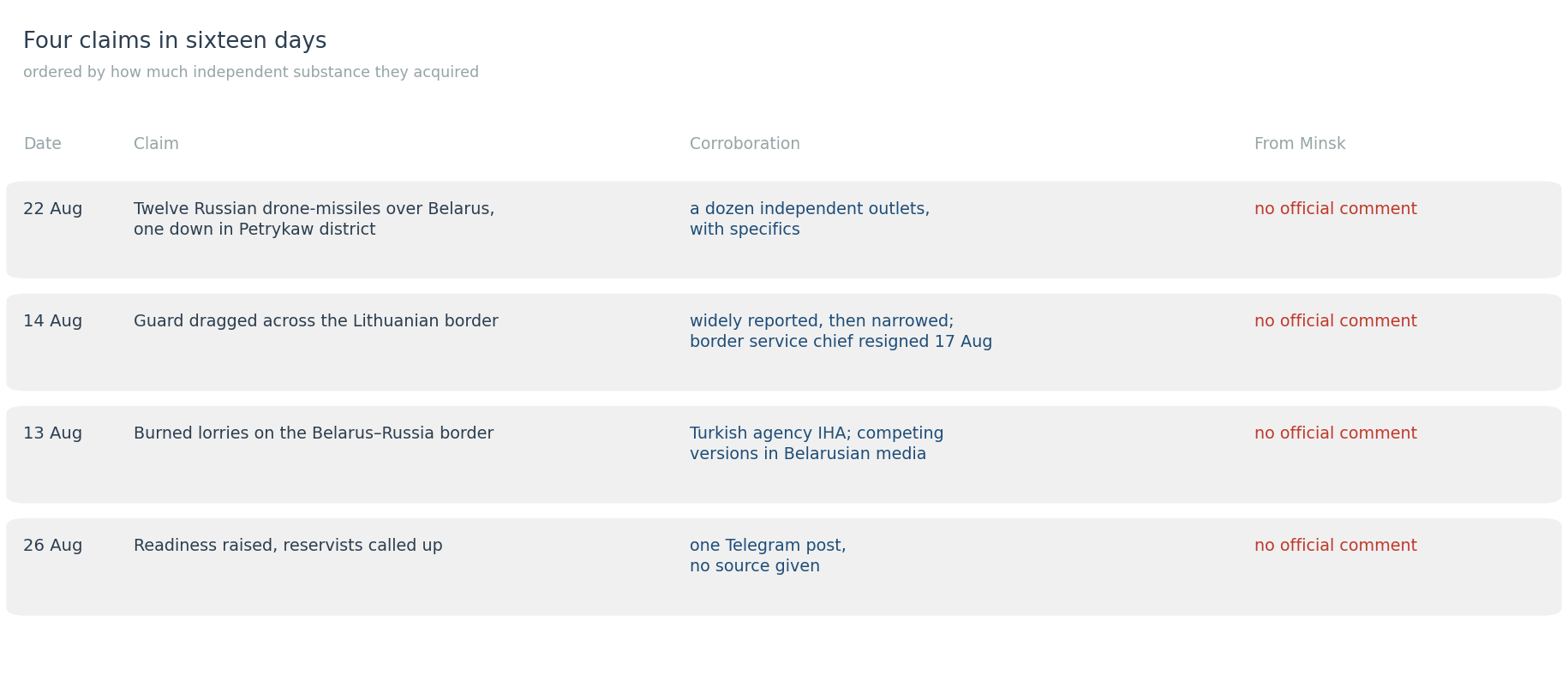
The best-established is the most recent. On 22 August at least twelve Russian S8000 drone-missiles entered Belarusian airspace, aviation was scrambled, and one came down in the Petrykaw district after a fighter failed to intercept it. That account was carried with those specifics by Reform, Nasha Niva, Charter97, Euroradio, UDF and others within the day. Zerkalo carried the narrower version attributed to a Ukrainian monitoring channel. A dozen outlets, converging detail, and not a word from any Belarusian authority.
Next comes the Lithuanian border. On 14 August accounts of migrants dragging a Lithuanian guard across the line into Belarus ran everywhere from Zerkalo and Mediazona to Delfi and Onet, which asked whether Lithuanian services had concealed the incident. On the 15th prosecutors said they had no information about injuries. On the 17th the head of the Lithuanian border service resigned. The claim was narrowed, and the consequences fell on the side that had reported it.
Third, the burned lorries. On 13 August the Turkish agency IHA described a drone strike on lorries at the Belarus–Russia border with an Iranian and a Belarusian driver killed. Reform set out the competing versions — an Iranian trail, a Moscow provocation — and Svaboda reported the authorities saying nothing about it. Nothing has been established since.
Last, and thinnest, the mobilisation claim. On 26 August a Ukrainian journalist’s channel with 322,000 subscribers reported that Belarus had raised combat readiness and begun a reservist call-up resembling mobilisation. The post gave no source for either statement, and within hours carried 71,000 views. An unsourced claim of imminent mobilisation, carrying a heavy emotional charge and originating inside a belligerent’s information space, has the shape that an information operation would need. That is a statement about its form, not about anyone’s intent, and it is unresolvable from outside.
Twelve drone-missiles, a resignation, a contested version, and one unsourced post. From Minsk, the same silence for all four.
The spread matters. This is not uniform fog: the drone incursion is about as well attested as anything can be without official confirmation, and the mobilisation claim has nothing behind it at all. Treating them as equivalent would be its own failure. The constant across the range is the state, which speaks about none of them.
The register that is loud
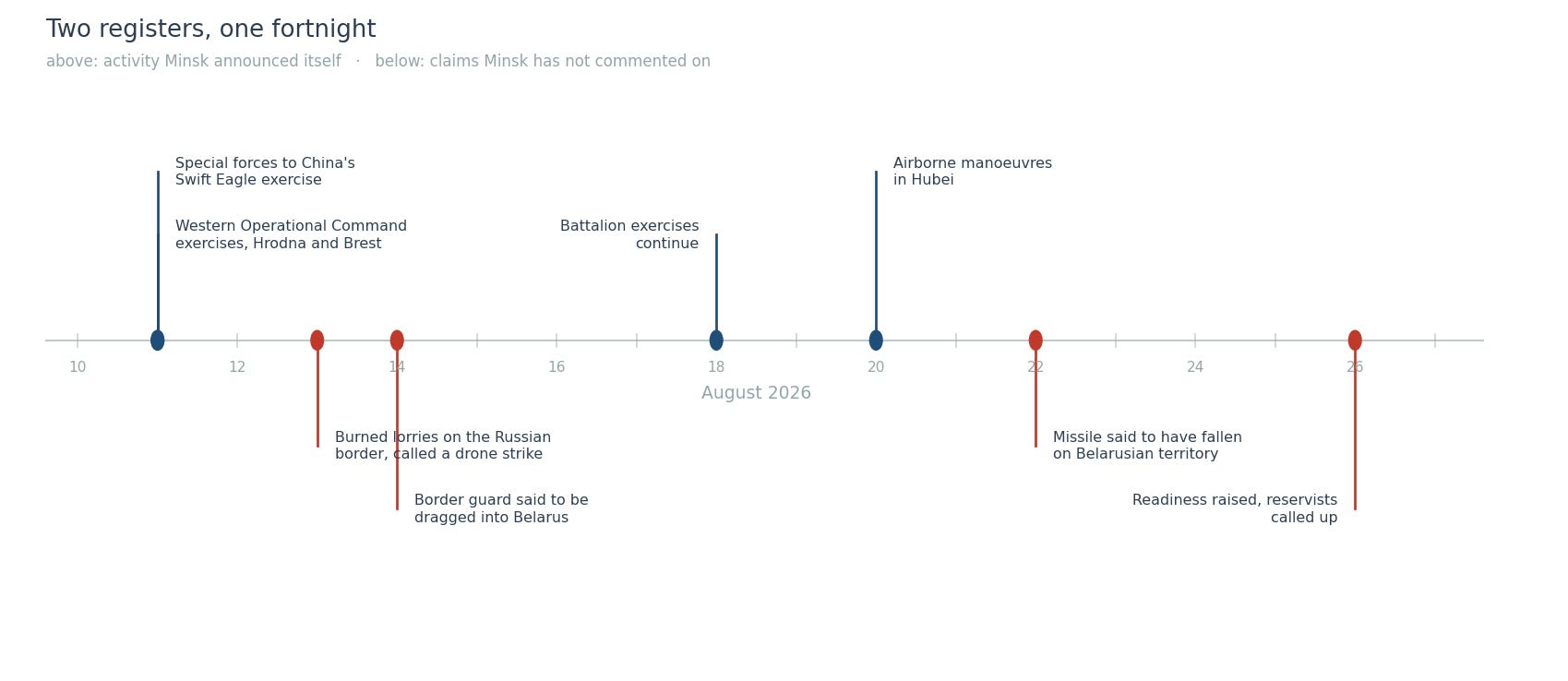
Set against those four is everything Minsk said about its own army in the same fortnight, and it is not a quiet record. Western Operational Command ran reconnaissance, electronic-warfare and air-defence exercises across Hrodna and Brest regions on 11–13 August, with emphasis on countering drones, reported by BelTA. Battalion exercises continued into the following week, reported by SB. Belarusian special forces went to China for the Swift Eagle exercise in Hubei, running to 24 August. And on 2 August the commander of special operations forces announced through SB the formation of a new air-assault brigade near Homel.
Where Minsk chooses the message it speaks in detail. Where the claim comes from outside it says nothing.
None of that had to be discovered. It was published, with dates, by the state’s own outlets.
The pattern is exact. Where Minsk chooses the message, it speaks in detail. Where the claim is contested and comes from outside, it says nothing at all — and silence has become the cheapest available response.
One announcement, sixteen renderings
The brigade shows the same scarcity working from the other end.
On 2 August SB, the government daily, published the special operations commander’s account of the new unit: one air-assault battalion formed, another planned by the end of the year, supporting sub-units to follow, deployment intended for next year. Eleven outlets carried it that day — Nasha Niva, Zerkalo, Reform, Euroradio, BDG, Charter97, Belmarket, Gazeta.by, UNIAN, Delfi in Lithuania and TASS. Five more followed on the 3rd, including Onet in Poland and Ukraine’s border service commenting that Kyiv would watch the deployment.
They were not reporting different facts. They were rendering one statement in different verbs. SB had the brigade being formed; Zerkalo had it being actively created; Reform had the forming continuing; TASS had Belarus completing its creation; UNIAN had Belarus deploying it. The announcement said one battalion existed and deployment was a plan for next year, which makes completion and deployment readings ahead of the text.
The same announcement: forming, being created, continuing, completing, deploying.
Twelve days later Onet returned to the subject under a headline quoting an expert to the effect that Lukashenka is preparing for war with Ukraine and that the development is without precedent. Between the 2nd and the 14th no new evidence about the brigade entered the public record.
Meanwhile the Belarusian defence ministry’s own channel and state television spent that week on the 38th brigade in Brest, where graduating officers were doing their summer training. The state’s military coverage had moved on; everyone else’s had escalated.
This is the mirror image of the four claims. There, thin evidence was filled with alarm. Here, a single thin announcement is filled with expertise. The mechanism is the same, and it is not confined to one side.
Why it is cheap
Silence is only cheap when there is nobody to fill it.
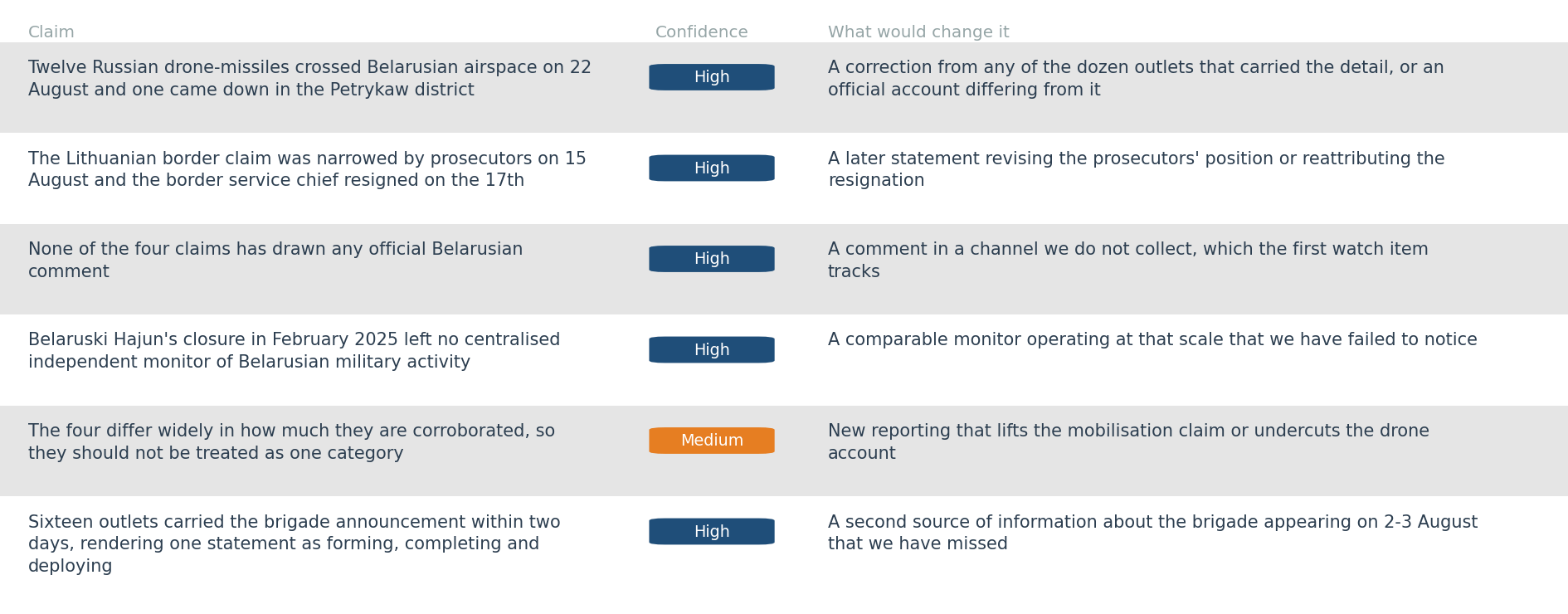
Until February 2025 there was. Belaruski Hajun ran a public monitoring service that tracked military movements inside Belarus, and its readers sent in what they saw. It closed after its bot was compromised, the archive of contacts going back to 2022 passed to the security services, and prosecutions followed under the article covering assistance to extremist activity — at least 183 defendants, with sentences still being handed down through 2026.
The consequence is structural rather than sentimental. A claim about troop movements or a call-up now has to be checked against what is left: Flagshtok, local reporting, satellite imagery bought or borrowed, and the judgement of people reading each other’s Telegram channels. That is thinner than what existed eighteen months ago, and everyone making claims about Belarus knows it.
Silence is only cheap when there is nobody to fill it.
What follows for the reader
Two temptations, both wrong. The first is to treat every claim as probably true because the sources are on the right side of the war. The second is to treat every claim as probably false because it is unverified. Both replace evidence with an allegiance, and both flatten a range that is real: on 22 August a dozen outlets converged on the same specifics, and on 26 August one post carried none.
Treating every unverified claim as true, or as false, both replace evidence with an allegiance.
The workable rule is duller. Ask what would have to exist for the claim to be checkable — a satellite pass, a court filing, a cadastral record, a named unit — and then ask whether anyone is in a position to look. For the railway near the Ukrainian border, that test is passable: construction has been traceable since late 2023 through cadastral maps and imagery, and the design work was commissioned from a named institute. For a reservist call-up, it currently is not.
Confidence
Watch
By 15 September, any of the four claims receives an official Belarusian comment, in either direction. None has in the first fortnight.
Flagshtok or another remaining monitor reports reservist gatherings in August or September, which would move the fourth claim from unverified to supported.
The 37th brigade appears in Belarusian state reporting as deployed rather than as forming, which is the announced next step.
A fifth claim of the same type arrives before 15 September. Four in sixteen days is a rate, not a coincidence, unless it stops.
Method and limits
The four claims and the state’s own military reporting are as recorded in our weekly monitoring of the Belarusian information space for 10–23 August, with the 26 August claim added from the post itself. Attribution of each claim is to the outlet that carried it, not to any assessment of its truth.
Absence of official confirmation is not evidence of falsity, and this piece asserts none of the four to be false. Nor does it treat them as equal: the drone incursion of 22 August is well attested across the independent segment, while the mobilisation claim rests on a single unsourced post. What the four share is the silence they met, not their evidential standing.
Our corpus records what our collectors hold. An official comment made in a channel we do not collect would not appear here, and would change the first watch item rather than the argument.