
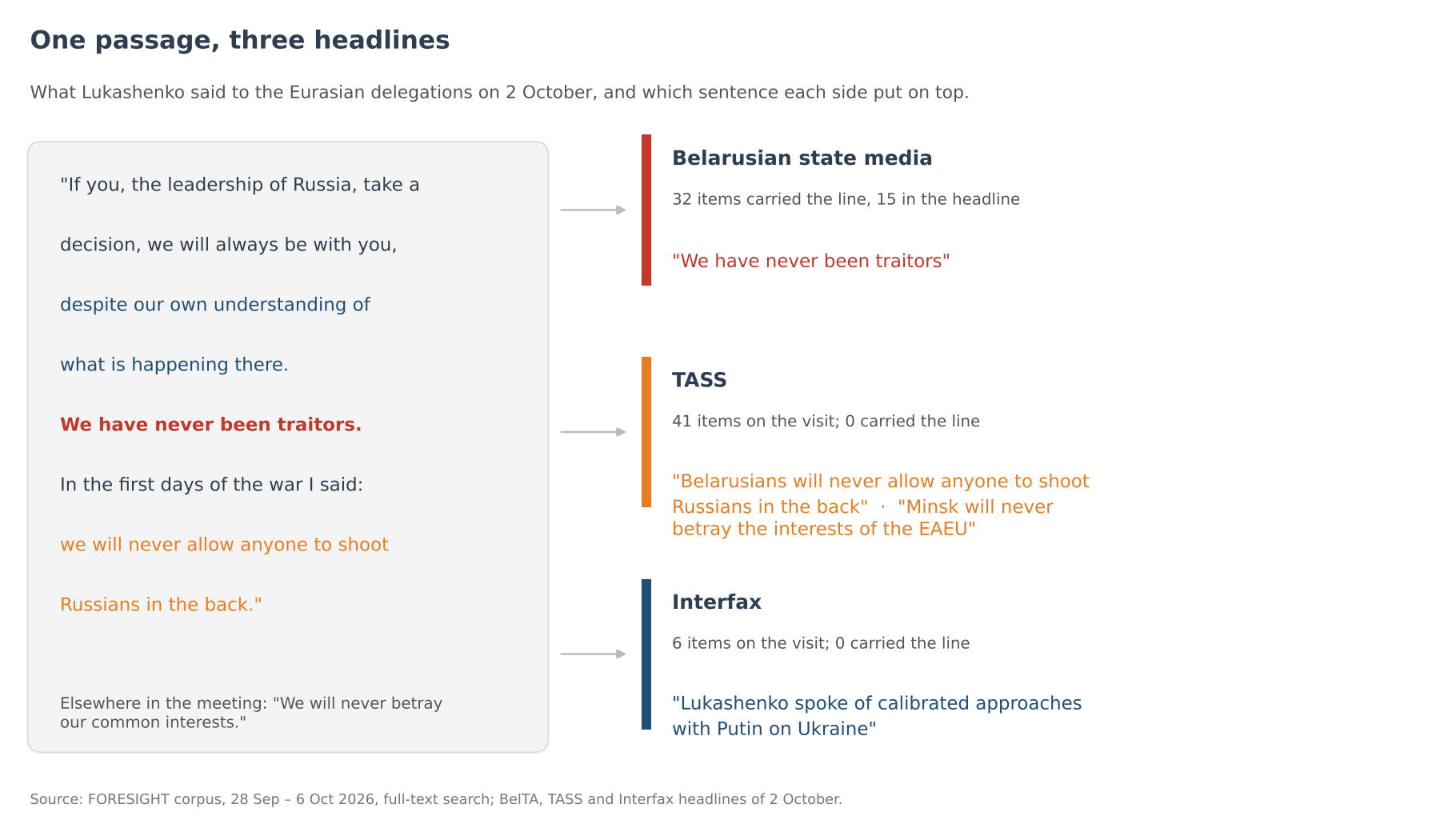
Russia’s prime minister, Mikhail Mishustin, spent 1–2 October in Minsk for the Union State’s Council of Ministers and the Eurasian Intergovernmental Council. Meeting the delegations on 2 October, Lukashenko said that Belarus would always be with Russia’s leadership “despite our own understanding” of the war, and that “we have never been traitors”. In our collection, 32 state items carried that sentence and 15 put it in the headline. TASS ran 41 items on the visit, and Interfax six, and none of them contains it. What we cannot see is whether the Russian wires left it out by choice or by routine.
One sentence, two audiences
The passage is short. “If you, the leadership of Russia, take a decision, we will always be with you, despite our own understanding of what is happening there. We have never been traitors,” Lukashenko said, BelTA reported. He added that in the first days of the war he had said Belarus would never let anyone “shoot Russians in the back”.
BelTA headlined the first sentence, and SB, STV, ONT and the press pool’s channel followed. STV framed it as an answer to critics: relations with Russia are a subject of frequent speculation, and the leader had “openly” set out his position. STV also noted that it was his second statement on relations with Russia that week. BelTA’s weekly summary quoted the other one: there is “no retreat, and still less betrayal”, and Ukraine shows how betrayal ends.
In our collection, 32 state items carried that sentence and 15 put it in the headline.
What Moscow printed
TASS printed the sentence next to it instead: “Belarusians will never allow anyone to shoot Russians in the back”. Its other headline on loyalty moved the theme to economics: “Minsk will never betray the interests of the EAEU”. That came from a different remark at the same meeting, “we will never betray our common interests”.
Interfax picked a third sentence. Its headline said that Lukashenko spoke of “calibrated approaches” with Putin on Ukraine, and its text kept the reservation, “despite our own understanding”. It did not quote the line about traitors either.
The same split ran through a second remark. Lukashenko thanked Trump, and BelTA’s headline said that Trump had “exposed Western policy to the limit”. Interfax’s said that Lukashenko had thanked him “for an open policy”. And TASS put Armenia in a headline, “Lukashenko urged Armenia not to leave the EAEU common market”, while BelTA’s version addressed “the EAEU countries” in general. Armenia’s prime minister had joined the council only by video and sent no one to the meeting with Lukashenko.
TASS printed the sentence next to it instead.
A spike from one wire
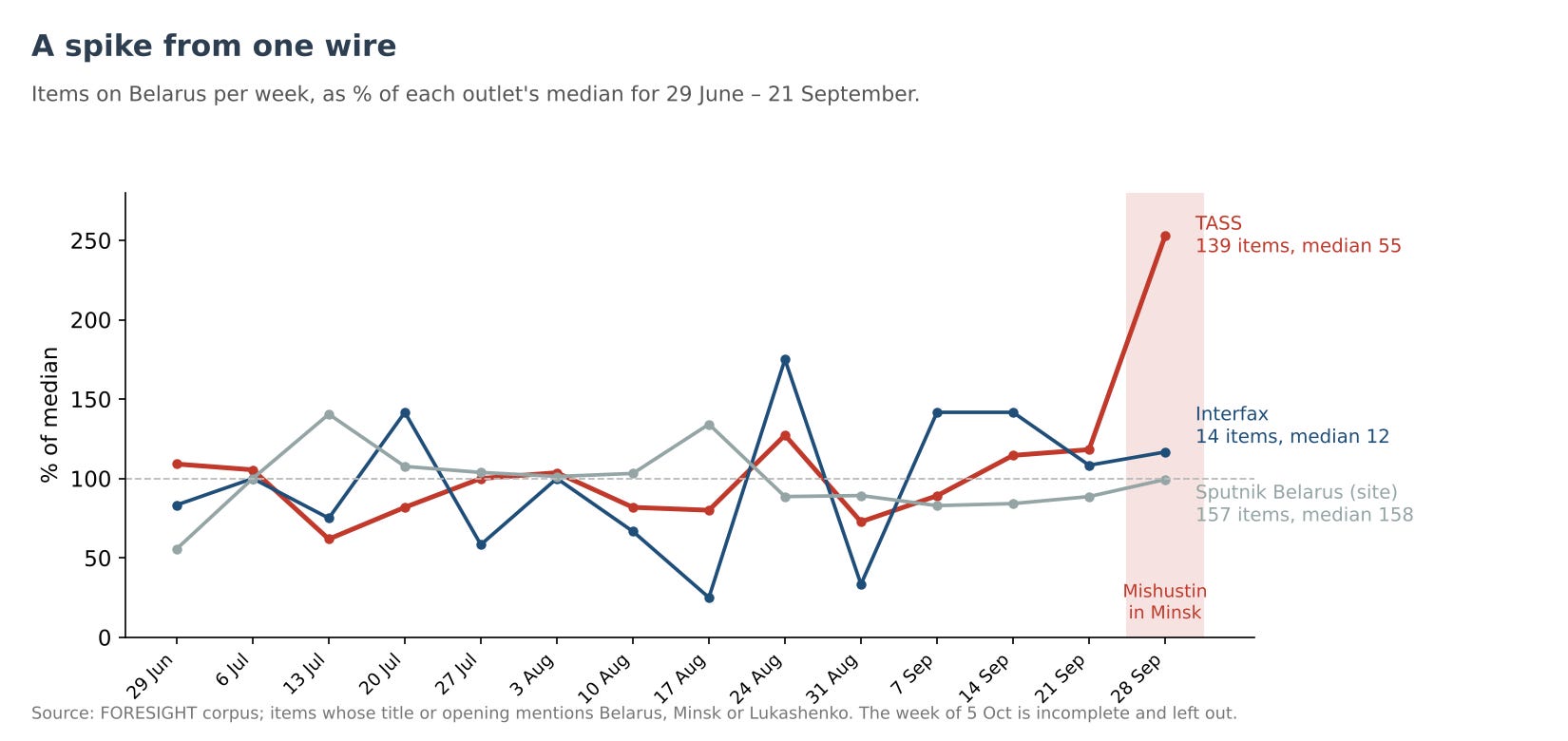
Our weekly digest flagged a rise of about 150% in TASS items on Belarus that week. The rise came from TASS alone. It ran 139 items in the week of 28 September, against a median of 55 a week from July to September. Interfax ran 14, against its median of 12, and Sputnik Belarus’s site 157, against 158.
Most of the extra TASS items covered the Council of Ministers on 1 October, in Mishustin’s words. Some of them appear only in TASS headlines in our collection, such as a youth policy strategy for the Union State and cooperation in space. The memorandum on a Moscow–Minsk high-speed railway reached both sides: BelTA wrote that the trip could shrink to three hours.
The rise came from TASS alone.
How sure we are
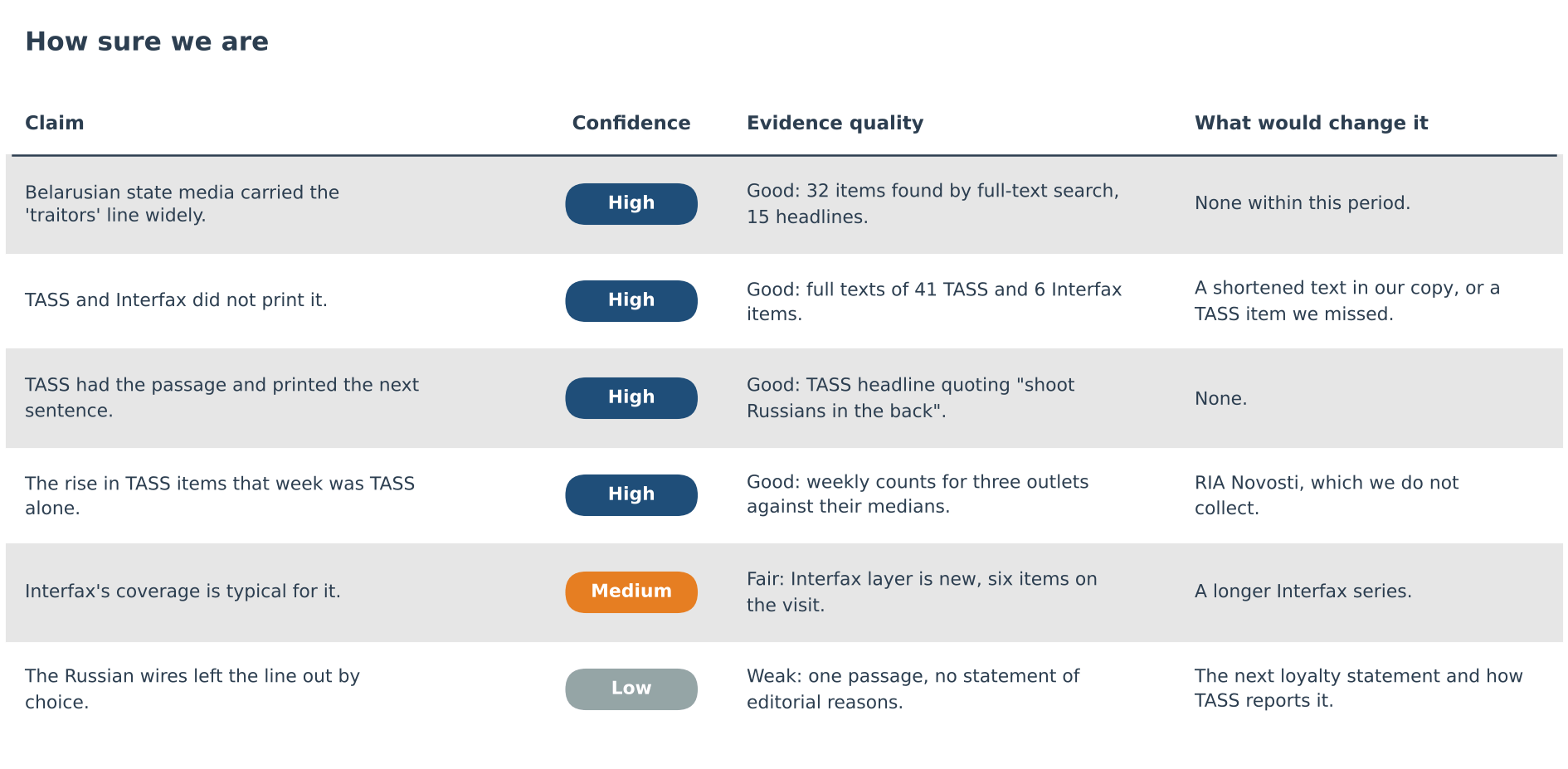
The counts of what was printed are High, because the search ran over the full texts we hold. The weakest row is the reason for the gap. TASS printed the sentence that followed, so it had the passage, but nothing tells us why it chose the other one.
Interfax picked a third sentence.
How it fits
How it fits. One passage reached three audiences, with a different stress each time: loyalty to Russia at home, loyalty to the union in TASS, and a calibrated, separate view in Interfax. This fits T1, Minsk aligned with Moscow without merging into it: the alignment is real, but each side chooses which part of it to print. A simpler reading is wire routine. TASS often picks the most concrete line for a quick headline, and “shoot in the back” is more concrete than “traitors”. The next statement of the same kind will help to separate the two readings.
What to watch
By 31 December 2026, Lukashenko again says that Belarus has “never been traitors” or similar, and TASS prints that wording. We expect he repeats it and TASS does not print it, with Low confidence.
At the next Eurasian Intergovernmental Council, due in Moscow in December, BelTA’s headline from the meeting is about loyalty to Russia rather than trade. We expect trade, with Medium confidence.
By 31 March 2027, a Union State document sets a route or a budget for the Moscow–Minsk high-speed railway. We expect no such document, with Medium confidence.
Method and limits
We searched our corpus from 28 September to 6 October 2026 for the council, the Council of Ministers, Mishustin and Innoprom. We then searched the full texts of the same days for the phrase about traitors and for Pashinyan. Interfax entered our corpus only recently, with texts from 16 August 2024, so its six items are a small base. RIA Novosti is not in our collection. TASS texts are as we collected them, and a shortened text could hide a quote. The weekly counts are items whose title or opening mentions Belarus, Minsk or Lukashenko, and the week of 5 October is not complete. Thesis tag: T1.