
Explaining in a BelTA interview on 23 August why the digital economy comes to 6% of GDP in Belarus, 6–7% in Australia and the United States and 33% in China, the chair of Belstat said the differences come not from the quality of the data but from the methodology — a standard worth applying to the rest of what she said.
The principle
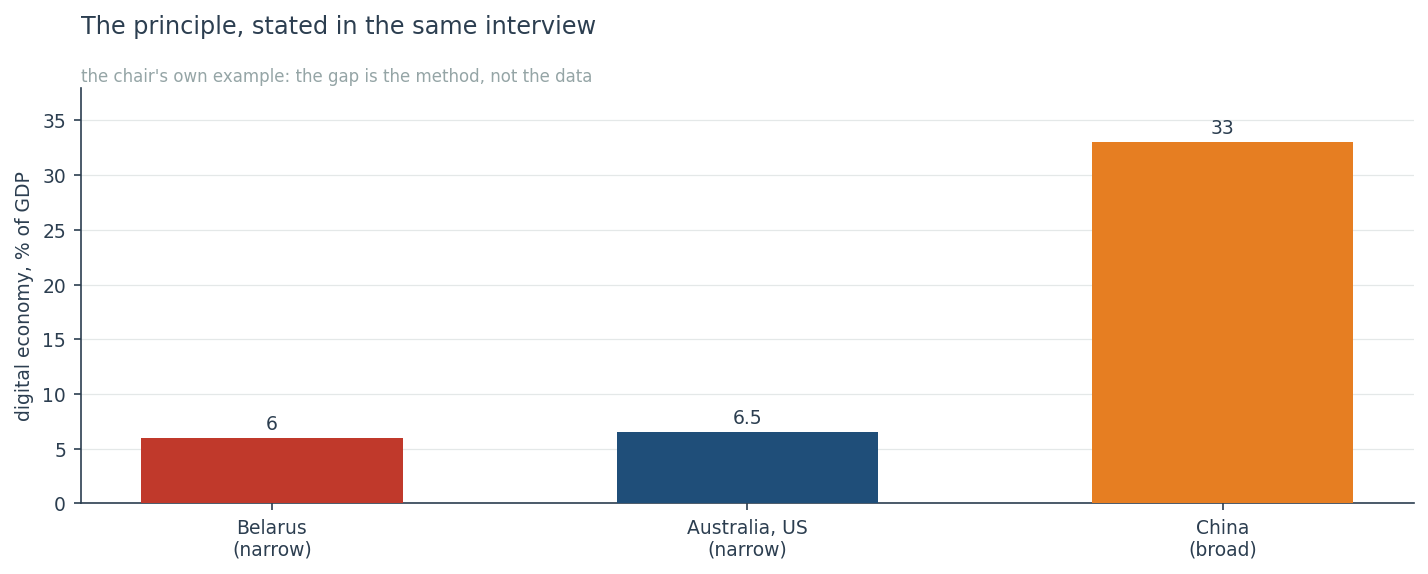
The narrow definition of a digital economy counts the sector that produces digital goods and services. The broad one counts every use of digital tools across the whole economy. China’s 33% and Australia’s 6% are not a gap in performance; they are two different questions. A statistical office that says so plainly is doing its job, and Belstat says so plainly.
The gap is the method, not the data. Her words, four questions earlier.
Belarus is moving from the narrow measure to the broad one. When it does, the figure will rise sharply, and nothing about the economy will have changed.
The comparison
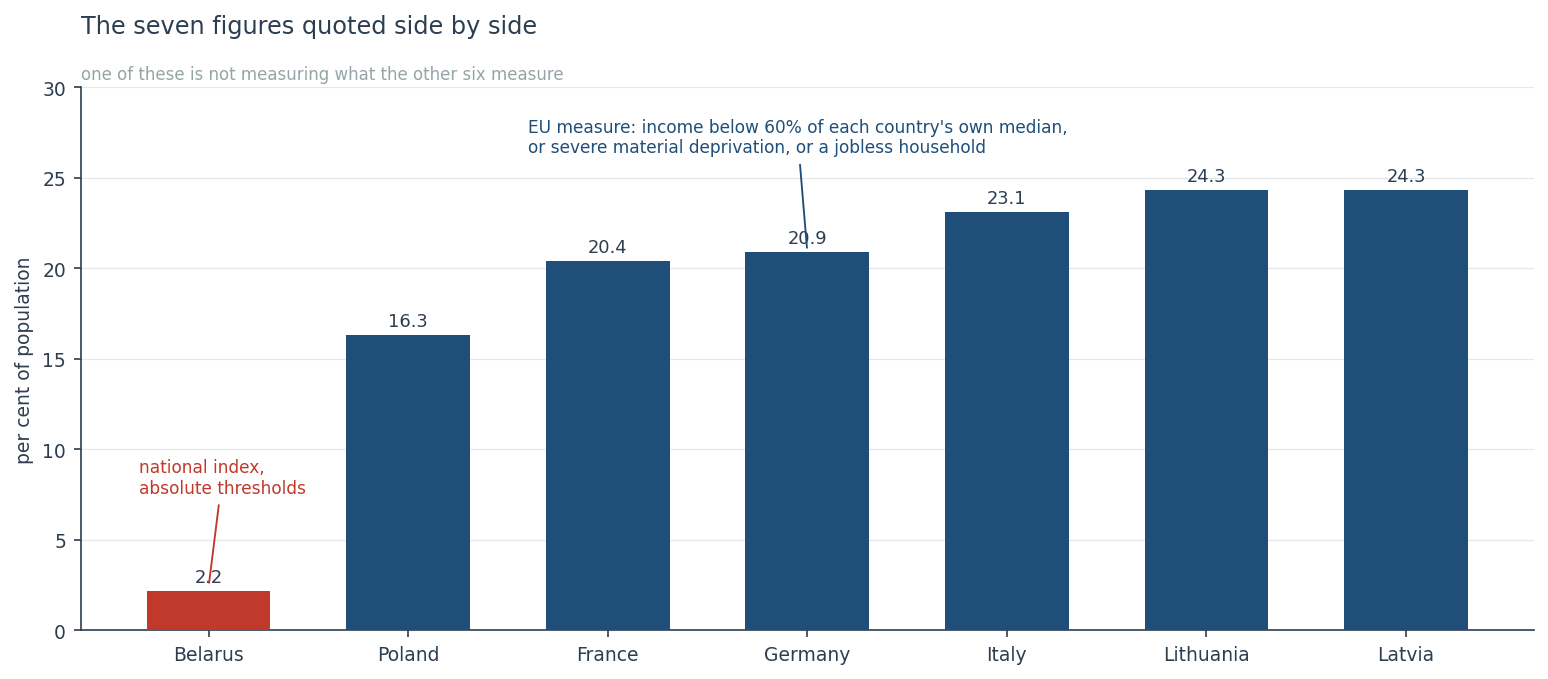
A few sections later the interview turns to poverty. Belarus’s national multidimensional poverty index stands at 0.008, with 2.2% of the population affected. The interview then places that figure beside Poland at 16.3%, France at 20.4%, Germany at 20.9%, Italy at 23.1%, and Lithuania and Latvia at 24.3%.
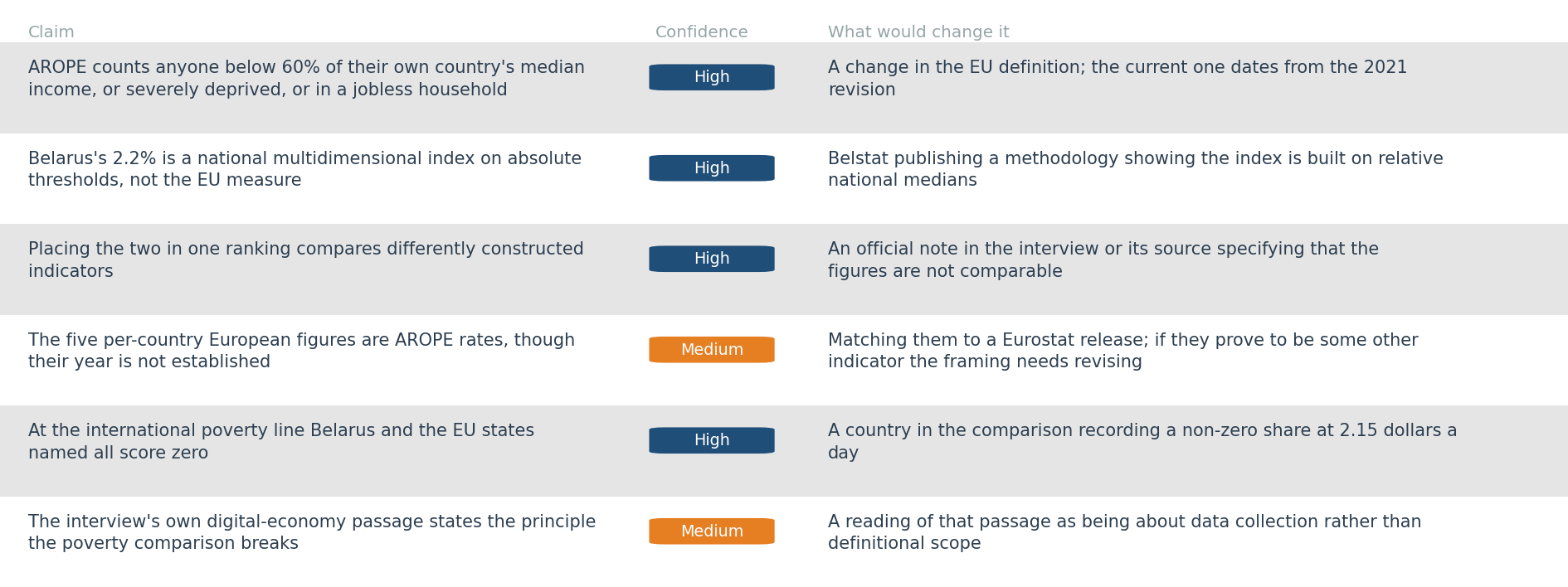
The six European figures are the European Union’s AROPE rate, and AROPE counts a person if any one of three things is true of their household. Their income is below 60% of the median income in their own country after social transfers. Or they face an enforced lack of at least seven of thirteen items considered necessary for an adequate life. Or the working-age adults worked a fifth or less of their available time in the previous year.
The first component is the decisive one. It is relative, and the yardstick is each country’s own median. A country can become richer, keep its distribution unchanged, and hold exactly the same AROPE rate. A country where almost everyone earns a similar modest wage will score well on it, and a country with high average incomes and wide dispersion will score badly. Belarus’s national index measures something else — absolute thresholds set by Belarus.
Ranking the two together does not show that Belarusians are ten times less poor than Latvians. It shows that a national absolute measure and a European relative one produce different numbers, which is what the chair said about the digital economy four questions earlier.
Two different questions never stop being two different questions because you put their answers in the same row.
The other two claims about poverty
A yardstick fixed to each country’s own median cannot rank countries against each other.
The interview reports that 3.3% of the population lived below the minimum subsistence budget in the first quarter, calling it a record low for the whole history of sovereign Belarus. That is a national absolute measure against a nationally set threshold, and taken on its own terms it may well be accurate; nothing here disputes it.
It also reports that at the international poverty line the figure is zero. This is true and tells the reader nothing. The international line is 2.15 dollars a day at purchasing power parity, a threshold designed to identify destitution in low-income countries. Germany, Poland, Lithuania and Latvia are also at zero by it. A measure on which every country in the comparison scores identically cannot rank them.
At the international line Belarus scores zero. So does Latvia.
What we could not check
The six European figures do not match the current Eurostat release cleanly. For 2025 the EU-wide AROPE rate is 20.9%, the same number given here for Germany; Germany’s own rate is close to that, so the coincidence may be nothing. Poland in the 2025 release sits below 16%, not at 16.3%. Lithuania and Latvia carrying an identical 24.3% is unusual enough to be worth tracing to its year and table — in the 2025 income release their at-risk-of-poverty rates, one component of AROPE, are 22.6% and 22.0%.
None of that changes the argument. Whether the figures are from 2022, 2023 or 2025, they are AROPE, and AROPE is not what Belarus’s 2.2% measures. The dating question is separate and worth answering, not a substitute for the methodological one.
Confidence
Watch
Belarus publishes its digital-economy share on the broad definition. The number will rise steeply; whether the release says why is the test.
The next Belstat comparison of poverty with European countries states which measure the European figures are.
The population register absorbs the census. The interview describes a register built from 24 information systems of 8 state bodies, holding national composition and native and spoken language for every resident, and explicitly enabling a register-based census. Whether the next census reports language as declared or as recorded is a different question from any in this piece, and a larger one.
Method and limits
All figures attributed to the interview are as published by BelTA on 23 August 2026 and should be read against that text. The AROPE definition and the 2025 EU-wide rate are from Eurostat’s Living conditions in Europe article and the ilc_peps01n dataset; per-country AROPE values for the five states named have not been matched to a specific year, which is stated above rather than resolved.
This piece takes no position on whether absolute poverty in Belarus is low. A national statistical office reporting its own absolute measure is doing ordinary work, and the measure may be sound. The objection is only to placing it in a ranking with a differently constructed indicator, and the objection is the interview’s own.