
On 4 August a district court in Horki, Mogilev region, ruled that the website of Euronews is an extremist material. A week earlier the same status was given to the Polish Press Agency. In July 2025 a court in the Leninsky district of Mogilev did the same to the Russian-language YouTube channel of Delfi Lithuania.
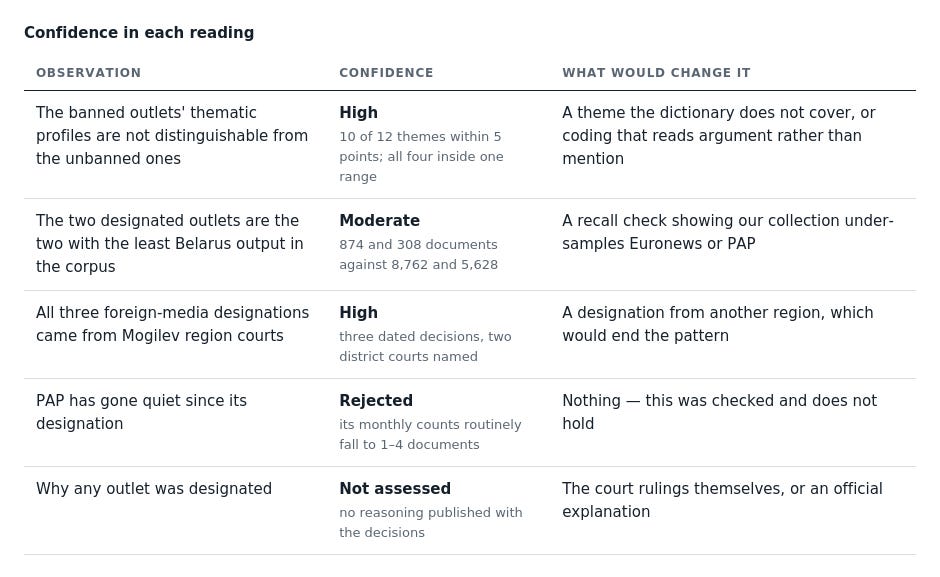
The obvious question is what these outlets published that others covering Belarus did not. Coded against a twelve-theme dictionary, the answer is nothing that the coding can see. Euronews and PAP have Belarus coverage profiles that sit inside the range set by Delfi and LRT, neither of which has had its website designated. Ten of the twelve themes differ by less than five points between the two banned outlets, and on the largest categories — border and migration, war, repression, sanctions, the nuclear plant — all four are within a few points of one another.
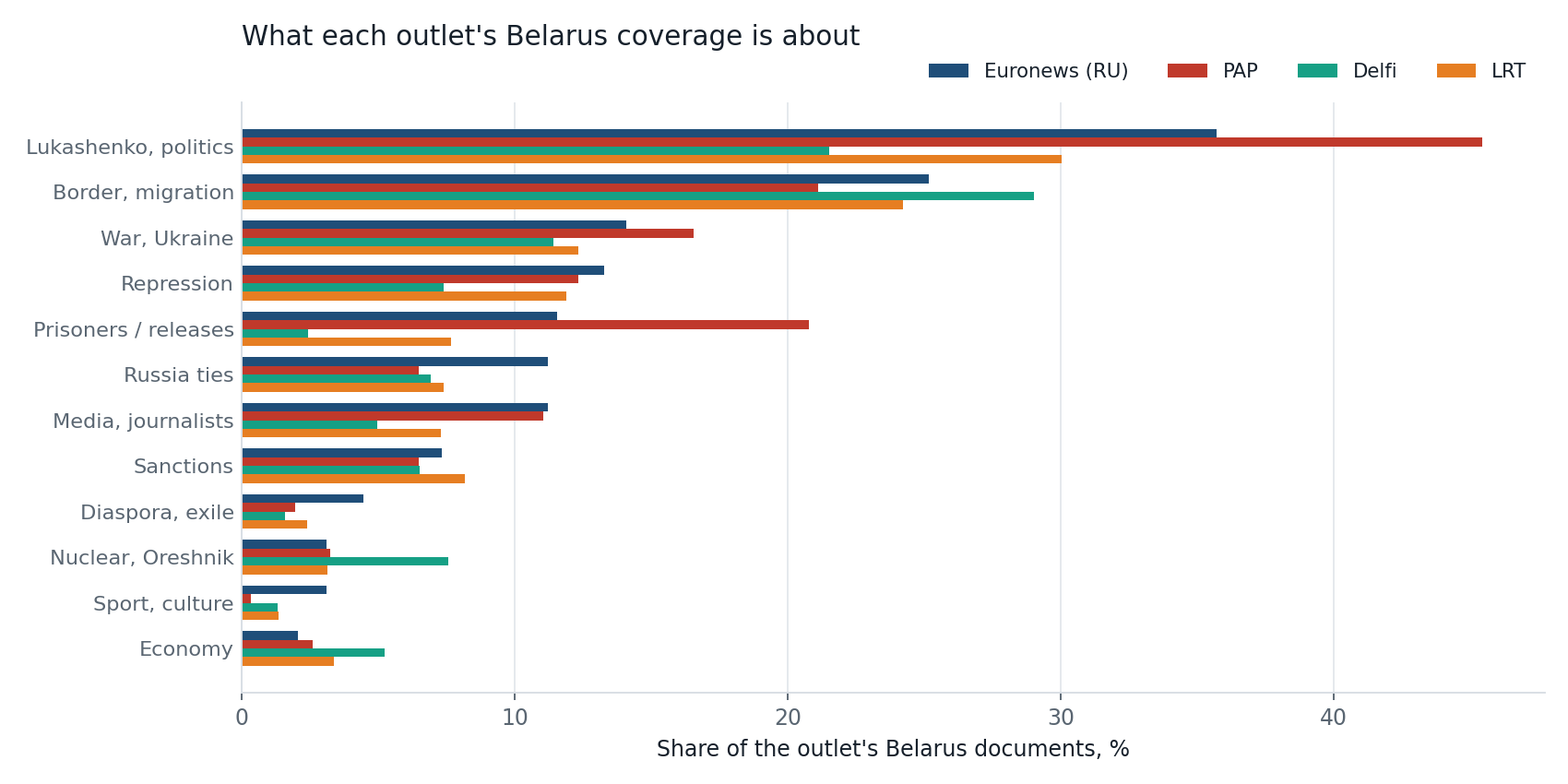
What does separate the two designated outlets from the two that were not is volume. Delfi has 8,762 Belarus documents in the corpus and LRT 5,628. Euronews has 874, accumulated since 2012. PAP has 308 since mid-2023. The two outlets declared extremist are the two that write about Belarus least.
The arc
Euronews entered this corpus in April 2012 and has been in it ever since, which makes it the only one of the four with a record spanning the whole period.
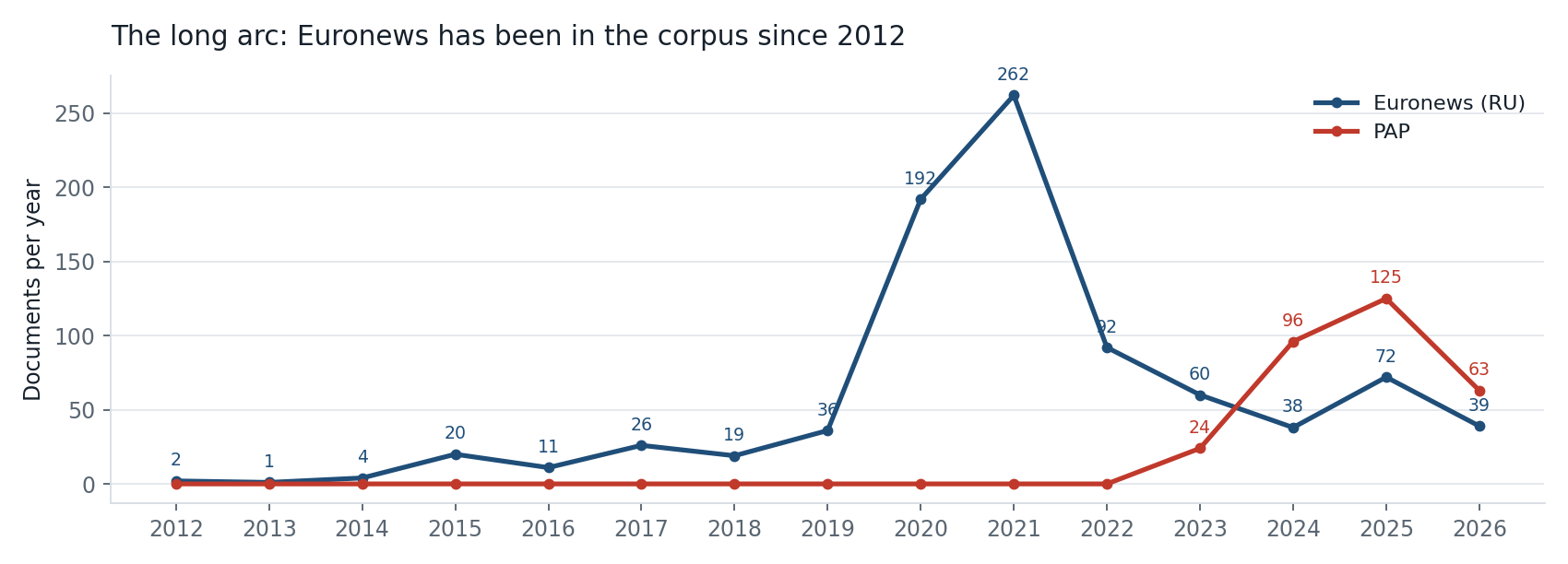
The shape is a single mountain. Two documents in 2012, one in 2013, a slow climb through the 2010s, then 192 in 2020 and 262 in 2021 — the peak. After that the fall is steep: 92, 60, 38. A partial recovery to 72 in 2025 and 39 so far this year.
The peak year matters because of what else happened in it. Euronews had been broadcast in Belarus since the early 2000s, carried by cable operators including the state’s own Beltelecom, and Lukashenko gave the channel four interviews between 2009 and 2014. On 12 April 2021 the Information Ministry removed Euronews from the list of foreign outlets permitted to broadcast, and the retransmission stopped. That happened in the middle of the channel’s most intense year of Belarus coverage.
The designation of August 2026 arrives at a different point on the curve — at roughly a seventh of the 2021 volume. Whatever the ban responds to, it is not a surge in output.
What the two banned outlets do differently
The comparison between Euronews and PAP is worth a paragraph, because it is the one place where the profiles part.
PAP leads on politics — 45 per cent of its Belarus documents against 36 for Euronews — and, more distinctively, on political prisoners and releases: 21 per cent, against 12 for Euronews, 8 for LRT and 2 for Delfi. That is a Polish agency’s specific interest, and it has a name in it. Andrzej Poczobut, the Union of Poles journalist held since 2021, runs through PAP’s Belarus file the way no single figure runs through the others.
Euronews, in turn, carries a heavier Russia component — 11 per cent against 6 — and is the only one of the four with a visible sport and culture share.
Neither difference maps onto the designations. Both outlets were listed within a fortnight of each other despite profiles that diverge on exactly two of twelve themes, and the outlet whose profile sits closest to PAP’s on those two themes — LRT, at 30 per cent politics and 8 per cent prisoners — has not been listed at all.
Monthly rhythm, and a claim not made
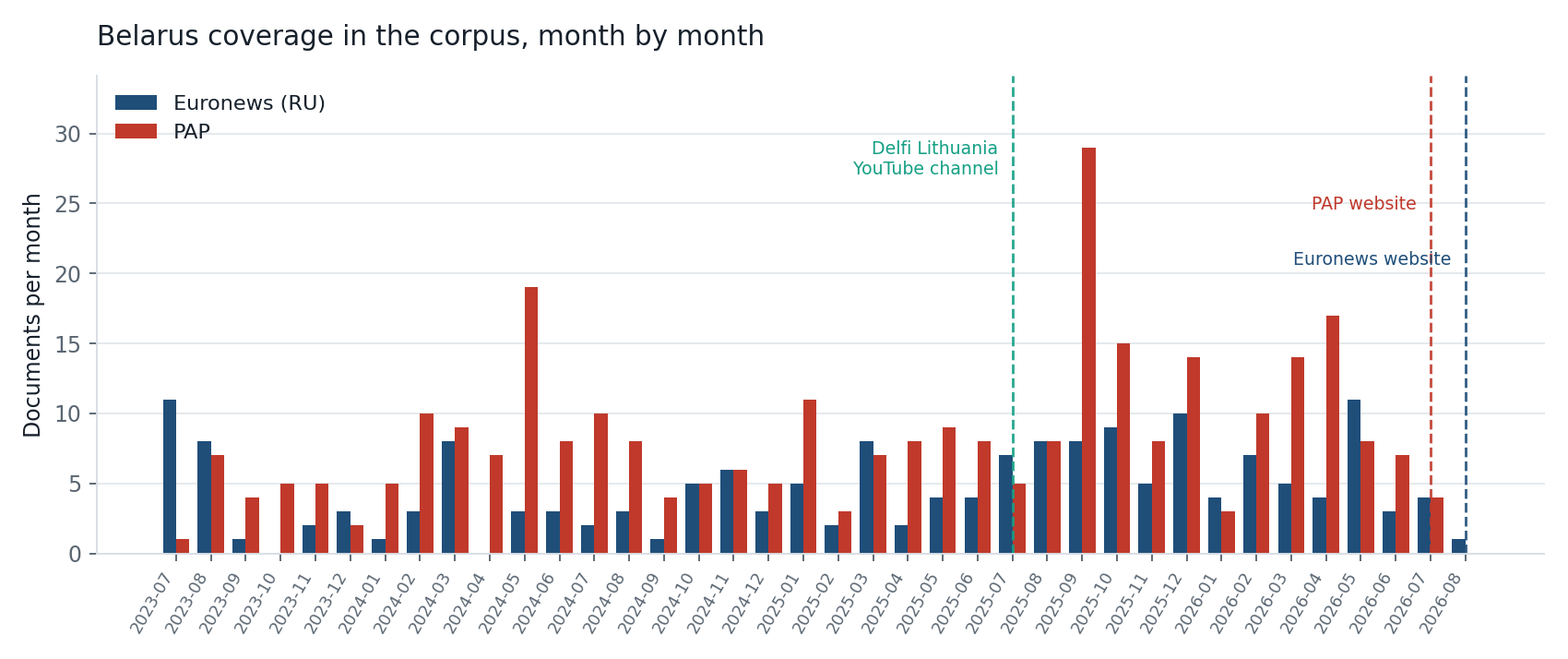
The month-by-month record disposes of one story I nearly wrote. After the designations, PAP’s Belarus-tagged output appeared to stop: a re-scrape of three tags returned seventy-six items, all of them already collected. It looked like a newsroom going quiet.
It is not. PAP’s monthly counts in this corpus routinely drop to one, three or four documents — January 2026 has three, July 2026 has four. A sparse fortnight in August is inside the normal range, and the corpus only reaches 8 August in any case. Whether PAP has published Belarus material since its designation is a question about tagging practice and our collection, not about editorial retreat, and nothing here supports the stronger version.
One symmetry does survive. The most recent document from each banned outlet in this corpus is about its own designation: PAP on 30 July reporting that its website had been listed, Euronews on 7 August with an interview in which Tsikhanouskaya calls the ban revenge for the channel’s coverage. Their public responses differ in kind — PAP said it would carry on covering events; Euronews’s editorial director said the decision was taken without any notification to the channel.
The jurisdiction
The one thing the three designations demonstrably share is a place. Horki district court and the Leninsky district court of Mogilev are both in Mogilev region; PAP’s listing came from the same region.
That region’s prosecutors have filed 234 applications to have materials declared extremist since the start of 2026, a figure the Prosecutor General’s Office published in July — roughly one court filing per working day, from one of six regions. Decisions taken at district level there apply to the entire country.
Confidence
Watch items
Whether the reasoning behind any of these decisions is ever published. At present the designations reach the public as entries on a list; the rulings themselves, and whatever standard they apply, are not available. That absence is the single largest gap in this brief and the one thing that would settle what the coding cannot.
Whether Euronews and PAP appear in this corpus at their previous rate through September. Two weeks of sparse output proves nothing either way; three months would distinguish an editorial change from ordinary variance, and the monthly series above gives the baseline to measure against.
Whether the concentration in one region survives an audit. Three decisions from Mogilev region is an observation drawn from three reported cases, and reported cases are not a random sample. The Republican list records the issuing court for every entry; counting them by region would establish whether this is a real concentration or an artefact of which designations got covered.
Method and limits
Four foreign outlets were pulled from the corpus in full and coded against a twelve-theme dictionary applied to lead text. Themes overlap by design — an article about a jailed journalist counts under both repression and media — so shares do not sum to 100. The coding is dictionary-based, not read; it measures what a document mentions early, not what it argues.
The sampling frame is the limit that matters. These are documents our scrapers collected, by outlet tag, not everything the outlets published about Belarus. For PAP that means three tags; for Euronews, its Russian-language service. A statement like “Euronews covers Belarus less than Delfi” is therefore a statement about this collection until a recall check against the outlets’ own archives says otherwise — the same problem that nearly broke a previous corpus study of a British tabloid, where an independent probe found the crawler had seen barely a tenth of the tagged articles.
The exact date of the court decision on PAP is not established here; the outlet’s own report of its listing is dated 30 July. The Euronews decision is dated 4 August and the Delfi Lithuania decision 18 July 2025.
This brief measures coverage profiles and the sequence of designations. It does not establish why any outlet was designated, and the thematic similarity is evidence against a content-based criterion rather than proof of any other.