

Human Constanta’s Digital Freedoms Lab has published a forty-page map of how the Belarusian state reaches its critics abroad through screens. Its one new dataset is small: 102,200 Telegram posts from eleven pro-regime channels. Those posts say the channels are staffed, fed from one place and cheap to run. They say nothing about how many people the channels reach.
The document
The report is called “Transnational digital repression in Belarus: from doxxing to deepfakes” (Digital Freedoms Lab, Human Constanta). It covers August 2020 to July 2026. Most of it is a case typology: fabricated films, fake bots and link traps, recruitment through relatives, DDoS attacks, published addresses, financial “audits” of exile NGOs built from Lithuanian company registers. We counted 62 dated cases in chapters two and three. Almost every one of them has appeared in the independent press before. The typology is a filing system for known material, and a good one.
The new material sits in chapter one. The authors pulled every post from eleven channels through the Telegram client API, from January 2023 to 12 July 2026, and asked a simple question. Are these channels a network, or eleven desks with the same taste?
What a shared post proves
The report tests the network idea two ways. Identical texts are merged into one record with a list of the channels that carried it. Forwards are traced through the fwd_from field, which keeps the numeric id of the source channel even after a rename.
The identical-text count looks strong at first. Kniga GU BAZA and Pervyi Rubezh share 1,066 posts. ZhS Premium and Puls Grodno share 740. Then the authors check each pair at message level. Of the 1,066, only four were posted by both channels on their own. Of the 740, none. The overlap is forwarding, not co-authorship.
Of 1,066 posts shared by two channels, four were written twice. The rest were forwarded once.
One pair breaks the pattern. Nevolfovich and ZhS Premium share 221 posts, and 54 of them are not forwards. Two channels with no formal link publish the same text on the same day, each from its own account. The report reads this as a common upstream source. That reading matches what we found in our own larger sample: five personal propagandist channels plus the state news channel and the presidential press pool, about 267,000 posts, all forwarding the same thirty or so state and Russian nodes with the press pool at the top. The Human Constanta sample sits one level below ours. Its channels carry police material, ours carry the presidential line. The shape is the same.
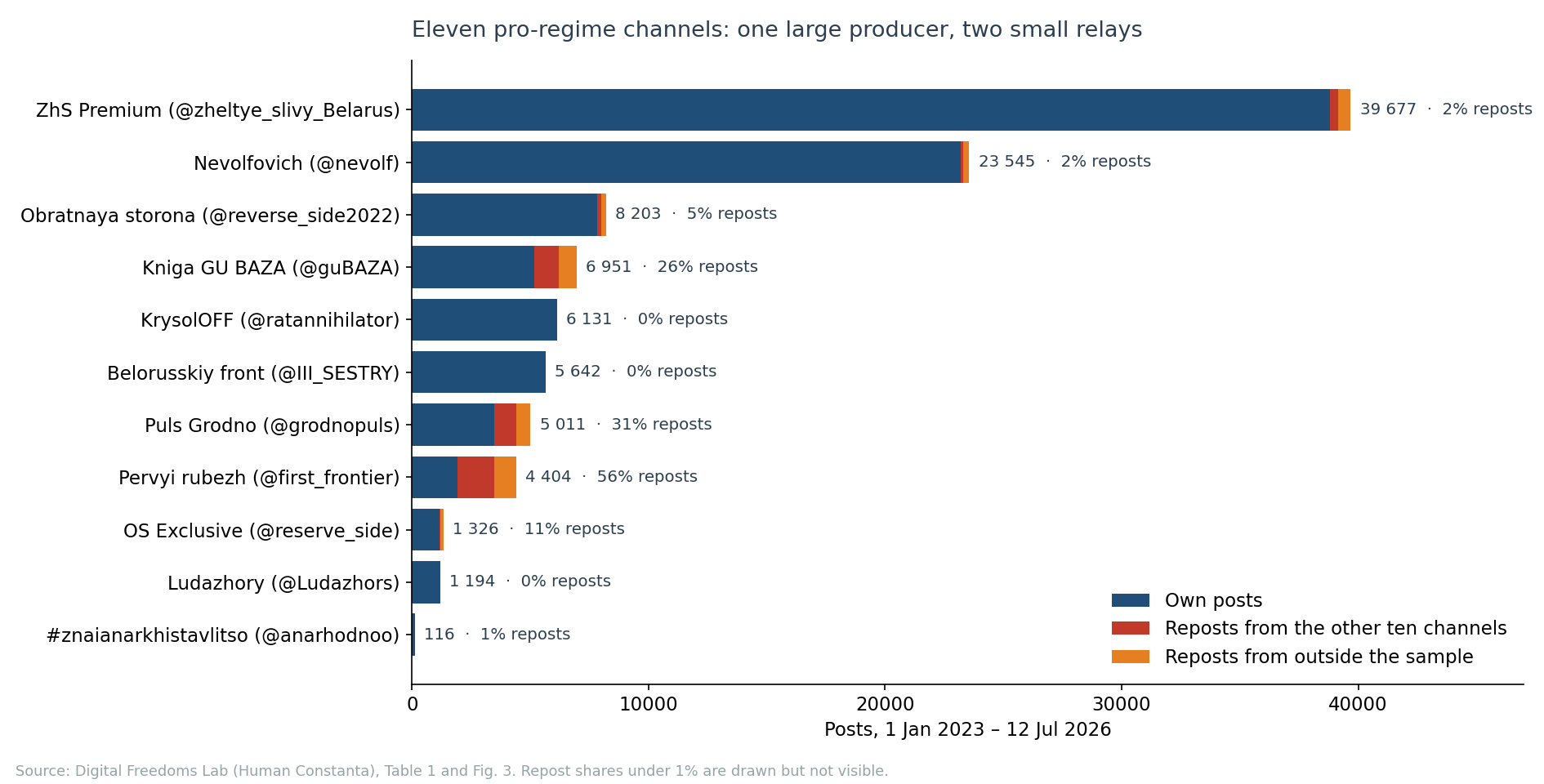
The structure chart is the report’s best single figure. Pervyi Rubezh, the Brest regional channel, is 56% reposts. Puls Grodno is 31%. Everyone else is a producer. ZhS Premium alone wrote 38,817 original posts in three and a half years, about thirty a day, and forwarded almost nothing. It is the source, not the hub.
The clock
The second test is the calendar. Own posts from all eleven channels cluster between 9:00 and 18:00 Minsk time on weekdays. For five channels the share inside those hours is 75 to 89 per cent. Activity drops after 22:00 and bottoms out between 3:00 and 6:00. Saturday is quiet, Sunday quieter.
The authors are careful here. A working-hours profile rules out volunteers posting after their day job. It does not separate a ministry press office from a commercial newsroom. Two channels widen the window into the evening, ZhS Premium and Nevolfovich. Belorusskiy Front never really sleeps. And Ludazhory, the AI-comics channel run by an SB. Belarus Segodnya columnist, posts 31.8% of its material at weekends, the highest share in the sample. The columnist works from home.
Five channels post three quarters of their material between nine and six. Nobody runs a hobby on that schedule.
What the cases are made of
The typology has one finding that runs against its own title. The data behind these operations almost never comes from hacking. The ByHelp recipient list came from a volunteer’s computer seized in Minsk. The Viasna training videos of 2019–2020 had been in the prosecutors’ hands since the Bialiatski case. The Kabanchuk screenshots were lifted from a Pastebin dump by an unknown hacker a month before GUBOPiK claimed them. The “leak” of the New Belarus platform was Polish-language company data from open registers. Financial doxxing works from rekvizitai.vz.lt, a public Lithuanian register that exile NGOs are legally required to feed.
This is the report’s real argument for host states. Nothing in this system crosses the threshold at which ordinary protection starts. There is no intrusion, no attacker inside the jurisdiction, no event a police report can name. The report calls this a design feature, and we agree.
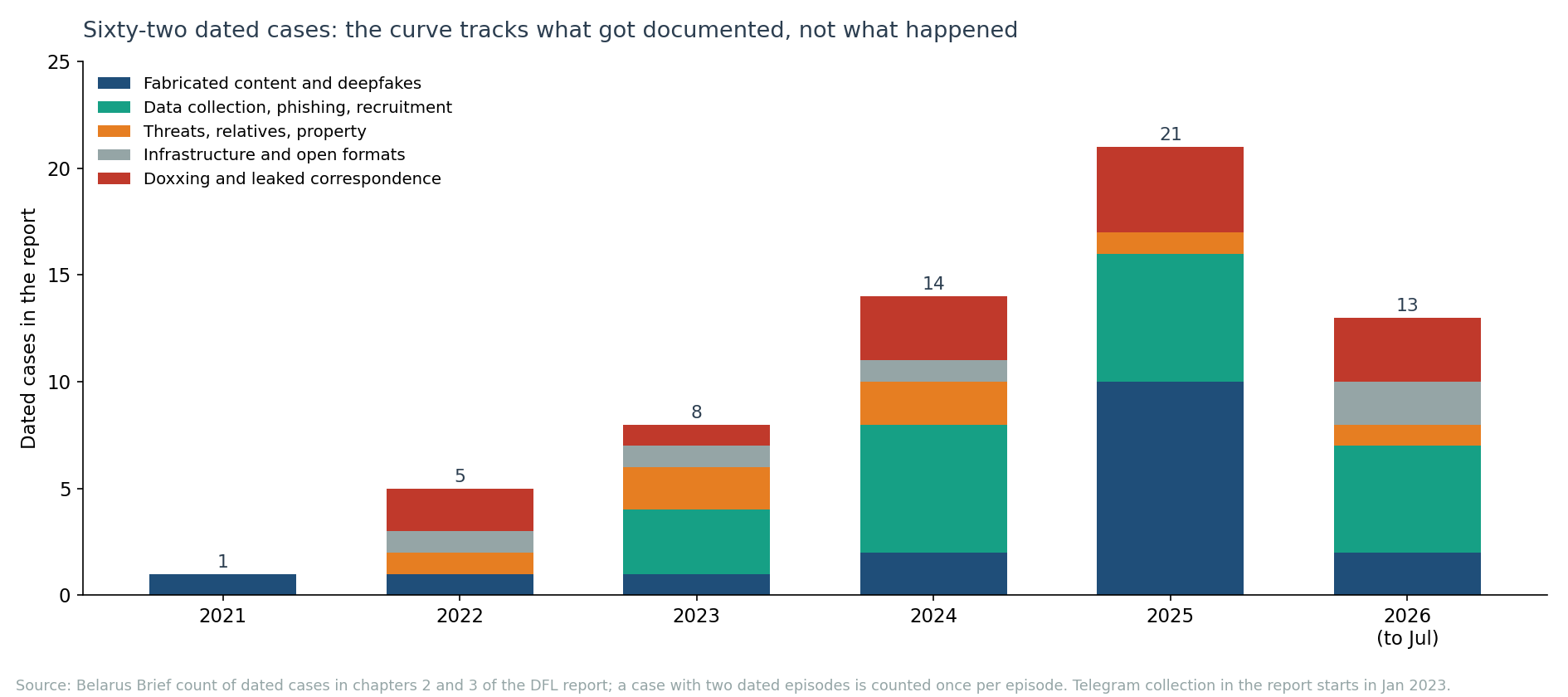
The case curve needs a caveat the report does not give it. Dated cases rise from five in 2022 to twenty-one in 2025. Part of that is the method. The Telegram collection begins in January 2023, and the 2022 cases are the ones that made it into major outlets. A rising line drawn on a rising number of sources is not evidence of a rising practice.
Gender, counted elsewhere
The chapter on AI content lists eleven women targeted by Ludazhory and states that erotic synthetic material is used against women only, while men get alcoholism, treason and prison slang. The claim rests on reading the channel, with no counts. Our own coding of the FORESIGHT corpus on technology-facilitated gender-based violence gives it a number: 2,671 relevant documents since 2018, and 99% of the documents that are themselves acts of violence come from the state or pro-regime segment. The two readings agree. Only one of them can be checked.
Erotic fakes for women, alcohol and prison for men. The report saw it. We counted it.
What is not in the report
The eleven channels are described by post count only. There are no subscriber figures, no views, no forwards outward. A channel with 39,677 posts and a channel with 116 posts sit in the same table, and nothing says which one anybody reads. TGStat and Telemetr are cited for channel descriptions, not for audience.
Two of the eleven are quiet cases of substitution rather than continuity. Obratnaya Storona stopped on 28 January 2026. OS Exclusive started on 3 February, six days later, with the same format and a near-identical name. The report notes the dates and declines to claim a single editorial team. That is the right call and a missed measurement: the fwd_from id of the first channel would have settled it.
The numbers do not fully agree with themselves. The text gives the top three pair counts as 1,066, 740 and 725. The chart gives 1,065, 724 and 716. The difference is small and the direction is unexplained.
Human Constanta is a target in its own report. Its staff appear in a 2022 SB. Belarus Segodnya interrogation video and in a 2025 financial “audit” by Shtab Onoshko. The report does not say so in the methods section. It should, once, and move on.
The same organisation wrote the report and appears in two of its cases. That is a note for the methods section, not a reason to doubt the count.
Takeaways
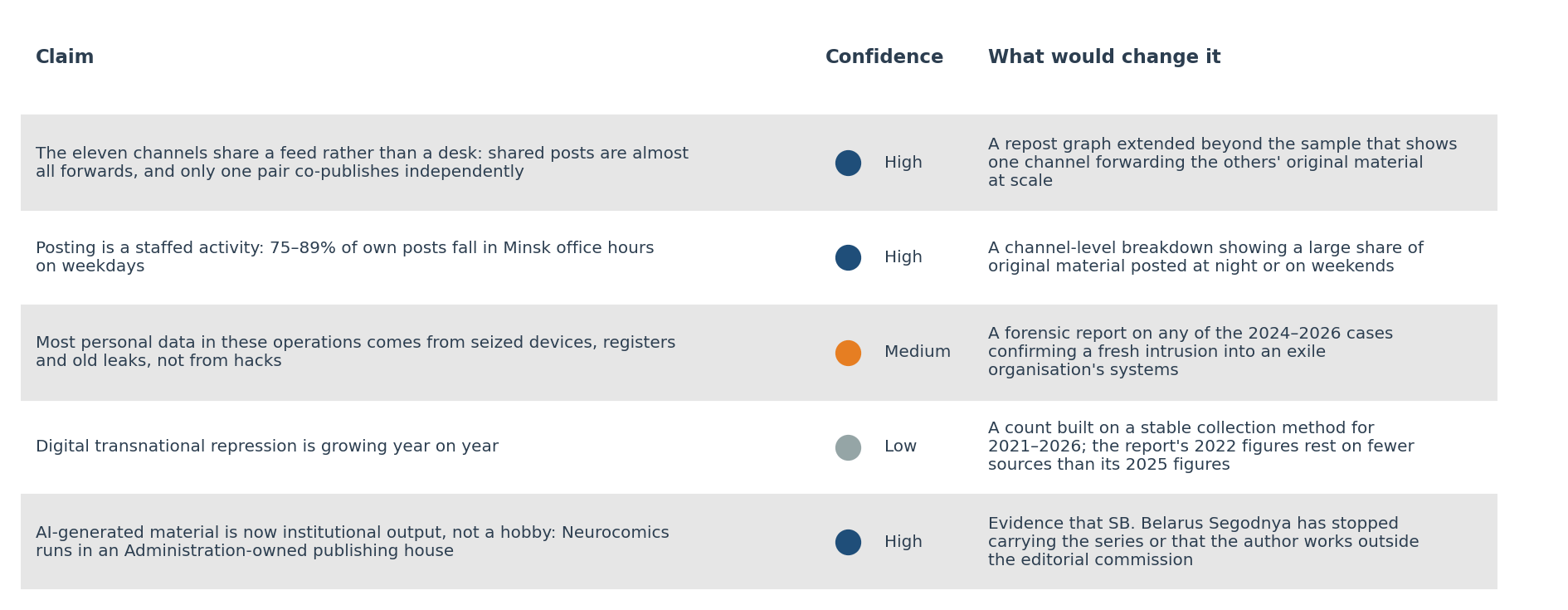
The eleven channels are not one desk. They are one feed. Shared posts are forwards; independent co-publication exists in one pair only, and points upstream.
Posting follows a state working day. That excludes the volunteer model and nothing else.
The material is cheap. Seized devices, public registers and old leaks supply most of it, and the system is built to stay under the threshold where host-state law reacts.
The case curve reflects collection, not incidence. Treat 2022 as under-documented, not quiet.
Reach is unmeasured. Until it is, “network” describes the supply side only.
Watch
By 31 December 2026: the Investigative Committee names a TikTok or Threads post in at least one public case announcement. Its June 2026 statement promised monitoring; a case would show it is real.
By 31 March 2027: the Neurocomics series in SB. Belarus Segodnya passes 200 issues. It stood above 150 in July 2026 at roughly one a week. Fewer than 180 would mean the project slowed.
By 31 December 2026: OS Exclusive’s forward metadata shows forwards from the Obratnaya Storona id, or the old channel resumes posting. Either outcome closes the substitution question.
Method and limits. Channel figures are the report’s own (Table 1, Fig. 2–5), read from the PDF. The 62-case count is ours, from the dated cases in chapters 2 and 3; undated episodes are excluded and two-date cases count twice. The 267,000-post comparison refers to our earlier analysis of the pro-regime Telegram pyramid; the two samples overlap in period but not in channels, so the shape comparison is qualitative. The TFGBV figures come from a FactCheck.LT study. No reach data for the eleven channels was available to us either.