
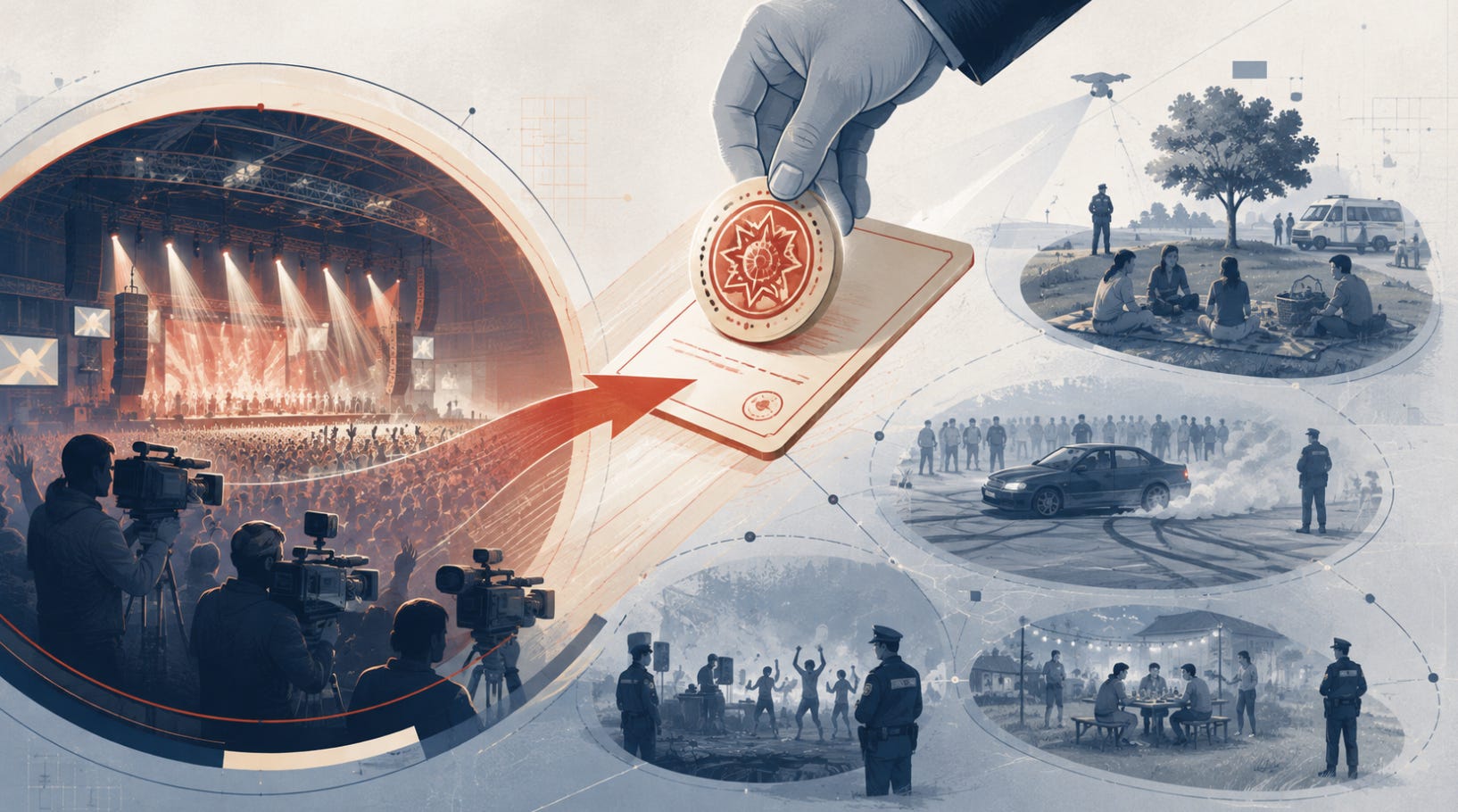
Five gatherings in eleven weeks, all of them apolitical, all falling under the same Belarusian law on mass events. One was held in a state-owned arena with a foreign preacher on stage and produced 54 documents in the state media segment. The other four ended in police stations, and produced three.
The variable is not size. The permitted gathering drew roughly fifteen thousand people over two evenings; the largest dispersed one drew about 350. It is not foreigners, who were present at both. It is not minors, or religion, or crowd control. The variable is authorisation, and authorisation in these eleven weeks tracked what the gathering was worth to the state abroad.
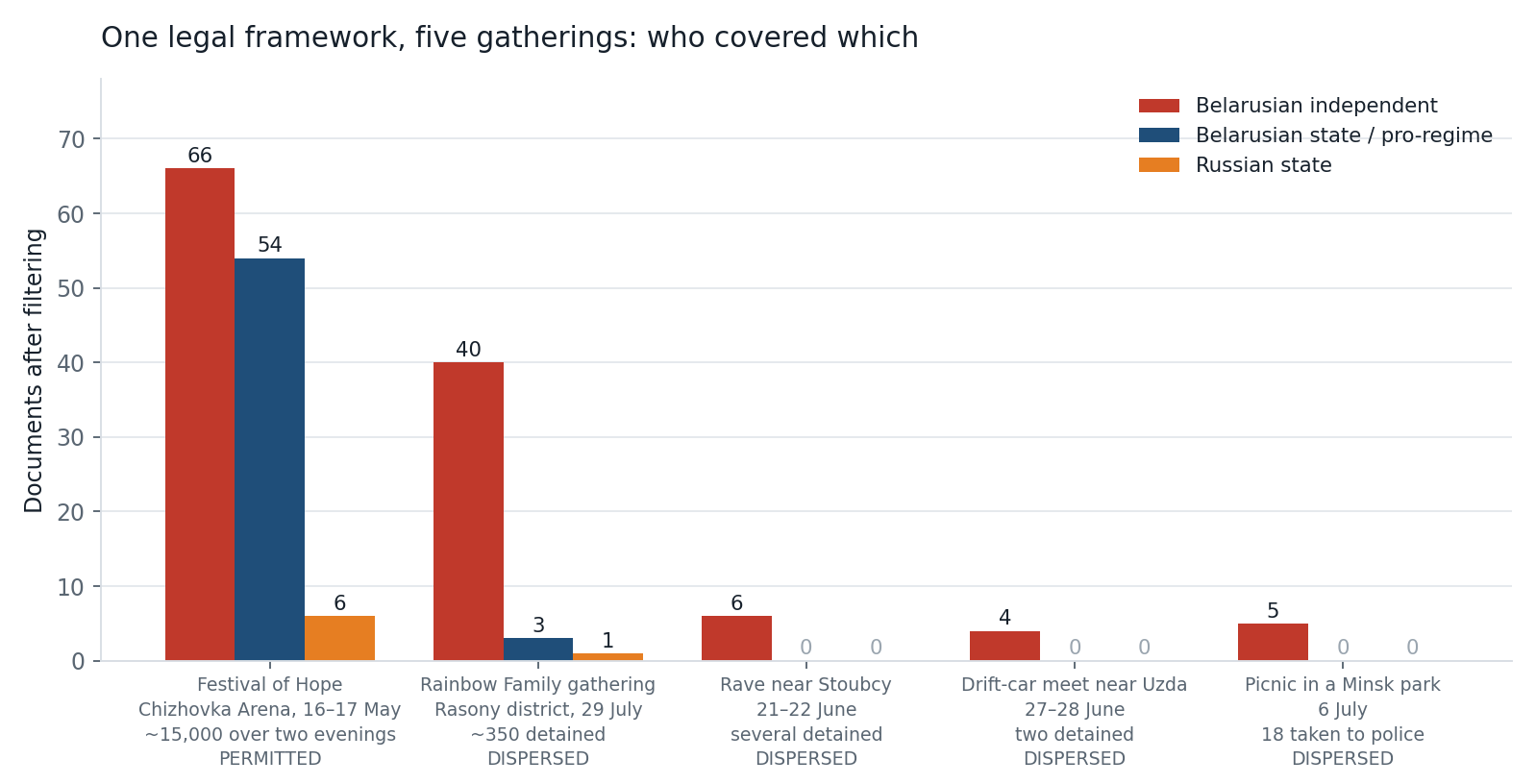
The five
On 16 and 17 May the Festival of Hope filled Chizhovka Arena in Minsk. Two Protestant denominations organised it jointly, entry was free, and the headline guest was the American evangelist Franklin Graham. The day before, Graham met Lukashenko, described himself as a close friend and spiritual adviser to Trump, and said he hoped a Trump–Lukashenko meeting would follow. Independent outlets reported that John Coale and Greta van Susteren were expected too, and connected the festival to the possibility of further prisoner releases.
On the night of 21–22 June, police broke up a closed music rave near Stoubcy. On 27–28 June, at least two people were detained at a drift-car meet near Uzda, south of Minsk. On 6 July, a group of eighteen having a picnic in a Minsk park were taken to the Pershamayski district police station; officers told them the gathering required prior authorisation. On 29 July, at a lakeside camp in Rasony district, around 350 people were detained at the annual Belarusian Rainbow Family gathering.
The last of those is worth a paragraph on its own, because it is the limit case. Rainbow Family has no membership, no leadership, no legal entity and no one authorised to speak for it — the movement has been unable to sign for permits in the United States for fifty years for exactly that reason. It has gathered in Belarus since 2010. The Interior Ministry nonetheless identified two organisers; one was given seven days’ detention, the other released. Where an association does not exist, the procedure supplies one.
What the state published
The state segment is not simply absent from these stories. It is present in proportion to its authorship of them.
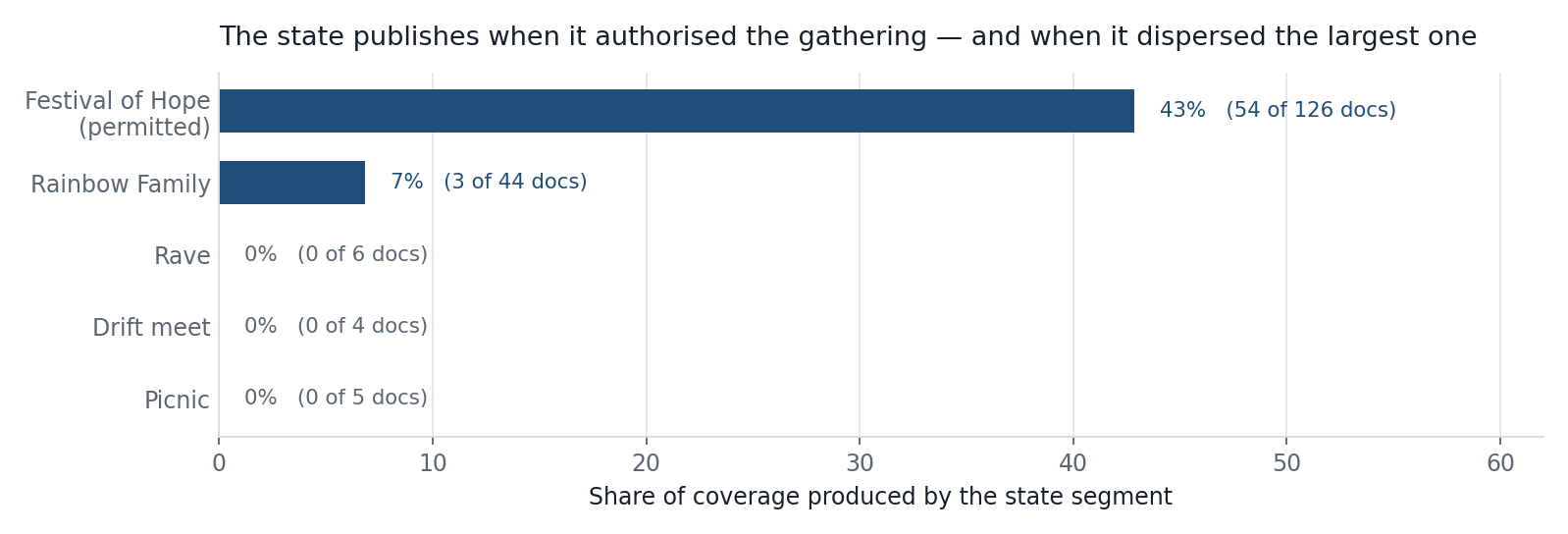
On the festival, state and pro-regime outlets produced 54 of the 126 documents in the corpus — 43 per cent of all coverage. Thirty-one of those landed on 15 May alone, the day of the meeting: BelTA, CTV, ONT, state television broadcasts, and the pro-regime Telegram tier amplifying in parallel.
On Rasony, the state segment produced three documents, all on 30 July, all carrying the same Interior Ministry account: a call to the emergency line, more than three hundred citizens found at the lake, foreigners and minors among them, tents, bonfires, loud music. Sputnik carried the same text. The ministry also published photographs of the site, and added a further justification later — that many participants were naked in front of minors.
On the rave, the drift meet and the picnic, the state segment produced nothing at all.
Put the two ends together: the state wrote more about the gathering it authorised — 54 documents — than Belarusian independent media wrote about all four dispersed gatherings combined, which comes to 55.
What independent media added
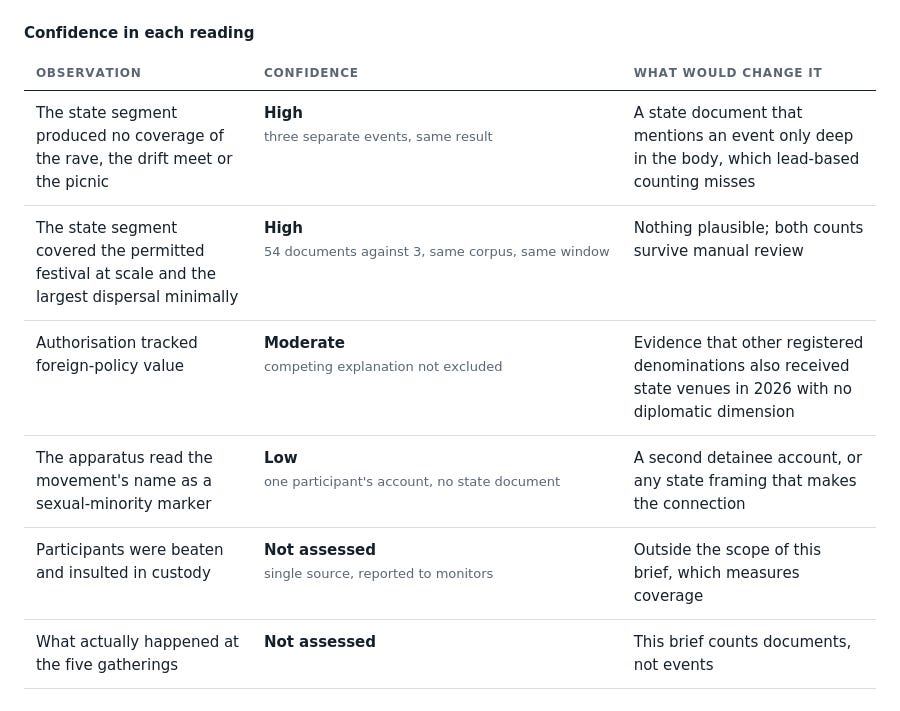
Coverage of Rasony continued after the state’s single day. Human rights defenders reported that Russian citizens among the detainees were released after nearly a day in custody and issued one-year entry bans — an instrument that appears in no state or Russian state document in the corpus. On 3 August a participant told human rights defenders about insults during processing, pressure while protocols were drawn up, and the beating of one detainee; officers, by his account, used a homophobic slur apparently derived from the word “rainbow”. That account is single-source at the time of writing.
The conflation is worth noting for what it says about the apparatus rather than the officers. A movement named for a rainbow was read as a sexual-minority gathering, three weeks after amendments on “propaganda” were signed. Whether that reading reached state framing is checkable, and in this corpus it did not: no state document connects the two.
Two readings
The pattern admits a second explanation, and it is a good one. The system may not be trading permission for foreign-policy value at all; it may simply be processing what is institutionally legible. The festival was organised by two registered denominations through a formal application. The rave, the drift meet, the picnic and the Rainbow camp had no organiser to apply, and in the Rainbow case could not have had one.
Both readings fit the coverage data equally well. What separates them is a question the corpus cannot answer yet: whether a comparable registered-denomination event with no foreign-policy dimension also received a state arena in 2026. If several did, legibility explains everything and the diplomatic timing is a coincidence. If the Festival of Hope stands alone, the timing is the explanation.
The July legislative record leans slightly toward the first reading being incomplete. In the same month, the Commissioner for Religious and Ethnic Affairs was moved out from under the Council of Ministers and re-subordinated directly to the Presidential Administration, and a criminal case went to court against the leader of an unregistered religious organisation. Religious assembly is being managed closer to the centre, not more procedurally.
Confidence
Watch items
No state outlet has covered the detainees’ accounts of their treatment. If one does — even to deny it — that is the first state document on the aftermath, and it would say more than the current silence.
Whether the one-year entry bans issued to Russian citizens surface anywhere in Russian state media. Sputnik carried the ministry’s version of the raid; it has not carried what happened to Russian nationals afterwards.
Whether another registered denomination gets a comparable venue before the end of the year. That single fact decides between the two readings above better than any amount of further coverage analysis.
Method and limits
Corpus of 73 sources, web and Telegram, segment labels assigned at source level in advance, queries reproducible against PostgreSQL. Each event was matched on an anchor plus a required context term, and the check step was run against anchors alone first — the arena shares its name with a Minsk district and a reservoir, and “rainbow” names shops and kindergartens.
The filtering matters more than usual here. One outlet embeds a “popular now” widget — headlines with view counts — inside the stored article text, which put the festival into 268 of 494 raw hits and Rasony into 44 of 97. Documents were therefore counted only where the anchor appears in the headline or the first 400 characters. That removes the widget; it also removes any genuine article that mentions an event only deep in the body. All figures here are lower bounds.
Two things were dropped from this brief rather than reported weakly. A series of monthly counts of the mass-events article was built and discarded: it falls from 15–35 documents a month through 2024 to single digits from April 2025 and shows an empty January 2026, which measures how media cite an article number and where the corpus has gaps, not how often the article is applied. And a 2025 precedent — more than 300 foreign students detained in Viciebsk for celebrating their new year without a permit — could not be located in the corpus under any tested formulation, so it is mentioned nowhere in the analysis above.
Attendance at the festival is a reported two-day aggregate, not a single crowd; the arena seats 7,280. Detention figures come from human rights monitors and from the Interior Ministry and differ from each other. This brief measures coverage. It does not establish what happened at any of the five gatherings.