

Reading. In the first part of this series we used Viasna’s monthly count of newly recognised political prisoners as a measure of new repression. Valery Kavaleuski objected on X: since the US-brokered releases began, some of the new names belong to people arrested a year or two earlier, who only now sought the status in the hope of release. We tested that against Viasna’s full list, and he is partly right. The share of people recognised more than a year after detention rose from 18% to 32%, but two thirds of new recognitions are still people detained within the year. What the data cannot tell us is why the older cases surfaced, because two different explanations leave the same trace.
The question
The first part of the series, What the Apparatus Is Owed, argued that Minsk trades the stock of political prisoners while the flow of new cases continues. We measured the flow with Viasna’s monthly count of new recognitions, about 45 a month.
Kavaleuski’s point was simple. A recognition is not an arrest. If people who were detained long ago started asking for the status once releases became possible, the monthly count would rise because of American diplomacy, not because of new repression. He added that this is a question human rights defenders should clarify for everyone who uses the figures.
He was right that we had not checked. We said we would, and this is the result.
The test
Viasna’s public list records, for each person, the date of detention and a link to the statement that recognised them. The full list has 8,773 people, but about 3,900 of them are people convicted in political cases whom Viasna has not recognised as political prisoners, so they have no recognition date. That leaves 4,754 recognised people whose statement we could date exactly, almost all of those recognised. For each, we measured the time from detention to recognition.
A recognition is not an arrest.
We then compared two windows: the twelve months before the first release of 11 September 2025, and the twelve months after it. That is 404 people recognised in the first window and 420 in the second.
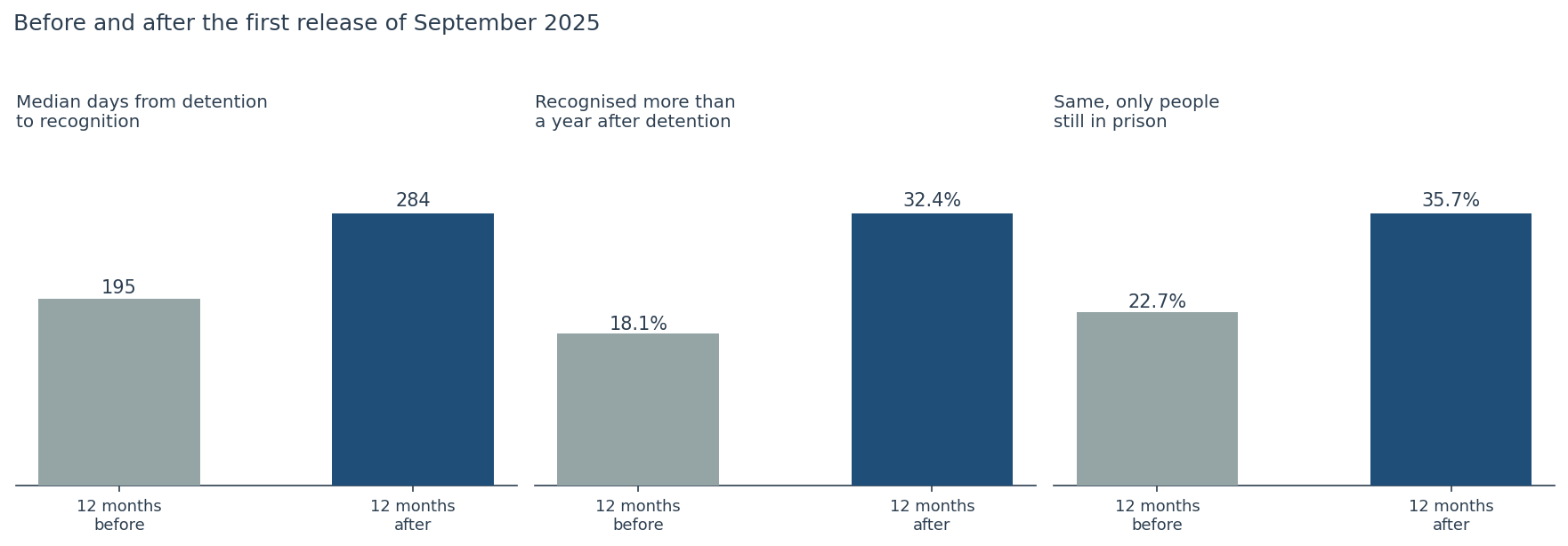
The median delay rose from 195 days to 284. The share recognised more than a year after detention rose from 18.1% to 32.4%. Among people still in prison, excluding those already released, it rose from 22.7% to 35.7%. The shift holds when we use only exactly dated statements.
That part of his claim holds: more of the new names are older cases than before.
Where the claim goes further than the data
The claim was not only that older cases appear, but that they explain the new names. That part does not hold.
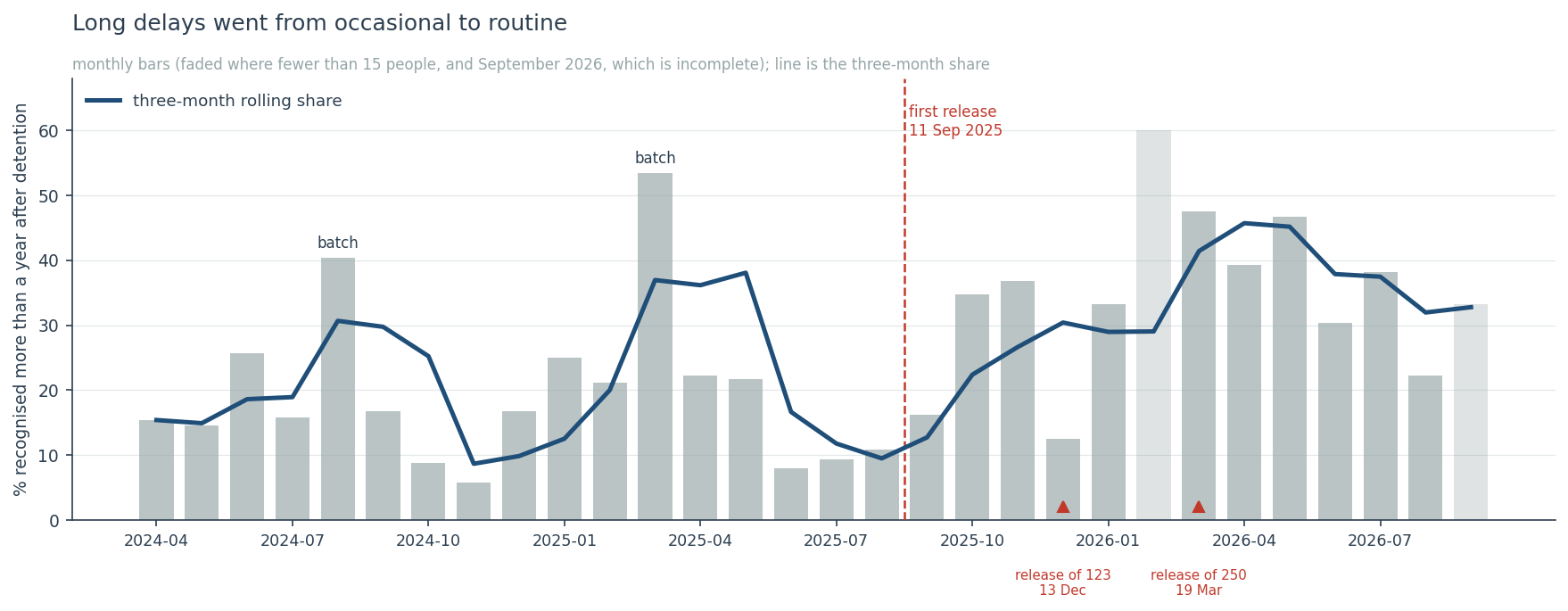
After the first release, about two thirds of new recognitions are still people detained within the previous year. The rise in long delays adds roughly five recognitions a month to a flow of around 45. The monthly count, in other words, overstates new cases by something like a tenth, not by half.
Partly right: some new names are older cases. Most are not.
The chart also shows a change in form. Before September 2025, long delays came in single bursts, when Viasna recognised a batch of older cases at once, as in August 2024 and March 2025. After it, they settled at a level above 30% in most months. That looks less like a one-off event and more like a new routine.
Roughly five extra long-delay cases a month, in a flow of about 45.
Two explanations, one trace
The third part of the claim is the cause. Kavaleuski’s reading is that people chose to seek the status once release became possible. There is a second reading. Released prisoners carry out news of cellmates nobody outside knew about, and those people are then recognised, sometimes long after their arrest.
Both produce the same signature in the data: more recognitions of people detained long ago, rising after each release. We cannot separate them with this list, so his explanation remains possible but unproven.
We can see that both are at work. A week after 250 people were freed on 19 March 2026, Viasna recognised 44 people in one statement, 43 of whom had already been released. That timing suggests the release itself brought many of them to light. At the same time, the share of long delays also rose among those still in prison, which is what Kavaleuski’s reading predicts.
Both explanations leave the same mark on the list.
Does this change what we wrote?
Partly. The flow we reported in the first part is a flow of recognitions, not of arrests, and after September 2025 somewhat more of it reflects older cases coming to light. We should have said so, and we have added a note to that piece.
What stands is the core of the argument. The monthly flow never fell to zero, and most of it is still people detained within the year. Releases take people out of the stock; new cases keep arriving.
Confidence
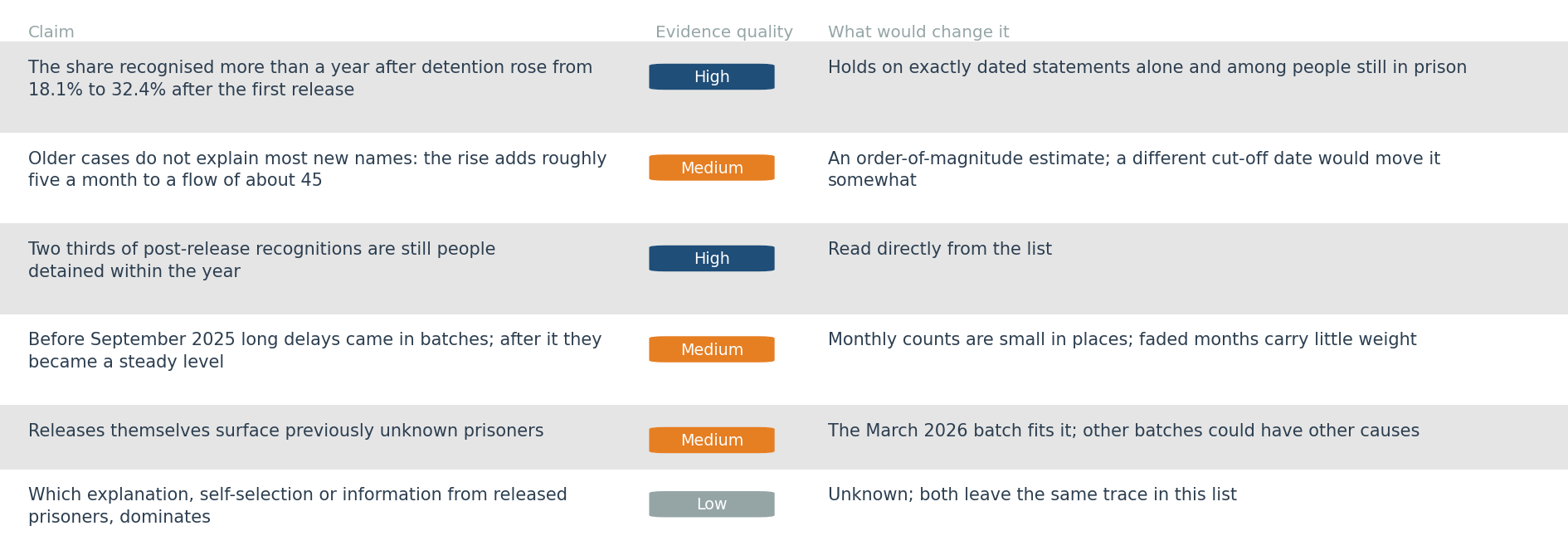
In text: the rise in long delays comes straight from Viasna’s list and survives every check we ran, so the evidence is strong. The estimate of its size is solid for order of magnitude, not to the unit. Which of the two explanations accounts for it is unknown.
Watch
Whether the share of long delays falls back below 20% in months without a release, which would point to the release effect rather than a lasting change.
Whether Viasna begins to mark, in its statements, when a person was first reported to it. That would separate the two explanations.
The next US-brokered release, and whether another batch of already-freed people follows it.
Method and limits
The data is Viasna’s public list of political prisoners, exported with detention dates and links to recognition statements. We dated each recognition by the publication date of its statement, taken from Viasna’s own site; 512 of 528 statements carry an exact date. We excluded people recognised only after their release, since Viasna counts them separately from its monthly figure. As a check, our monthly counts match Viasna’s published series in most months, and the months that differ are driven by single large statements.
Detention dates in the list are as Viasna records them. Some release dates are missing, so a few already-freed people remain in the count; the check restricted to people still in prison is the safeguard against that. The comparison uses twelve months either side of 11 September 2025, and a different cut-off would move the figures somewhat.
Valery Kavaleuski raised the question publicly and has not seen this analysis before publication.