
Officials in Kletsk district were given until 10 August to assemble the paperwork removing seven objects from Belarus’s register of historical and cultural values. The instruction came from the deputy chairman of the Minsk regional executive committee, cites orders of the Council of Ministers, and was published by the heritage channel Spadczyna and reported by Nasha Niva. What the officials had to produce were survey reports describing what had been lost.
What one district is losing
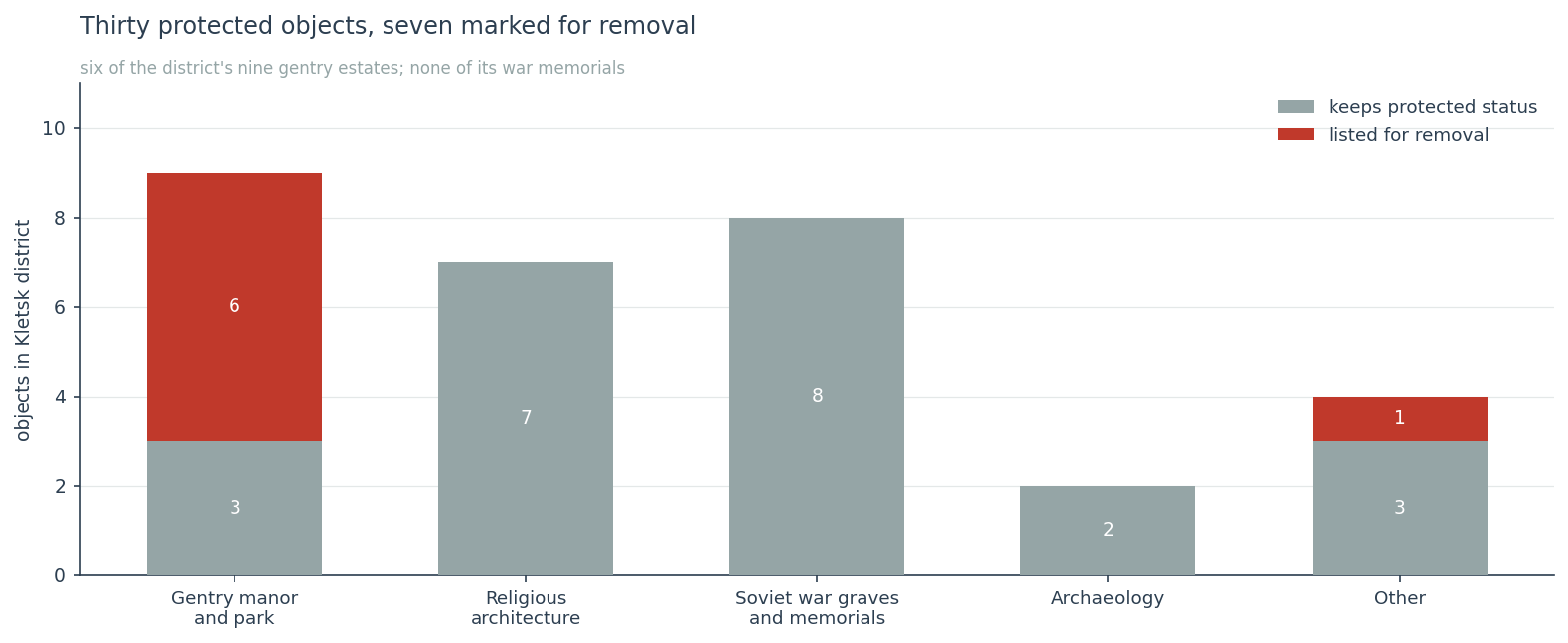
Kletsk district had thirty protected objects. Seven are on the list for removal, which is 23% of them, and the seven are not a cross-section.
The district holds eight war graves and Soviet military memorials. None is being removed. It holds seven objects of religious architecture — Orthodox and Catholic churches and a former yeshiva building — and two archaeological sites. None of those is being removed either.
Of the district’s nine gentry estate-and-park complexes, six are going. Two of them carry category two status, meaning republican significance: the wooden classicist Radziwill palace at Radziwiłłmonty, built in the 1780s to a design by the Italian architect Carlo Spampani, and the remains of the Wajniłowicz folwark at Kuncaŭščyna. The district had three category-two objects in total; two are on the list. The seventh object is a wooden windmill at Šajki.
Six of nine gentry estates. None of eight war memorials.
The requirement is ruin
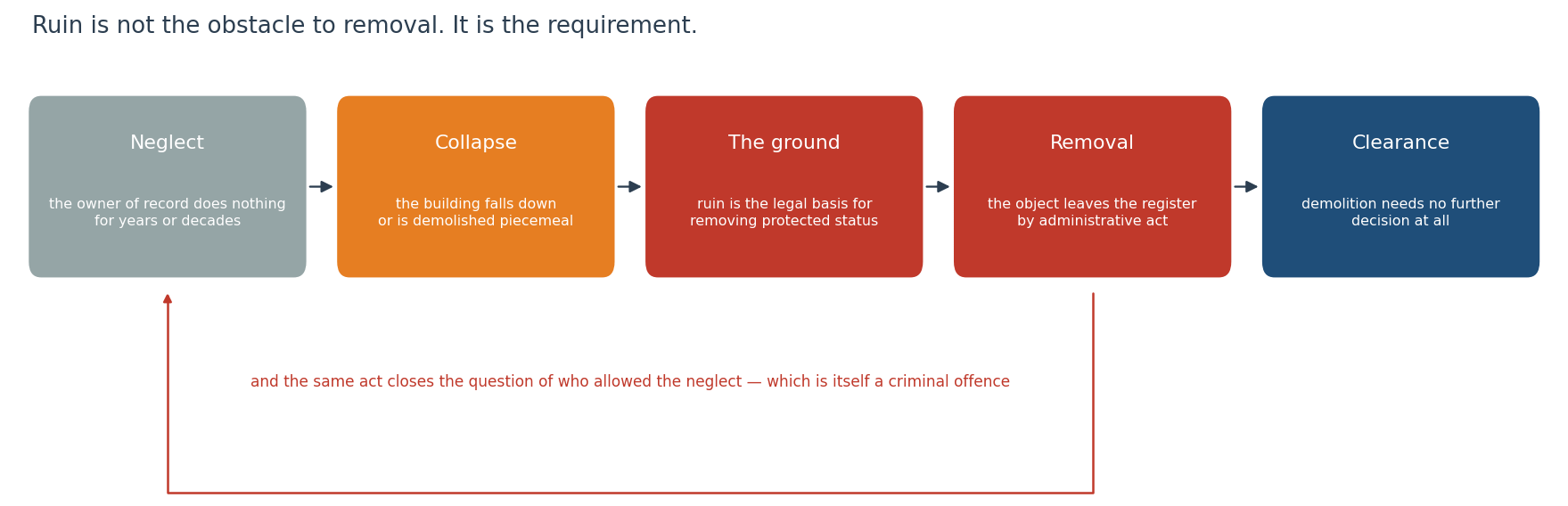
To remove an object lawfully, officials must demonstrate that it has lost its value or been physically destroyed beyond scientific restoration. So the paperwork needs a ruin, and the ruins were produced by the bodies that now need them.
The windmill at Šajki had been protected since 1987. It collapsed from decay in July 2025, after thirty-eight years in which the local authority carrying it on its books did nothing to hold it up. At Tesnaŭka the classicist portico of the Łabocki manor fell in 2017, and nothing was done before or after. At Radziwiłłmonty in 2021 local managers demolished several nineteenth-century buildings and felled fifty-two trees in the historic park, which was possible because the protection boundaries the same authorities were supposed to commission had never been drawn.
Under Belarusian law, allowing a historical and cultural value to reach destruction is a criminal offence. The act that removes protection also closes the question of who allowed it.
The paperwork needs a ruin, and the ruins were produced by the bodies that now need them.
Protected since 1987. Collapsed in 2025. Now the collapse is the reason to unprotect it.
After removal
The record of what follows is consistent. At Dvor-Homiel near Polack in 2021, a wooden manor was demolished immediately after a regional council found insufficient grounds to grant it status, having itself recommended that the building be preserved. The Siestrancevič residence at Pieczersk in Mahiliou was stripped of status in the 2000s and most of it was cleared. In Minsk, the hospital block at Pietrusia Broŭki 5, designed with the participation of the French modernist André Lurçat, was stripped of status in 2019 on the initiative of republican authorities, on the strength of commissioned findings signed by obliging academics; demolition began this summer. On 6 May 2026 the culture ministry formally removed the eighteenth-century St Michael’s church at Stepanki, which had burned the year before — after which it emerged that no archival measurements of it exist anywhere in the country.
Last month the Dziaržynsk district executive committee advertised the remains of the 1836 church of Saints Peter and Paul at Starynki, on the condition that the buyer demolish it. And in Brest region last year officials went looking for specialists who would prepare findings on the «impossibility of scientifically justified restoration» of two objects still on the list: the ruins of the Holy Spirit church at Jazviny and the Puzyna manor at Hrymiači. The finding is commissioned before the conclusion it is meant to support.
Removal from the register is the last decision anyone has to take.
Scale
Belarus’s State List holds 5,685 objects, of which 5,366 are immovable; subtract 2,226 archaeological sites and about 3,140 are actual buildings, urban complexes, war graves and historic places. Poland’s register of immovable monuments holds 79,935, and its municipal-level inventory more than 600,000 cards. Lithuania, three times smaller than Belarus by area, has over 26,600 immovable objects on its register. Per hundred square kilometres, Poland protects 25.5 immovable monuments and Belarus 1.5.
The flow matters more than the stock. Lithuania added 1,455 objects to its register in 2025 alone, and has removed 1,089 in the entire history of the modern register. In Poland, removal is the exclusive prerogative of the General Conservator: in 2024 the office granted 54 removals and refused 77. Belarus’s record year for additions was 2023, with 25 objects; the culture ministry’s current target asks each region to identify two new material objects a year, which would add about fourteen nationally.
Against fourteen a year, one district removing seven in ten days is not a rounding error.
There is also a comparison closer to home. The Soviet-era inventory of monuments compiled between 1984 and 1988 recorded over 14,000 objects. The list that replaced it holds 5,685. When the new register was assembled in the 2000s, most war graves were carried across and a large share of the architecture was not, because the lists were submitted by the same local authorities who would then have been responsible for the upkeep.
The late-Soviet state protected more churches and manors on paper than the independent republic does.
What this is being read as
Nasha Niva reads the selection as an ideological campaign against everything the state codes as Polish, and points to a documented context: Lukashenka’s January 2022 statement that the country had too many portraits of Polish and Lithuanian nobility before 2020, the removal of the 1863 insurgents’ monument in Hrodna in 2023, the disappearance of the 1794 plaque from the New Castle in 2024, the removal of the Kościuszko bust and exhibition at Malyja Siachnovičy in 2025, and the cancellation of the Grunwald reenactment festival this year.
That reading is an interpretation of intent and is theirs, not ours. What the document establishes without interpretation is narrower and hard to argue with: the instruction is central rather than local, the deadline was ten days, and in the one district whose list has been seen, the objects selected are almost entirely the estates of the pre-Soviet gentry while every Soviet memorial stays.
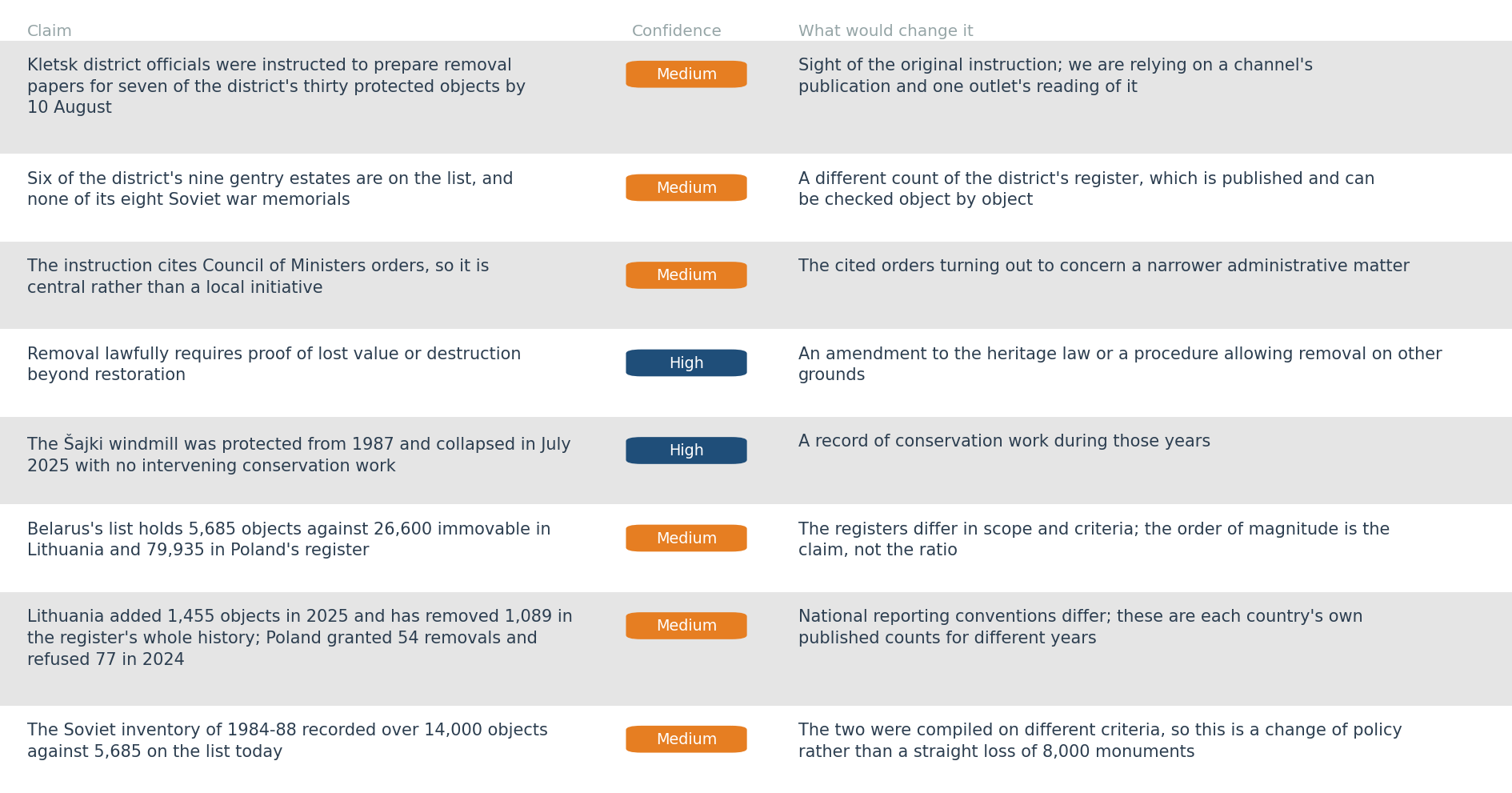
Confidence
Watch
Lists appear for districts beyond Kletsk. The instruction went to all district and city executives in Minsk region, so six more oblasts would indicate the scale.
Any of the seven Kletsk objects is demolished within twelve months of removal, following the pattern at Dvor-Homiel and Pietrusia Broŭki 5.
A criminal case is opened over the destruction of a protected object, which the law provides for and which the removals make moot.
The State List total falls below 5,500 in the next official count.
Method and limits
The instruction is a document published by a Telegram channel and reported by Nasha Niva; we have not seen the original and are relying on their account of it. The composition of Kletsk district’s register, and the figures for Lithuania and Poland, are as published in that reporting.
We do not know how many districts have received the same instruction or how many objects are involved nationally. The seven in Kletsk are what has been shown; the “thousands” mentioned in some coverage is an estimate, and we do not adopt it.
Whether the selection reflects ideology, or the simpler fact that neglected estates are the easiest objects to certify as ruined, cannot be settled from one district’s list. Both readings predict the same seven names.