

At Panel 7 of the New Belarus conference this weekend, Media IQ senior analyst Pavliuk Bykouski presented Press Club Belarus data on exiled independent media, 2025–2026. The reading up front: the triangulation across mediametrics, sociology, content tracking and impact cases is better than anything the sector has produced before, and the sociological floor of 31.9% declared contact is credible. Two structural problems remain. The headline slide claims “reach” for figures that are not reach in any measurement sense. And the comparison universe — independent versus Belarusian state media — excludes the largest daily information actor in Belarusian households, which is Russian-produced content on television and the Russian platform ecosystem online.
What was presented
Thirteen exiled newsrooms run a distributed network of 133 accounts across six platforms, split into branded, unbranded and reserve channels. The mediametrics slide, titled “Independent media in exile maintain mass reach of the audience in Belarus,” puts that reach at 6 million on TikTok (79% of platform users), 3 million on YouTube, 1.9 million on Instagram, 1.3 million on websites with a VPN correction. Views grew from 280 to 448 million year-on-year to autumn 2025. A CAWI survey (urban 18–65, N=1000, May 2026) found 31.9% declaring contact with independent media; the loyal independent-media audience is 92% against Russia’s war, the loyal state-media audience 67% for it. The slides carry unusually honest caveats — platform figures cannot be summed, contact is self-reported, attitude gaps are association rather than proven causation.
A word that belongs to a discipline
Reach — ахоп — is a currency term.
In audience measurement it means the share of a defined target audience that had contact with a medium over a defined window, established by a measurement independent of the media being measured.
Every element of that definition fails on the headline slide.
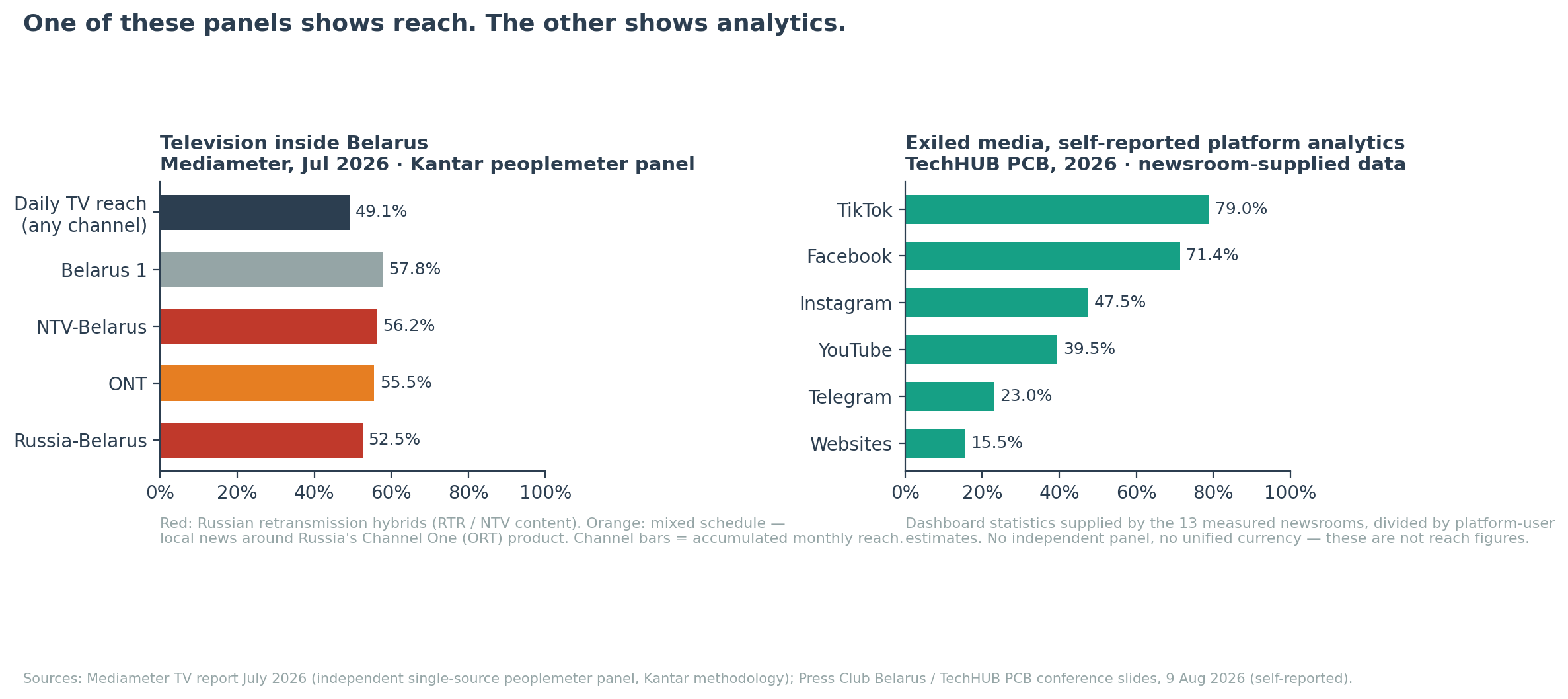
The numerators are dashboard statistics that the thirteen newsrooms supplied to Press Club’s TechHUB aggregation: the measured parties reporting their own performance, which violates the founding principle of the field — the measurer must not be the measured.
A television channel publishing its own ratings would be laughed out of any ad market; the same arrangement here is presented as sector mediametrics. The denominators are platform-user estimates from datareportal-class compilations — accounts and SIM profiles, not people. And each platform computes its metrics by its own opaque methodology: a TikTok view, a YouTube unique and a VPN-corrected site visit are different objects that cannot share an axis. Dividing one non-comparable set by another manufactures percentages that look like reach and are not. The slide’s own footnote concedes the figures cannot be summed; the title claims mass reach anyway.
The contrast is uncomfortable but has to be stated. The Mediameter panel measuring television inside Belarus — whatever one thinks of operating under the regime — runs an internationally recognized methodology derived from Kantar peoplemetry: a single-source panel, one universe (urban 4+), one currency, independent of the channels it measures. Ironically, the strongest reach-like number in the Press Club deck is the one that makes the least noise: the 31.9% CAWI figure, which at least measures people against a defined universe. The platform millions above it are engagement footprints. They demonstrate presence and scale of activity; they measure nothing.
The missing third actor
That same Mediameter report, July 2026, describes the field the exiled sector competes in.
Average daily TV reach: 49.09% of the urban population, 165 minutes per day. The top three channels by share are Russia-Belarus (11.78%), ONT (11.59%) and NTV-Belarus (11.58%). The first and third are retransmission hybrids built on RTR and NTV content; ONT’s own schedule wraps local Belarusian news around programming from Russia’s Channel One (ORT).
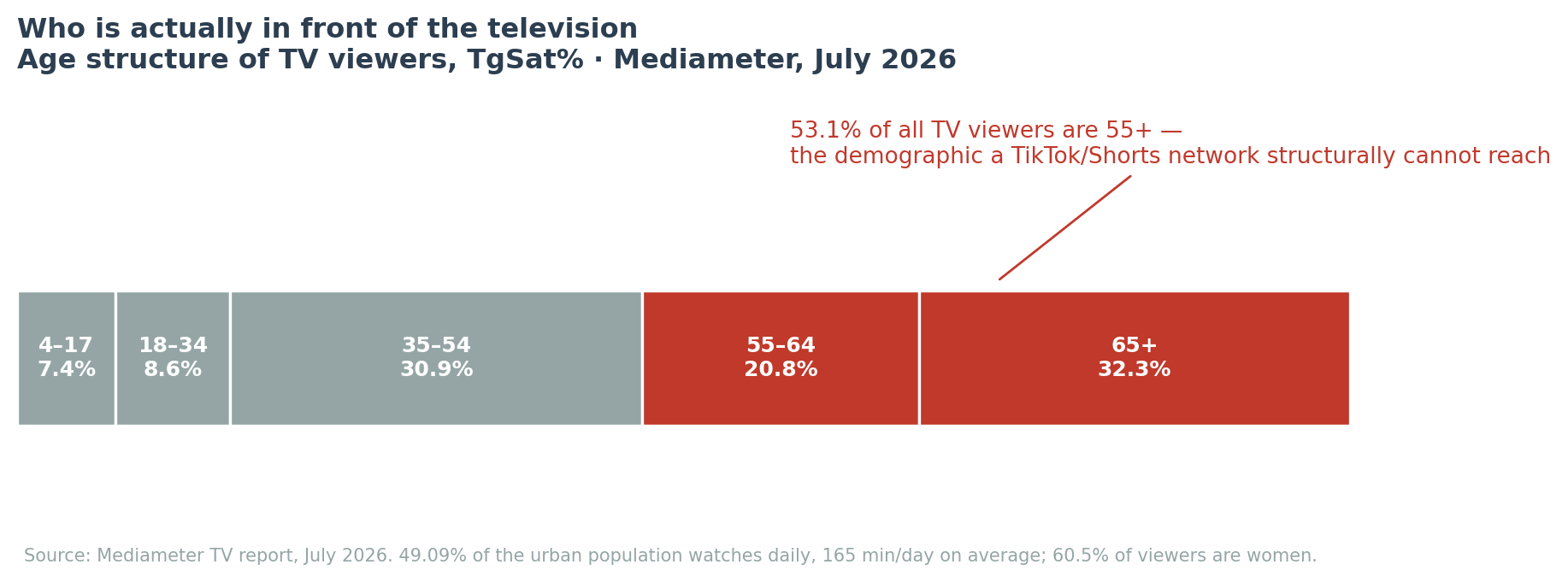
Counted honestly, all three leading channels in Belarusian households — close to 35% of combined viewing share — carry Russian-produced content, and viewers of the two full hybrids log the longest daily viewing times, 77 and 74 minutes. Over half of all TV viewers are 55 or older; 60.5% are women.
The internet layer points the same direction. SimilarWeb’s June 2026 top-20 for Belarus contains six sites of the Russian ecosystem — yandex.by and yandex.ru at ranks three and four, then mail.ru, vk.com, ok.ru and dzen.ru — plus the Russian-language pirate streaming site kinogo. The only news-adjacent Belarusian entry is the apolitical onliner.by. Exiled media sites are blocked and reached through VPN and mirrors, so their absence from a national top-20 is partly an artifact of blocking; the Russian ecosystem sitting directly under Google and YouTube is not.
Put the datasets together and the “independent vs state” dichotomy dissolves. The largest single daily information habit in Belarus is watching Russian television content, and it sits in exactly the demographic — older, female, offline — that a TikTok-and-Shorts network structurally cannot reach. The same gap runs through the internet layer: VK, the Yandex ecosystem and Russian Telegram channels appear nowhere in the six-platform universe.
The presentation answers the question donors like — is the exiled media system alive? It is. It does not answer the question the Mediameter panel raises: who holds the field. On current evidence, that is Moscow, by direct transmission, without needing the Belarusian state as intermediary.
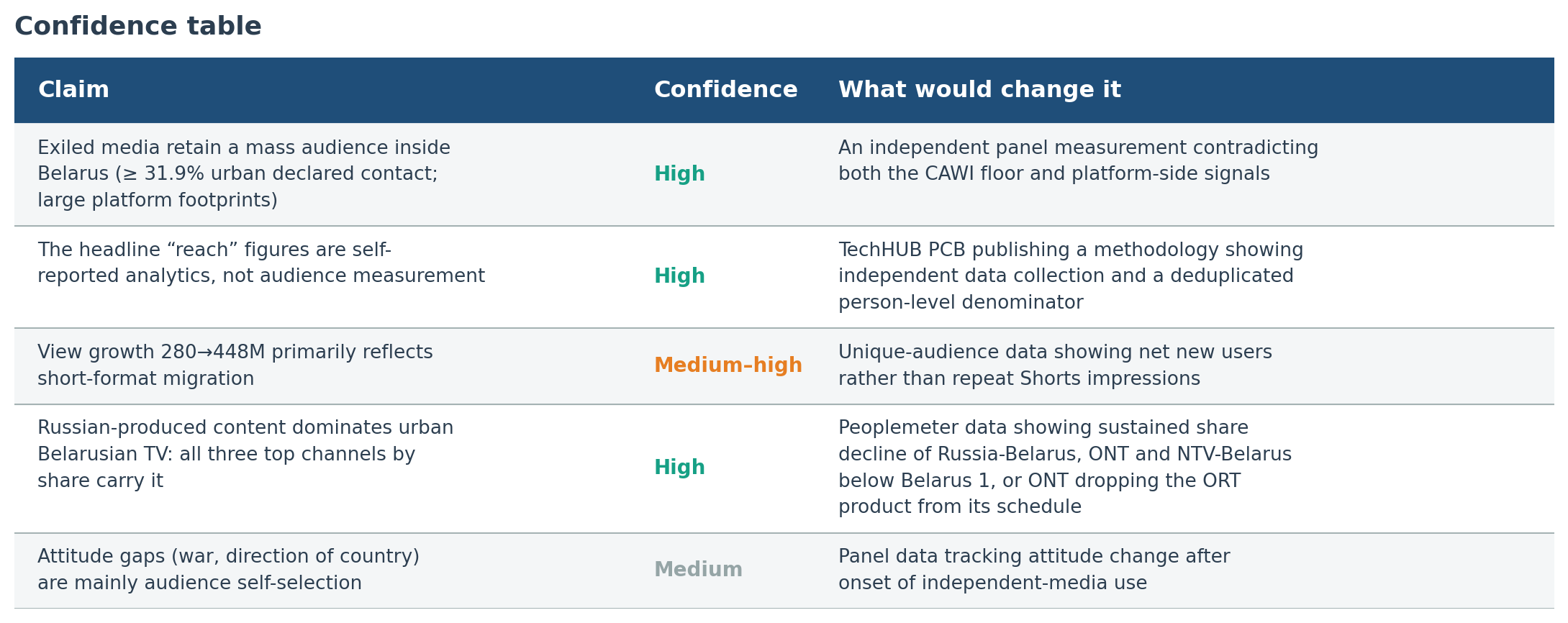
Confidence table
Conclusions
First. The exiled media system is alive, and its defensible number is the sociological one: at least 31.9% of urban Belarusians 18–65 declare contact. That figure, with its limits, should lead the sector’s case — ahead of platform millions that cannot survive methodological scrutiny.
Second. Until TechHUB PCB publishes a methodology showing independent data collection and a deduplicated, person-level denominator, the word “reach” should be retired from these slides. Self-reported dashboard analytics divided by account estimates is presence data. Presenting it under the central term of audience measurement hands critics of the sector an easy target and devalues the parts of the study that are solid.
Third. The sector has no measurement currency of its own, and this presentation shows the cost. Even a modest recurring independent panel — the CAWI wave extended to quarterly frequency with published intervals — would give exiled media a number that donors, advertisers and researchers could actually use.
Fourth. The strategic opponent is misidentified. By measured currency, Russian-produced content dominates Belarusian television through all three top channels, and the Russian platform ecosystem dominates the national web top-20. A media strategy calibrated against “Belarusian state media” is calibrated against the smaller adversary.
Fifth. The gap is demographic before it is technological: over half of TV viewers are 55+, mostly women, averaging nearly three hours daily — and the 13-newsroom network’s growth engine is Shorts and TikTok. Whether anything reaches that segment is currently measured by no one. Part II of the media-consumption study, the TechHUB methodology (if published) and Mediameter’s August report will each test a claim made here.
Method and limits: this brief compares three third-party sources — Press Club Belarus / TechHUB PCB conference slides (photographed 9 August 2026), the Mediameter July 2026 TV report, and SimilarWeb’s June 2026 Belarus website ranking — without access to any underlying dataset. Slide values transcribed manually; one TikTok growth figure was cropped in the source image. Peoplemeter panels measure household sets, not individuals’ full media diets; SimilarWeb ranks domains by modeled traffic, not people; the CAWI universe (urban 18–65) differs from the peoplemeter universe (urban 4+). Comparisons are directional. The self-reporting critique concerns measurement architecture, not the honesty of the newsrooms involved.