

Shortly after midnight on 15 September an Italian NATO fighter shot down a drone that had entered Lithuania from Belarus, the first ever brought down in Lithuanian airspace. Belarusian state newsrooms had spent the weekend reporting a Lithuanian false alarm caused by birds. About the real drone we found four items. Only two were news, and SB addressed it only in a column dismissing the attribution. Pro-regime Telegram channels then folded the real event into the bird joke. What we do not know is whether this was an instruction or a set of separate editorial choices, and whether state outlets outside our sources covered it.
What happened
On the night of 14 to 15 September a drone crossed from Belarus and flew for about half an hour over Lithuania. Air alerts went out for Vilnius, Trakai and Elektrėnai. At about 00:20 an Italian Eurofighter on NATO’s Baltic air policing mission shot it down near the village of Pratkūnai, about five kilometres from the Kruonis pumped-storage power station. Lithuania’s air force commander said there was no information on whether the station was a target, and that Belarus had given no warning.
The defence minister said the drone carried explosives. On 16 September President Nausėda called it a Russian-made Gerbera and said it had probably been heading for Ukraine and strayed off course. The same day the foreign ministry handed a protest note to a representative of the Belarusian embassy. It was Lithuania’s third note to Minsk over a drone from Belarus in fourteen months, after notes in July and August 2025.
Two nights, two days apart
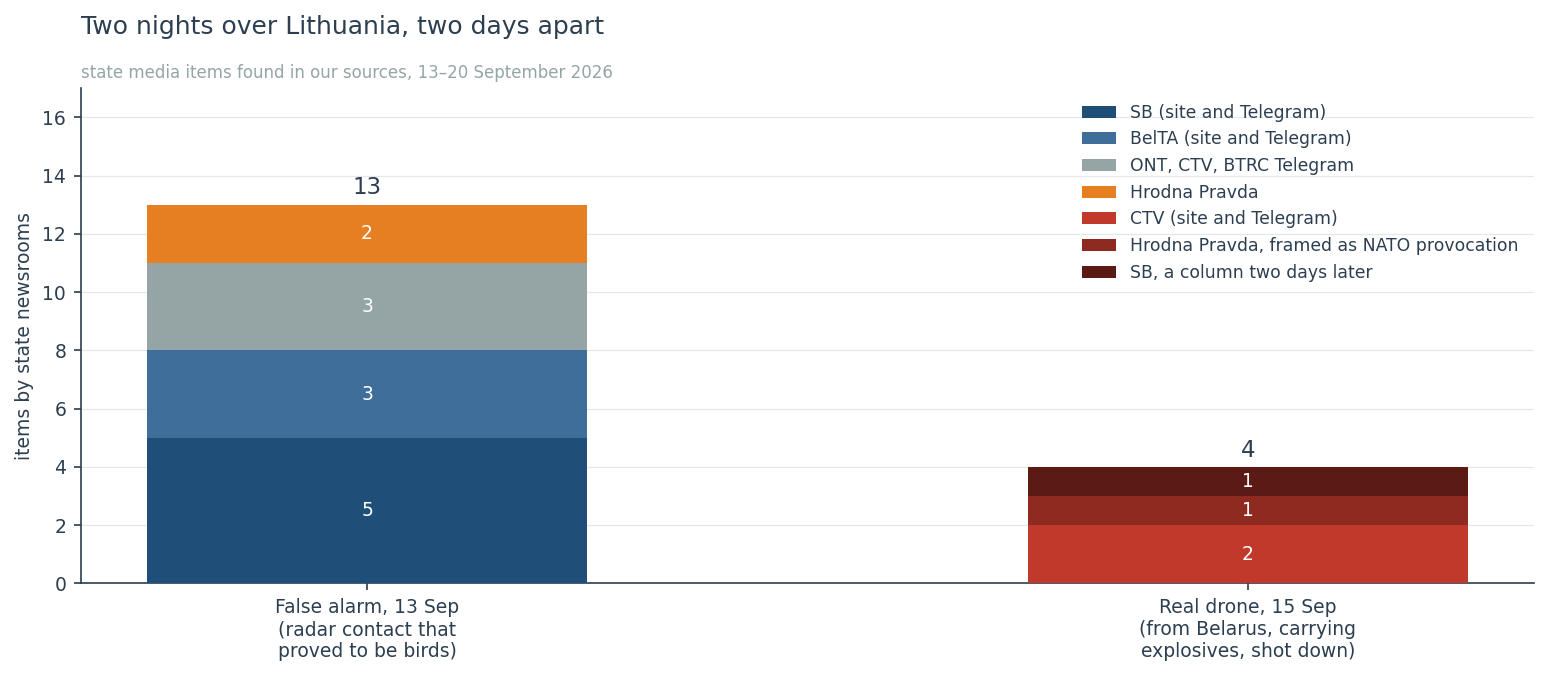
Two days earlier, on Sunday 13 September, a radar contact near Vilnius closed the airport for 38 minutes, from 12:59 to 13:37, and sent up NATO fighters from Šiauliai. The pilots found a flock of birds. That was not the day’s only contact: early that morning Lithuania’s defence ministry had reported an unidentified object, possibly a drone, that entered from Belarus and crossed into Russia’s Kaliningrad region.
The first drone ever shot down over Lithuania came from Belarus.
Belarusian state media covered the false alarm thoroughly. SB wrote that Lithuania had raised a NATO fighter after mistaking birds for drones. BelTA reported the fighter’s visual check. The Telegram channels of ONT, CTV, BTRC, BelTA and SB carried the same line. Hrodna Pravda followed with a piece on how NATO fighters lost a battle with migrating geese. In all, we found thirteen state newsroom items on the birds.
On the real drone we found four, and only two of them were news. CTV ran a short item on its site and Telegram: a drone “of undetermined type” had been shot down in Lithuania for the first time. It did not say where the drone came from. Hrodna Pravda covered it the same day inside a piece headlined “Provocation on a NATO scenario”. It described the airport closure and an SMS alert that, in its words, sowed panic among the population.
SB did not report the shoot-down. Two days later its columnist Andrei Mukovozchik opened a column with it, filed under the heading “Let’s remember geography”. He called the attribution a “Highly Likely” circus. In his telling, nobody knows where the drone came from, so it must be Belarus, and nobody knows whose it was or where it fell, so it must be Russian. The column says the debris fell into a swamp at a place still unknown. The Lithuanian army had released video of the debris near Pratkūnai on the morning of the shoot-down, and Nausėda identified the model the next day.
We found nothing on the shoot-down from BelTA, ONT or BTRC, on the day or in the week after. That includes 16 September, when the drone was named as Russian and the note was delivered. On 16 September Hrodna Pravda ran the birds again.
Thirteen news items on the birds. On the drone, two short notes and a column.
What the drone became

Pro-regime Telegram channels did write about the real drone, and more than state newsrooms did: we found twelve items. Several turned it into something else.
On 15 September one channel reported the shoot-down under the line that NATO had once again “defended” the Baltics by chasing ducks, joining the real event to the false alarm. Another presented it as a Ukrainian drone for which Lithuania had wrongly blamed Belarus. On 17 September a third mocked the foreign minister’s note without describing what it said.
So the event reached the pro-regime audience, but as a joke about Lithuanian nerves. The facts in the Lithuanian account, that it came from Belarus and carried explosives, did not reach it through any channel we checked.
The other explanation
There is a simpler reading, and it deserves a test.
On 15 September the American envoy John Coale arrived in Minsk, and the next day 25 prisoners were released and sanctions lifted from two companies. State newsrooms had a large story that week. A drone incident after midnight may simply have been crowded out.
The event reached that audience as a joke about Lithuanian nerves.
That reading predicts that the drone would be picked up once the Coale news passed, or once Lithuania named the drone and delivered the note. It was not: we found nothing from BelTA or ONT on 16 or 17 September either, and SB’s only response, on the 17th, was a column. The newsrooms had seen the event. And it does not explain why the birds, two days earlier, received thirteen items from the same newsrooms. Crowding may account for some of the gap. It does not account for the difference in treatment between a Lithuanian mistake and a Belarusian drone.
A Lithuanian mistake was reported as news. A drone from Belarus got a column.
What we checked
The event did not reach our own weekly digest either, which is how we came to it late.
For this piece we searched every state, state-affiliated, ministry and pro-regime source in our archive for 13 to 22 September. We matched Lithuania together with drone, unmanned aircraft, Gerbera, air alert, fighter or NATO in the headline or first lines. We then read all 85 titled results by hand and confirmed with a separate count that the list of 100 was complete. A second, full-text search of the main state newsrooms looked for words specific to this event. We found no BelTA, ONT or BTRC item on the shoot-down; SB’s only item was the 17 September column.
Confidence
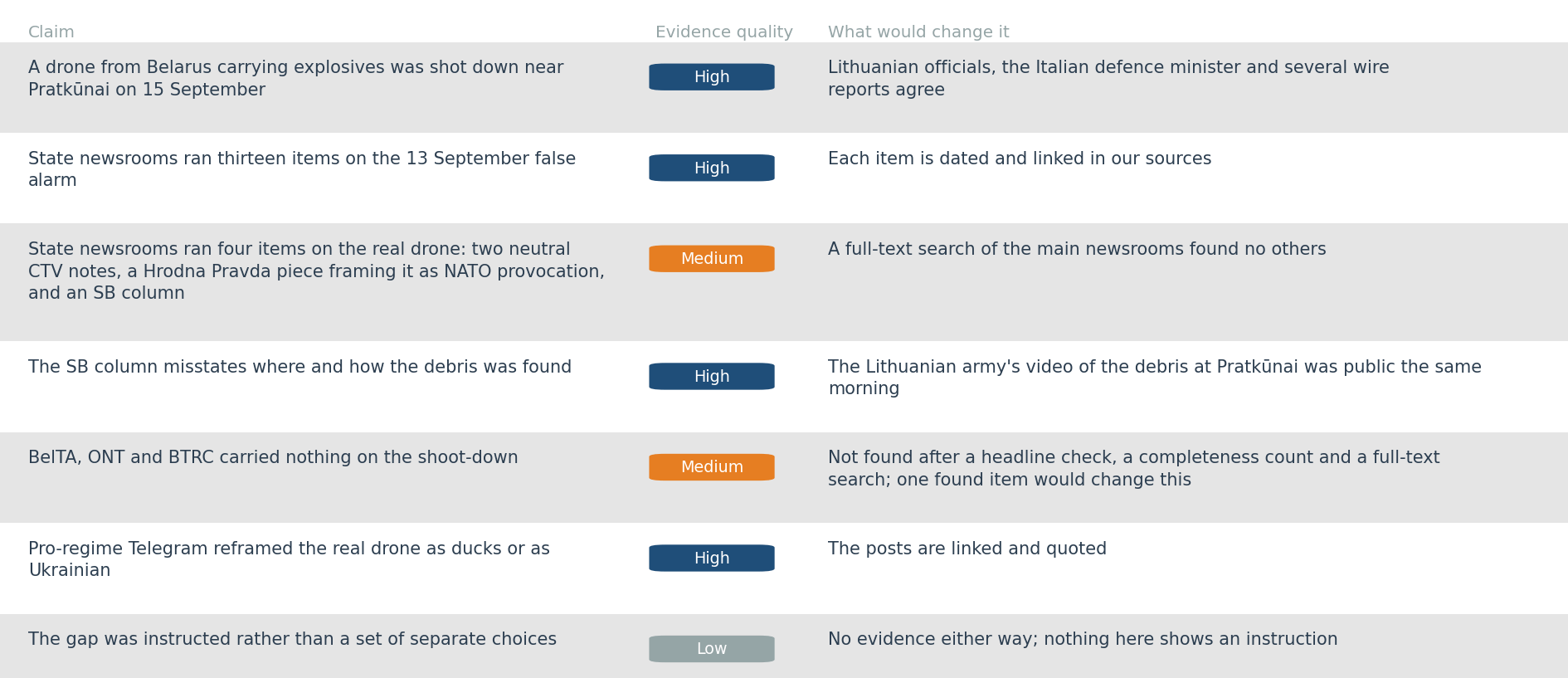
In text: the difference between the two nights is clear in our sources, and the items are linked above. The SB column is an opinion piece, and we count it separately from news. That SB, BelTA and ONT carried nothing on the real drone is a finding about our sources, not a proof that nothing exists. Whether the difference was instructed is unknown.
Watch
Any reply from the Belarusian foreign ministry to the note of 16 September. We found none.
The next drone incident from Belarus, and whether state coverage again follows the pattern: wide on Lithuanian mistakes, thin on the drone.
Any state outlet that names the 15 September drone as Russian or says it came from Belarus.
Method and limits
The search covered 13 to 22 September 2026 across state media, state-affiliated sources, ministry Telegram channels and pro-regime Telegram channels in our archive, matching the headline and the first 600 characters of text. Items that discuss the drone without naming Lithuania in the opening lines would be missed. Fifteen Telegram posts in the results had no title and could not be classified. The result list ran to exactly 100 rows. A separate count of the same filter returned 100, so the list was complete.
“Not found” here means not found in these sources with this search. It is not a claim that no state outlet ever mentioned the drone. A state item we missed, especially from SB, BelTA or ONT, would change the central finding, and we would correct it.