
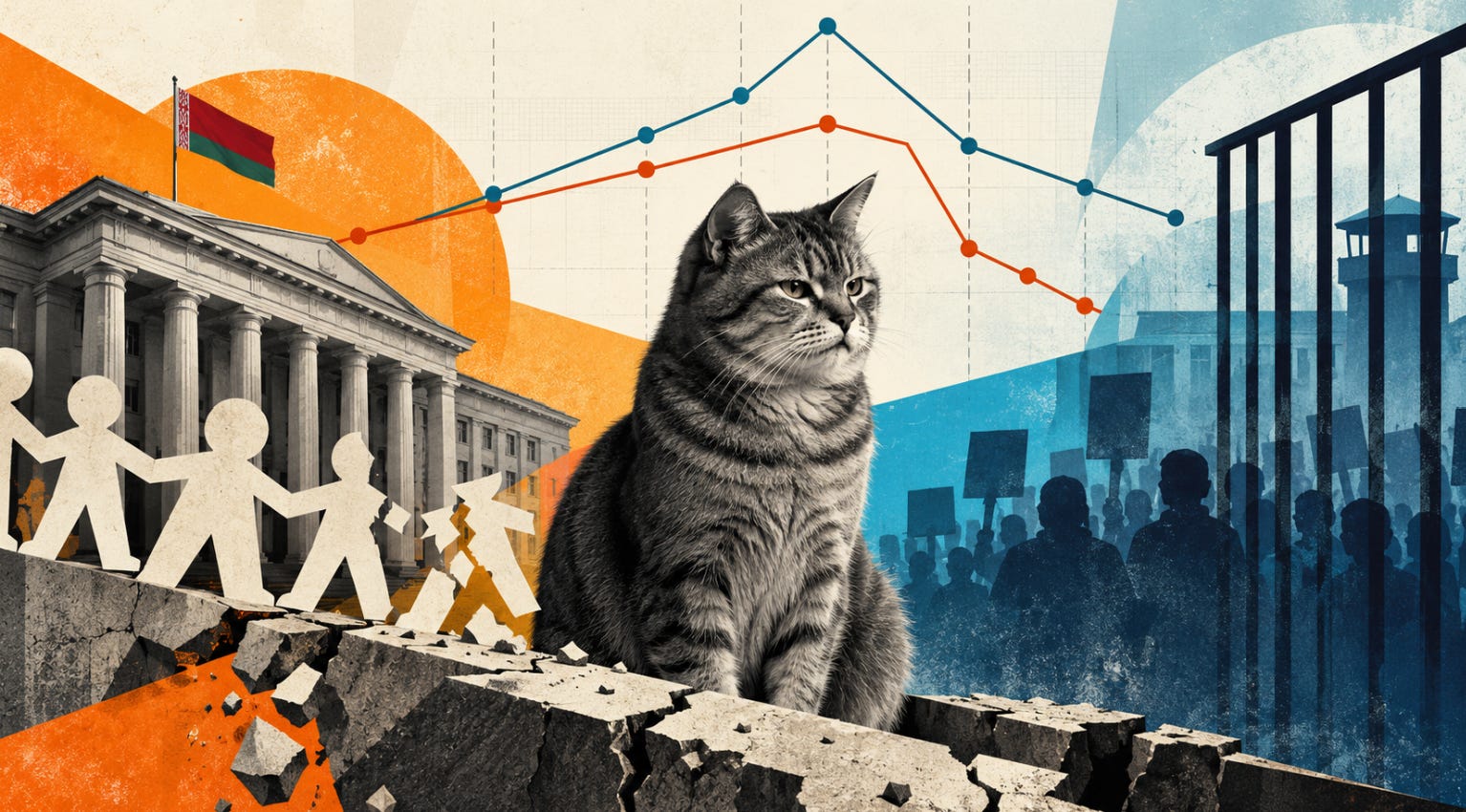
Anton Jäger’s Hyperpolitics (Verso, 2026) is built around one diagram. On the horizontal axis he puts politicisation: how much people mobilise, argue, protest and vote. On the vertical axis he puts institutionalisation: how far parties, unions and membership organisations channel that participation. Mass politics of the twentieth century sat high on both. The post-1989 decades sat low on both. The 2010s, in his account, split the two lines apart: politicisation rose while affiliation kept falling. The result is a politics of huge intensity and almost no organisation. His first chapter is titled after Chris Marker’s 1977 film about the decade after 1968, A Grin Without a Cat: the mood of a movement outliving the organisations that carried it.
Jäger draws that diagram by hand. He says so himself, calling it a synthesis of fragments from other people’s charts. Belarus does not appear in the book, and neither does any dictatorship. But Belarus is one of the few countries where both of his axes can be read from official registers, year by year, back to the 2000s. We did that.
What the two registers are
The institutionalisation axis comes from the Ministry of Justice. Every February it publishes one standing sentence: how many political parties, trade unions and public associations were registered on 1 January, together with their local organisational structures. We rebuilt the series for 2004–2026 from the ministry’s own page, from pravo.by and BelTA reprints, and from the annual reviews of the legal group Lawtrend, which quote the same sentence each year.
The politicisation axis is harder, because the state does not count mobilisation. We used the closest thing it does count: people the state has imprisoned for political reasons, as recognised by the human rights centre Viasna. The count on 1 January of each year comes from Viasna’s own Telegram channel, 4,473 posts read by a parser. For 2010–2019 the number is close to zero, and that is part of the finding.
Belarus is one of the few countries where both of Jäger’s axes can be read from official registers.
The institutionalisation line grew for ten years, then was cut
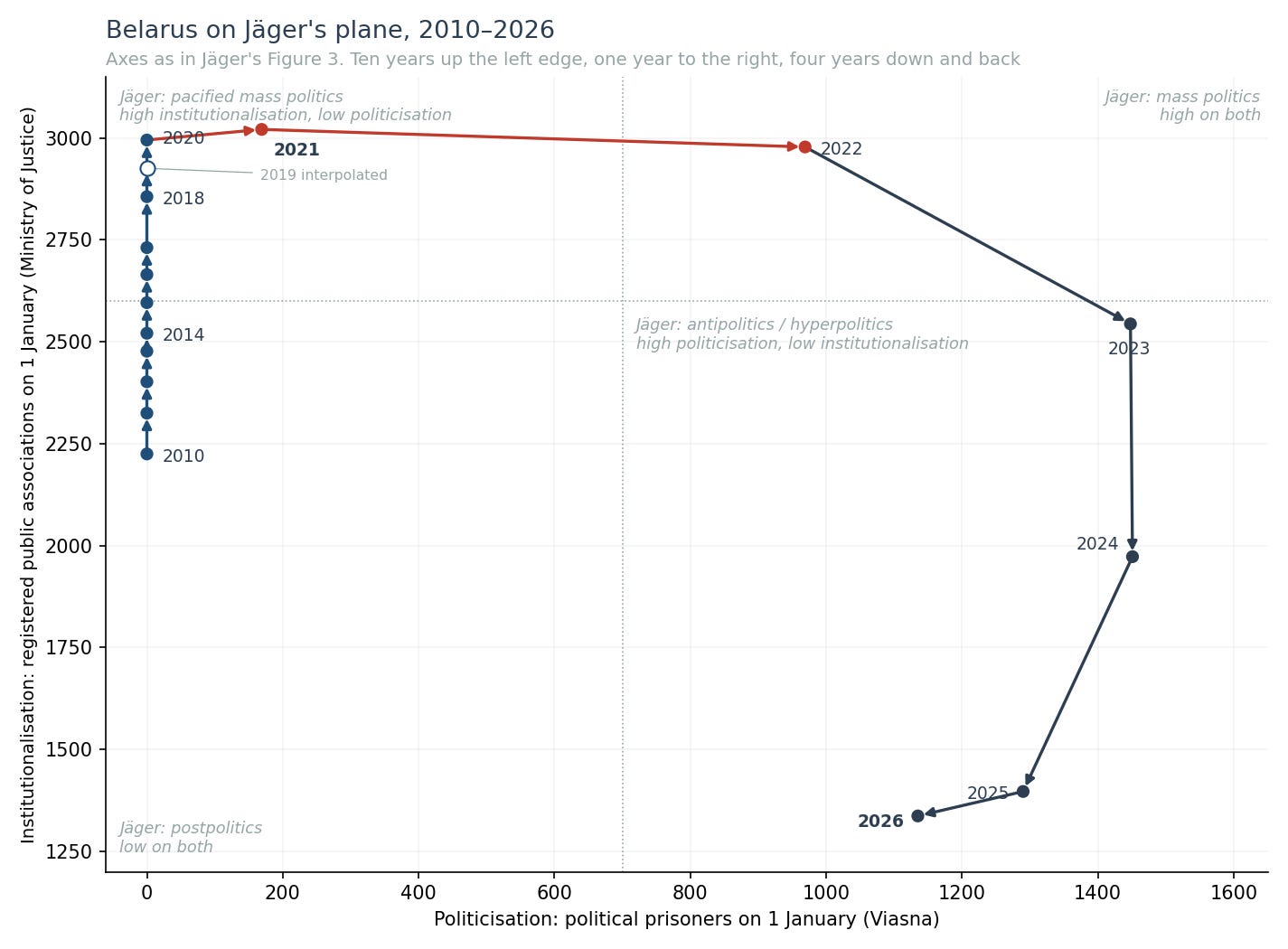
The number of registered public associations sat at about 2,200 from 2004 to 2010. Lawtrend describes those years as a frozen level. From 2011 it rose every single year: 2,325, 2,402, 2,477, 2,521, 2,596, 2,665, 2,731, 2,856, then 2,995 on 1 January 2020 and 3,021 on 1 January 2021. The peak comes after the protest year, when the protests were already over.
The fall starts a year later. On 1 January 2022 the ministry counted 2,978 associations. Then 2,544, then 1,973, then 1,397, then 1,337 on 1 January 2026. That is a loss of 56 per cent in five years. Trade unions went from 25 to 19 after the independent unions were liquidated in 2022. Parties went from 15 to 4 after the re-registration of 2023, and one of the four was created that same year.
None of this happened by people leaving. Lawtrend’s liquidation monitor counted at least 1,509 organisations closed by court or forced to close themselves between September 2020 and the end of 2023. In 2023 alone the ministry ran inspections of more than a thousand associations and issued 410 written warnings, one for every six organisations still on the list. The register also lags. Lawtrend’s own recount of live organisations at the end of 2023 found about 1,761 associations against the official 1,973, because organisations in liquidation stay on the list until they are struck from the company register.
The peak comes after the protest year, when the protests were already over.
The politicisation line rises and then leaks
Viasna’s count of political prisoners was 102 in October 2020. It was 169 at the turn of 2021, 969 a year later, 1,448 at the start of 2023 and 1,451 at the start of 2024. Then it began to fall: about 1,290 at the start of 2025, 1,135 at the start of 2026, and 909 by the end of March 2026 after 250 people were released in one US-brokered exchange. The number falls through pardons and deportations, and it rises through new sentences. Since 2024 the state has been running both valves at once.
Put the two lines on Jäger’s plane and Belarus traces a shape he does not describe. From 2010 to 2020 the point climbs the left edge: institutionalisation grows, politicisation in this measure stays at zero. In 2021 and 2022 it moves almost straight to the right, into the quadrant Jäger reserves for the mass politics of the past, high on both axes. It stays there for one year, because the state had not yet closed the register. From 2022 the point falls and drifts left at the same time. By 2026 it sits where Jäger places hyperpolitics: low institutionalisation, second axis still high. It is moving left. At the pace of the last two years, about 250 fewer prisoners a year, it reaches his post-political corner around 2030.
Jäger’s Western democracies reach that corner by drift. People stop joining, and after a while they stop caring. Belarus is being moved there by administration. One axis was cut by liquidation orders, the other is being lowered by pardon decrees and exchanges.
Where the state moved in
There is a second number in the same ministry sentence, and it runs the other way. The ministry also counts “organisational structures” of associations: local branches and cells. Those went from 35,634 in 2011 to 41,760 in 2018, 43,865 in 2021, 45,706 in 2023, and 47,812 on 1 January 2026. While the number of associations fell by more than half, the number of their branches rose by nine per cent.
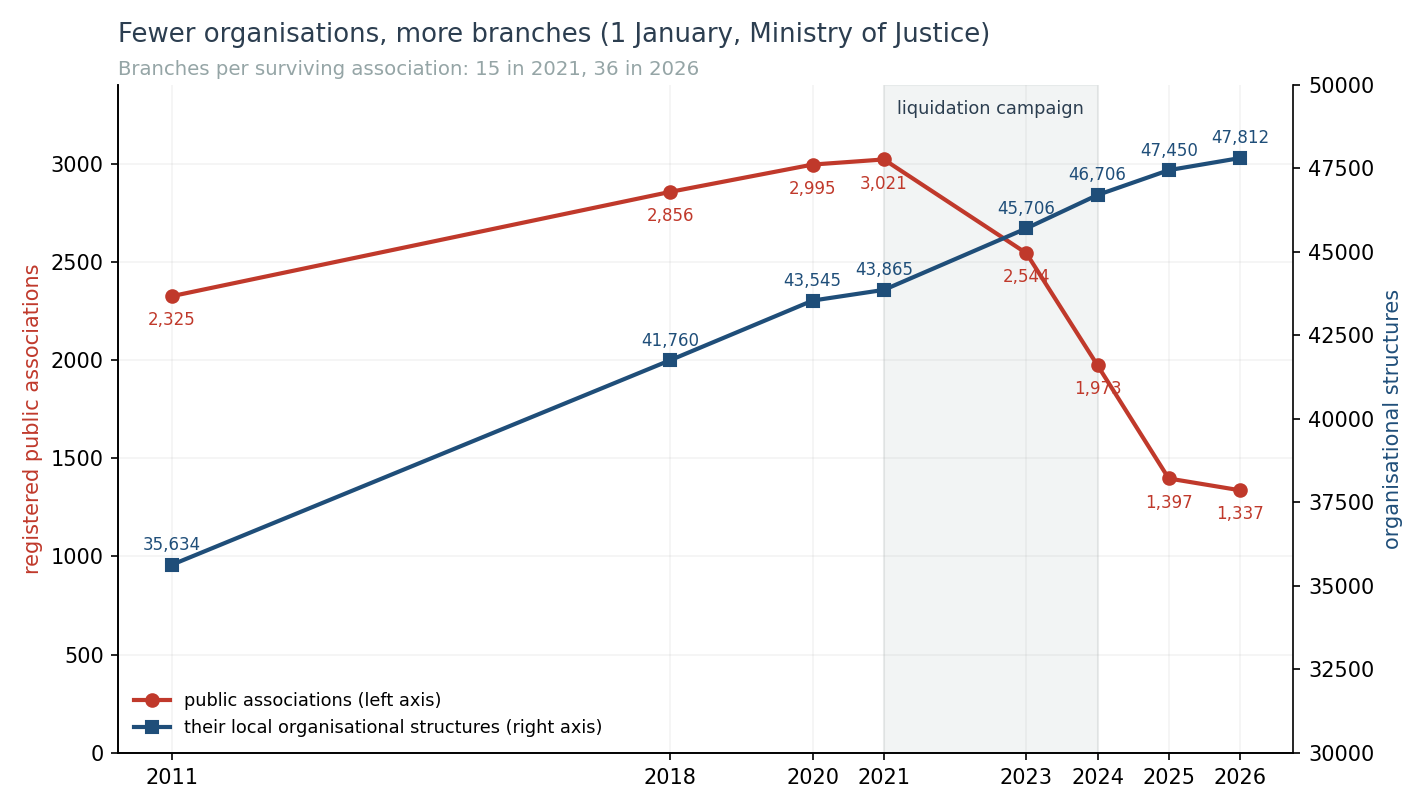
The arithmetic is simple. The branches belong to the few organisations that survived and grew: the Federation of Trade Unions, Belaya Rus, the BRSM youth union, the veterans’ union and the Union of Women. In 2023 a law on the foundations of civil society gave a small set of organisations a special status, and the ministry’s list of those “subjects of civil society” is these five. Each surviving association now has on average 36 branches, against 15 in 2021. Lawtrend identifies the five as the main holders of those branches; the ministry does not publish the breakdown. Membership in Belarus moved into structures where joining is expected and politics is absent.
Membership moved into structures where joining is expected and politics is absent.
That is the fourth quadrant on Jäger’s diagram: high institutionalisation, low politicisation. He gives it to the second, pacified phase of mass politics, the post-war decades when parties and unions kept their members and lost their fights. Belarus’s official society sits in it now, a cat without any grin. The exile side of the same society sits in the opposite corner, where we have measured it before: attention without organisation, comebacks on other people’s channels, artefacts whose coverage fades within a year.
What the registers stopped saying
One more thing happened to the ministry’s sentence. Until 2021 it also gave the number of foundations and the number of new associations registered that year. From the 2023 edition both were gone, as Lawtrend noted at the time. The annual press release that used to carry the sentence, “On the registration of non-profit organisations in year X”, was last issued for 2020. Since then the numbers live only in a standing paragraph on the ministry’s website and in the president’s portal. The series still exists. The state just stopped announcing it in the year it turned down.
The series still exists. The state just stopped announcing it in the year it turned down.
What to watch
The 2027 edition of the ministry sentence, due in February 2027. If our reading is right, associations will be between 1,250 and 1,320 on 1 January 2027, and organisational structures will pass 48,000. If associations rise, the liquidation campaign has ended, as Lawtrend claimed in July 2025.
Viasna’s count on 1 January 2027. The last twelve months show a net fall of about 250 a year. Below 850 would confirm that the exit valve is now larger than the intake.
The foundation count. If the ministry restores it to the annual sentence, the 2023 omission was clerical. If it stays out for a third year, it was a choice.
Takeaways
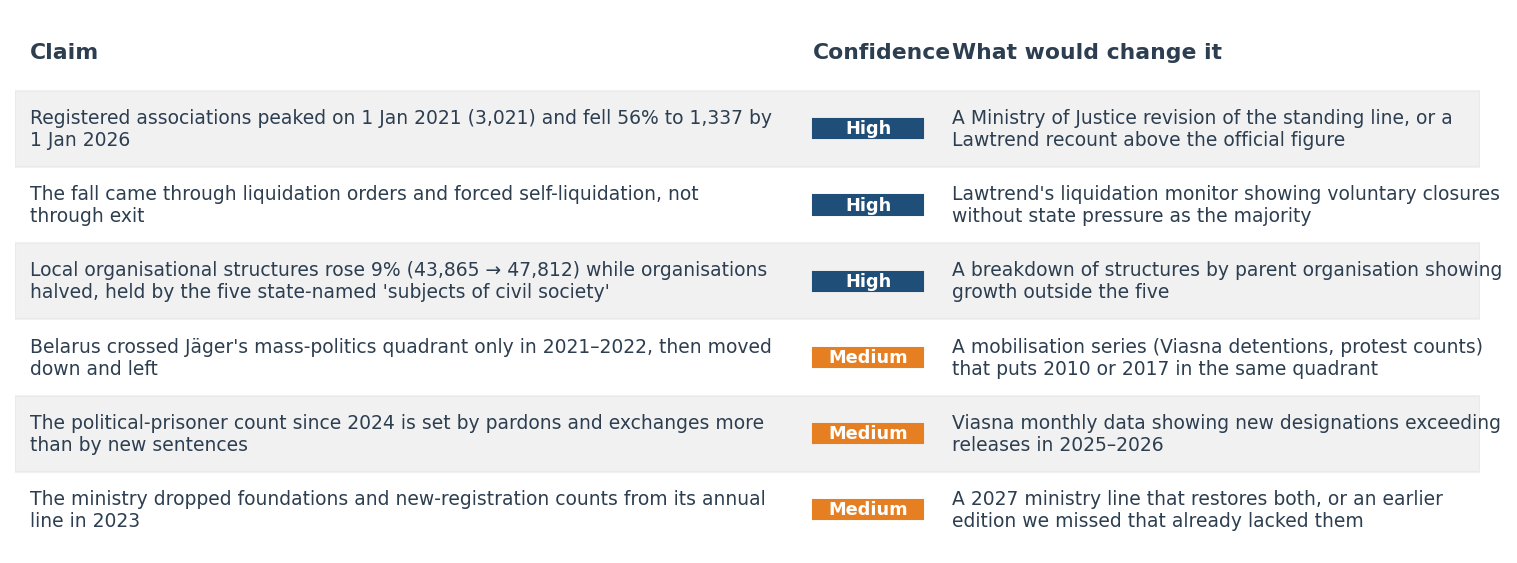
Registered associations peaked on 1 January 2021 at 3,021 and stood at 1,337 on 1 January 2026, a fall of 56 per cent through liquidation.
Their local branches rose from 43,865 to 47,812 over the same years, held by five organisations that a 2023 law names as subjects of civil society.
Viasna’s count of political prisoners went from 102 in October 2020 to 1,451 at the start of 2024 and 909 by the end of March 2026.
On Jäger’s diagram Belarus crossed the mass-politics quadrant in 2021–2022 and now sits in his hyperpolitics quadrant, moving left. The quadrant he gives to pacified mass politics, high institutionalisation and low politicisation, is where the state’s own associations sit: 47,812 branches for 1,337 organisations.
Method and limits.
Institutionalisation figures are the Ministry of Justice “as of 1 January” line, reconstructed from the ministry page, pravo.by, BelTA, president.gov.by and Lawtrend’s annual and monthly reviews; 2004–2017 associations come from a table in Lawtrend’s 2016 review that reprints ministry data; 1 January 2019 is missing from our sources and the chart interpolates it.
The ministry counts organisations still in liquidation, so the official line runs above the number of live organisations. Political-prisoner counts are Viasna’s, read from its Telegram channel by a parser that keeps the value nearest to 1 January within ten days; where several posts disagree within a month, the modal value is shown.
Viasna is the only source for that axis in our corpus; Lawtrend’s monthly reviews, which repeat the number, are not in it. Both axes are administrative counts, one from the state and one from a group counting the state’s prisoners; neither measures mobilisation directly, and the politicisation axis is blind before 2020. The extremist-materials register (19 designations in 2020, 427 in 2021, 1,462 in 2024) supports the same reading and is kept out of the chart because it counts objects, not people.
Jäger’s book is used for its diagram, which he describes as intuitive; nothing here tests his argument about the West.