
On July 9, 2026, at the Palace of Independence in Minsk, Alexander Lukashenko told visiting Uzbek President Shavkat Mirziyoyev that Belarus needs “working hands” — and publicly invited Uzbek labor migrants to come, with their families. “The will of the presidents is there, the support is there, we must act.”
For a state that spent years mocking Europe’s migration policies, this was a remarkable announcement. But it was not a sudden one. We traced the preparation through 2.96 million documents — and found a six-month normalization campaign that laid every piece of infrastructure for this moment, while never admitting the problem it was built to solve.
Two Parallel Coverages
Between January and June 2026, our corpus contains 253 independent-media documents on labor shortage and workforce topics, led by Charter97 (53), Zerkalo (48), and Euroradio. Their story: exodus. Emigration of specialists, personnel deficits, workers leaving for Poland and Lithuania.
Over the same period, state media produced 158 documents on the same keyword field. But read them, and they tell a different story entirely — not one of departure, but of arrival. Happy foreign workers. Rising migrant statistics. School enrollment guides. In six months of state coverage, the causal chain — workers are leaving, therefore foreign workers are needed — appears exactly zero times.
The diagnosis was taboo. The cure was advertised daily.
The Normalization Timeline
The preparation is visible week by week:
January 8 — BELTA reports amendments to the citizenship law under review at the Council of the Republic’s expert council: simplified paths for “certain categories of foreigners.” The legal infrastructure moves first.
January 22 — BELTA publishes “Happy to work and earn”: a feature about African workers on a farm in the Lida district. The normalization imagery begins.
February 5 — BELTA: “About 3,500 labor migrants arrived in Gomel region in 2025.” Arrival becomes a positive statistic.
March 2 — The trade-union outlet Prof1 runs “Germans retire, and foreigners take their place” — the European precedent frame. What Belarus mocked in 2021, it now cites as normality.
March 9 — Lukashenko receives the Uzbek ambassador. The CTV headline: “Belarus is always glad to see hardworking people from Uzbekistan.” State coverage of Uzbekistan spikes to 130 documents that week — the Mirziyoyev visit enters preparation four months before it happens.
April 1 — BELTA: “Labor migrants from 30 countries work in the agro-industrial complex of Grodno region.” Scale is normalized.
June 5 — The regional outlet Mlyn publishes a practical guide: “Children of foreigners in Belarus: how to enroll in school.” A month before the “with families” invitation, the family-migration infrastructure narrative is already in place.
July 7-8 — State coverage of the Uzbek-labor intersection jumps from 2 documents a day to 14, then 27 — the information ramp precedes the talks by 48 hours.
July 9 — The invitation.
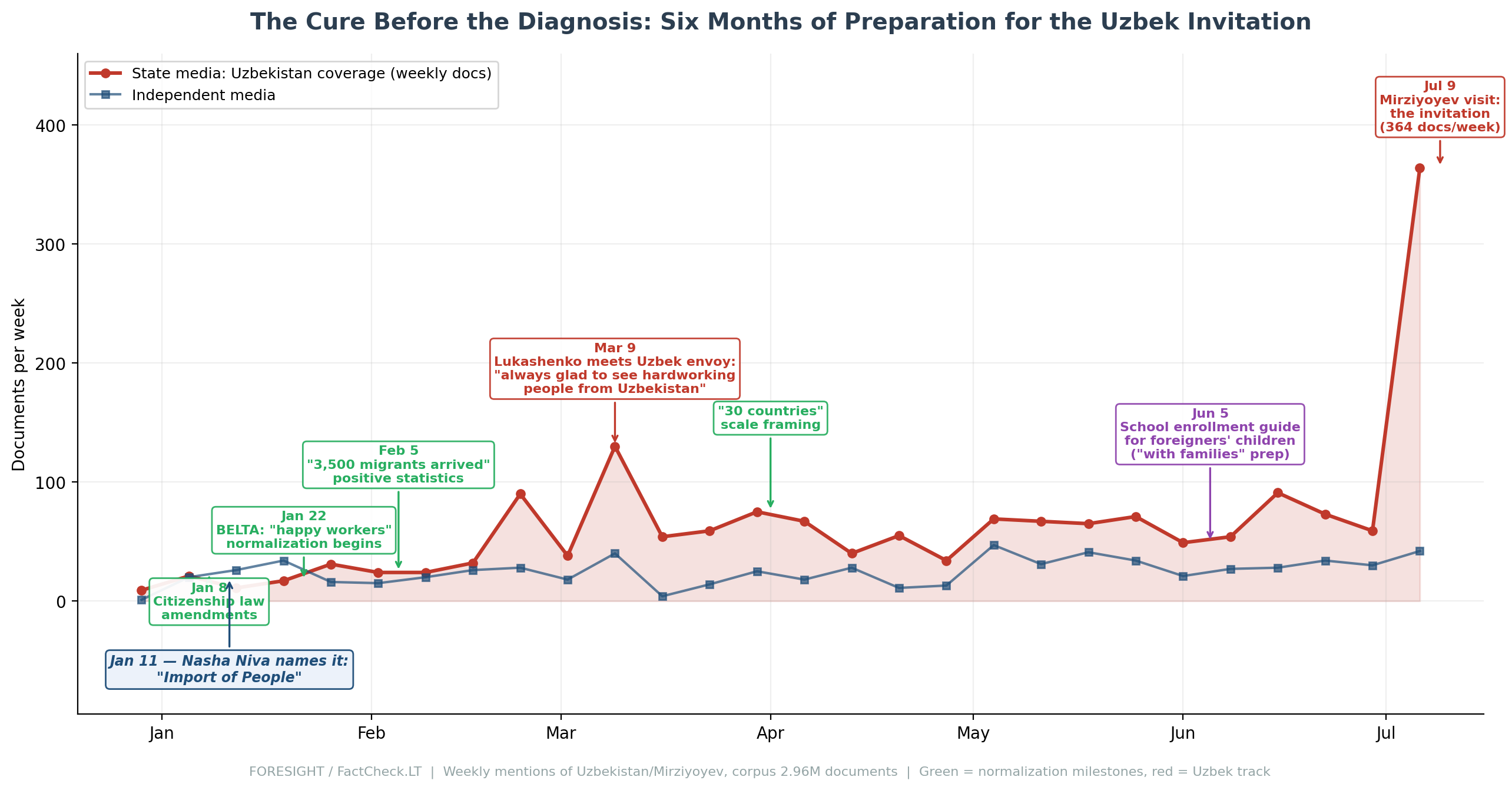
Weekly state-media Uzbekistan coverage with normalization milestones. The March 9 ambassador meeting and the July 9 visit bracket the campaign.
The Ones Who Called It
Independent media did not just document the exodus — they spotted the pivot. On January 11, Nasha Niva published a piece whose title needs no improvement: “Import of People: Belarus spent years criticizing Europe over migrants — now it moves down the same path.”
That was published three days after the citizenship-law story and six months before the presidential invitation. The analytical layer of the Belarusian independent media ecosystem saw the trajectory when it was one data point old.
Our own FORESIGHT system flagged the same track from a different angle: the European Choice agent’s Q1 2026 assessment listed an active “Uzbekistan track” among the regime’s diversification moves, months before the visit was announced.
What “With Families” Means
The invitation’s most consequential phrase is its quietest. Seasonal labor migration does not come “with families.” Family migration is permanent migration — a demographic policy, not a staffing fix.
Belarus has lost hundreds of thousands of residents since 2020 — to repression-driven exile, to war-adjacent emigration, to the slow drain of specialists. A regime that cannot invite its own citizens back is inviting replacements. The school-enrollment guides were not a coincidence; they were the operational layer of a decision that had already been made.
The Coming Pivot — a Testable Prediction
Our economic signals agent rated labor migration the most negatively framed indicator of H1 2026 (sentiment -0.95) — driven by independent coverage of the exodus. Here is our prediction, stated now so it can be scored later:
By Q4 2026, the labor migration indicator’s sentiment will turn positive — not because the exodus ends, but because state media will flood the field with arrival stories: integration successes, grateful workers, growing statistics. The state will sell the solution to a problem it never acknowledged having. When that happens, the sentiment flip itself will be the measurement of the propaganda campaign’s scale.
We will check in January 2027.
Methodology: FORESIGHT processes 3 million documents from 80+ sources across the Belarusian information space. This brief draws on keyword-tracked coverage of labor and migration topics (January 1 – July 10, 2026), weekly Uzbekistan mention counts segmented by source type, and manual review of all 158 state-media documents in the sample. FactCheck.LT, Vilnius.