
Minsk held its fourth conference on Eurasian security on 3 and 4 November. State media counted more countries than ever. Fewer foreign ministers came than a year earlier, Hungary sent none, and the OSCE secretary general came for the first time.
Belarusian state media said about 50 countries took part in this year’s Minsk International Conference on Eurasian Security, up from about 30 at the first one in 2023. Two serving foreign ministers came from abroad, Russia’s and Myanmar’s, against four in 2025. Hungary’s foreign minister had spoken at each of the first three conferences, and Hungary’s new government sent no minister to the fourth. What we cannot see is who was invited and declined: we have not found a full list of delegations.
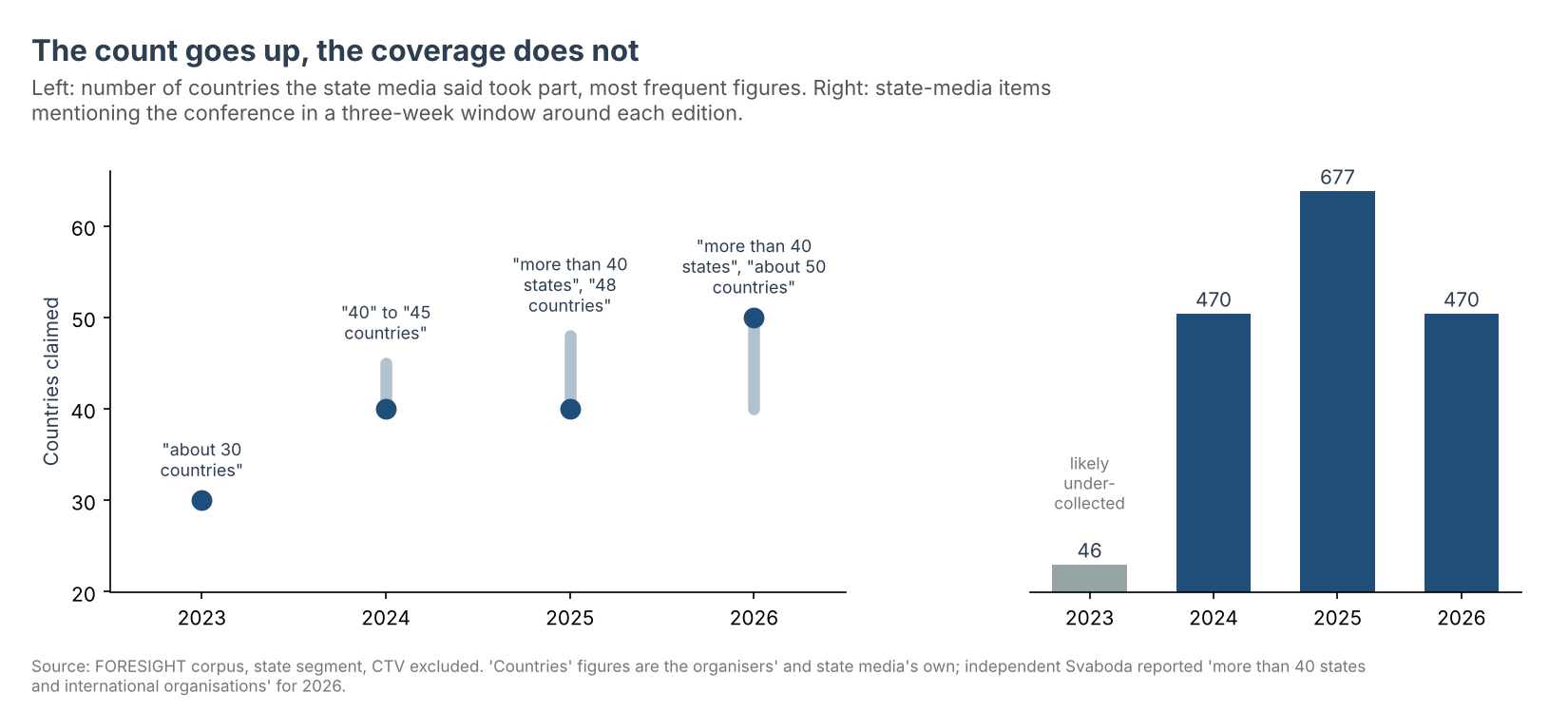
A bigger number
The count of guests has grown each year: in 2023 state outlets wrote of “about 30 countries”. In 2024 they wrote of 40 to 45 countries and about 600 participants. For 2025 the foreign ministry gave “more than 45 countries” and about 700 participants (MFA of Belarus). This year state outlets wrote of “about 50 countries” and “more than 600 participants”. Xinhua reported about 600 representatives from about 50 countries and regions (Xinhua, 4 November 2026). Svaboda, quoting the organisers, gave a smaller figure: “more than 40 states and international organisations” (Svaboda, 3 November 2026).
The coverage did not follow the count: state items on the conference rose from 470 in 2024 to 677 in 2025 and fell back to 470 this year. The count of countries went up, and the count of ministers went down.
Hungary was the only EU member to send a minister, and this year it sent none.
Who sat at the table
Russia’s foreign minister, Sergei Lavrov, has come every year. Péter Szijjártó came three years running (BelTA, 26 October 2023; Eurointegration, 31 October 2024; Eurointegration, 28 October 2025). In 2024 Syria’s foreign minister came (BelTA, 29 October 2024), and so did Serbia’s deputy prime minister, Aleksandar Vulin (BelTA, 31 October 2024). In 2025 the foreign ministers of North Korea and Myanmar joined Lavrov and Szijjártó (Reform.news). This year state outlets and Xinhua name two: Lavrov and Myanmar’s foreign minister, Tin Maung Swe (ONT, 4 November 2026).
Hungary was the only EU member to send a minister, and this year it sent none. Its government changed in May: Péter Magyar’s cabinet took office on 12 May, with Anita Orbán as foreign minister and deputy prime minister (Telex, 12 May 2026; Hungarian government). Before taking office she said: “We will anchor ourselves in the Western alliance system” (Telex, 20 April 2026). Of 470 state items on this year’s conference, three mention Hungary, and none names Szijjártó.
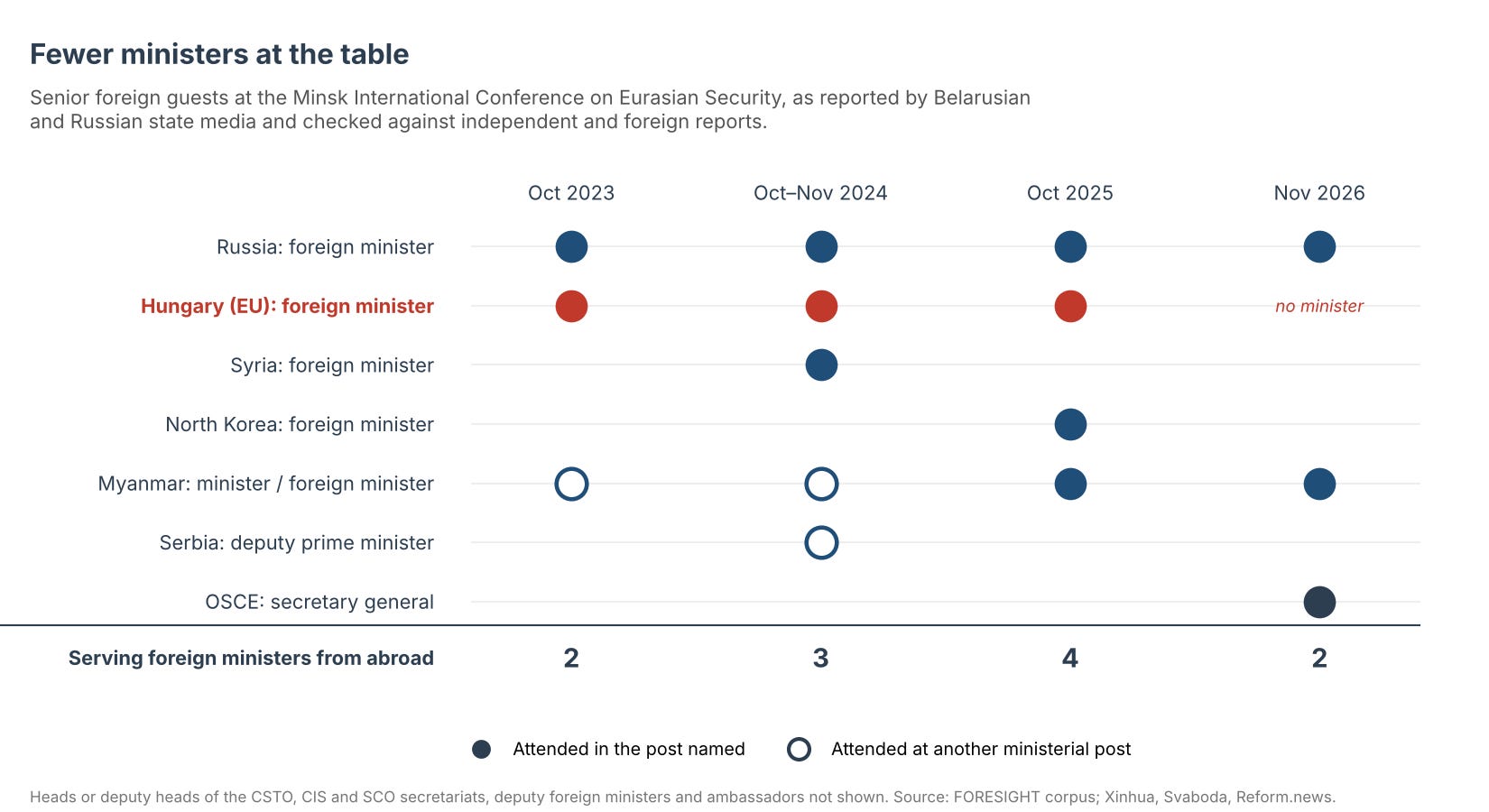
The OSCE took a seat instead. Its secretary general, Feridun Sinirlioğlu, made his first visit to Belarus (Sputnik Belarus, 3 November 2026). Svaboda noted that the previous visit by an OSCE secretary general was in 2019 (Svaboda, 3 November 2026). Sinirlioğlu told the conference that dialogue had to continue (BelTA, 3 November 2026). Turkey has nominated him for UN secretary-general, and Belarus’s foreign minister welcomed the nomination (Reform.news, 3 November 2026). In exile, Pavel Latushko called the visit “illogical” and asked him to raise the issue of political prisoners (Pozirk, 2 November 2026).
Below the ministers, the list grew wider. In each of the last three years the CSTO, CIS and SCO secretariats sent their heads or deputies. This year deputy foreign ministers came from Iran, Tajikistan and Kazakhstan. State outlets ran 21 headlines built on “an expert from” a named country, against 10 in 2024 and 29 in 2025.
Hostility stayed, aimed at named states.
What the hosts said
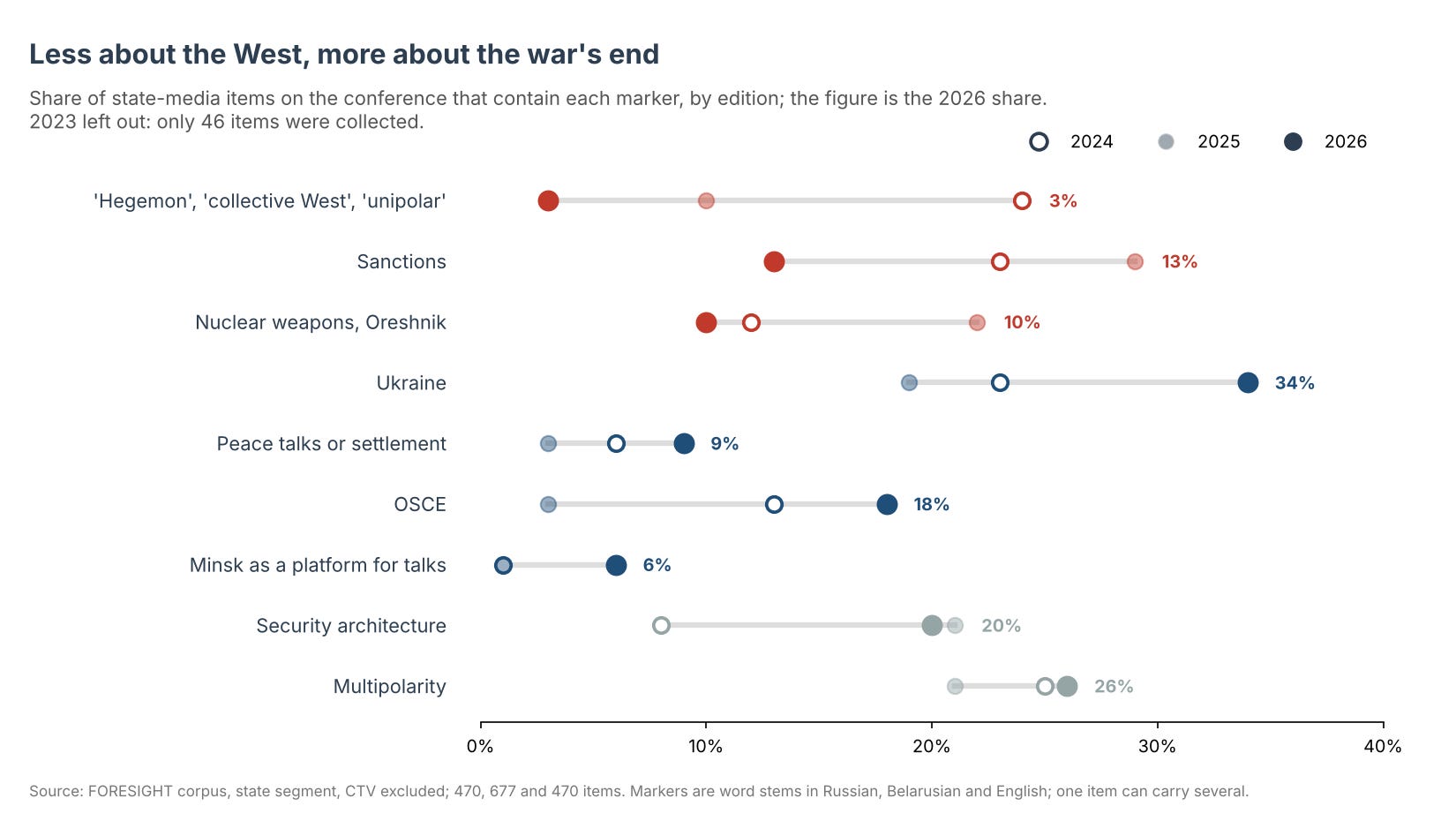
State coverage changed its words: in 2024, 24% of state items on the conference used “hegemon”, “collective West” or “unipolar”. In 2025 the share was 10%, and this year 3%. Part of the 2024 language came from the guests. Szijjártó spoke of a “hegemony of opinions” (ONT, 31 October 2024), and Syria’s minister said Minsk “rejects hegemony” (ONT, 31 October 2024).
Ukraine now appears in 34% of state items, against 23% in 2024 and 19% in 2025. The OSCE appears in 18%, up from 3% a year ago. Lukashenko told the conference that the war in Ukraine would end soon (SB, 3 November 2026).
Hostility stayed, aimed at named states. Lukashenko said the Americans were arming Poland at their own expense, and warned Poland’s leaders that Poles “are not fools” and would still show them “Kuzka’s mother”, Khrushchev’s old threat (BelTA, 3 November 2026). He said Europe “very much wants to play at a third world war” (SB, 3 November 2026). BelTA headlined another part of the speech with a question: would France face sanctions over the dispersal of protests? (BelTA, 3 November 2026).
The count of countries went up, and the count of ministers went down.
Two speeches
Lukashenko’s own speech moved the same way. In 2025 he set out four proposals: no sanctions on food and medicine, protection of pipelines and cables, a deal on migration, and rules for artificial intelligence (BelTA, 28 October 2025). Ukraine came up about 8 times in BelTA’s report of that speech. He said he feared that the US position on Russia over Ukraine was “a staged performance”.
In BelTA’s report of this year’s speech, Ukraine comes up about 30 times, the OSCE 14 times and the UN 10 times (BelTA, 3 November 2026). He said he feared the UN would go the way of the League of Nations, and that the OSCE “could work normally if it were allowed to”. Without a halt in Ukraine, he said, “we will definitely come to a third world war”, so “Trump is doing a great thing”. He presented the Eurasian Charter, a Belarusian initiative, as “a Helsinki Act for a new, polycentric era”.
Lavrov kept to Moscow’s line. In 2025 he said EU leaders were refusing to discuss security guarantees for Eurasia on a collective basis (BelTA, 28 October 2025). This year he called a “Greater Eurasian Partnership” the material foundation of the security architecture discussed at the Minsk conferences (Soyuz.by, 3 November 2026).
Polish voices
Pro-government channels filled the Western seats with people out of office. The channel BelVPO carried a comment from Krzysztof Tołwiński, a former member of the Polish Sejm and deputy minister of the state treasury in 2007. Its headline claimed that Poland is preparing to annex Western Ukraine. It quoted him as saying politicians were already taking “certain steps”, and added in brackets that these were steps to prepare for sending troops there (BelVPO). The same channel reported that the Polish politician Janusz Korwin-Mikke took part in the conference (BelVPO; Belsat, 3 November 2026). The pro-government channel grodnosliv quoted Tomasz Szmydt, a former Polish judge who moved to Belarus in 2024 (grodnosliv). BelTA quoted a member of a Polish party: “I would like to have a president in Poland who thinks like Lukashenko” (BelTA, 3 November 2026).
Polish guests are not new. In 2025 BelTA quoted Szmydt (BelTA, 28 October 2025) and another Polish guest who said Poles were ashamed that their leadership was absent from Minsk (BelTA, 28 October 2025). This year we counted 13 state and pro-government items with Poland or a Polish guest in the title during the conference window. No Polish election is due this autumn, so this is a quiet-month level.
Pro-government channels filled the Western seats with people out of office.
How sure we are
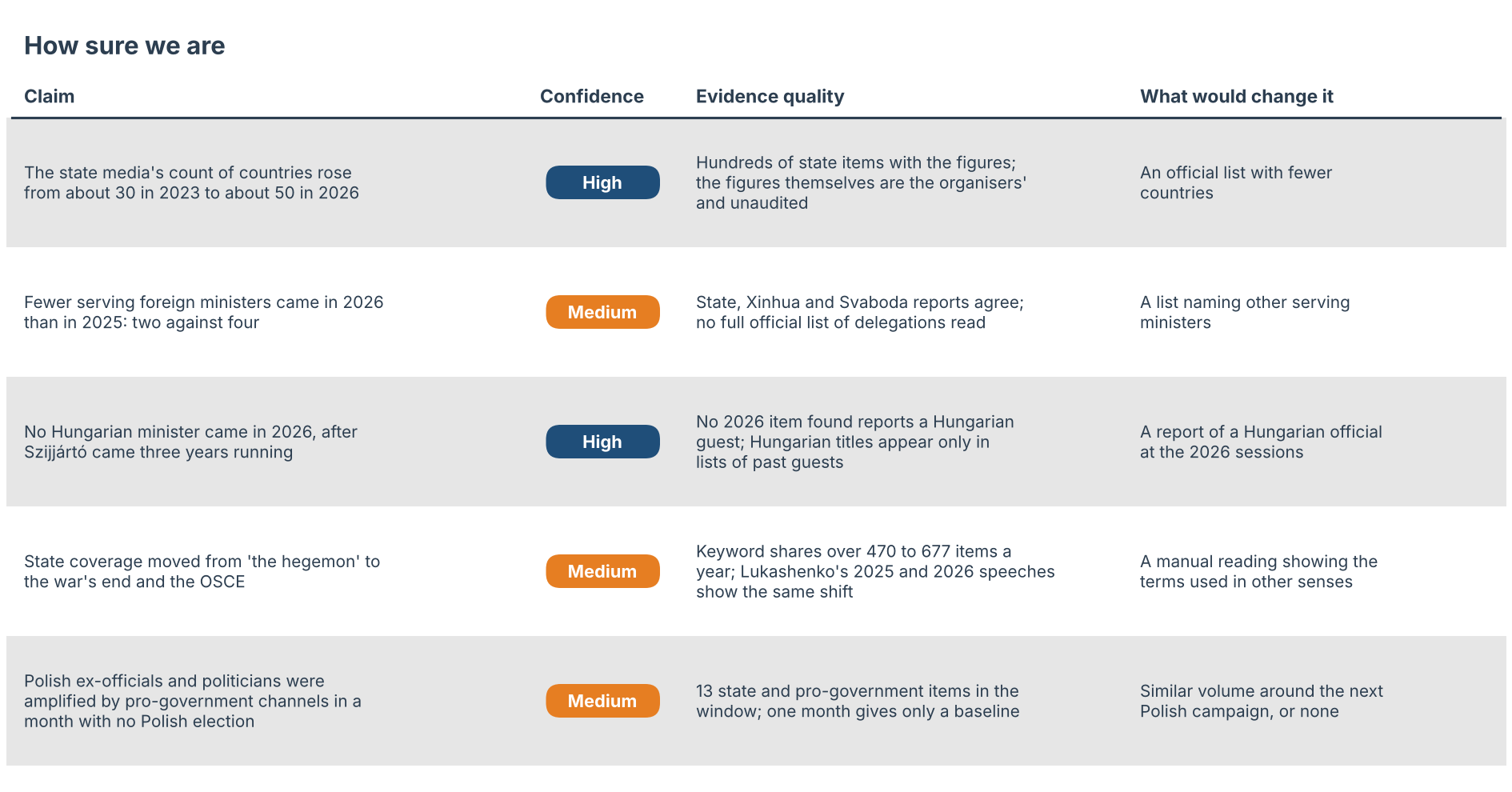
The state media’s count of countries rose from about 30 in 2023 to about 50 in 2026. High. Hundreds of state items carry the figures, but the figures are the organisers’ own. An official list with fewer countries would change it.
Fewer serving foreign ministers came in 2026 than in 2025: two against four. Medium. State, Xinhua and Svaboda reports agree, but we have not read a full list of delegations. A list naming other serving ministers would change it.
No Hungarian minister came in 2026. High. No 2026 item we found reports a Hungarian guest at the sessions; Hungarian titles appear only in lists of past guests. A report of a Hungarian official at the sessions would change it.
State coverage moved from “the hegemon” to the war’s end and the OSCE. Medium. Keyword shares over 470 to 677 items a year, not read item by item; Lukashenko’s speeches of 2025 and 2026 show the same shift. A manual reading that finds the terms used in other senses would change it.
Polish ex-officials and politicians were amplified in a month with no Polish election. Medium. Thirteen items in one window give a baseline only. The volume around the next Polish campaign will test it.
How it fits
The frame held: multipolarity appears in about a quarter of state items each year since 2024, and Lavrov spoke of collective security for Eurasia in both years we read. The cast and the emphasis changed. This fits T1: Minsk keeps the common frame and sets its own timing, with its own charter, an opening to the OSCE and talk of the war’s end. A simpler reading is that the words follow the guests. In 2024 some of the sharpest language came from Szijjártó, Syria’s minister and Vulin, and none of them came this year. The Polish voices give T3 a baseline. If amplification of Polish divisions rises well above this level before Poland’s next election, T3 gains.
What to watch
3 and 4 December 2026. The OSCE Ministerial Council meets in Lugano (Swiss government, 2 November 2026). Expectation: Belarus’s statement there mentions the Minsk conference and the secretary general’s visit. Confidence: medium.
By 31 December 2026. A Hungarian minister visits Minsk or meets Belarus’s foreign minister. Expectation: no. Confidence: medium.
By 30 November 2027. The fifth conference. Expectation: state media again claim 50 or more countries, and no serving EU foreign minister attends. Confidence: medium.
Method and limits
We took items from the FORESIGHT corpus that name the conference in Russian, Belarusian or English. Each window covers about three weeks around an edition, with each URL counted once and the CTV website left out. The 2023 edition yielded only 46 state items, so we compare shares from 2024 on. Markers are word stems, and one item can carry several. Guest lists come from state headlines checked against Xinhua, Svaboda, Reform.news and the foreign ministry. For the speeches we read BelTA’s reports of Lukashenko’s 2025 and 2026 addresses and the longest available Lavrov items; counts in those reports include BelTA’s related headlines. Items that use only a short name, such as “the Minsk security conference”, fall outside the set. The Tołwiński post did not enter it. Our export returned no full speech for 2023 or 2024.
Thesis tag: T1; T3 (baseline).