

On 14 September 2026 Defence24 published We Can’t Afford to Lose Belarus, a 15-page report based on a closed panel held under the Chatham House rule on 6 May. More than twenty experts on Belarus took part. Their shared conclusion is that the European Union needs its own long-term strategy towards Minsk, and that doing nothing has a cost.
The report ends with a short update on events after the panel. It says no real normalisation followed, and migration pressure moved from the Polish border to the Latvian one. It also says Washington reduced its activity on Belarus to focus on Iran and the Middle East. On 15 September, the day after publication, the US envoy John Coale was in Minsk. It was his first visit in six months, and it was no surprise. By 30 August he had said in public that he planned to travel to Belarus in mid-September to free more prisoners. Belarusian media had the exact date by 11 September. On the day the report appeared, Coale was in Vilnius, meeting Lithuania’s foreign minister.
The talks in Minsk ended on 16 September with what Coale called an interim agreement. As a goodwill gesture, Belarus will free 25 people, and the US will lift sanctions on two state companies, the paint maker Lakokraska and the forestry concern Bellesbumprom. Coale added that more releases and more delistings would follow once the remaining issues are agreed. Both statements first appeared on Pul Pervogo, a Telegram channel close to Lukashenko.
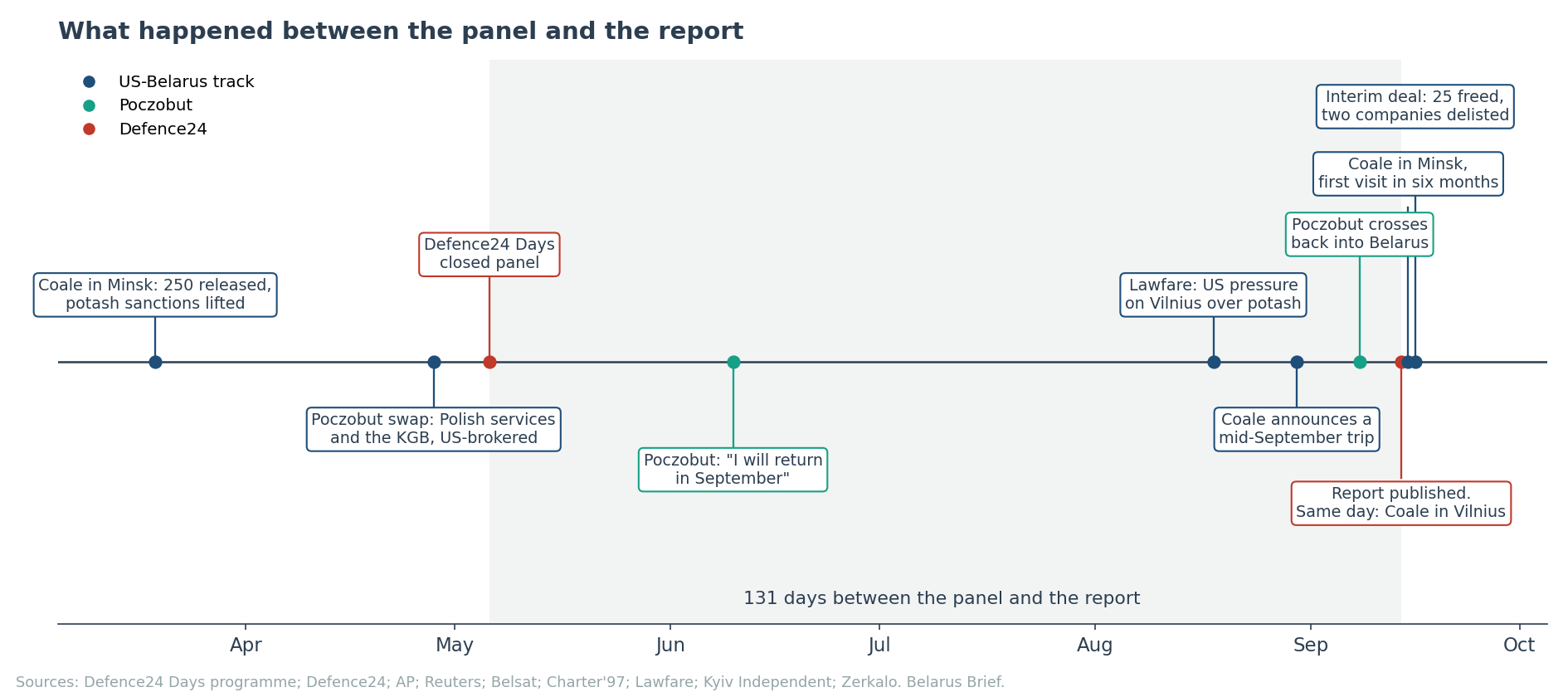
A gap of 131 days between a discussion and its written record is normal for this kind of paper. The update paragraph is the weak part. It describes a quieter calendar than the real one. The report also expects the US to press Poland to change course. A version of that was already visible next door: in August, Lawfare described US pressure on Lithuania to reopen potash transit.
Credit first
The report separates co-aggression from co-belligerence. Belarus gave its territory for the invasion of Ukraine, but its own army has not fought there. The authors argue this gives the EU more tools for Minsk than for Moscow. Their advice that Brussels should not wait for signals from Washington is sound. So is the point that UN mechanisms keep political prisoners on the agenda, whatever happens in Washington or Brussels. The report also rejects a full lifting of EU sanctions, which keeps its call for engagement within limits. Its forecast that any normalisation would be limited and gradual has held up well. The 16 September deal freed a tenth of the March number, far from the hundreds Coale had hoped for in August.
Its most useful idea is a warning. Panellists asked Europe to separate real signals of change from political noise, and to beware of a “false dawn”. The sixth recommendation repeats this. Yet the report never says what a real signal would look like, or which number would show one.
Where the envoy and the counters disagree
The prison is the obvious place to test the warning, because that is where the trade happens.
Between releases, the stock has twice turned back up.
Coale has claimed credit for 700 to 800 releases since mid-2025. Over the same period, Viasna’s count of political prisoners fell from 1,185 at the start of June 2025 to 911 on 16 September 2026. That is a net fall of 274. It is not yet clear whether that reading already excludes the 25 people freed the same day.
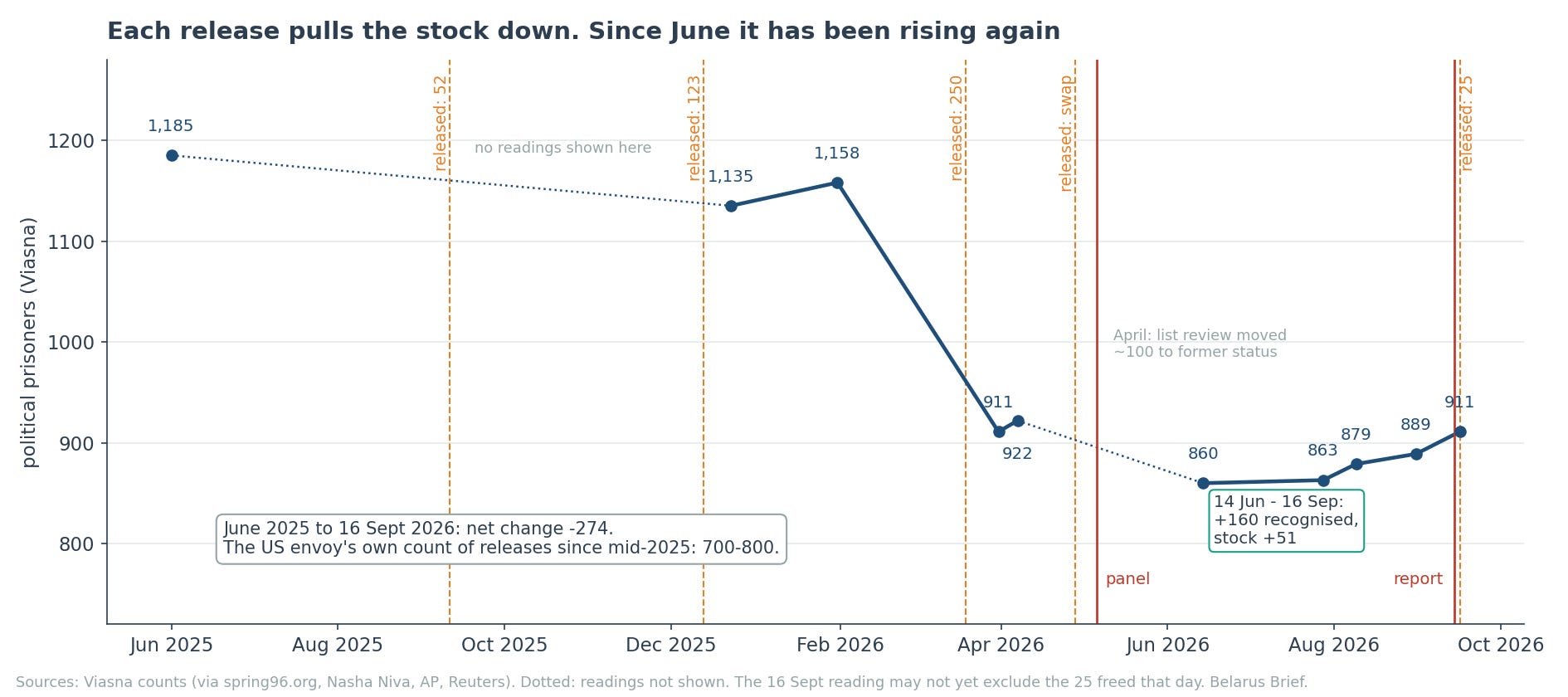
The two figures may not cover exactly the same people. Still, the curve has a clear pattern. Each release pulls the stock down. Between releases, the stock has twice turned back up: in January, and again since June. It was 860 on 14 June, 863 at the end of July, 889 on 31 August and 911 in mid-September.
Part of the spring fall was bookkeeping. In April Viasna reviewed its list, and about 100 people were moved to the status of former political prisoner. So the net fall of 274 overstates what the releases achieved.
Viasna also keeps a second counter: everyone recognised as a political prisoner since the 2020 campaign. It stood at 4,655 on 14 June and 4,815 on 16 September. That is 160 new political prisoners in 94 days, about one every 14 hours. In the same period the stock grew by 51, so roughly 110 people left the list, through completed sentences and pardons.
At the meeting on 15 September, Lukashenko described the objection himself. Émigrés, he said, had persuaded the Americans that Minsk releases some people and detains twice as many. He called this an exaggeration. Twice as many is indeed too high. Over the summer the ratio was closer to three in for every two out. In the twelve months to 9 August, Viasna recorded 538 new political prisoners. The three largest US-brokered releases of that period freed 425 people. We first set out this arithmetic in August, in The Offer in the Same Speech.
A released political prisoner who went home on a Belarusian passport has no Russian equivalent.
Viasna lawyer Pavel Sapelka calls the system a revolving door. The report makes the same point in general words. It says releases belong to a transactional policy and prove nothing about a new course. What it does not add is the one series that would tell a reader, month by month, whether that is still true.
Two registers that kept moving
A false dawn can also be checked outside the prisons. On 1 January 2021 the Ministry of Justice listed 3,021 registered public associations. On 1 January 2026 it listed 1,337. The fall was steepest during 2023 and 2024. In 2025, the year of the first US deals, it slowed to 60 but did not turn.
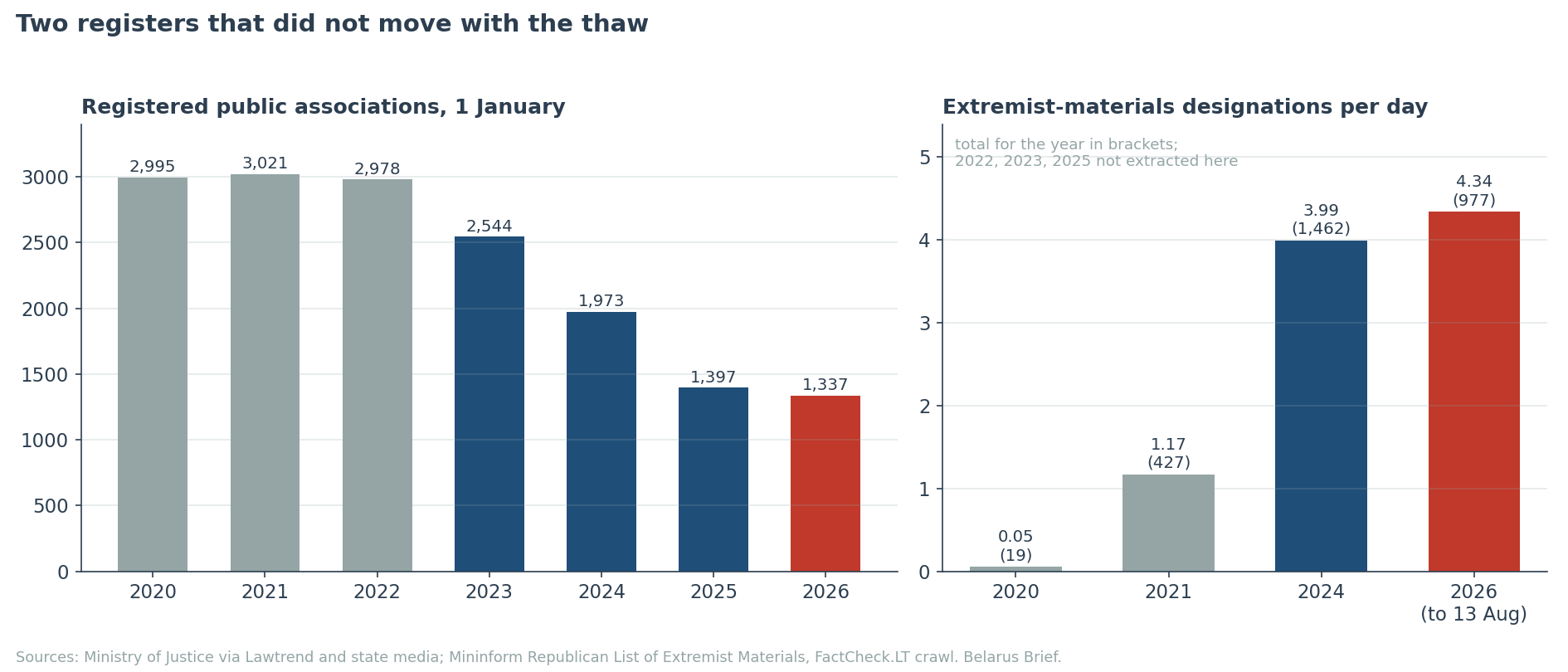
The register of extremist materials moves the same way. In 2024, its busiest full year, courts added 1,462 entries, about four a day. In the first 225 days of 2026 they added 977, a slightly faster pace. From July 2027, people who found a new non-profit will [face KGB checks](LINK: Who May Start One). None of this is in the report. Each item is dated and counted, which is exactly what the sixth recommendation needs.
Poland, and a test with a date
The report calls Poland’s position “very limited and rather rigid”. Its Polish panellists said the regime does not see Warsaw as a political partner. Both points may be true of public diplomacy. But eight days before the panel, Polish intelligence and the KGB completed an exchange at the border. It freed Andrzej Poczobut and four others, with US help, and Donald Tusk met Poczobut at the crossing. The report mentions Poczobut only as a gesture that should not be overestimated. It leaves out that the Polish state had just negotiated directly with Belarusian security services.
Twice as many is too high. The count still rose at every reading since July.
Poczobut then gave the report its best test case. In June he said he had a passport and assurances that he could go home. On 8 September he crossed back into Belarus and went to Hrodna. Reuters described the trip as a visit, while he has spoken of going home. Tsikhanouskaya praised his courage and said his return was no sign of a thaw. The same week, a Catholic news agency reported that a 17th Polish-born priest had been refused permission to keep serving in Belarus this year.
Here the report touches a real difference between Minsk and Moscow, but gets the example wrong. It says Russia, unlike Belarus, has not released its own political prisoners. That is incorrect as written. In August 2024 Moscow freed 16 people in an exchange with Western states, among them the opposition politicians Vladimir Kara-Murza and Ilya Yashin. Yashin later said an FSB officer had warned him against coming back. A released political prisoner who went home on a Belarusian passport has no Russian equivalent. Whether the 25 people freed on 16 September stay in Belarus is the next check of the same kind. Minsk does not offer every prisoner a way home: of 886 political prisoners pardoned since 2024, 205 were expelled. Whether Poczobut stays free in Hrodna through the autumn is a dated, observable test of the report’s own warning.
Gaps in the picture
The panel’s second theme was Minsk’s relations with Moscow and Kyiv. Kyiv hardly appears in the text. There is no mention of Ukraine’s sanctions against Lukashenko on 18 February, which cited relay stations for Russian attack drones on Belarusian territory. The public programme lists 22 speakers. Fourteen have an affiliation shown, and none of those is Ukrainian or Latvian.
Of 886 political prisoners pardoned since 2024, 205 were expelled.
The report says part of Belarusian youth is turning pro-Russian. It gives no source. Chatham House’s urban survey put support for an alliance with Russia at 44% in November 2025, the highest since September 2020. That figure covers the whole sample, and the report does not say whether young people drive it.
One point concerns method. The speaker list is public, and the report labels some views as “Lithuanian” or “Finnish”. When a public list shows only one or two institutions from a country, a national label can point to a person. The Chatham House rule protects who said what, and labels like these weaken that protection.
Watch items
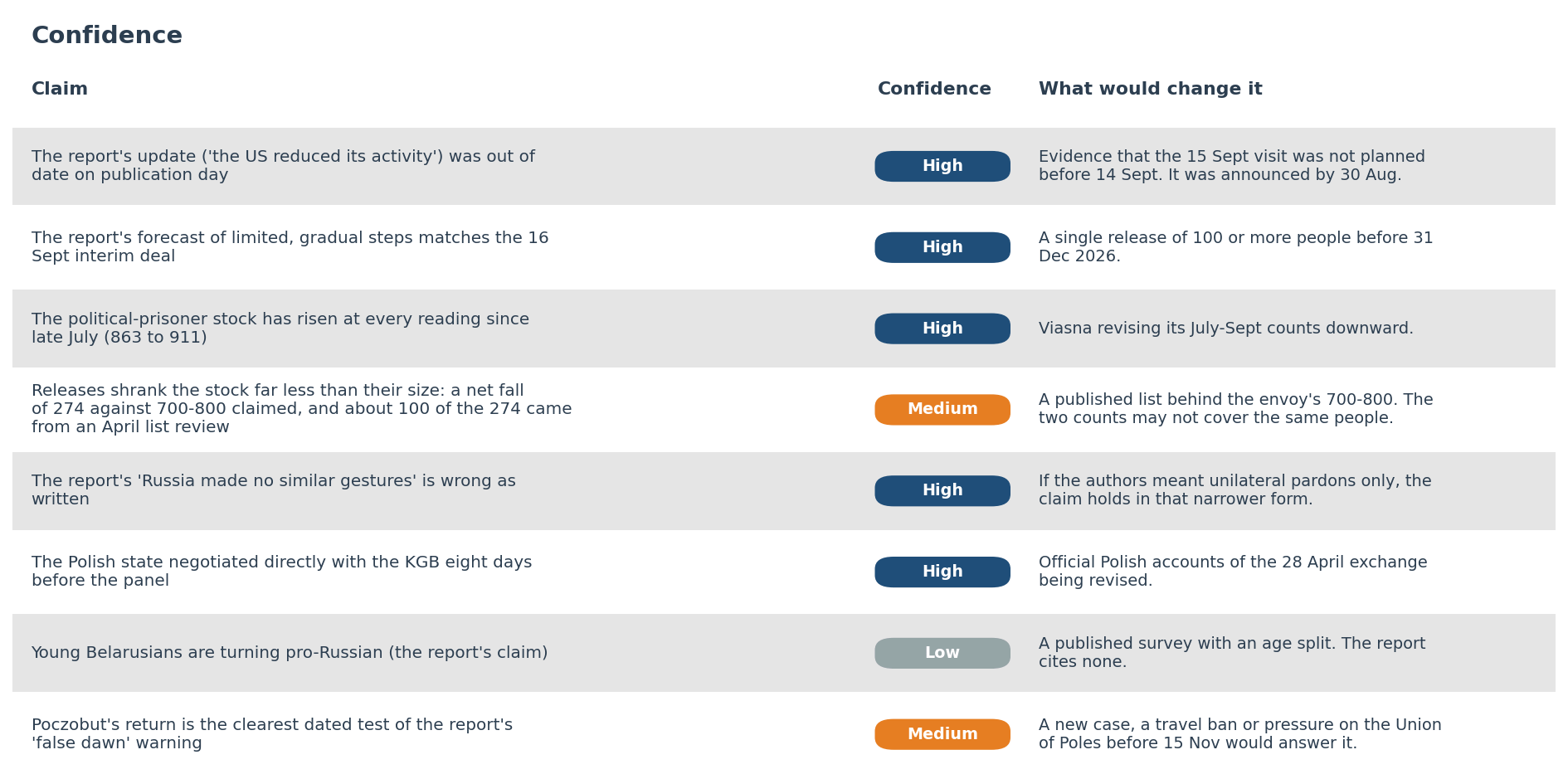
Viasna’s count will be higher on 31 December 2026 than at its first reading after the 25 people freed on 16 September are removed from the list.
No single release of 100 or more people will be announced before 31 December 2026.
By 15 November 2026, Poczobut faces no new criminal case and can still cross the Polish-Belarusian border in both directions.
The Union of Poles in Belarus holds the congress it postponed from 13 September by 5 March 2027, the end of the six months Poczobut named.
At the February 2027 renewal, the EU extends its Belarus sanctions without removing the potash measures.
Method and limits
The calendar uses public reports only and leaves out events we could not date. Viasna’s counts come from its own statements and from agencies quoting it. Readings between June and December 2025 and between April and June 2026 are not shown. The April 2026 list review moved about 100 people out of the stock without any release. The flow figures for June to September are the difference between Viasna’s two counters, so they carry no names. The envoy’s 700 to 800 and Viasna’s net change measure different things. His figure may include people who were never on Viasna’s list, and people also leave the list when their sentences end. Association figures are the Ministry of Justice’s 1 January line as quoted by Lawtrend and state media.