
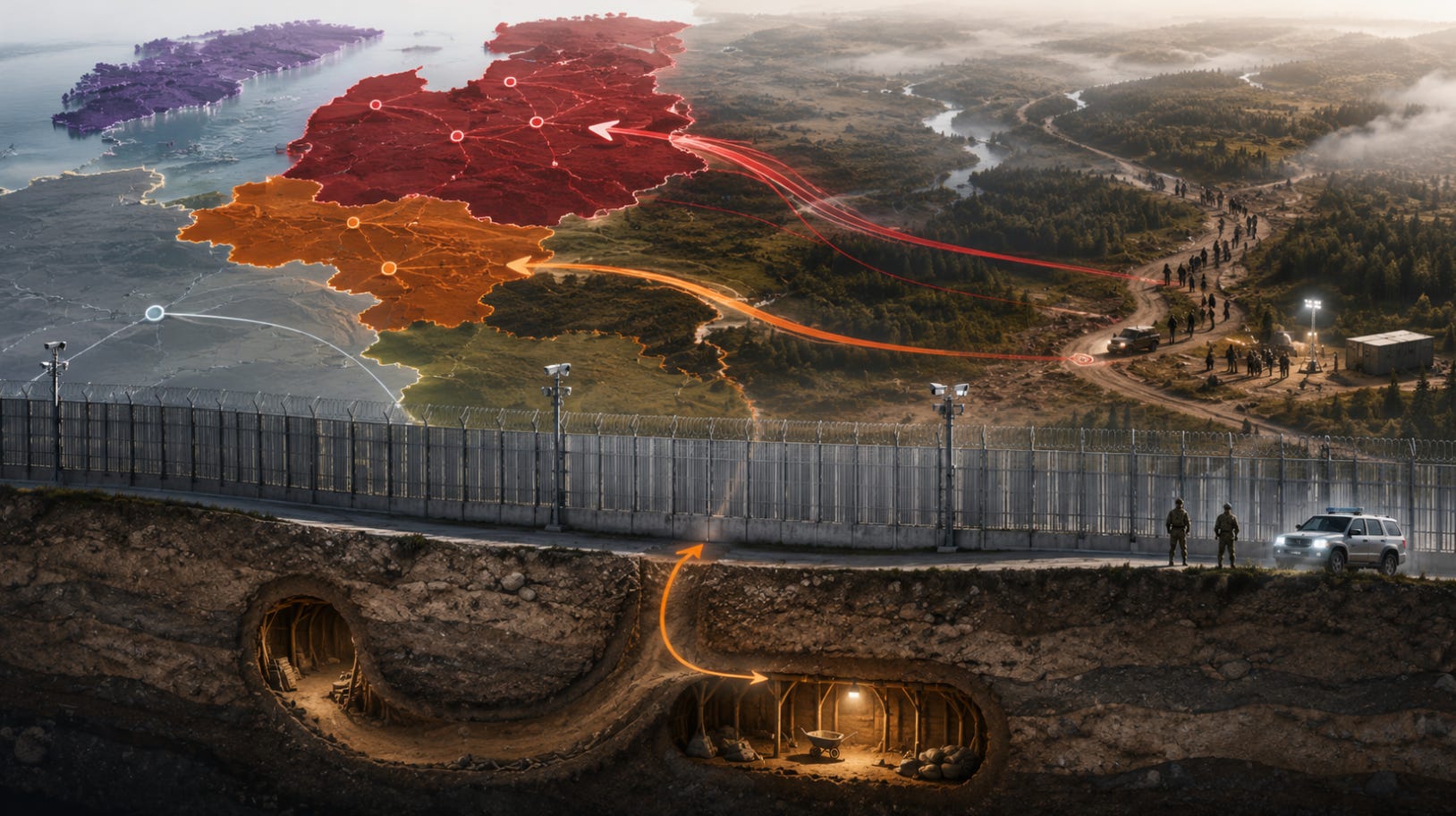
On 27 July, Lithuanian border guards in the Varėna district found a tunnel running under the border from Belarus. Twenty migrants who had come through it were turned back the same day. Two days later, a few kilometres away, they found a second one, unfinished. Before the first tunnel, Lithuania had recorded seven consecutive days without a single attempted illegal crossing on that border.
Those two facts belong together. The Lithuanian fence, finished and monitored, works. That is precisely why the route went underground.
Latvian outlets quoted specialists who examined the tunnels and concluded they were built professionally enough that people with relevant Middle Eastern experience may have been involved. Polish reporting put it more bluntly: there is practically no doubt the Belarusian authorities helped. Neither claim is verified, and both should be held loosely. What is not in doubt is the engineering itself — this is not a group of people improvising with shovels near a fence.
Three borders, three methods
The distribution of pressure this year has been extraordinarily lopsided. By Pozirk’s count of the daily figures published by all three border services, 10,058 crossing attempts have been recorded from Belarus into the EU since January. Latvia absorbed 8,813 of them, or 87.6%. Lithuania 960. Poland 285.
Now put that against the length of each border. Latvia’s is the shortest of the three, 173 kilometres. Lithuania’s is 679, Poland’s 418. Per kilometre, Latvia is taking roughly thirty-six times the pressure Lithuania is and seventy-five times Poland’s.
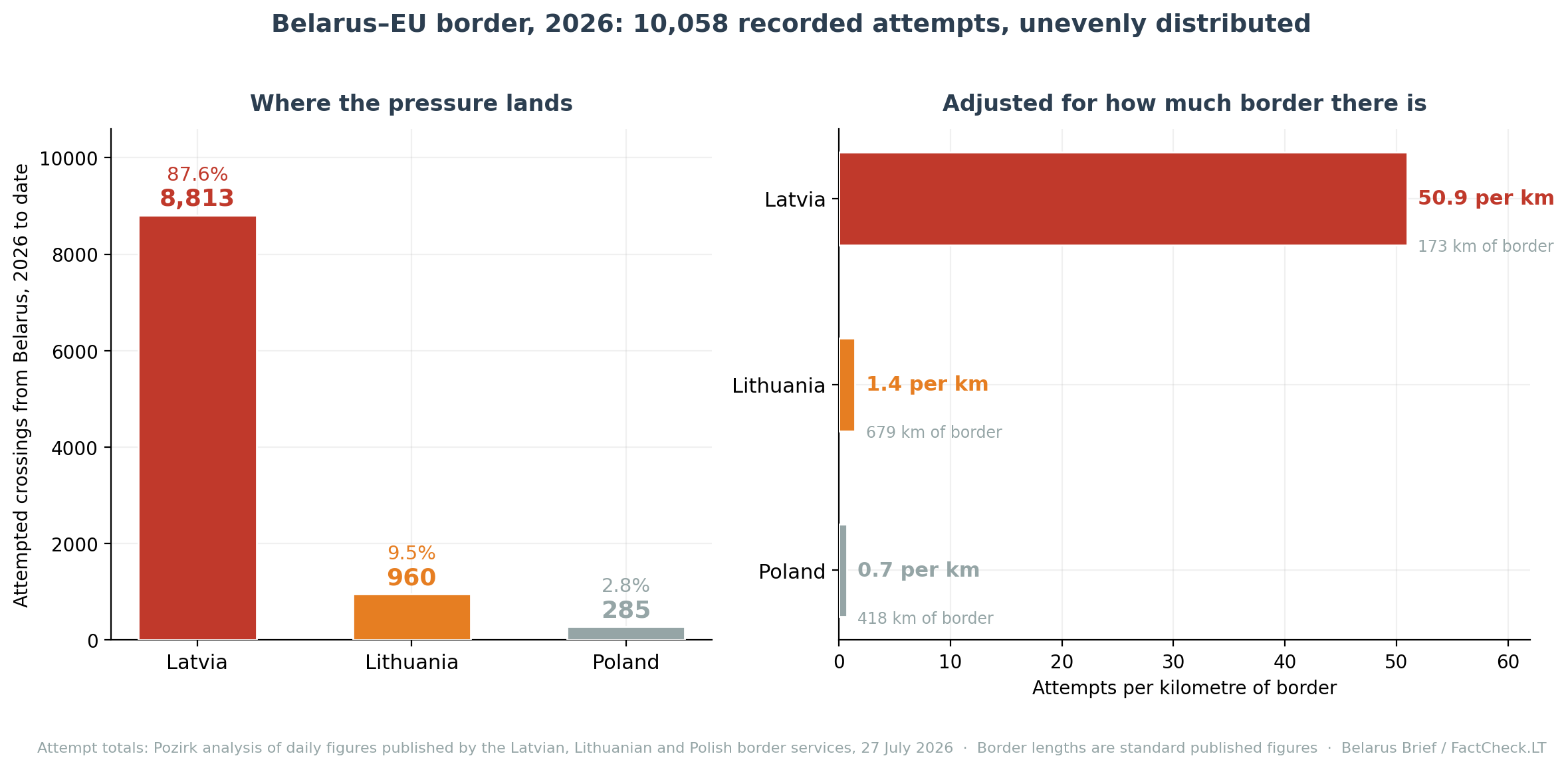
The obvious reading is that this reflects barrier completeness, and Latvian officials have been saying so for months: their fence and surveillance build-out lags behind. But the tunnels complicate the simple version. Where the barrier holds, the method changes rather than the volume moving. Lithuania gets engineering. Latvia gets the mass. Poland gets something in between, and this week it got more of it.
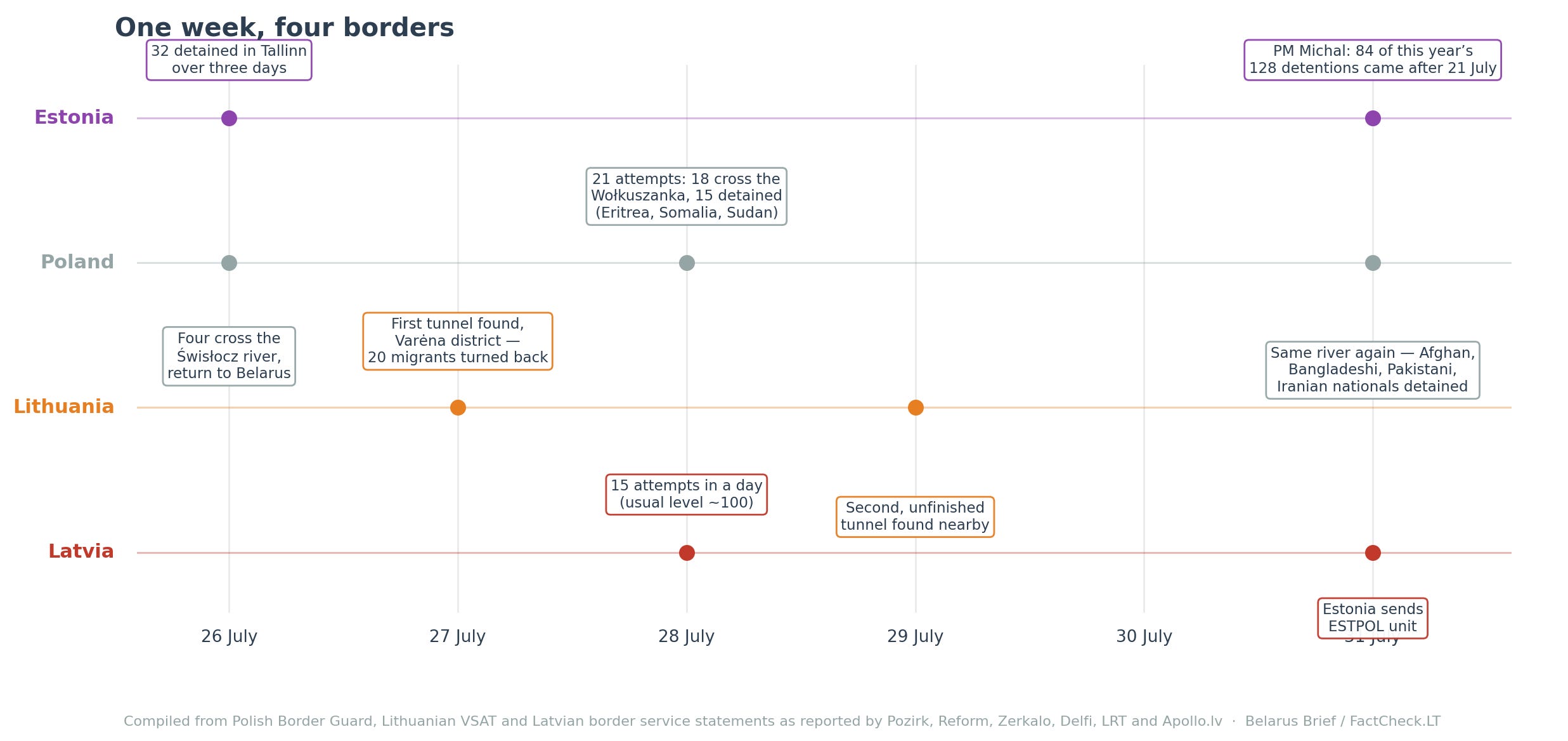
The Polish sequence is worth setting out day by day, because the shape is unusual. Across the weekend of 25–26 July, the Podlaskie branch of the Border Guard logged five attempts. Monday, two. Tuesday, twenty-one. That Tuesday figure was not twenty-one separate probes: eighteen people tried to cross the Wołkuszanka river in one group, of whom two turned straight back into Belarus and fifteen were detained, with a search continuing for one more. Three others were preparing to cross the Świsłocz nearby and were scared off by a patrol. The detainees were citizens of Eritrea, Somalia and Sudan. By 31 July the Border Guard was reporting another group at the Wołkuszanka — this time Afghan, Bangladeshi, Pakistani and Iranian nationals, detained close to the line.
Two things stand out. The Polish route runs through rivers rather than fence lines, which is what a completed barrier leaves available. And the nationality mix shifted within four days, from East African to South and West Asian, which points at whoever is assembling the groups rather than at any spontaneous flow.
Meanwhile, on that same Tuesday, Latvia recorded 15 attempts against a daily norm closer to a hundred. For one day the busiest border was the quiet one and the quiet one was busy.
The response is integration
What the four states are doing about it is the part policy audiences should watch.
Since 1 July, nine Lithuanian border guards have been serving on the Latvian border. On 27 July Estonia announced it would send its own police and border guard reinforcements to Latvia. Estonia is doing this because the pressure reaches it second-hand: migrants who cross into Latvia move north, aiming for Scandinavia. Estonian police detained 32 people connected to that flow in Tallinn over three days in late July — at a reception point in Nõmme, at the port, in the city centre. By 31 July, Prime Minister Kristen Michal put the year’s total at 128 detentions, of which 84 had come after 21 July.
Michal also said what the Baltic governments have converged on: Estonia will reinforce the EU’s external border rather than start checking its internal ones. That echoes the Lithuanian and Latvian presidents, who called restoring internal Schengen controls a capitulation after Lithuania’s interior minister floated the idea in mid-July.
That convergence is the actual target of the operation. Pushing people across a line is the mechanism; the objective is to make EU states erect barriers against each other. Nine Lithuanian guards in Latvia is the opposite outcome, and it is worth noting how quickly it was organised.
What the Belarusian state chose not to notice
We ran the corpus for the period. Belarusian state and pro-regime outlets produced 52 documents on the border. The word “hybrid” appears in six of them, “provocation” in five, the wall or fence in eleven. Tunnels appear in none.
This is not a case of the state ignoring its own border. On 29 July BelTA reported in detail that Hrodna border guards had detained a Belarusian citizen carrying a home-made drone, a tablet, six batteries and a charger near the Lithuanian border, all seized for examination. The state covers its border service catching people. It does not cover a professionally engineered tunnel running under the same border, in the same week, reported by every independent and neighbouring outlet.
For a story the regime officially maintains has nothing to do with it, that is a conspicuous gap in coverage.
Watch for
Whether the tunnels turn out to be a one-off or a method. Two in three days in the same district suggests capability rather than improvisation, and if a third appears — on any of the three borders — the engineering answer to fencing becomes the story of the autumn rather than an incident. Latvia’s election on 3 October remains the other date on the calendar.
Figures as reported: crossing-attempt totals from Pozirk’s analysis of daily border-service data, 27 July; Polish figures from the Podlaskie branch of the Border Guard via Zerkalo and Pozirk; Lithuanian figures from VSAT via Delfi, LRT and Apollo.lv; Estonian figures from the Police and Border Guard Board and PM Michal’s public statements via Reform and Postimees. Estonian totals differ slightly between sources depending on what is counted; both figures are given as published.