
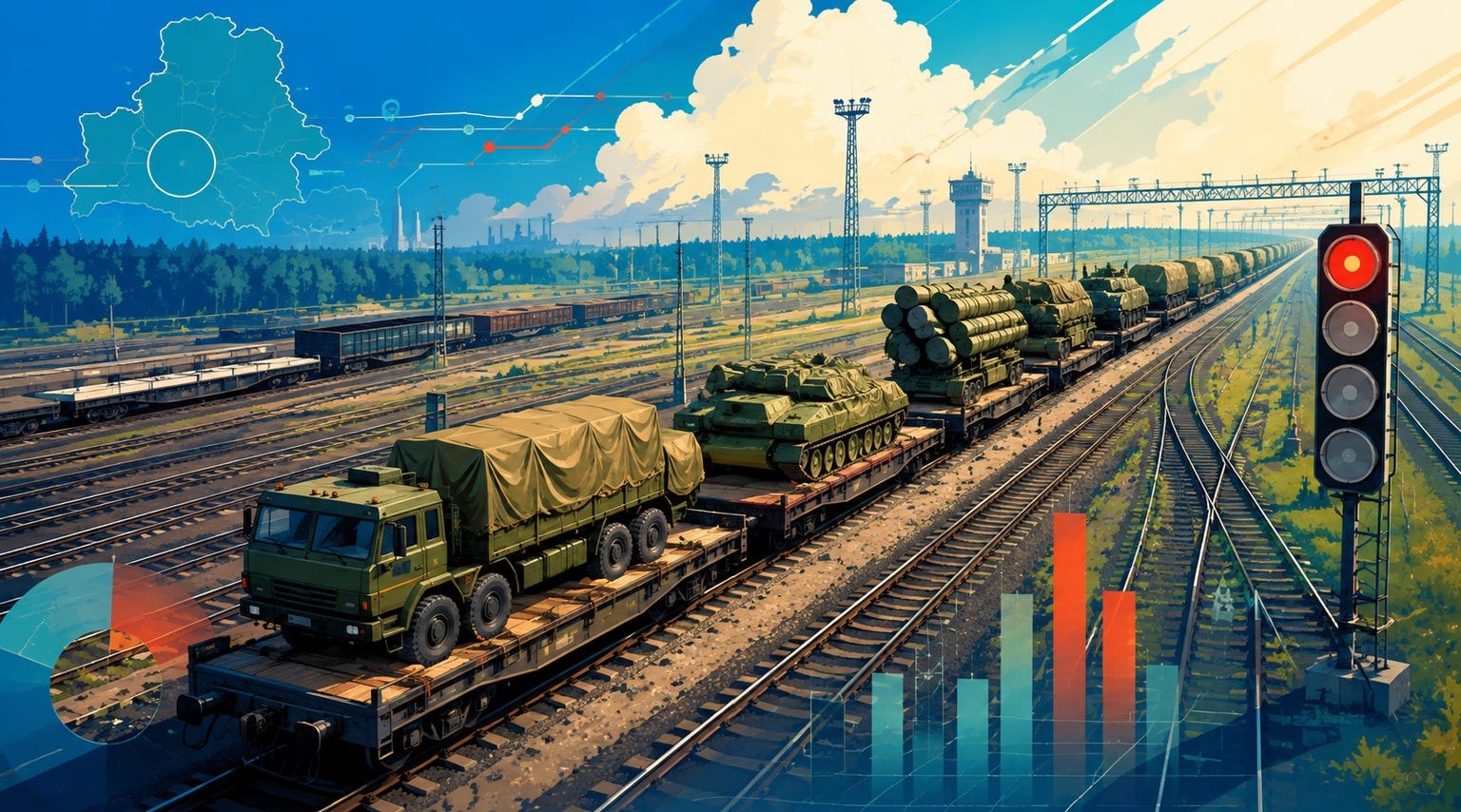
At the end of August the Belarusian Railway ran short of empty, serviceable flat wagons. The Community of Railway Workers of Belarus reported this on 30 August. Part of the railway’s own fleet, and part of the fleet of the state logistics operator BTLC, now goes to military orders or waits for dispatches due soon. Other customers now get fewer wagons, or wait. Nobody outside the railway knows how many wagons are involved, where they are being loaded, or where they are going.
Why flat wagons
Armoured vehicles travel on flat wagons. Tanks, infantry fighting vehicles, self-propelled guns, engineering vehicles and trucks all need a flat deck. Troops, ammunition and fuel travel in other types, so the flat wagon is the part of the fleet that military movement takes first.
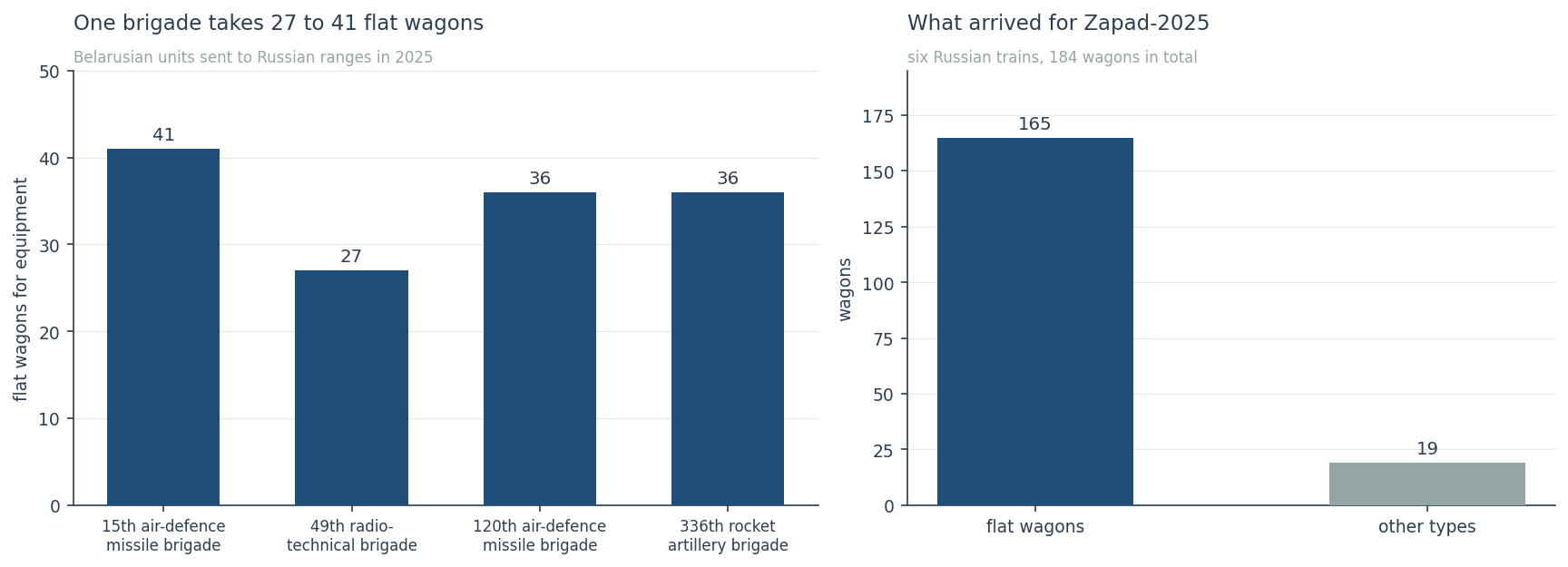
The numbers are known from last year. In 2025 three Belarusian air-defence units went by rail to the Ashuluk range in Russia. Their equipment took 104 flat wagons: 41 for one brigade, 27 for the second, 36 for the third. A rocket artillery brigade sent to Kapustin Yar took another 36. When six Russian trains arrived for the Zapad-2025 exercise, 165 of their 184 wagons were flats.
So one brigade needs between 27 and 41. A wagon also leaves the pool for longer than the journey itself. It counts as unavailable from the moment it heads for the loading station, and it comes back only after unloading, clearing, inspection and return.
One brigade moves on twenty-seven to forty-one flat wagons.
A wagon leaves the pool long before the train leaves the yard.
This has happened before, and it is documented
In September 2021, during the Zapad-2021 exercise, the same shortage appeared. The railway could not supply flat wagons for extra orders from Homselmash, the combine-harvester maker. BELAZ, which builds mining trucks, hit the same problem. The transport minister of the day, Aliaksiej Avramenka, wrote back to one company that no free flat wagons existed because of a state order connected with “national security”. Another firm, KATEK, was told directly that the railway’s flat wagons were carrying military equipment. It warned that it would lose export earnings, pay penalties and fail its contracts.
The same file shows the railway asking the Russian side to allow Belarusian flat wagons to be used inside Russia for loading wheeled and tracked vehicles. A transport ministry note recorded that much of the rolling stock would then go for maintenance and leave the working fleet for several weeks.
That is what the cost looks like when it is written down. Factories that export do not get their wagons, and the reason given in writing is national security.
The bill is paid in export earnings, penalties and broken contracts.
What is present, and what is not
The railway workers who reported the shortage were careful, and their caution is the most useful part of the report.
The timing fits an exercise. From 25 August to 10 September the Belarusian air force and air defence hold an operational-tactical exercise, with live firing at Ashuluk in the second stage. But their sources say the Ashuluk trains explain only a small part of current demand. The rest is held for other military orders whose routes and sizes are not known.
They also refuse the comparison that readers will reach for. In January 2022, Russian military trains began arriving on the 16th, and more than 33 had come by the 21st. Rail records later showed 5,229 wagons sent to the Belarusian defence ministry in January and 3,292 in February. The invasion followed on 24 February. Nothing on that scale is visible now, and the report says so plainly.
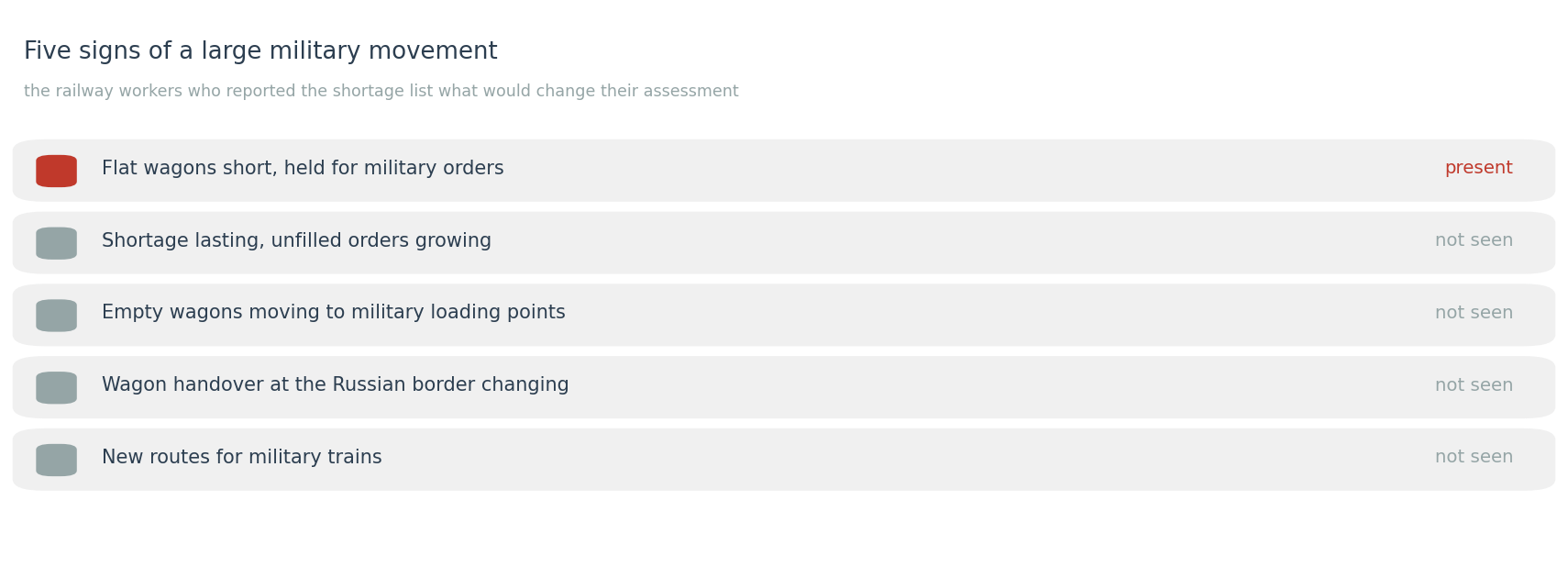
They then list what would change their assessment. A shortage that drags on. More orders the railway cannot fill. Empty wagons moving in bulk to military loading points. A change in how wagons pass the Russian border. New routes for military trains. One of those five signs is present, and four are not.
One of five signs is present. The people who found it said so themselves.
Where this sits
Two other things happened on the railway this month, and together they make a pattern rather than an incident.
In June the same source reported that a permanent group from the defence ministry’s military transport service occupies a floor of the traffic control building in Minsk. In August the railway began preparing a backup control scheme, in case the main control centre is destroyed, badly damaged or unavailable for a long time. That work includes reserve duty rooms and underground communication points. It has nothing to do with the wagon shortage. It prepares for a different possibility.
An institution that expects nothing does not rehearse for the loss of its own control centre.
Confidence
Watch
The shortage lasts into the second half of September, past the end of the current exercise on the 10th.
A Belarusian manufacturer says publicly that it could not ship because no wagons were available, as happened in 2021.
Empty flat wagons are reported moving in numbers toward military loading stations.
Belarusian state media or the railway itself comment on the shortage at all. As of today neither has.
Method and limits
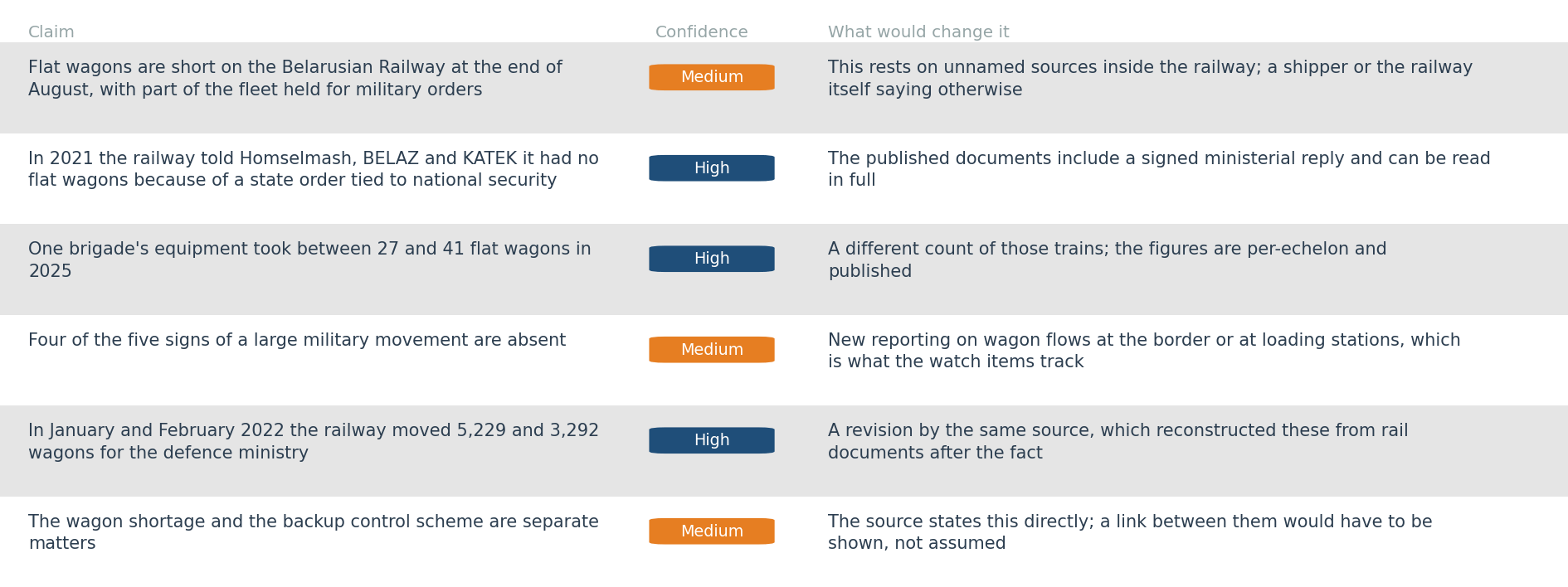
The shortage, the 2021 precedent and the 2025 wagon counts all come from the Community of Railway Workers of Belarus. It works with sources inside the railway and does not name them. We cannot verify their sources. We can check their record. The 2021 documents they published include a minister’s signed reply, and they reported the Russian build-up of January 2022 as it happened.
The figures from 2025 show the size of a routine movement, not the size of the current one. The report says the number of wagons now involved is unknown. It also warns against adding the 2025 totals together, because the same wagons served more than one trip.
Nothing here says a large military movement is under way. One early indicator is showing, four others are not, and the people who found the first one said so themselves.