
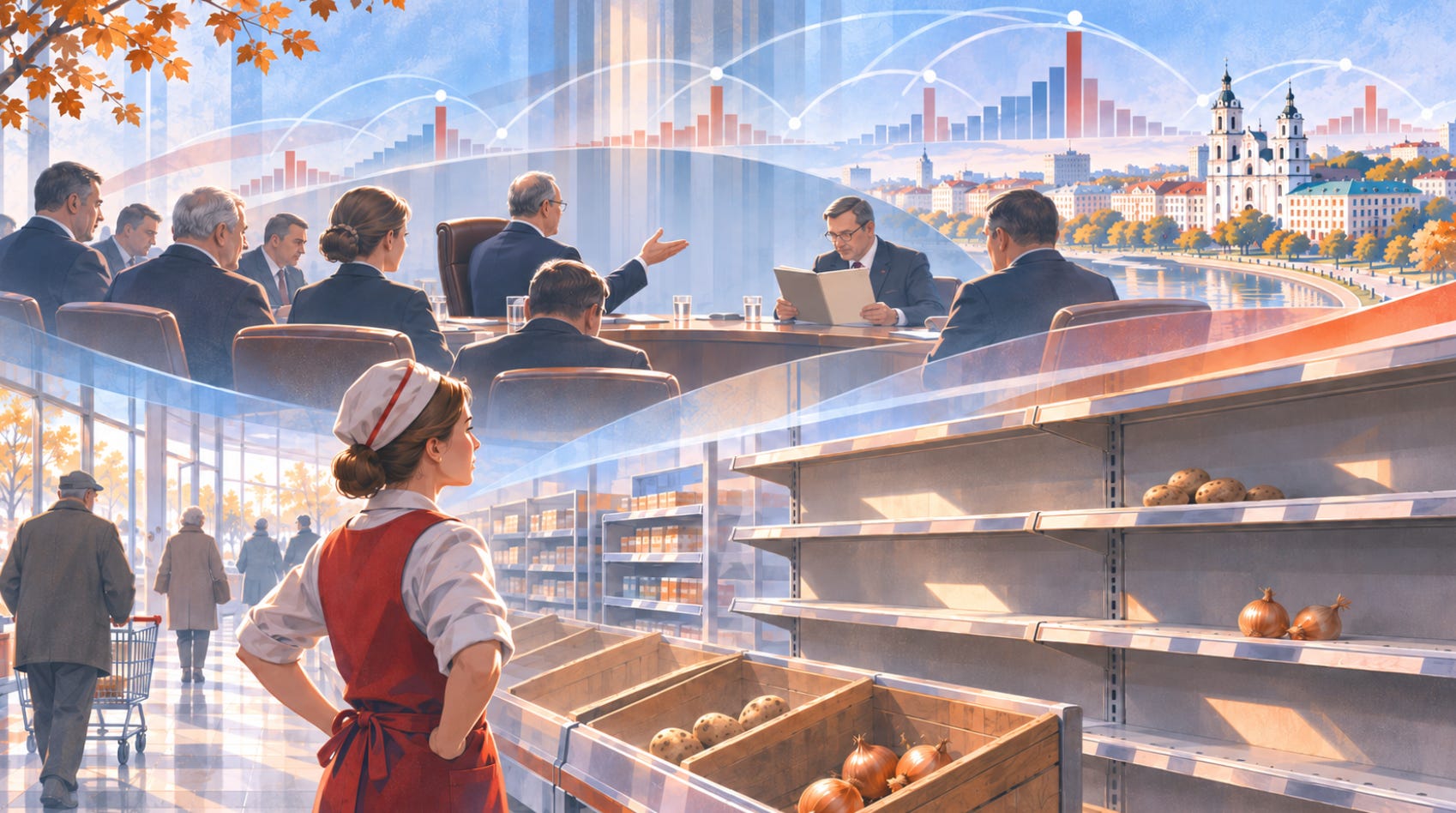
Since December 2024 Lukashenko has asked his government for a “fair price formula”. It was due on 1 April 2025. In September 2026 he changed the minister in charge. We counted where the phrase lives and what the shelves showed in between.
On 28 September Lukashenko replaced the minister of antimonopoly regulation and trade, Artur Karpovich, with Alexander Yakovchits. The new man received the task his predecessor had carried for twenty months: prices. Six weeks earlier he had told the government to “decide on the formula of a fair price”. The formula has a history. We traced the phrase through 1,442 items since 2022 and read what state outlets published at each of its peaks. We then set the series against the one thing a held price produces that cannot be hidden: an empty shelf. What we cannot see is the formula itself, because no text has been published.
A phrase with a birthday
The phrase “fair price” was rare in Belarusian state outlets before December 2024. It appears in a handful of items a month through 2022 and 2023, with one exception, October 2022, when Resolution 713 froze prices and 76 state and pro-government items used the words. Then on 30 December 2024, at the opening of a metro station, Lukashenko said the government was developing “a formula of fair pricing”. The aim, he said, was that “it is not as before, when a person has not yet received his pay and prices somewhere have already gone up” (Gomelskaya Pravda, 30 December 2024). The same day the then head of MART said three variants of a new price regulation system were ready (SB, 30 December 2024).
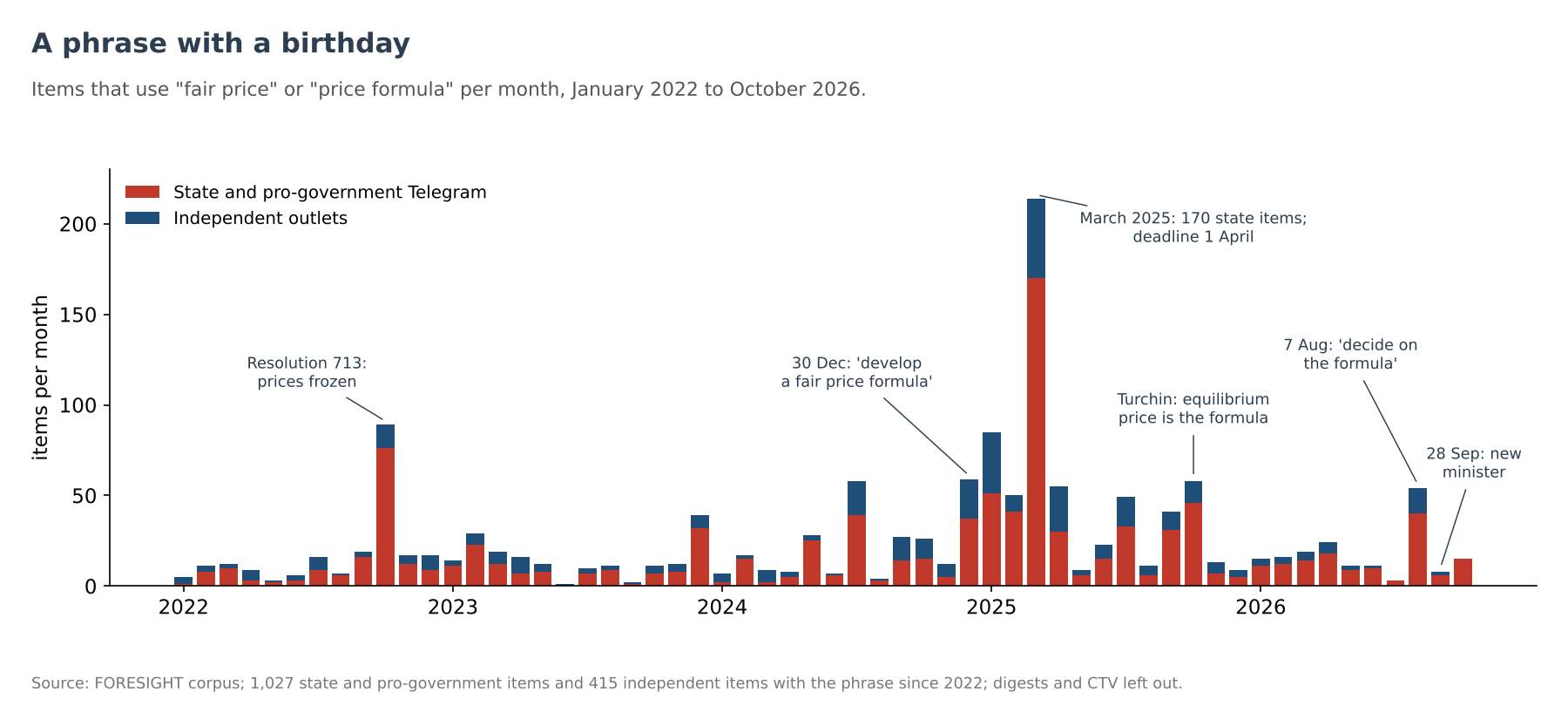
From that day the series follows one speaker. On 3 January 2025, meeting his election proxies, Lukashenko said the government was “finishing work on the formula of fairness in pricing” (Gomelskaya Pravda, 3 January 2025). On 2 March Karpovich explained “the principles of forming the fair price formula” (BelTA, 2 March 2025). On 18 March Lukashenko confirmed the formula would be ready by 1 April (BelTA, 18 March 2025); that month 170 state and pro-government items carried the phrase, the most in the series. On 28 March he rebuffed the new prime minister’s idea of shortening the list of regulated goods: “the new prime minister is starting to stir up old stuff” (Reform, 28 March 2025). Zerkalo noted that in January he had threatened to change the government if it did not produce the formula (Zerkalo, 25 March 2025).
April came and went. In September 2025 Turchin told him that “the classical market concept of an equilibrium price is in many ways identical to what the President says about the fair price formula”. Lukashenko replied that it was “a most difficult task” to find a price fair to buyer, producer and seller at once (BelTA, 23 September 2025). On 7 August 2026, at a meeting on rural trade, he demanded that the government “decide on the formula of a fair price” (SB, 7 August 2026). Four days later ONT’s Igor Tur called fair pricing “an ambitious project of the President in recent years” and explained why it only looks simple (ONT, 11 August 2026). Seven weeks after that, the minister was gone.
Of the 945 state items with the phrase, 272 carry Lukashenko’s name in the same passage. The rest are MART, the prime minister and regional papers repeating him. Independent outlets used the phrase 415 times, almost always in quotation marks. The formula is twenty-two months old, has had one deadline, and has no text.
What a held price looks like from the shelf
Price regulation in Belarus has run since October 2022, when Lukashenko banned price rises and Resolution 713 replaced the ban with a list of regulated goods and capped mark-ups. The list is the thing Turchin wanted to shorten. Its effect shows up not in the price series but in a second count: items that report a shortage of a named food or empty shelves.
The formula is twenty-two months old, has had one deadline, and has no text.
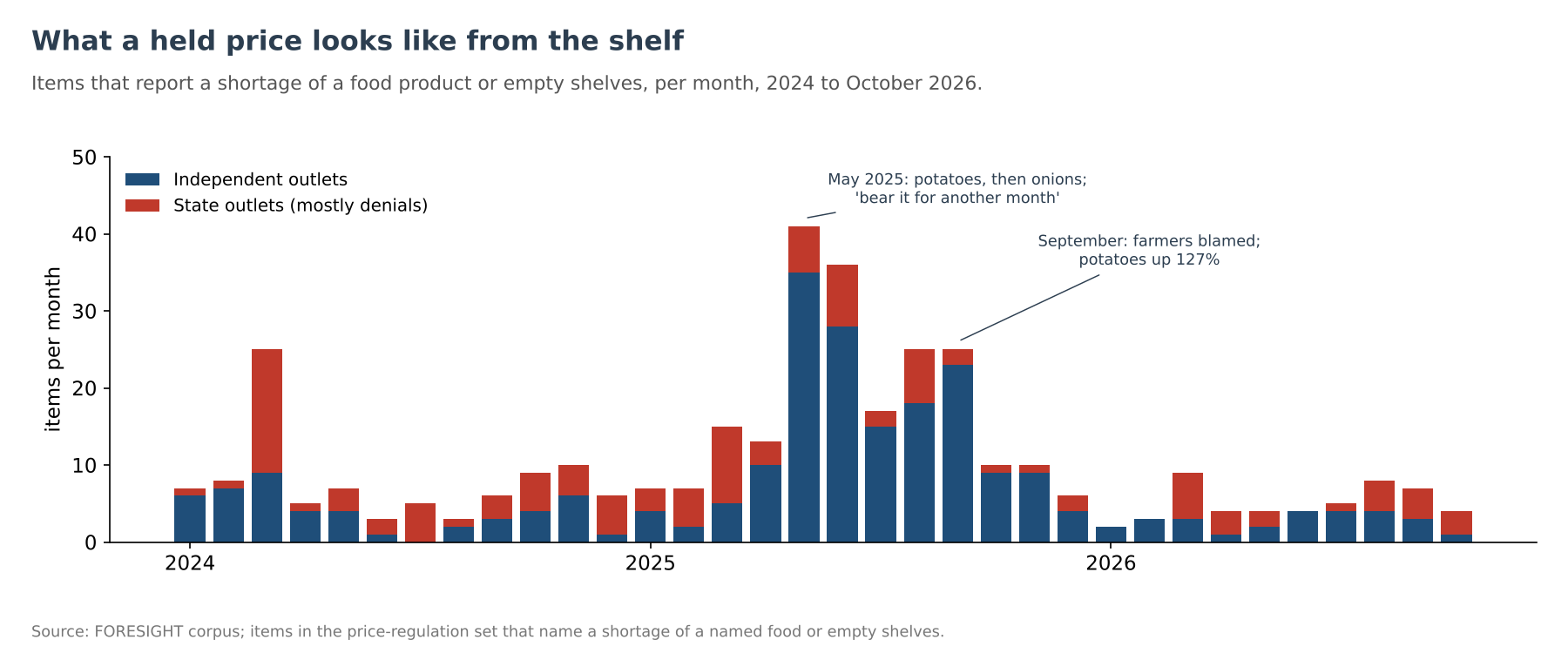
That series has one peak. In May 2025 independent outlets published 35 such items, against four to ten in a normal month. Potatoes disappeared first, then onions. Charter97 reported the onions on 2 May (Charter97, 2 May 2025). On 6 May the prime minister and the head of State Control reported to Lukashenko on the shortage. Zerkalo’s headline quoted them: “we let the farmers earn, we miscalculated” (Zerkalo, 6 May 2025). On 8 May Lukashenko suggested Belarusians “suffer” another month without potatoes (Pozirk, 8 May 2025). Later that month he said the potatoes had all been sold to Russia. Russian officials said the claim did not match reality (Pozirk, 27 May 2025), and Rosselkhoznadzor data showed imports from Belarus had halved since the start of the year (Pozirk, 28 May 2025). In September the government blamed farmers (Euroradio, 2 September 2025), and potatoes were up 127 per cent on the year (Gazeta.by, 25 September 2025).
State outlets that month published five items in the same set, and they were denials and explanations, not reports of empty shelves. The pattern holds across the three years: when a regulated good vanishes, independent outlets count the shelves and state outlets explain the plan. The two series are the same story told from the two ends of the counter.
Potatoes disappeared first, then onions.
The minister
Karpovich took the ministry on 14 January 2025, eleven days after Lukashenko said the formula was nearly finished. Our count of items that name him together with prices or MART runs at 20 to 40 state items a month for twenty months, with a peak of 92 in January and March 2025. Yakovchits, until then deputy agriculture minister, appears in 41 state items in September 2026, the month of his appointment, and in two in October. Lukashenko’s instruction to him was price control (Reform, 28 September 2026, via BIPART). No reason was given for Karpovich’s departure and no next post has been announced (BIPART digest 104).
The two series are the same story told from the two ends of the counter.
The ministry’s other output did not change. State outlets report MART and State Control fines for prices at a steady rate: 90 items in 2023, 95 in 2024, 92 in 2025 and 77 to the end of October 2026. The subjects run from baby food in January 2023 to a retail chain’s missing price tags in September (BelTA, 1 September 2026). The inspections continue whether or not a formula exists.
How sure we are
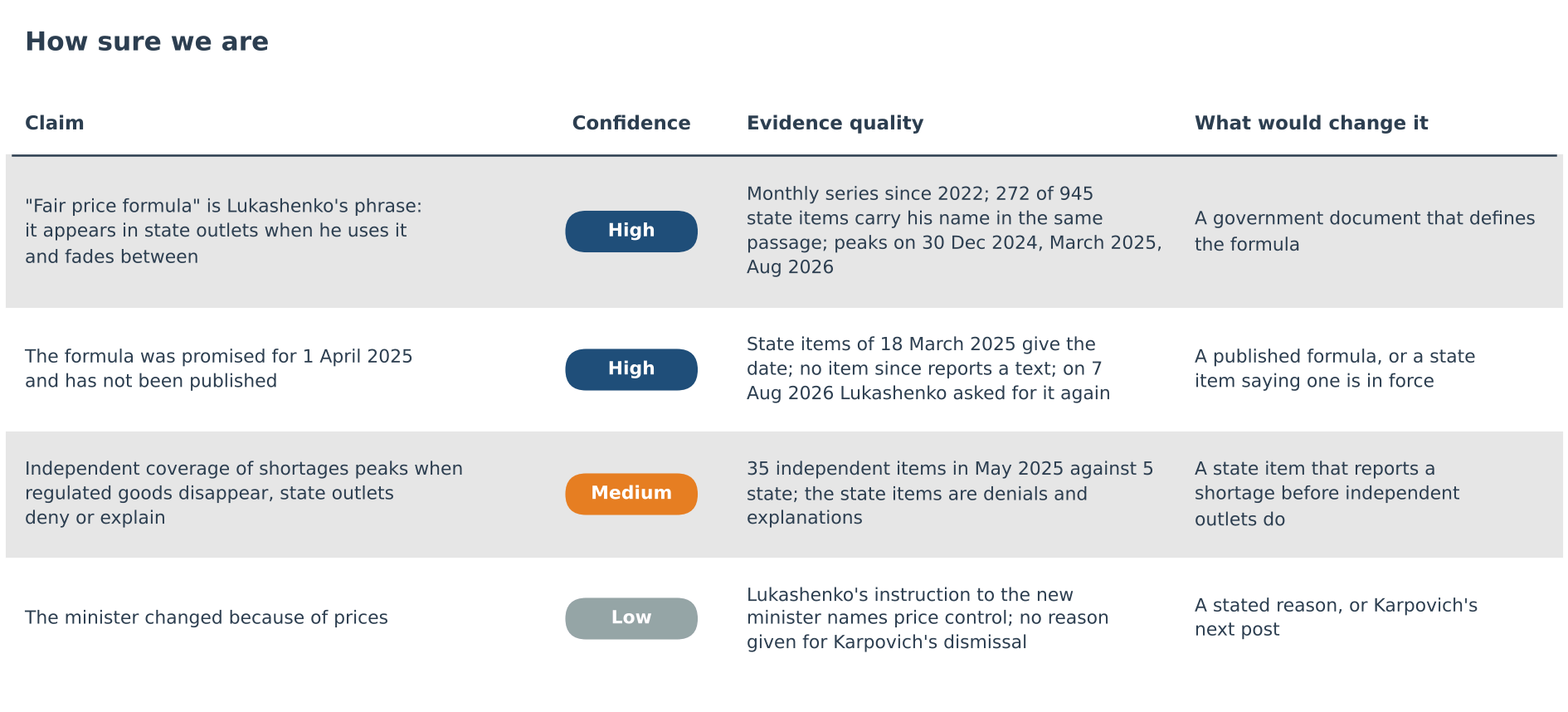
· “Fair price formula” is Lukashenko’s phrase: it appears in state outlets when he uses it and fades between. High. Monthly series since 2022; 272 of 945 state items carry his name in the same passage; peaks on 30 December 2024, in March 2025 and in August 2026. A government document that defines the formula would change it.
· The formula was promised for 1 April 2025 and has not been published. High. State items of 18 March 2025 give the date; no item since reports a text; on 7 August 2026 Lukashenko asked for it again. A published formula, or a state item saying one is in force, would change it.
· Independent coverage of shortages peaks when regulated goods disappear, and state outlets deny or explain. Medium. 35 independent items in May 2025 against five state; the state items are denials and explanations. A state item that reports a shortage before independent outlets do would change it.
· The minister changed because of prices. Low. Lukashenko’s instruction to the new minister names price control; no reason was given for Karpovich’s dismissal. A stated reason, or Karpovich’s next post, would change it.
The inspections continue whether or not a formula exists.
How it fits
This fits T5, the image ahead of the fact. A “fair price formula” has been announced, dated, explained on television and demanded again, and the words have done their work without a document behind them. A simpler reading is that the formula exists as administrative practice, the list of regulated goods and the mark-up caps. On that reading Lukashenko uses “formula” for a policy rather than an equation. The deadline weakens that reading: a policy already in force does not need a date. The prime minister’s attempt to call equilibrium price the formula suggests nobody had one to show.
It also sits beside Two Per Cent (29 October), where growth moved into the headline once it turned positive, and The Percentage Came Back in May (16 October). Prices are the other half of the same household arithmetic, and the one the state outlets handle with a phrase rather than a number.
What to watch
· By 31 December. The new minister’s first public use of “fair price formula”. Expectation: within his first hundred days, in a BelTA interview, without a text. Confidence: high.
· By 31 March 2027. A published document, decree or resolution, that defines the formula. Expectation: none. Confidence: medium.
· By 30 June 2027. A shortage month above 20 independent items in the series. Expectation: one, in spring, when stocks of a regulated vegetable run out before the new harvest. Confidence: medium.
Method and limits
The series count items in the FORESIGHT corpus from 1 January 2022 to 1 November 2026 within a wider set of items on price regulation. The first chart takes items whose title or first 6,000 characters contain “fair price” or “price formula” in Russian or Belarusian. The second takes items that name a shortage of a food product or empty shelves. Digest titles were removed, the CTV website was left out, and each URL was counted once. Segments follow the source type; the charts show state outlets with pro-government and ministry channels, and independent and diaspora outlets. The wider set is broad and we do not report its totals. One of its terms, the ministry’s abbreviation MART, also matches the month of March in Russian and inflates every March. The phrase count catches a different formula in July 2024, the oil price formula agreed with Russia, which we left in the chart and out of the text. The count of Lukashenko’s name is within 250 characters of the phrase, so items that quote him further away are counted as not his. Fines are counted from state items whose text places a penalty within 120 characters of a price. The Karpovich and Yakovchits counts require the ministry or prices in the same item. BIPART’s digest reached us by email and is cited from its PDF.
Thesis tag: T5.