
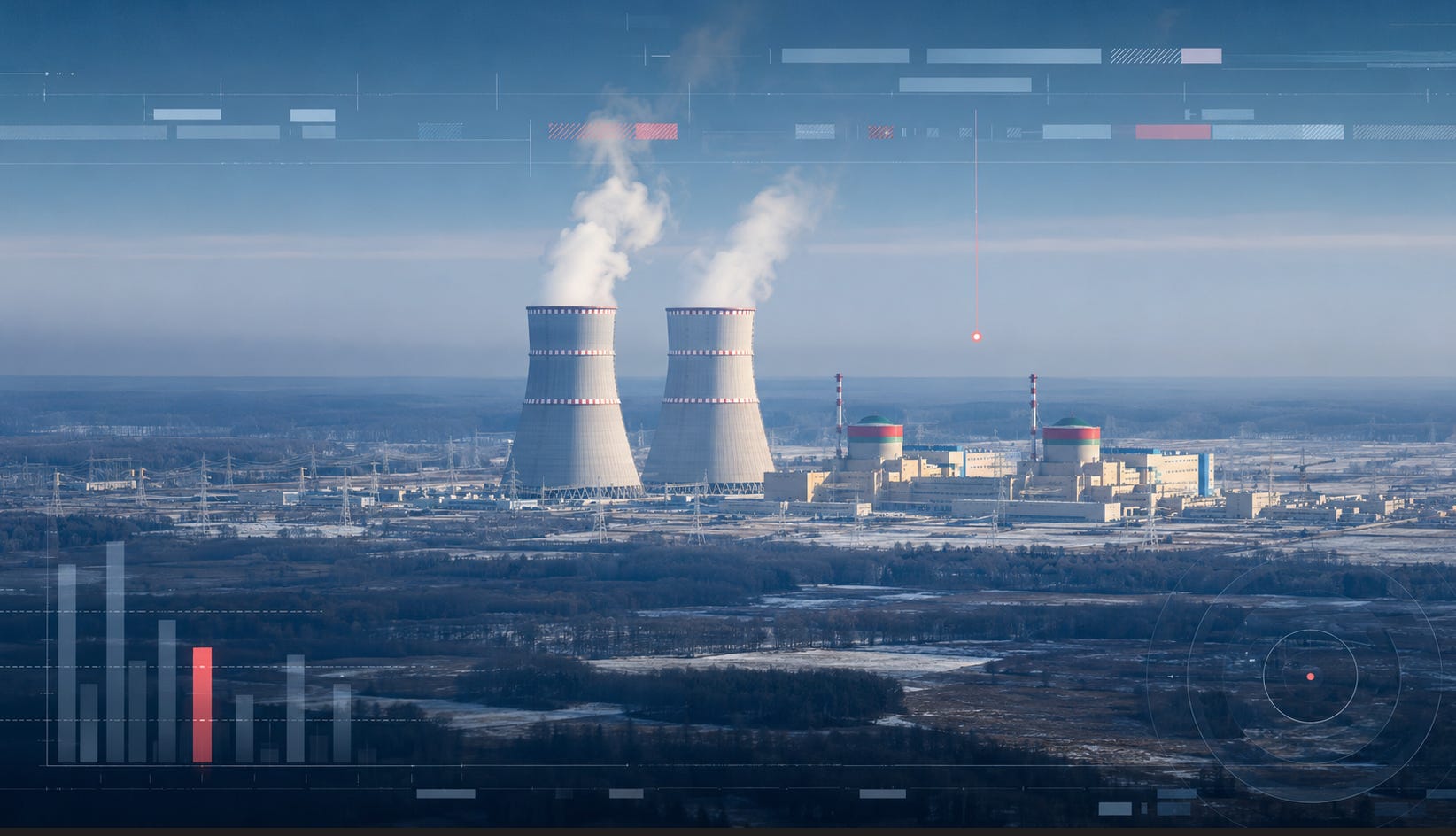
Yesterday the second unit of the Belarusian nuclear plant was reconnected to the grid after eleven days of diagnostic work. It was the twenty-second outage at the station since the first unit was first connected in November 2020, and the fourth this year.
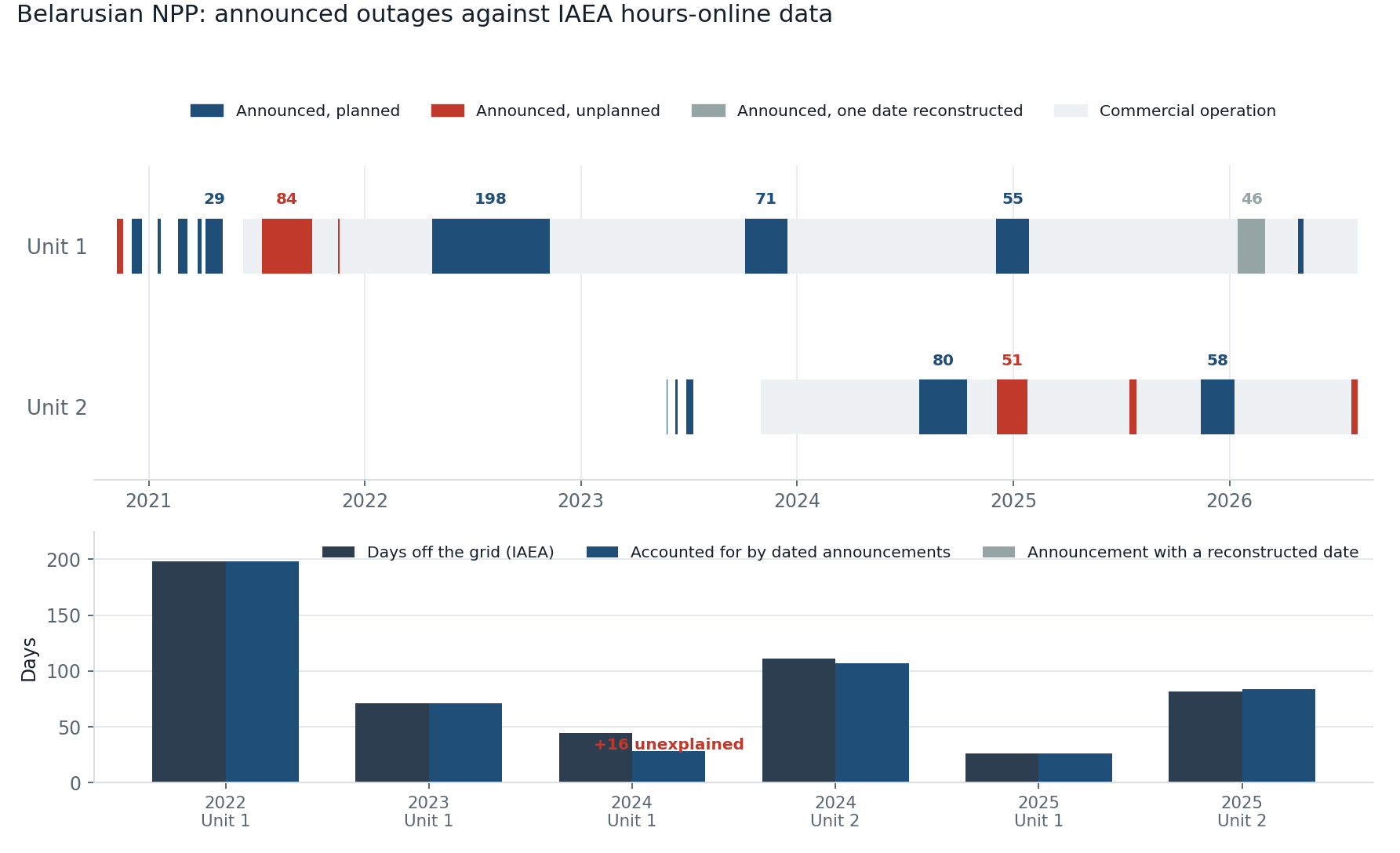
The obvious question is how much of that downtime the public has been told about. The answer, for once, is almost all of it. Set the announced outages against the hours the IAEA records each reactor as being online, and the two reconcile: 198 days against 198 in 2022, 71 against 71 in 2023, 26 against 26 for unit 1 in 2025. This is not a story about a hidden reactor.
It reconciles on one condition. For unit 2 in 2024, the official announcements account for 92 days against the IAEA’s 111 — a nineteen-day hole. The hole closes only if you use 4 December as the date the unit stopped. That date does not appear in any official statement. It comes from a source cited by the exile outlet Zerkalo, published while the Energy Ministry was still saying nothing, and the ministry acknowledged the outage on 19 December, fifteen days later.
An external dataset, compiled in Vienna from operator reporting, independently corroborates a single-source scoop by a newsroom in exile. That is the finding.
What the reference measures
PRIS publishes, per reactor per year, the hours the unit spent connected to the grid. Subtract from the hours in the year and you get days off the grid — a figure the operator supplies and the agency publishes, with no editorial layer in between. For the Belarusian units it gives 198, 71, 44 and 26 days for unit 1 across 2022–2025, and 111 and 81 for unit 2 in 2024 and 2025.
Two things follow immediately, and both cut against the impression left by the steady drip of outage news. Availability has improved every year since 2022. And the downtime is dominated by a handful of long planned repairs rather than by frequent breakdowns: the single 198-day maintenance outage of 2022 is the entire downtime of that year.
The frequency is real, though, and it is what produces the sense of a plant permanently switching off. Twenty-two outages in five and a half years, eleven of them shorter than a fortnight. A plant that stops often and briefly generates far more headlines than one that stops once and lengthily, even when the second loses more days.
The record, year by year
Announcements are prompt and precise. The Energy Ministry’s Telegram channel routinely gives the minute: the unit disconnected at 12:57 on 12 July 2021, reconnected at 18:20 on 4 October. Across 743 messages that report an outage or a restart, a reason is stated in 309 — 42 per cent. Restarts are announced as reliably as shutdowns, which is not something that could be said of every institution in this corpus.
The longest unplanned outage was 84 days, from 12 July to 4 October 2021, after the generator’s automatic protection tripped. The ministry said in July that the unit would return by mid-August. It returned eleven weeks later.
The longest outage of any kind was the 198-day maintenance shutdown from 25 April to 9 November 2022. It was announced at the start, and it was extended repeatedly; by October independent outlets were reporting that the plant had been idle for almost half a year and that the “planned” repair had been pushed back again.
Against the IAEA figures the reconciliation is close everywhere except one line. Unit 1 in 2024 has 28 announced days against 44 recorded — sixteen days that no announcement in the corpus accounts for. That residual is too small to be a concealed shutdown and too large to be rounding; the likely explanation is short trips of a few hours each, which the day-level chronology cannot see and which nobody announced.
Fifty-one days
The December 2024 episode deserves the detail because it is where every thread meets.
Unit 1 went into its third planned maintenance outage on 3 December, announced the same morning by the plant, the ministry, BelTA and a dozen others. Unit 2 stopped producing the following day. Nothing was said about it.
On 19 December, after Zerkalo reported that both units had been idle for a fortnight, the Energy Ministry confirmed that unit 2 was “temporarily disconnected from the grid because one of the sensors was triggered”. Independent coverage that week was unusually direct: officials had stayed silent about the incident, a secondary equipment fault could not have taken down a whole unit, and staff described pressure and searches for the disloyal inside the plant. Unit 2 came back on 24 January, unit 1 on 27 January.
For roughly fifty-one days a station that supplies something like 40 per cent of the country’s electricity supplied none of it. On 16 January, with both units still down, Lukashenko said he was increasingly convinced of the need to build a second nuclear plant.
What this brief did not look for
The original design included checking outages against surrounding political events. It was dropped deliberately, and the reason is worth stating rather than hiding in the method note.
There are twenty-two outages in five and a half years. Against any calendar of Belarusian politics, some of them will fall within days of something significant — sanctions packages, elections, Lithuanian protests, Russian negotiations. With that many events and that dense a calendar, coincidences are guaranteed and inference is impossible. Anything found that way would be an artefact of counting, presented as a discovery.
What can be checked is documented: whether a reason was given, how fast, and by whom. Those are the numbers above.
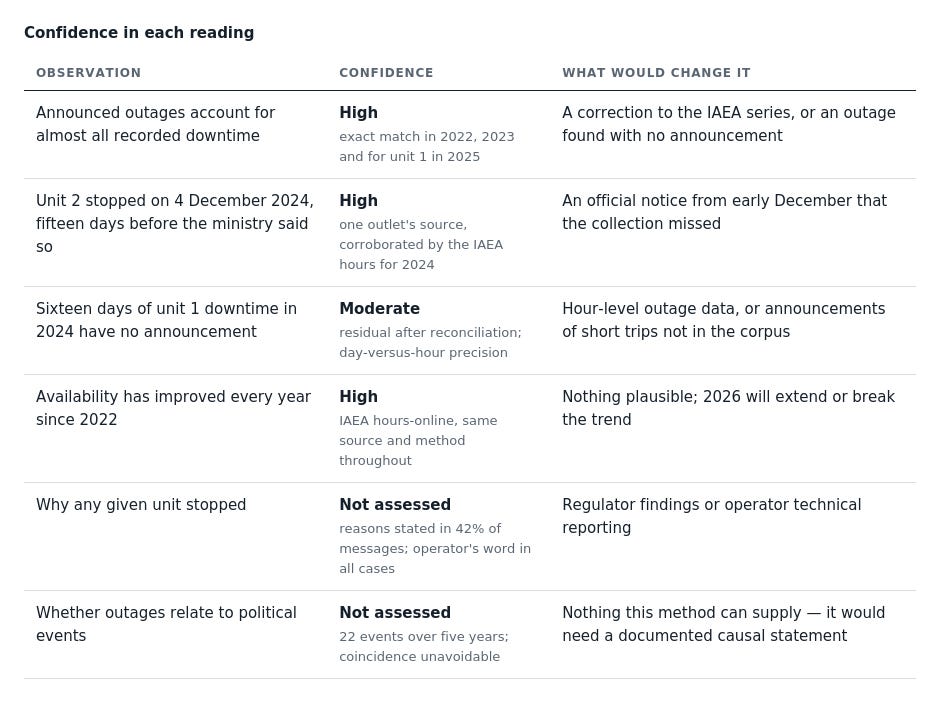
Confidence
Watch items
The end date of unit 1’s January 2026 maintenance outage is not in the corpus — the start is announced, a April–May outage is announced, but no restart notice for the January repair was found. Either it exists and the collection missed it, or an outage ended without an announcement, which would be the first such case in this record. Worth resolving directly with the ministry’s channel.
The next PRIS update, covering 2026, will test the reconciliation on a year we have already documented. If announced outages account for 2026 as closely as they do for 2022, 2023 and 2025, the record can be treated as reliable going forward; if a residual appears, it points at where to look.
Whether a residual like 2024’s sixteen days recurs for either unit. One year of short unannounced trips is noise. Two consecutive years is a practice.
Method and limits
The chronology was built from the corpus, not from a database of outages: 6,218 documents mention the plant with operational vocabulary, 3,873 survive the requirement that the anchor appear in the headline or the first 400 characters, and 743 of those report a shutdown or a restart. Automated clustering produced 129 candidate events, 64 of them carried by three or more sources; those were read individually and reduced to 22 outages with dated start and end.
One end date — unit 1’s spring 2026 restart — is reconstructed rather than sourced, and is marked as such on the chart. Nothing in the analysis rests on it.
The comparison mixes precisions. PRIS counts hours; this chronology counts days. A residual of a few days per unit-year is within that mismatch, which is why the 2025 unit 2 line reads as slightly over-explained rather than under.
The 4 December date rests on one outlet’s source, published at the time and never contradicted. It is treated here as corroborated by arithmetic rather than by a second witness: without it the IAEA figure for unit 2 in 2024 cannot be reconciled with the announced record, and with it the gap falls to four days.
This brief describes the public record of the plant’s operation. It does not assess why any unit stopped, whether any outage was safety-related, or what condition the equipment is in. Those questions require a regulator, not a corpus.