

On 4 July the communications minister, Kirill Zalessky, went on state television to grade his own regulation. The February resolution that put a 30 GB monthly ceiling on tariff plans still sold as “unlimited” had, he said, achieved its goals: mobile networks were relieved, and part of the traffic moved over to Wi-Fi. Five days later the business wire PrimePress carried a line from the ministry’s mid-year briefing that reads like the technical restatement of the minister’s sentence: for the first time, the capacity of Belarusian networks grew faster than the volume of subscriber traffic.
That second sentence is the half-year in one line. Between March and August the network and the allowance moved in opposite directions, and both movements were announced in public, on the record, often by the same institutions on the same days.
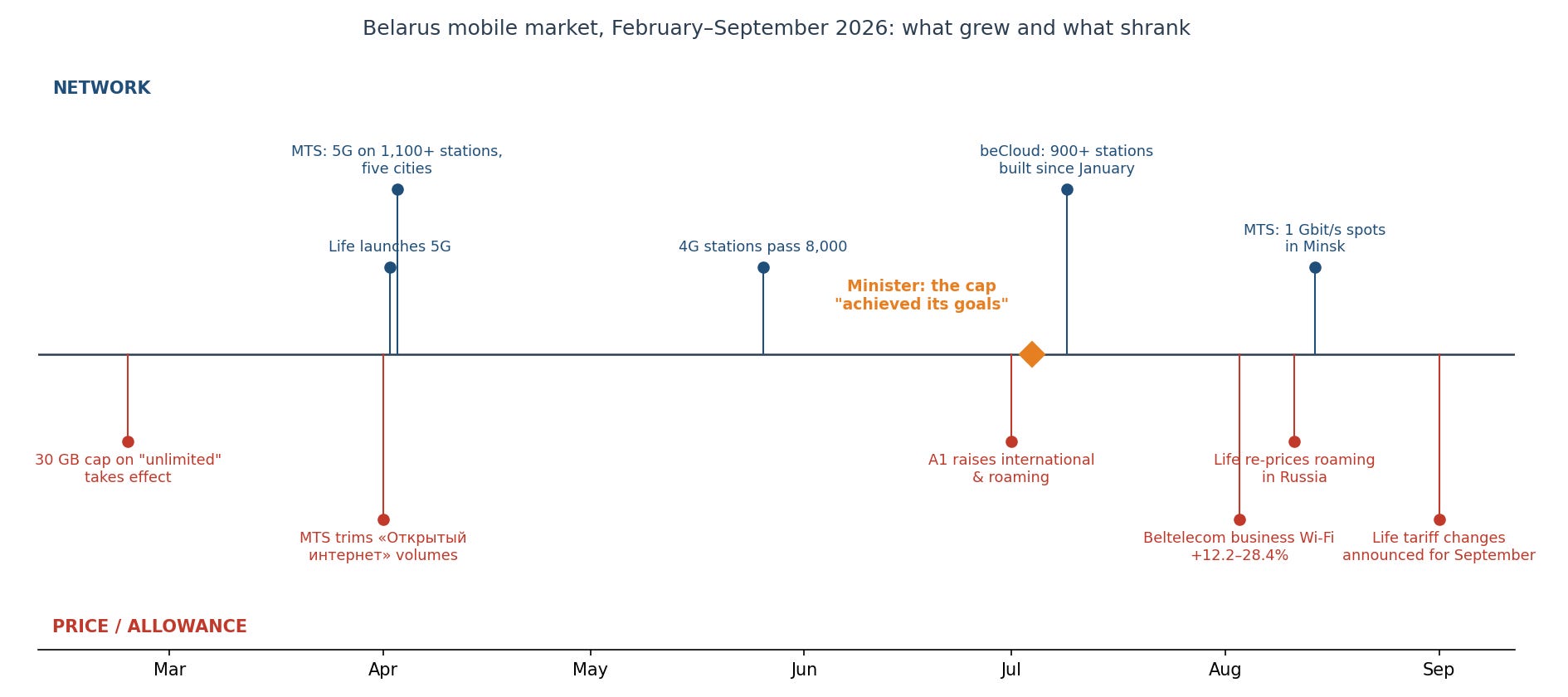
The build side is easy to trace because the state announces it loudly. MTS switched on 5G across more than 1,100 base stations in Minsk and four regional capitals on 3 April; Life launched its own 5G the day before. The national count of 4G stations passed 8,000 in May. The infrastructure operator beCloud reported over 900 stations built since January against a plan of 2,100 for the year. By mid-August MTS was naming the Minsk locations where its network exceeds 1 Gbit/s.
The allowance side runs on the same calendar with the opposite sign. From 1 April MTS reduced traffic volumes on intervals of its «Открытый интернет» service. From 1 July A1 raised prices for international calls and roaming, and on 11 August it updated the fair-use criteria that decide when an “unlimited” subscriber gets throttled. From 3 August Beltelecom raised business Wi-Fi access prices by 12.2 to 28.4 percent. On 11 August Life re-priced roaming in Russia, and it has announced tariff changes for September. Every dated price or allowance change recorded in our corpus window moved against the subscriber.
For the first time, the capacity of Belarusian networks grew faster than the volume of subscriber traffic.
Demand did not go anywhere. The ministry’s own first-quarter figures show 11.9 million mobile subscriptions, up 0.4 percent, and 8.76 million mobile-data users, up 2.9 percent year on year. Beltelecom’s fixed-broadband base reached 3.19 million in the first half, the line where the Wi-Fi offload the minister described should eventually become visible. So the “first time” in the PrimePress headline is not a saturation story. Users kept coming; what stopped growing at the old pace is how much each of them is allowed to carry.
Who carries which half
Six months of coverage split by register, and the split is clean. The speed records travelled through state media: BelTA carried the 8,000 stations and the 1 Gbit/s map of Minsk. The tariff changes travelled almost entirely through PrimePress, the market wire, which contributed 34 documents to the telecom theme in this window, the largest business-wire share of any of the thirteen themes we monitor, and through independent outlets, where the genre is consumer arithmetic: Zerkalo’s guides to fitting a month into 30 GB, its roundups of what each operator quietly changed. In the state segment we found no item on the A1, Beltelecom or Life price rises; that absence is a checkable claim and sits in the confidence table below.
Users kept coming; what stopped growing at the old pace is how much each of them is allowed to carry.
There is a third layer, and it is the strangest one. Belarusian state channels spent part of the spring retransmitting Russia’s Telegram blocking and mobile-internet outages, BelTA reporting on 16 March that “a full blocking of Telegram has begun in Russia,” with no mirror held up to the domestic market. Restriction gets covered as somebody else’s weather. Independent outlets ran the same Russian outages with the price and protest angle attached.
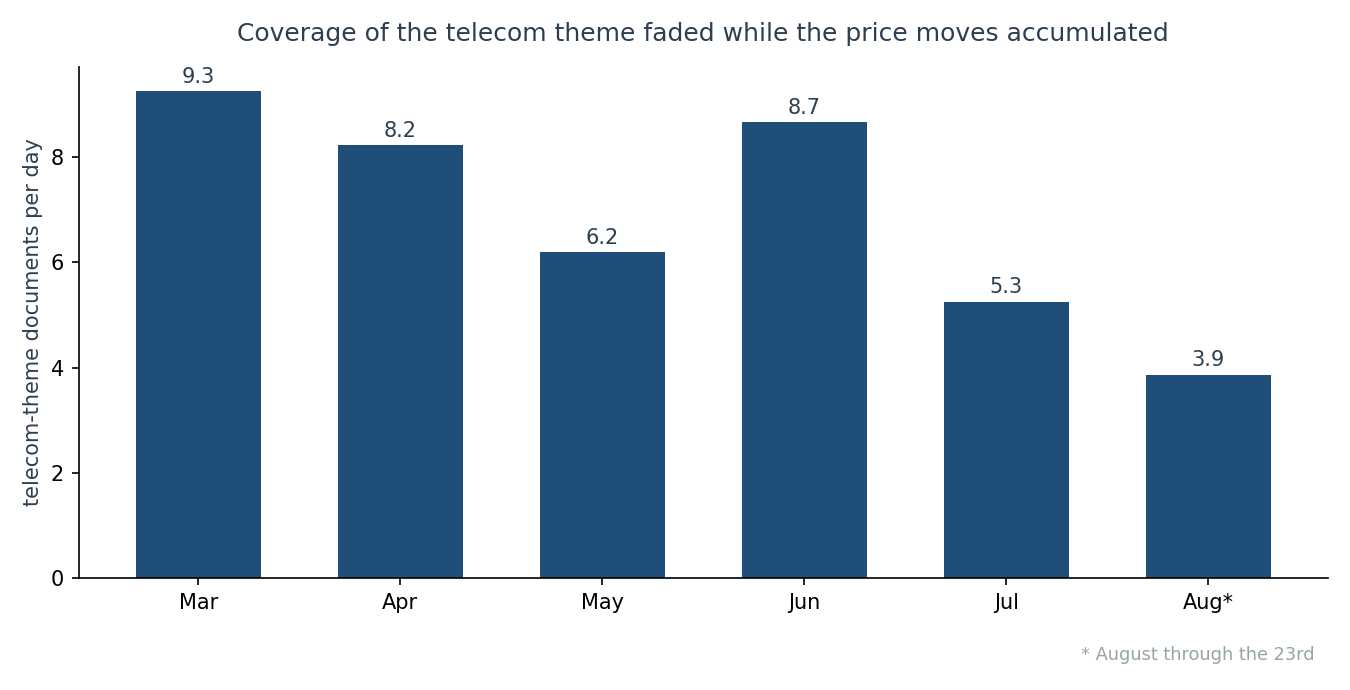
Belarus’s own ceiling meanwhile faded as a subject. In March the corpus carried about nine telecom-theme documents a day; by August, under four. The regulation stopped being news months before its author called it a success.
Every dated price or allowance change recorded in our corpus window moved against the subscriber.
What to watch
Life’s September tariffs take effect within days: the check, in the first week of September, is whether any mass-market plan still carries the word «безлимитный» after the change. The ministry’s third-quarter subscriber release, due by mid-November, is the demand test: mobile-data users above 8.8 million would mean the cap has pushed no one off mobile data, while a decline would make the offload larger than the minister claimed. Beltelecom’s full-year figures in early 2027 are where “traffic moved to Wi-Fi” either lands in the fixed-line numbers, somewhere past 3.25 million subscribers, or does not. And the February resolution itself: we expect no amendment raising or removing the 30 GB norm before the end of 2026. If one appears, the market read of this half-year changes.
The regulation stopped being news months before its author called it a success.
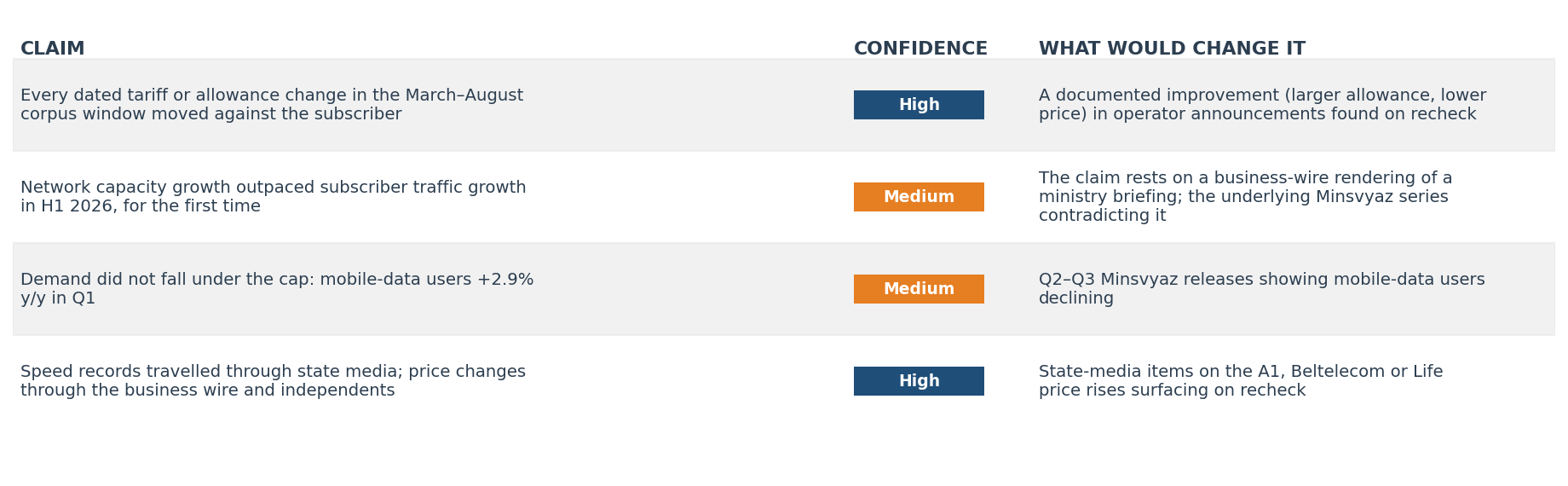
Method and limits. Built on the FORESIGHT corpus: 290,290 documents dated 1 March – 23 August 2026 within a 3.78-million-document archive of Belarusian state, independent, business and exile media. The telecom theme is selected by hybrid retrieval, semantic similarity plus a lexical anchor in the headline or lead; 68 percent of the theme’s documents carry a Belarusian marker in the headline or lead, and the rest, mostly Russian and Iranian connectivity stories, are excluded from the claims above. All figures are journalists’ renderings of ministry and operator releases, not the releases themselves; the capacity-versus-traffic claim rests on one wire report of a ministry briefing and is held at medium confidence until checked against the Minsvyaz series. August coverage counts run through the 23rd and are shown per day.