
In February 2025, someone walked into the closed chat of Belaruski Hajun through an invitation link that nobody had bothered to revoke. The project, which had spent three years crowdsourcing sightings of Russian troop movements from ordinary Belarusians, shut down within two days. Whoever came in could read the chat history back to 2022, along with the Telegram IDs of everyone who had ever written to the bot.
What happened afterwards is documented in public, but scattered across eighteen months of reporting in a dozen outlets. We pulled it back together: every publication in our corpus that mentions the project since the day it closed, then a structured extraction of every person named as a defendant, then deduplication down to individuals. The result is 212 people, of whom 188 are named and the rest appear only as “a 34-year-old resident of Homiel” and similar formulations.
The count of named individuals who reached sentencing is 183. Viasna’s figure, published on 24 February 2026, is at least 183 named defendants. We would like to claim independent confirmation, but honesty requires the opposite reading: much of the media coverage we mined is itself derived from Viasna’s documentation, so the two numbers converge because they share a source. What the match does establish is that the extraction pipeline neither invents people nor loses them across 1,193 separate mentions and two orthographies. Trafimovič in Belarusian and Trofimovich in Russian are the same defendant, and the deduplication knows it.
Where
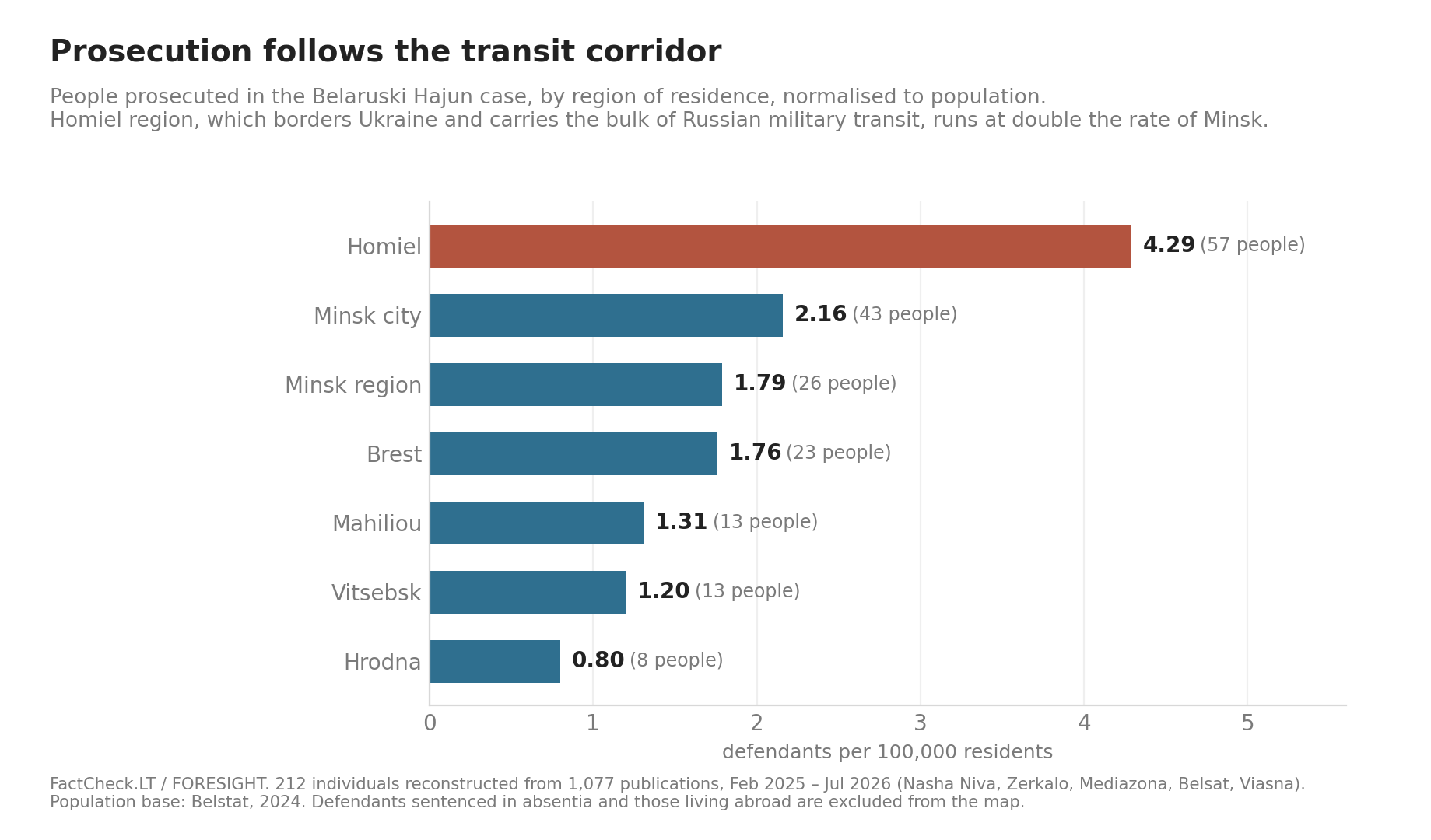
Homiel region accounts for 57 of the people we could locate, roughly a third of the total, at 4.29 per hundred thousand residents. Minsk, with twice the population, sits at 2.16. Hrodna, at the other end of the country from Ukraine, produced eight defendants.
This tracks something obvious once stated. Hajun’s value was in reporting the movement of Russian hardware, and the hardware moves through the south-east. The people best placed to photograph a column at a level crossing lived in the corridor between Homiel and the Ukrainian border, and so did the people the KGB most wanted to identify once it had the database. Risk concentrated where usefulness concentrated.
Two cautions about the map. Rate per capita is the right denominator for comparing regions, but it can imply a per-capita propensity to inform, which is not what the numbers measure. And a lexical baseline we ran first, counting documents mentioning each region rather than people, put Hrodna third with 729 documents. Hrodna in fact has eight defendants. Counting words about places tells you where journalists write from, not where prosecutions happen, which is the whole argument for spending the tokens on extraction.
Who
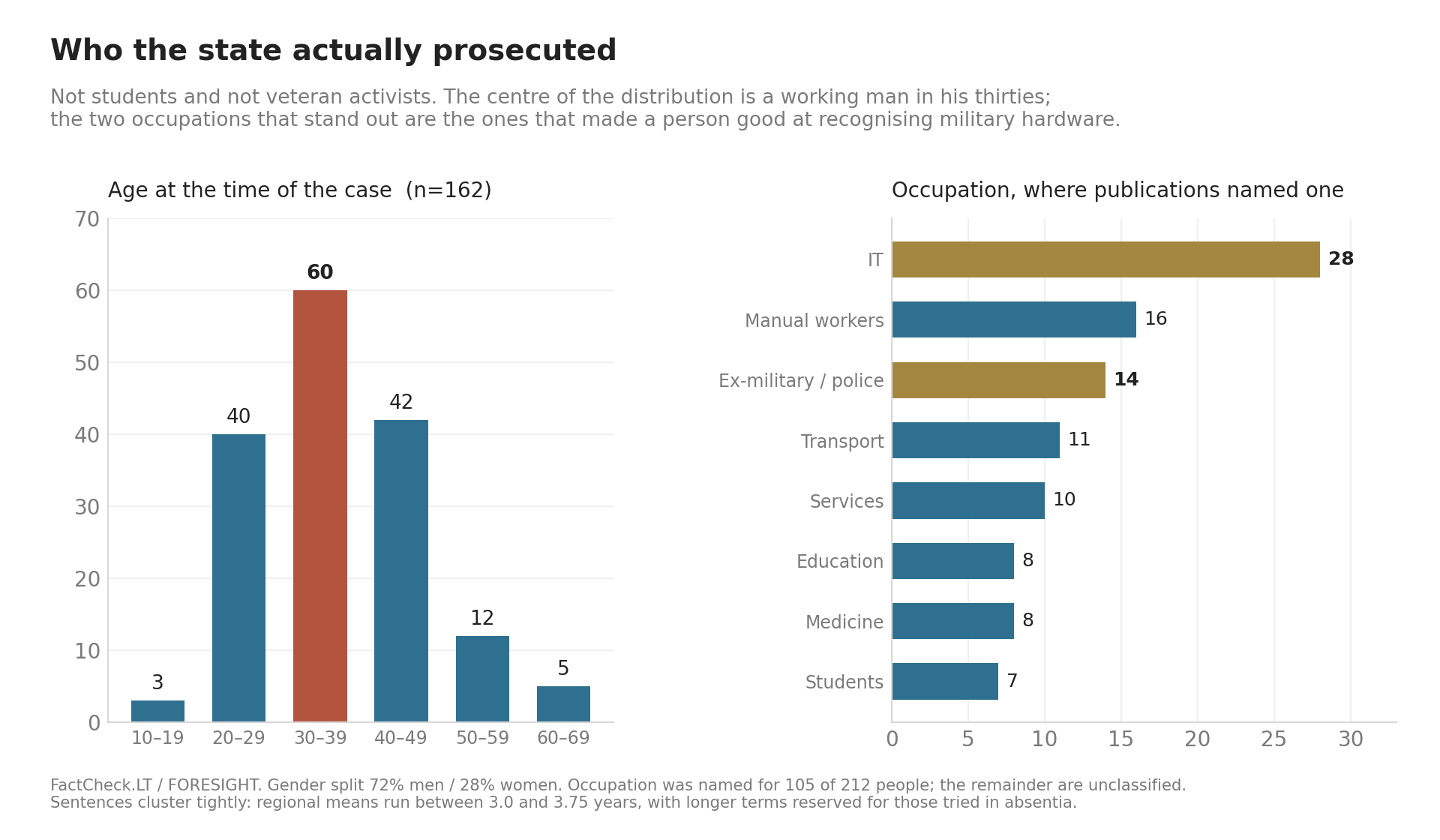
The typical defendant is a man in his thirties. The 30–39 bracket holds 60 of the 162 people whose age we know, with substantial shoulders on either side and almost nobody under twenty. Women are 28 per cent of the total, which is higher than the share in most Belarusian political cases.
The occupational data is thinner, since publications name a job for about half the defendants, but two categories are conspicuous. IT workers are the largest single group at 28. Former military and ex-police personnel come third at 14, ahead of transport workers and teachers. Both groups make sense as informants and both make sense as targets. Someone who served knows a BUK launcher from a fuel tanker on sight, and a photograph from that person carries a caption worth reading. The KGB, going through the archive afterwards, was reading the same captions.
There is an uncomfortable inversion in this. The features that made Hajun’s data reliable, the technical literacy and the military eye, are the features that make its contributors identifiable and, from the state’s perspective, especially deserving of punishment.
Sentences, by contrast, show no variation worth analysing. Regional means run from 3.0 to 3.75 years. Nothing in the spread suggests judicial discretion, local severity, or any relationship to what an individual actually sent. The longer terms in the dataset, up to twenty years, belong to people tried in absentia who left the country years ago.
When
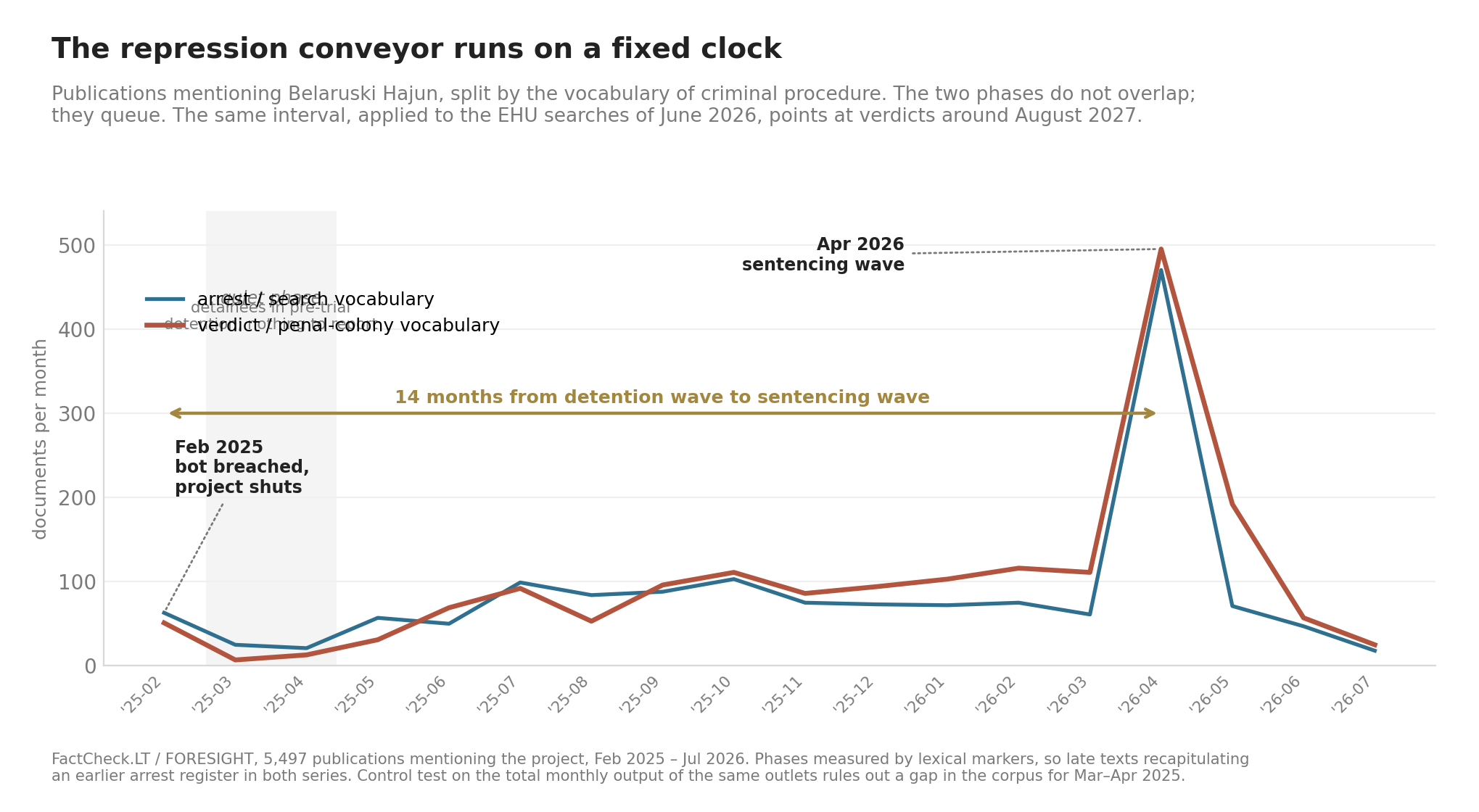
The third finding came from a question that looked like a data problem. Coverage of Hajun collapses in March and April 2025, to 64 and 48 documents from 351 in February, then recovers and keeps climbing for a year. Our first assumption was a hole in the corpus, a scraper backfilled late.
It was not. The total monthly output of the same outlets across all topics is flat through those months, which rules out a collection gap. What changed was the vocabulary. Split the coverage by the language of criminal procedure and the phases queue rather than overlap: arrest vocabulary peaks in February 2025, trial vocabulary stays near zero until May, and verdict vocabulary dominates from late 2025 onward, cresting in April 2026 at 495 documents.
The gap in March and April 2025 is the pre-trial detention period. People had been arrested, investigations were sealed, families were frightened into silence, and there was nothing to publish. Fourteen months separate the wave of detentions from the wave of sentences.
That interval is the least examined part of any repression case and the one that matters most operationally. During those months the detainees are invisible, media attention has moved on, and any monitoring based on publication volume will conclude that the case is over. It is exactly when funding for legal aid and family support is hardest to justify, because nothing is happening in public.
The EHU case will resolve around August 2027
The clock gives us something to test on a different case. On 14 April 2026, the European Humanities University was designated an extremist formation. In June 2026 came the criminal case and more than thirty searches across Belarus, reaching students, graduates, recently expelled students and their parents. Payments for tuition going back to 2016 are being treated as financing extremism.
If the Hajun interval holds, the sentencing wave in the EHU case arrives in the second half of 2027, with a central estimate around August. Three predictions, for review on 31 December 2027:
The first: the EHU case produces a concentrated sentencing wave between June 2027 and January 2028, defined as a single month in which verdict-vocabulary coverage exceeds three times its trailing twelve-month median. We put this at 65 per cent.
The second: coverage of the EHU case in the corpus drops below a hundred documents per month for at least three consecutive months during the first three quarters of 2027, the same quiet phase the Hajun defendants passed through, before recovering with the verdicts. We put this at 70 per cent.
The third, and the one we would most like to be wrong about: the geographic distribution of EHU defendants will not resemble the Hajun map. Hajun prosecutions concentrated where the intelligence value was, along the transit corridor. EHU affiliation is distributed by where students come from, which is Minsk and the regional capitals. We expect Minsk city to hold the largest share of located defendants, above 30 per cent, with Homiel below 20. Confidence 60 per cent.
If the first two resolve as stated, the interval is a property of the machinery rather than a coincidence of one case, and it becomes a planning instrument. Donors can schedule legal support against a calendar instead of against the news cycle.
What the numbers do not cover
The corpus measures documented prosecution, which is a subset of prosecution. Cases that never reached Viasna or an independent newsroom are missing from all three findings, and the missing cases are probably not distributed evenly. Rural districts with no local independent coverage are underrepresented in a way we cannot quantify from inside the corpus.
Event dates are the weaker part of the extraction. Only about a fifth of mentions carry a date for the event rather than for the publication, so the individual-level timeline is coarser than the phase analysis, which is why the forecast rests on lexical phases rather than on the reconstructed dates of individual arrests.
The dataset also contains a pre-breach cohort, people sentenced in 2022 and 2023 for photographing military equipment, who surface in retrospective coverage. They were caught by informants and cameras rather than by the leaked archive. We have kept them in the counts and flagged them, because they establish that photographing a column was already prosecutable before the breach. The breach changed the scale, not the offence.
The channel is still standing, and its audience was probably never Belarusian
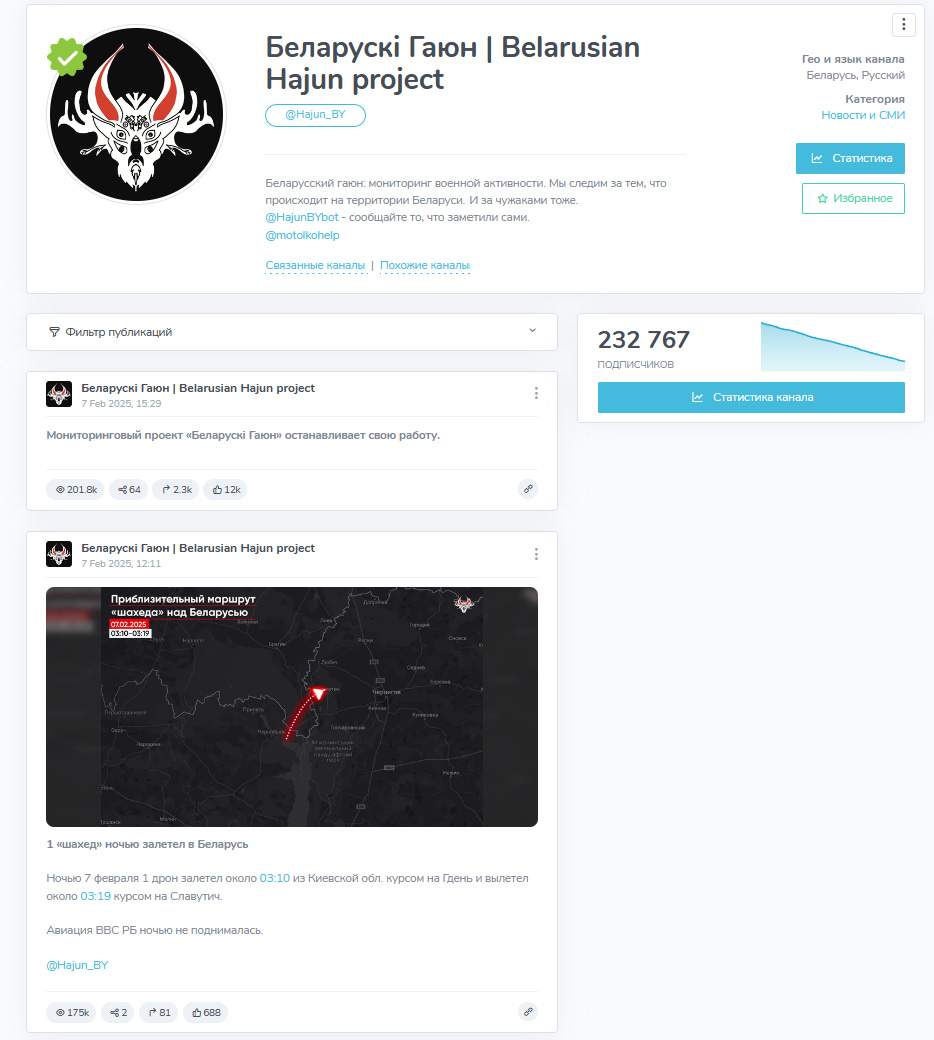
Eighteen months after the shutdown, the channel has 232,767 subscribers. The curve drifts down gently across the whole period, with no cliff at the breach and no cliff since.
The last two posts sit next to each other and are worth reading in order. At 12:11 on 7 February 2025 the channel published a routine item: one Shahed entered Belarusian airspace overnight, in at 03:10 on a course towards Hden, out at 03:19 towards Slavutych, air force did not scramble. Three hours and eighteen minutes later came a single sentence announcing that the project was stopping work. The routine post drew 175,000 views; the closure notice drew 201,800 and twelve thousand reactions. The most-read thing the project ever published was its own obituary.
The composition of that audience matters more than its size, and our working assumption is that a large share of it sits in Ukraine rather than Belarus. Hden and Slavutych, the two place names in that final routine post, are on the border and just across it. A Shahed crossing Belarusian airspace at 03:10 is a Ukrainian air-raid alert at 03:40, and for eighteen months of the full-scale war this channel functioned as early warning for the northern oblasts. People in Kyiv, Chernihiv and Zhytomyr regions had a practical reason to subscribe that had nothing to do with Belarusian politics, and no reason at all to unsubscribe once the project died.
That reading turns the asymmetry of this whole case sharper. The service was consumed in large part abroad; the risk was carried entirely at home. The 212 people in our dataset are the domestic minority who sent something in, photographed a column at a level crossing, wrote a line to the bot, and they are the ones serving three to four years for it. The audience that benefited most directly from their work is, by this hypothesis, sitting in a country where the designation means nothing. The transit-corridor map earlier in this piece is the same finding seen from the other end: prosecution concentrated in Homiel region because that is where the information originated, feeding an early-warning need on the far side of the border.
We have not measured this, and it is stated here as a hypothesis rather than a result. TGStat’s own geography label describes the channel, not its subscribers, and audience-country estimates for a dormant channel are unreliable. The check we can run inside the corpus is indirect: whether historical view spikes on Hajun posts track Ukrainian alert schedules rather than Belarusian news events, and how the volume of Ukrainian-language forwarding and citation compares with Belarusian. If it resolves the way we expect, the finding is worth a piece of its own.
The part that has no technical fix
The failure that produced 183 sentences was a setting. History was visible to new members of a chat, and an old invitation link was never revoked. Both are thirty minutes of work in 2022. Neither was done, and the consequence sat dormant for three years before it detonated.
That is the part worth carrying into other projects. The archive is the liability. Every message retained is potential evidence against the person who sent it, and the retention that makes a monitoring project valuable is the same retention that makes its contributors prosecutable years later. The audience, meanwhile, outlives the project and largely escapes the consequences: a channel cannot unsubscribe its readers, and 232,767 of them are still there, most of them in all likelihood beyond the reach of the courts now sentencing the people who supplied them.
The conveyor we mapped runs on a fixed clock whether or not the project that fed it still exists.
Data and method: FactCheck.LT / FORESIGHT. 5,497 publications mentioning Belaruski Hajun from 1 February 2025 to 21 July 2026 across 73 sources; extraction on 1,077 documents from Nasha Niva, Zerkalo, Mediazona, Belsat and Viasna; 1,193 person-mentions deduplicated to 212 individuals across Belarusian and Russian orthography. Population base for per-capita figures: Belstat, 2024. The individual-level register is held internally and not published: every name in it is already public separately, but a consolidated list creates a risk that the sources do not.